The Equipment Room Still Runs on Windows
The shelter is where the real work lives. Baseband and radio units are configured through the manufacturer's own Windows application, fetched over RS232 or RS485, or reached on the local RJ45 segment when the backhaul is down. A tablet that boots Android cannot install that suite, full stop, which is why a desktop OS is not a nice-to-have here but the entry ticket. The HOTUS ST11-U boots Windows 11 Pro on an Intel Core i5-1235U, carries native RS485 and RS232 alongside RJ45, and shows the single-line diagram on a 10.1-inch 450-nit panel rated IP54 with a 1.2 m drop spec.
The FIELDBOOK P122G2 is the stronger room machine on paper and partly in practice: a 12.2-inch 650-nit screen, an i7-1255U with 16 GB RAM, IP65 sealing, 1.2 m drop resistance, and a tool-free swappable battery, with RS232 and a 1D/2D scanner offered as build options. It is brighter, better sealed, faster and field-swappable, and for a pure desk-and-shelter role it is the safer pick. The trade is weight and cost: 1.6 kg, a European price tag, no native UHF RFID, and a screen too large to pocket on the climb. The ST11-U's answer is lighter at 1190 g, cheaper to deploy, and available with UHF RFID or barcode as a factory option, which the room-only European slab leaves to add-ons. See the broader industrial inspection context where Windows logging meets field hardware.

The Mast Needs Centimeter Coordinates
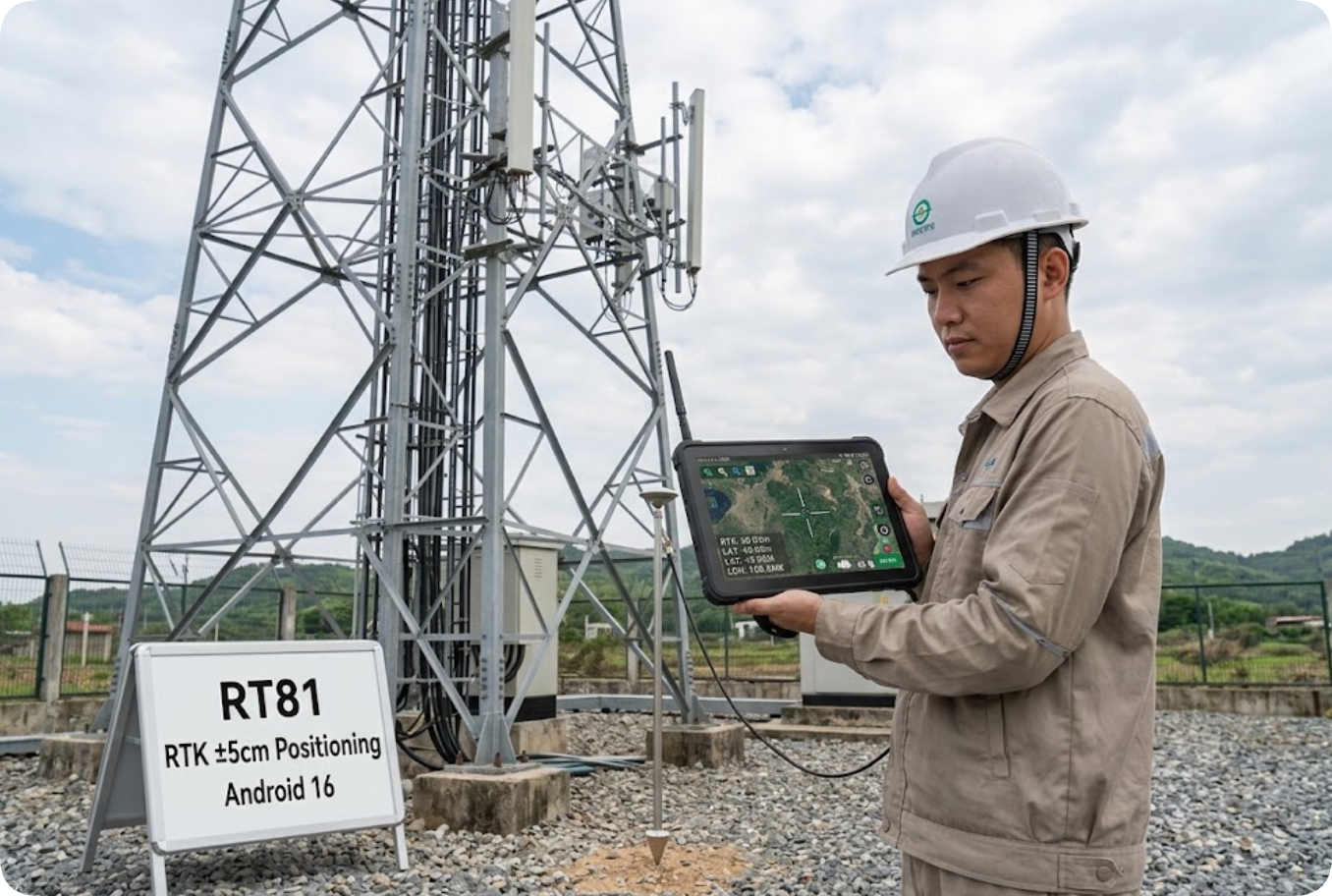
New builds and retrofits do not trust a tape measure for antenna positions. Survey crews log each sector's coordinates through network RTK, record azimuth and mechanical tilt, and push the points to the planning tool so the next audit finds the same mark. The HOTUS RT81 is an Android RTK tablet quoting +/-5 cm positioning, built as a single sealed field unit that also runs the same inventory and photo apps the rest of the crew uses.
The Qpad X8 is the specialist here and deserves the credit. Hi-Target is a surveying house: 184 tracking channels, network RTK at 5 cm + 1 ppm, a detachable helical antenna for clean signal, IP67 with 1.5 m drop, a 10000 mAh pack rated 10 to 15 hours, and mature GIS data-collection software. On raw positioning it matches or edges the RT81, and its antenna and channel count are honestly better for pure survey work. The gap is everything around the survey: Android 8.1 is old, there is no barcode or UHF RFID path, and it does not share an ecosystem with the room or yard devices. A mast job favours the Qpad; a mast-plus-shelter-plus-yard day does not. The same coordinate discipline shows up in remote assistance calls where the expert needs the exact asset the field hand is touching.
The Yard Asks for a Scanner
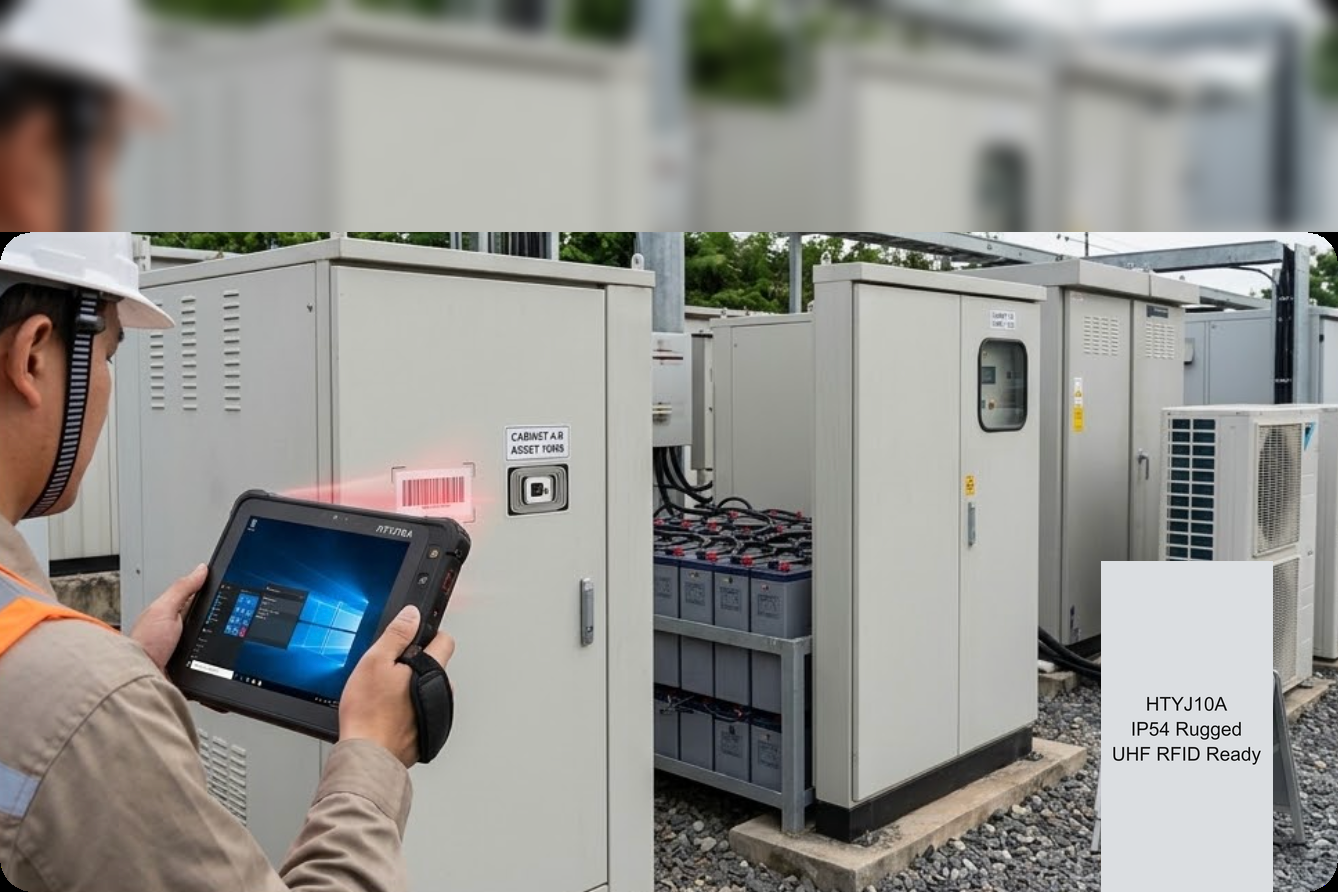
Outside, the compound is a volume game. Power modules, rectifiers, optical transceivers and feeder tags each carry a serial that has to land in the asset register during acceptance and again at every audit. The HOTUS HTYJ10A is a 10-inch Android slab at IP54 with barcode and UHF RFID offered as options, light enough to hold one-handed while the other hand steadies on a cabinet edge.
Neither competitor owns this step. The FIELDBOOK can scan only through an optional RS232-connected reader, which means a cable and a fragile joint on a windy roof. The Qpad X8 has no scanning or RFID path at all and ships Android 8.1, so modern MDM and app builds are a chore. The HTYJ10A is not the brightest or the most sealed unit on the site, but the barcode or RFID capture plus single-hand operation is exactly the task the two specialists leave hanging. For crews already on field service rounds, that capture is the difference between a finished audit and a notebook full of hand-written serials.
A Crew That Covers Every Post
Put the three HOTUS units together and one team closes the whole site: the ST11-U owns the Windows shelter, the RT81 owns the mast mark, and the HTYJ10A owns the yard count, all on one charging bench, one spares kit and one support line. The FIELDBOOK and the Qpad X8 each master a single post and fumble the other two, so a two-device or three-device mixed fleet is the realistic outcome of buying the specialists. Mixed fleets mean mixed chargers, mixed cases, and a technician who has to guess which slab is in the bag for today's task. The industrial set trades a little peak performance in any one lane for no empty lane at all.
Spares and Training Follow the Ecosystem
A mixed fleet of specialists quietly bills the operator twice. One European Windows slate, one surveying GNSS pad and a third unit for scanning mean three chargers on the bench, three rugged cases to stock, three MDM profiles to maintain, and three training sessions before a new hire is useful on any single post. A single-vendor set of three HOTUS units collapses that to one charging rack, one spares drawer and one onboarding path, and a technician qualified on the ST11-U already understands the RT81 and HTYJ10A menus.
The same logic protects the offline hour: when the shelter backhaul drops, local RS485 and RJ45 logging on the Windows unit keeps commissioning running, and the remote assistance call can show the exact asset because every device speaks the same ecosystem. The saving is not on the spec sheet; it is in the drawer and the calendar.
| Capability | HOTUS ST11-U | HOTUS RT81 | HOTUS HTYJ10A | LOGIC FIELDBOOK P122G2 | Hi-Target Qpad X8 |
|---|---|---|---|---|---|
| Operating system | Windows 11 Pro, i5-1235U | Android, RTK +/-5 cm | Android, IP54 | Windows 11 Pro, i7-1255U 16 GB | Android 8.1, 8-core |
| Screen | 10.1" 450 nit | field panel | 10" panel | 12.2" 650 nit | 8" 450 cd/m2 |
| Sealing and drop | IP54, 1.2 m | rugged, field-rated | IP54, 1.2 m | IP65, 1.2 m | IP67, 1.5 m |
| RTK positioning | no | yes, +/-5 cm | no | no | yes, network RTK 5 cm+1 ppm |
| Barcode or UHF RFID | optional | optional | optional | RS232 reader option | none |
| Weight | 1190 g | field unit | light, one-hand | 1.6 kg | 680 g |
| Best at the site | shelter Windows logging | mast coordinate mark | yard asset scan | shelter desk role | pure survey work |
🏟️ What Each Device Actually Gives the Team
None of the five is wrong; they are aimed at different posts. If the role is a fixed shelter desk with a heavy Windows suite, the FIELDBOOK P122G2 is the brighter, better-sealed, faster choice and worth the weight. If the role is kilometres of antenna coordinate collection, the Qpad X8 is the surveying instrument built for it. If the role is a crew that touches the shelter, the mast and the yard in one shift, the ST11-U, RT81 and HTYJ10A set closes every lane on one bench. The honest cost of the specialists is the lanes they leave open; the honest cost of the set is that no single unit is the brightest or the most sealed on the hill. Pick the gaps you can live with, not the spec sheet that impresses in the boardroom.