A working farm generates data from three directions at once. Livestock carry tags that need counting without walking every animal through a gate; field boundaries and irrigation lines need measuring to the metre; and every crate, feed bag and chemical drum moving through the barn needs a barcode scan before the book balances. Fleet buyers feel this as a confusing comparison chart, because the devices built for these jobs look alike in a thumbnail and nothing alike in the hand. This article puts five of them side by side — three from Hotus and two established rivals — and judges each against the farm job it would actually be handed at dawn.
One Farm Counts in Three Different Ways
The three jobs deserve naming up front. Long-range identification means reading a herd or a shelf of tagged assets from a distance, without funneling anything through a choke point. Close-range capture means the opposite: walking the rows, scanning a label at arm's length, keying in a count with gloves on. And platform work means running mapping software, weather models and record systems that only exist as full desktop programs. No single handheld is honest about doing all three, and the five devices below split cleanly along those lines rather than along price tags. The comparison that follows uses published specifications only, and where a figure is missing from a manufacturer's own materials, the text says so instead of guessing.
R366C-S: Reading Ear Tags from Twenty Metres
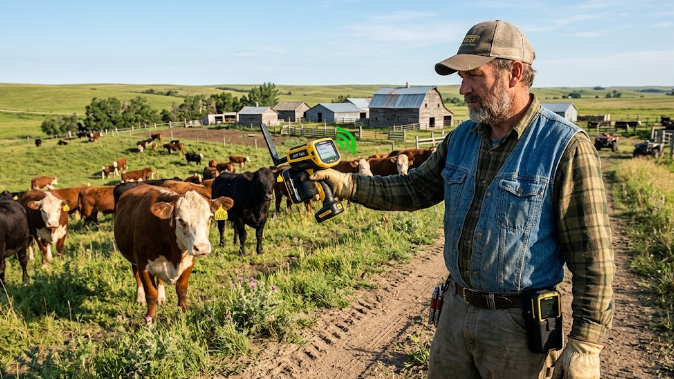
The R366C-S UHF Reader is the specialist of the group, and the only one of the five built around long-range radio identification. Its Impinj E710 module runs the EPC Class1 Gen2 (ISO 18000-6C) protocol through a 4dBi antenna, reaching 10 to 20 metres and clearing at least 900 tags per second — the difference between counting a pen of tagged cattle in one pass versus one animal at a time. Frequency coverage spans FCC 902-928MHz, ETSI 865-868MHz and SRRC bands, so the same unit serves export operations on either side of the ocean. Around that radio sits a Qualcomm SM6225 octa-core processor at 2.4GHz on Android 13, with 4GB of RAM, 64GB of storage expandable to 256GB, and a 5.5-inch 720 x 1440 touchscreen. The 3.8V 10000mAh battery is removable with Power Delivery fast charging, connectivity covers 4G LTE, dual-band Wi-Fi and Bluetooth 5.1, and two PSAM slots plus dual Nano-SIM slots serve operators who need encrypted fleet cards. The pistol-grip enclosure weighs under 700g and is rated for -10°C to 50°C operation, which covers a dawn count in most climates.
R530C and R350C: The Short-Reach Pair
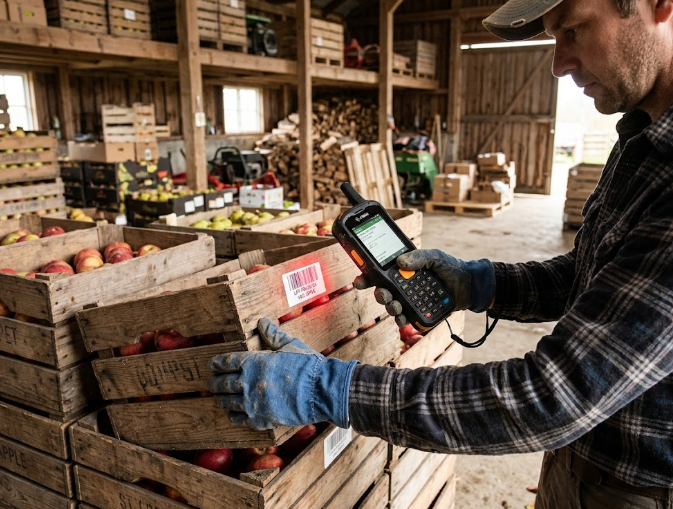
Hotus splits the close-range job across two body styles rather than pretending one size fits both hands. The R530C PDA is the screen-first option: a 6.0-inch 1080 x 2160 panel on a Qualcomm SDM450 octa-core chip running Android 11 (upgradable to 13), with an embedded 40x40mm ceramic UHF antenna that reads to a stated 2 metres — enough for pallet labels and bin tags, and the product page itself directs buyers needing 10 to 20 metres to the R366C-S. It carries 16MP and 8MP cameras, a 3.8V 6000mAh built-in battery, a PSAM slot, and lands under 500g. The R350C PDA goes the other way entirely: a 4.0-inch 480 x 800 touchscreen paired with a full physical numeric keypad, a Qualcomm QCM2290 quad-core at 2.0GHz on Android 13, and a body under 300g — the lightest of the five by a wide margin. Its published durability figures are the most complete of the three Hotus units: IP67 dust and water sealing, 1.5m drop resistance and Corning Gorilla Glass. The removable 3.8V 4000mAh battery swaps in seconds, which matters when the scan shift runs past a charging window.
💡 Juniper Mesa Pro: The Windows Tablet Contender
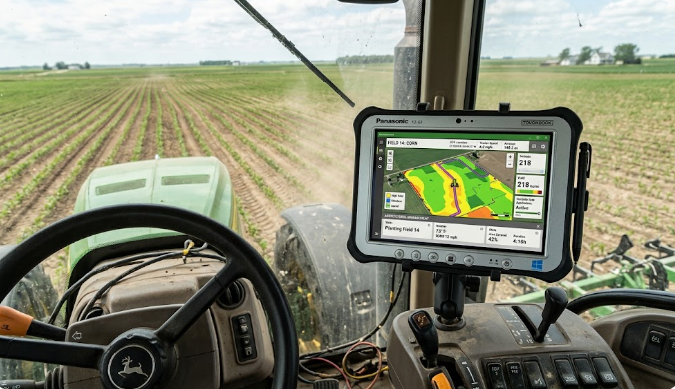
The Mesa Pro answers a different category question, and fair comparison means saying so plainly. It is a 10.1-inch full Windows 11 tablet on 11th Generation Intel Core i5 (standard) or i7 silicon with 16GB of LPDDR4X, built for desktop-class software — the platform job, not the walking scan job. Its display is 1920 x 1200 with optically bonded glass and a chemically strengthened cover, though no brightness figure in nits is published. The rugged tablet is sealed to IP68 per its release materials, tested to MIL-STD-810H with repeated 1.2 to 1.5m drops onto concrete, and rated from -20°C to 50°C. Power comes from a removable 43.2Wh Li-Ion pack with hot-swap capability and an optional second pack — capacity quoted in watt-hours rather than milliamp-hours, so direct comparison with the mAh figures elsewhere in this article is not valid. Ports include USB Type-C, two USB 3.1 Type-A, an audio jack and an optional RS-232 serial port, with TPM 2.0 on board. The trade is weight: 1.76kg depending on configuration, roughly six times the R350C, which is the honest cost of carrying a desktop in one hand.
Nautiz X81: The 5G Keypad Survivor
The Nautiz X81 is the closest structural rival to the R350C — a keypad handheld — and the differences between them are instructive. The X81 runs a MediaTek i350 quad-core at 2.0GHz on Android 12 with 4GB of RAM and 64GB of storage, behind a 4.8-inch 720 x 1280 sunlight-readable panel with glove and rain modes. Its radio suite is the standout: global 5G data alongside 4G LTE, dual-band 802.11ac, Bluetooth 5.0 and NFC, plus a dedicated u-blox GNSS receiver covering GPS, GLONASS, Galileo, BeiDou and SBAS — positioning depth the Hotus trio does not claim at this level. Published sealing is IP67 with 26 drops from 1.5m; channel datasheets cite MIL-STD-810G while the full spec sheet references 810H test methods, so the military standard version is quoted inconsistently across sources. The operating range of -30°C to 60°C is the widest of the five. Battery figures vary by source — most list a 3.6V 6900mAh (about 25Wh) field-replaceable pack while one channel page states 6600mAh — and the 490g body adds RS-232, RS-422 and RS-485 serial ports that neither the Hotus units nor the Mesa Pro carry.
The Five Devices on One Sheet
| Item | R366C-S | R530C | R350C | Mesa Pro | X81 |
|---|---|---|---|---|---|
| OS | Android 13 | Android 11, upgradable | Android 13 | Windows 11 | Android 12 |
| Processor | SM6225 octa 2.4GHz | SDM450 octa 1.8GHz | QCM2290 quad 2.0GHz | Intel i5/i7 11th Gen | MediaTek i350 quad 2.0GHz |
| Display | 5.5in 720 x 1440 | 6.0in 1080 x 2160 | 4.0in 480 x 800 + keypad | 10.1in 1920 x 1200 | 4.8in 720 x 1280 + keypad |
| Special radio | UHF RFID 10-20m | UHF RFID to 2m | None | None | 5G data |
| Cellular | 4G LTE | 4G LTE | 4G LTE | 4G LTE optional | 5G + 4G LTE |
| Positioning | GPS/GLONASS/Beidou | Four-system GNSS | GPS/GLONASS/Beidou | Not published | u-blox + SBAS |
| Weight | Under 700g | Under 500g | Under 300g | 1.76kg | 490g |
| Operating range | -10°C to 50°C | -10°C to 50°C | -10°C to 50°C | -20°C to 50°C | -30°C to 60°C |
Three figures deliberately stay out of this table. Battery capacity is quoted in milliamp-hours by four devices and watt-hours by the Mesa Pro, so the columns cannot be compared honestly — the text above treats each on its own terms. Sealing and drop ratings are incomplete on the Hotus side: the R350C publishes IP67 with 1.5m drop resistance, but the R366C-S and R530C pages list IP65/IP67/IP68 only as OEM customization grades rather than standard specifications, so quoting a standard rating would be guessing. And no manufacturer among the five publishes a nits brightness figure, which is itself worth knowing before a tender demands one.
Where Each Design Wins and Where It Bends
On the long-range job, the R366C-S has no competitor in this set — neither rival offers UHF RFID at any range, so a herd or high-shelf count either happens with it or happens on foot. The close-range job is a genuine three-way race. The R350C wins on carry weight and swap-ability, and its keypad keeps counting accurate in gloves; the X81 counters with 5G backhaul, deeper GNSS, serial ports for legacy farm implements and a temperature ceiling 10 degrees lower on both ends; the R530C splits the difference with a bigger screen for form-heavy apps at a mid-range weight. The platform job belongs to the Mesa Pro outright — 16GB of RAM and an 11th Gen Core processor run desktop agricultural software the Android units cannot install — and farms that need that software in the field will accept its 1.76kg or mount it on a vehicle. Where the X81 bends is scanning depth of ecosystem and price of its radio suite; where the Mesa Pro bends is everything that happens beyond arm's reach of the vehicle.
Matching the Fleet to the Field Season
A practical farm fleet usually resolves to two purchases, not one. Pair a long-range unit for the herd and high shelves with a keypad scanner for barn and chemical inventory, and the daily work splits without overlap: the R366C-S covers the first half while the R350C covers the second, both syncing over 4G to the same records. Operations whose records live in full Windows software add the Mesa Pro as the desk and vehicle layer instead of forcing tablets to emulate it. Buyers weighing the rivals directly can start from the industrial PDA series page to see the full Hotus range in one place. The selection picture is easiest to settle with units in hand, and the Hotus product family ships with factory-direct SDK support and sample loaner programs for exactly that purpose. More head-to-head device comparisons across other industries are published on the same news channel.
Frequently Asked Questions
1. Can any of these read livestock ear tags from a vehicle?
Only the R366C-S. Its Impinj E710 module reads EPC Class1 Gen2 tags at 10 to 20 metres through a 4dBi antenna at 900 tags per second or better, which is what makes drive-by counting practical. The other four devices have no UHF capability at all, and the X81's 5G and GNSS strengths do not change that.2. Which devices survive a freezer or a winter morning first?
The Nautiz X81 has the widest published operating range at -30°C to 60°C, followed by the Mesa Pro at -20°C to 50°C. The three Hotus units are rated -10°C to 50°C, so for cold-chain barns or high-altitude winters the X81's ceiling is a genuine advantage, while temperate-climate farms are unlikely to touch any of the limits.3. Are the batteries swappable in the field?
The R366C-S and R350C use removable packs with fast charging, the Mesa Pro hot-swaps its 43.2Wh pack even with an optional second one, and the X81's pack is field-replaceable. The R530C's 6000mAh battery is built in, making it the only one of the five that must return to a charger rather than a pocket.4. Which one runs desktop farm management software?
The Mesa Pro, and only the Mesa Pro. It runs full Windows 11 on an 11th Generation Intel Core processor with 16GB of RAM, so desktop-class mapping and record programs install natively. The Android units depend on whatever mobile or web clients the software vendor offers, which is worth confirming with each vendor before standardising a fleet.Five devices, one farm, and no winner that matters until the job is named. The R366C-S owns distance, the R530C and R350C own the walking scan in two body styles, the Mesa Pro owns the desktop layer, and the X81 pushes the environmental and radio envelope for crews that need both. Match the purchase to the season's hardest hour and the comparison chart finally stops being confusing.