- Select Language
RT80 5G Rugged Tablet | 10.1" FHD 400nit | Un...
The N60 PDA is a cutting-edge device for inventory...
Enterprise Flagship SeriesEngineered for mission-c...
R350C 4-inch Industrial Handheld PDA | Qualcom...
️ X8 Series Handheld Label & Thermal Printing ...
RS51 4G Rugged Handheld Terminal | 6.3" FHD+ ...
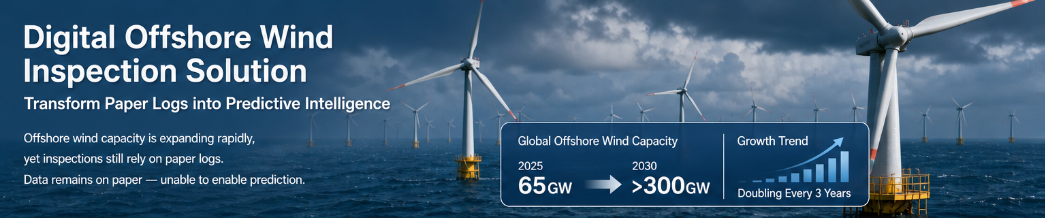
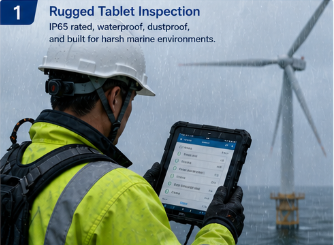
Fig 1 – Offshore wind turbine inspection using SH6 rugged handheld in harsh marine conditions
Field reality check: offshore wind is scaling at record speed, but inspection workflows haven’t kept up. Paper logs, delayed reporting, and missing data are still common across fleets. In an environment where one missed anomaly can lead to multi-million-dollar downtime, relying on handwritten notes is no longer acceptable. Digital inspection at the source is now a baseline requirement—not an upgrade.
By HOTUS Technology | May 2026
Offshore wind farms are expanding into deeper waters and harsher climates, pushing operations and maintenance (O&M) teams to their limits. Turbines are larger, service intervals are tighter, and regulatory scrutiny is increasing. Yet one weak link remains consistent across many operators: inspection data capture in the field.
Traditional workflows rely on manual recording—notes written inside nacelles, later transferred into maintenance systems. This introduces three critical risks: data loss, delayed response, and zero traceability. When failures occur, historical context is often incomplete or unavailable.
The shift toward predictive maintenance and digital twins requires accurate, timestamped, and structured data. That starts at the inspection point. The Hotus SH6 rugged Windows handheld enables technicians to capture inspection data directly on-site, even under rain, wind, and salt exposure.
Built for offshore conditions, the SH6 combines IP67 protection, high-brightness display, and glove-ready touch input. Inspection workflows are digitized into guided checklists, ensuring consistency across teams. Each entry is automatically time-stamped and can include images, voice notes, and structured measurements.
More importantly, the device connects field activity with central systems. Once connectivity is available, inspection data syncs to maintenance platforms, allowing engineers onshore to review conditions in near real-time. Issues are identified earlier, decisions are made faster, and downtime risk is reduced.
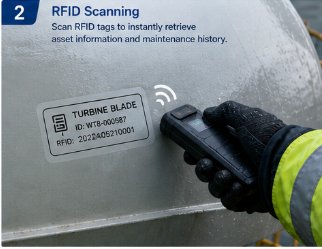
Fig 2 – RFID-based component tracking for turbine maintenance and asset traceability
Asset traceability is another major gap in offshore operations. Components such as blades, gearboxes, and converters move between storage, vessels, and turbines. Without proper tracking, maintenance history becomes fragmented.
The Hotus U9000 RFID industrial PDA solves this by enabling fast, non-line-of-sight identification of tagged components. Technicians can scan multiple assets in seconds, linking each part to a specific turbine and maintenance event.
This creates a complete lifecycle record—from installation to replacement—supporting warranty validation, compliance audits, and long-term reliability analysis. In large wind farms, this level of visibility directly impacts operational efficiency and cost control.
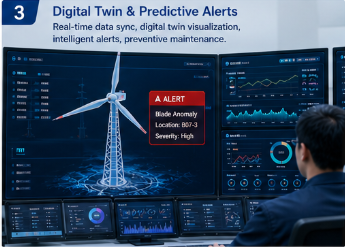
As offshore wind projects scale, centralized monitoring becomes essential. Data collected in the field must translate into actionable insights. When inspection records are structured and consistent, they can feed condition monitoring systems and predictive models with far greater accuracy.
Operators who have transitioned to digital inspection workflows report measurable gains: higher inspection completion rates, faster issue escalation, and reduced unplanned outages. The improvement is not incremental—it fundamentally changes how maintenance teams operate.
Offshore wind is built on advanced engineering, but reliability depends on execution in the field. Digitizing inspections is one of the fastest and most practical ways to improve performance across the entire asset lifecycle.
Fig 3 – Real-time offshore wind farm monitoring dashboard for condition-based maintenance
Contact HOTUS Technology to explore digital inspection solutions for offshore wind operations, request SH6 field testing units, or integrate U9000 RFID tracking into your maintenance workflow.