A retail POS procurement spreadsheet looks complete once three device rows repeat the same shorthand: barcode scanning, RFID, rugged build, wireless connectivity, and warranty coverage. While the Retail Store Stocktaking & POS Application Solutions overview outlines how these devices support daily store operations, a purchase order needs exact module definitions rather than broad labels.
Across the ST9-J, ST13-J, and R530C PDA, identical shorthand points to very different hardware configurations. An 8-inch rugged tablet can ship without an integrated barcode engine unless specified, a 13.3-inch terminal supports short-range NFC rather than long-range tag reads, and a 6.0-inch handheld offers a dedicated ceramic UHF antenna built for aisle stocktaking. Clarifying those distinctions before issuing a purchase order prevents costly mismatches on opening day.
Why Repeated Procurement Terms Create Store-Floor Gaps
Multi-store retail rollouts frequently duplicate specification rows across checkout counters, back-office desks, and sales-floor handhelds to keep purchasing sheets uniform. When generic terms like "scanning" or "RFID" get copied down every line, buyers often assume every unit arrives with identical data-capture hardware pre-installed.
Assigning each device by its physical workflow avoids those gaps before boxes reach the loading dock:
- Checkout counter terminal: Requires compact, lightweight one-handed handling so cashiers can scan items while bagging merchandise or handing over receipts.
- Back-office and exception desk: Needs a large display capable of showing side-by-side inventory tables, return forms, and shelf audit photos without constant scrolling.
- Sales-floor stocktaking handheld: Demands pocketable ergonomics, all-shift battery endurance, and dedicated barcode or UHF RFID read range for rapid aisle sweeps.
What Barcode Scanning Means on the 8-Inch ST9-J Tablet
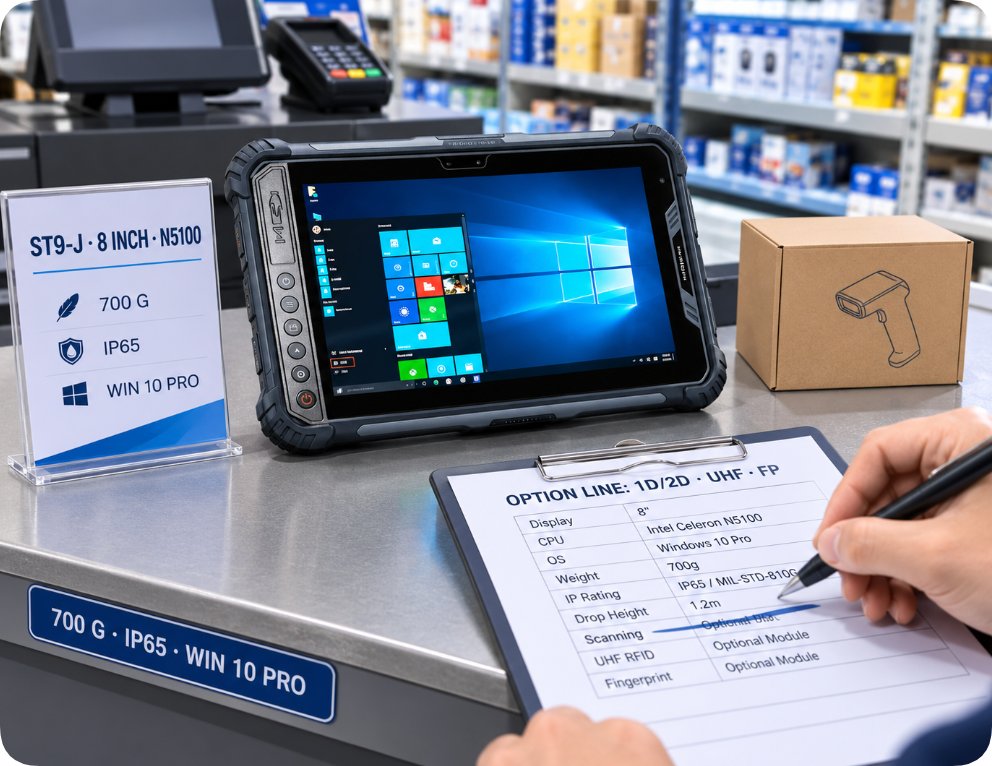
Specs on the 8 Inch Windows Industrial Tablet ST9-J Manufacturer page highlight a 700g rugged form factor powered by an Intel Celeron N5100 quad-core processor running Windows 10 Pro. Its IPS display offers optional brightness up to 1000 nits for brightly lit storefronts, backed by IP65 sealing, MIL-STD-810G compliance, 1.2m drop protection, global 4G LTE, and dual-band Wi-Fi.
On the data-capture side, the ST9-J lists a 1D/2D barcode scanner, UHF RFID, and a fingerprint reader as optional modules rather than standard base hardware. Purchase orders must explicitly specify the required factory-fitted module and verify a pre-shipment sample so stores never unbox a bare tablet during peak checkout hours.
UHF RFID vs. NFC on the R530C Handheld PDA
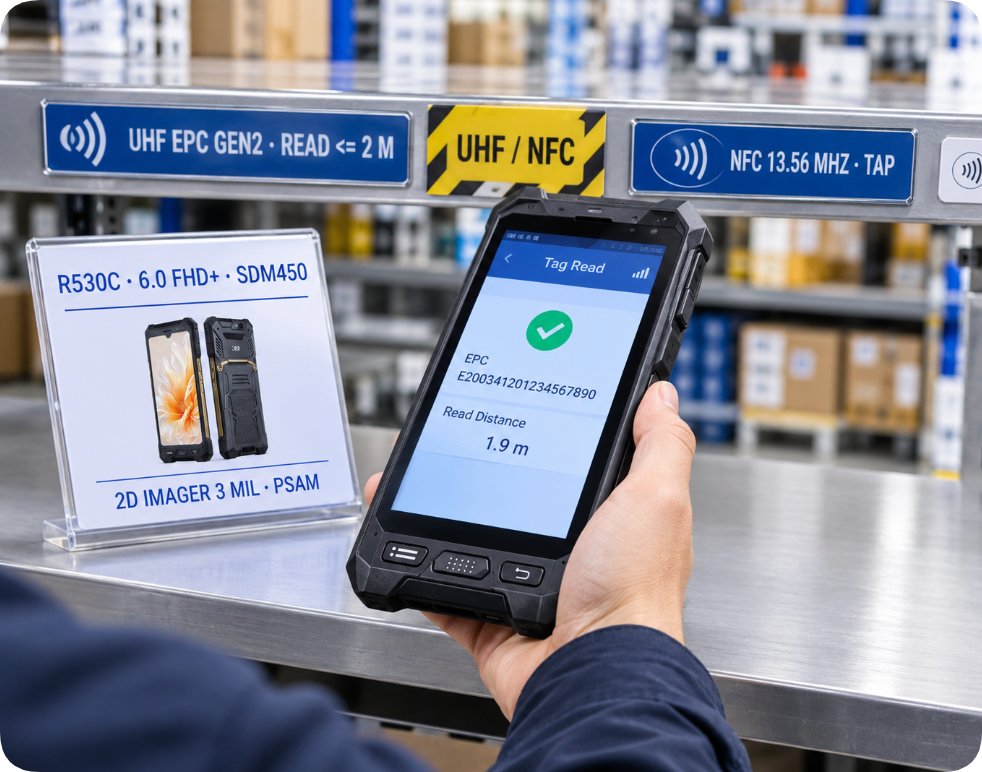
Built for mobile floor staff, the R530C Octa Core UHF RFID Barcode PDA combines a 6.0-inch IPS FHD+ screen (1080 × 2160) with a 1.8GHz Qualcomm SDM450 octa-core processor and a 6000mAh non-removable battery. Measuring 188mm × 83mm × 22mm and weighing under 500g, it fits comfortably in one hand during extended cycle counts.
Crucially, its wireless identification hardware separates long-range UHF from tap-range NFC:
- UHF RFID module: Uses an optional 40mm × 40mm ceramic antenna supporting EPC Class1 Gen2 tags up to a 2m read range across FCC, ETSI, or SRRC-MII regional frequency bands.
- NFC module: Operates at 13.56MHz with ISO14443A/B and ISO15693 protocol support for close-contact loyalty cards, staff badges, or tap pairing.
- 2D barcode and security hardware: Includes a high-precision 2D imager capable of reading dense codes down to 3mil alongside a PSAM slot for encrypted transactions.
Writing only "RFID" on a quote request leaves antenna format, regional frequency tuning, and read distance undefined. Naming the exact protocol and target range ensures the delivered handheld matches shelf-tag distances.
Side-by-Side Comparison of Published Hardware Specifications
Comparing published specifications side by side shows why generic labels cannot substitute for line-item engineering checks. The table below includes only directly comparable parameters stated across the three product listings, omitting fields where individual pages use different measurement formats or omit figures.
| Specification Category | ST9-J (8-Inch Tablet) | ST13-J (13.3-Inch Tablet) | R530C PDA (6.0-Inch Handheld) |
|---|---|---|---|
| Display | 8-inch IPS, optional brightness up to 1000 nits | 13.3-inch Full HD, 10-point capacitive touch | 6.0-inch IPS FHD+, 1080 × 2160 resolution |
| Processor | Intel Celeron N5100 quad-core | Intel Celeron N5100 quad-core | Qualcomm SDM450 octa-core, 1.8GHz |
| Optional Capture & Security Modules | 1D/2D barcode scanner, UHF RFID, fingerprint reader | 1D/2D barcode scanner, NFC | UHF RFID (up to 2m), 2D imager (down to 3mil), NFC, PSAM |
| Wireless Connectivity | 4G LTE, dual-band Wi-Fi | 4G LTE, Wi-Fi 5, Bluetooth, GPS | 4G LTE, dual-band Wi-Fi, Bluetooth 4.2 |
| OEM/ODM Customization Options | Logo, housing appearance, modules, boot image, pre-installed system | Brand identity, system configuration, software, module integration | Logo, Android build, preloaded apps, regional UHF frequency tuning |
Keeping the matrix focused on verified specs—and cross-checking selection criteria in Hotus Product Comparisons & Technical Insights—gives procurement teams a reliable baseline before locking down final BOM configurations.
How the 13.3-Inch ST13-J Shifts the Role to Back-Office Operations
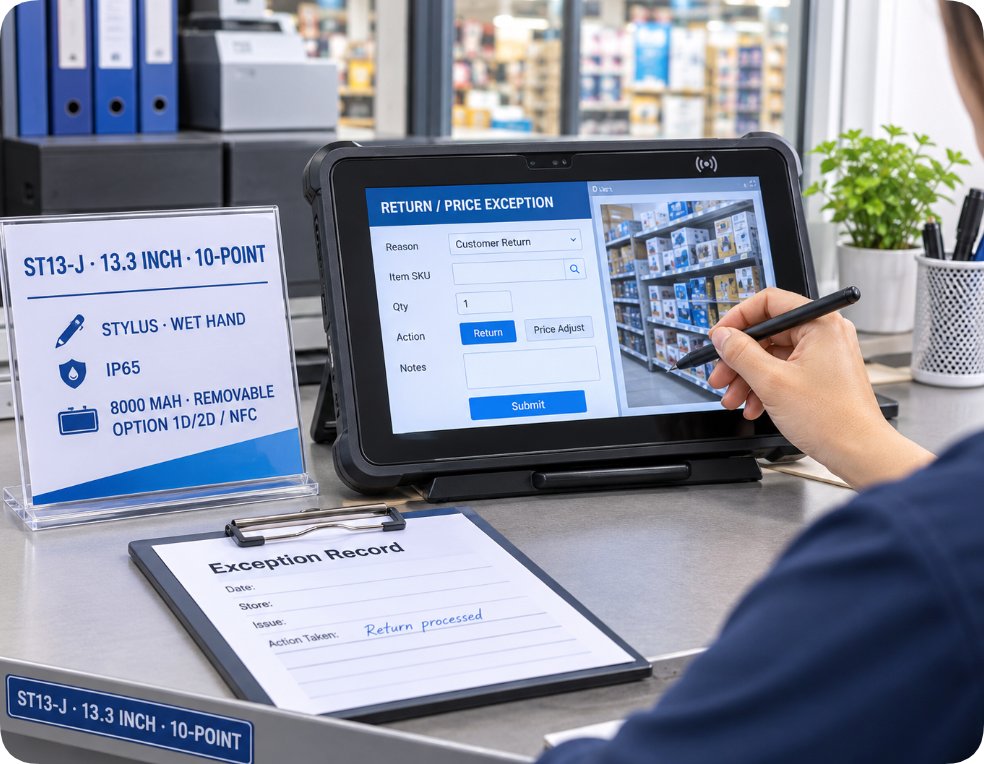
The 13.3 Inch Heavy Duty Industrial Tablet ST13-J pairs the Intel Celeron N5100 quad-core processor with a 13.3-inch Full HD 10-point capacitive touchscreen supporting active stylus input and wet-hand operation. Rated to IP65 and 1.2m drop resistance, it incorporates an 8000mAh removable battery, 4G LTE, Wi-Fi 5, Bluetooth, GPS, optional 1D/2D barcode scanning, and NFC, with docking station and vehicle-mount support for fixed stations.
That larger workspace belongs at the supervisor station or back-office desk rather than a fast-moving checkout lane. Staff can review shelf-audit photos alongside inventory adjustment forms, compare multi-line supplier manifests, and process price overrides across split windows, while cashiers keep the lighter 700g ST9-J at the register.
Defining System-of-Record Ownership Across Store Devices
Data-capture hardware reads tags and barcodes, yet software permissions determine which terminal commits stock updates. When three device tiers share a store floor without clear read/write rules, conflicting inventory edits can appear across registers and handhelds. Assigning primary stock-write authority to one designated tier—while configuring secondary screens for lookup and verification—keeps SKU counts consistent.
Reviewing the full Hotus Smart Hardware Products Manufacturer Catalog helps IT and operations leads map available module combinations early, followed by confirming exact fitted parts on each model's specification sheet prior to production release.
Validating Return Workflows and Pre-Rollout Sample Testing
Customer returns quickly expose any ambiguity in device specs. On the R530C handheld, a 16MP rear camera with flash captures damaged packaging or missing-label evidence, an 8MP front camera supports remote supervisor calls, and a PSAM slot secures payment or authorization steps. Meanwhile, the ST9-J handles initial counter intake scans and the ST13-J displays full return documentation and sign-off fields. For a closer look at counter-to-backroom handoffs, see an under-counter close-out.
Support and validation terms also merit explicit sign-off on the purchase order. Both the ST9-J and ST13-J include a three-year warranty, while the R530C supports pre-order sample evaluation to verify UHF read range, 3mil barcode decoding accuracy, and shift battery endurance inside the buyer's actual store environment before scaling to full deployment.