Multi-Position Deployment Reality: A home server installation often looks complete the moment storage drives mount and network shares appear, yet real-world usage shifts across multiple physical locations—a common dynamic across Soft Router, NAS & Edge Computing Application Solutions. Reviewing a deployment one month post-installation reveals how operator workflows evolve: primary console monitoring happens in one spot, routine backup verification happens in another, and off-site drive transfers take place on the move where a laptop proves impractical.
This case study tracks a four-bay NAS build—configured with mirrored volumes, nightly snapshots, and off-site replication to a second property—across three distinct stations: the rack corner, the living room, and the garage doorway. Each station uses a dedicated Hotus unit selected for its specific physical and operational constraints rather than chasing a single "do-it-all" device.
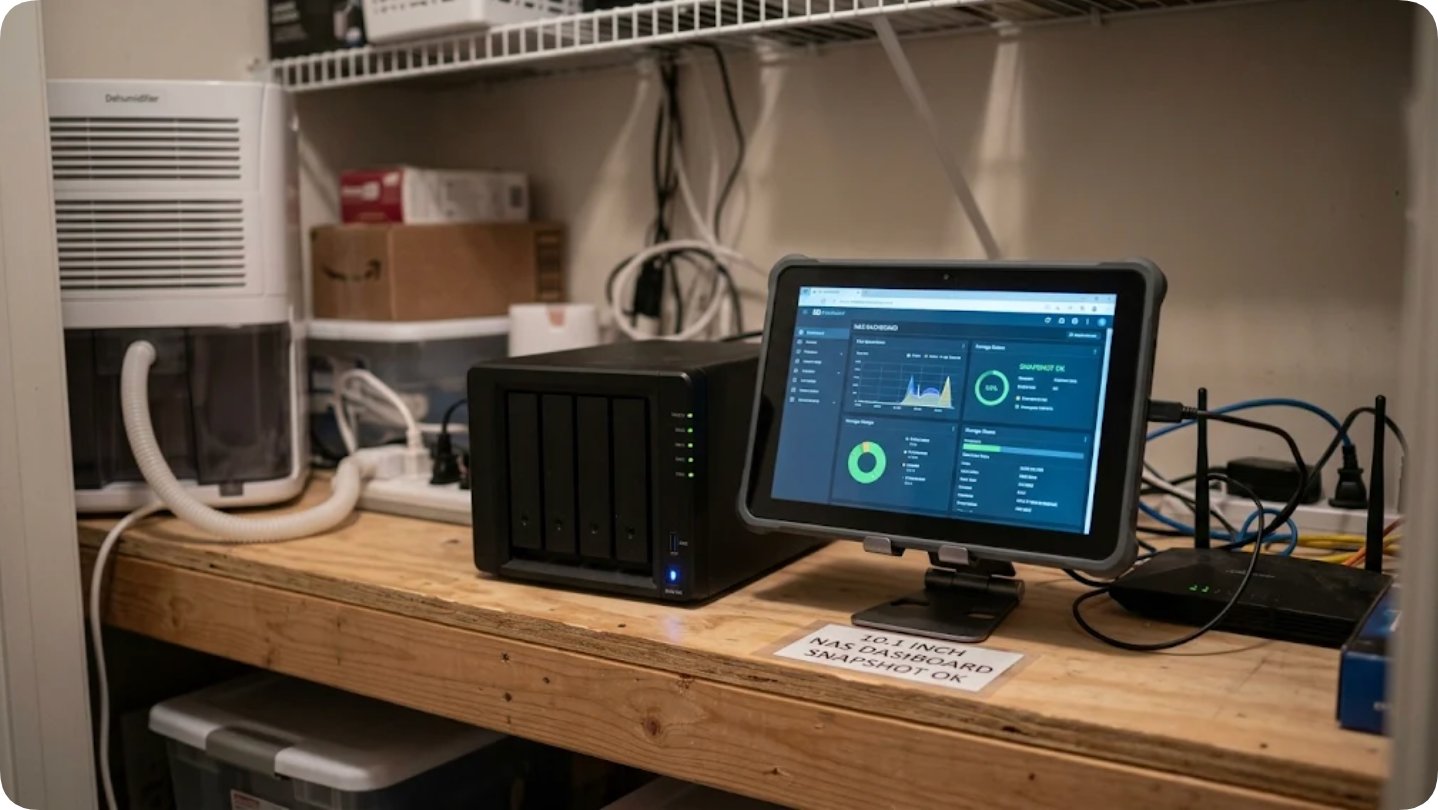 Rack-side monitoring: ST11-J 10.1-inch Windows rugged tablet displaying NAS storage and network status.
The Rack Corner: Persistent Console Monitoring Without Mains Clutter
Positioned on a compact stand beside the utility-cupboard NAS enclosure—where a shared outlet also powers a dehumidifier—the 10.1 Inch Windows Rugged Tablet PC ST11-J Supplier runs the storage management utility and router interface continuously. Its 10.1-inch IPS display delivers 1200 × 1920 resolution at 420–450 nits (with an optional 1000-nit sunlight panel unnecessary for indoor use), powered by a quiet Intel Celeron N5100 quad-core processor and a 6000 mAh removable battery rated for approximately 8.5 hours.
During follow-up evaluation, power continuity proved vital: battery backing kept the management session active through brief power fluctuations without forcing re-authentication. IP65 ingress protection, MIL-STD-810G compliance, 1.2-meter drop durability, and a three-year limited warranty safeguarded the unit against minor dehumidifier moisture and shelf handling.
The Living Room: Lightweight Snapshot and Backup Checks
Routine status checks—confirming whether nightly snapshots completed or verifying folder replication—happen away from the utility cupboard. For quick checks from a sofa or study, the 8 Inch Rugged Field Tablet Computer ST9-M provides an 8-inch 1200 × 1920 IPS screen at 400 nits and an Intel Core i5-8200Y processor that loads media thumbnails and status dashboards briskly.
Weighing 700 grams, the ST9-M handles comfortably in one hand, runs roughly 6.5 hours on a 5000 mAh removable battery, and combines Wi-Fi 5 with global 4G connectivity for local checks at home or remote status monitoring while traveling. It shares IP65 sealing, MIL-STD-810G certification, 1.2-meter drop protection, and a three-year limited warranty.
The Garage Doorway: Why the SH6 Replaced a Laptop for Drive Handovers
Transporting off-site backup drive caddies between properties exposed a third workflow requirement: quick verification in a damp garage doorway while holding a drive caddy with one hand. A conventional laptop proved impractical because it required a flat dry surface, steady power, and two-handed operation. Replacing it with the 6.5 Inch Industrial Rugged Tablet SH6 OEM solved the bottleneck immediately.
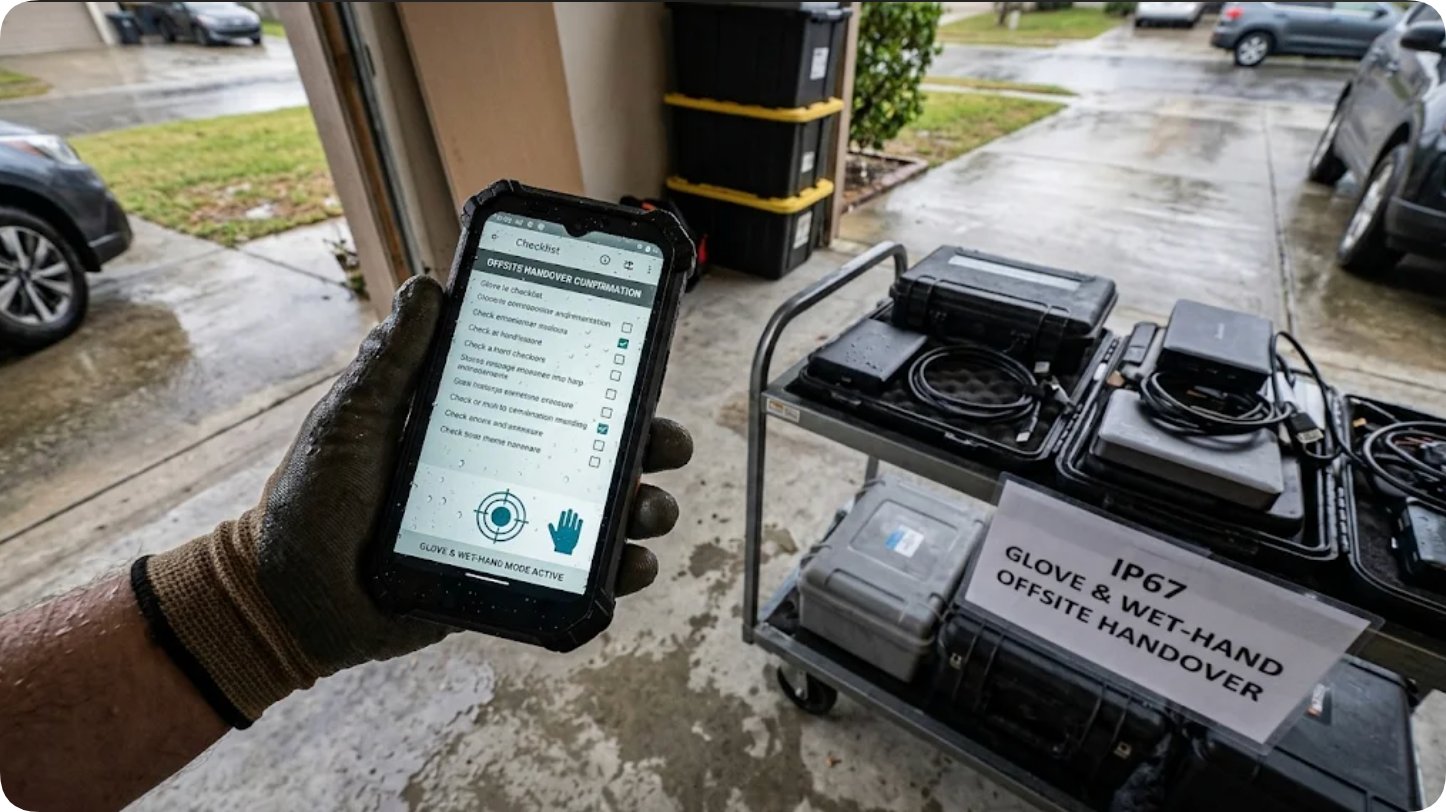 Doorway handover: SH6 handheld supporting wet-hand and glove touch during off-site drive transfers.
Featuring a 720 × 1440 IPS display with Corning Gorilla Glass, glove and wet-hand touch support, IP67 sealing, and a 1.5-meter drop rating, the SH6 handles damp thresholds and accidental drops cleanly. A 5000 mAh removable battery with quick-swap capability and Type-C fast charging—paired with a spare battery kept in the vehicle—eliminates charging downtime, while optional 2D barcode, NFC, and UHF RFID modules offer future inventory expansion under a three-year limited warranty.
Mapping Hardware Form Factors to Operator Positions
Rather than forcing one large tablet into every role across a Hotus Smart Hardware Products Manufacturer Catalog deployment, matching each device to its actual point of work keeps every position practical:
| Operator Position | Assigned Unit | Display | Key Decision Factor | Battery |
|---|---|---|---|---|
| Rack Corner | ST11-J | 10.1" IPS, 1200×1920 | N5100 quad-core, power-cut continuity | 6000 mAh (~8.5 h) |
| Living Room | ST9-M | 8" IPS, 1200×1920 | 700 g one-hand use, Core i5-8200Y | 5000 mAh (~6.5 h) |
| Garage Doorway | SH6 | 6.5" IPS, 720×1440 | IP67, glove & wet-hand operation | 5000 mAh quick-swap |
Handover Rules That Kept Multi-Device Operations Clean
Three practical rules documented during handover prevented operational drift: labeling each device's designated station so similar form factors are not swapped; maintaining distinct charging routines (docked/stand for ST11-J, periodic room charging for ST9-M, vehicle spare battery swap for SH6); and restricting NAS configuration changes to the rack console while keeping living-room and handover units read-only. Separating configuration authority from status viewing avoids accidental changes—a lesson reinforced across multi-device deployments in HTNJ10C and WTR PRO AMD: The Closing Line Was Not the Opening Line and further explored in Hotus Product Comparisons & Technical Insights.
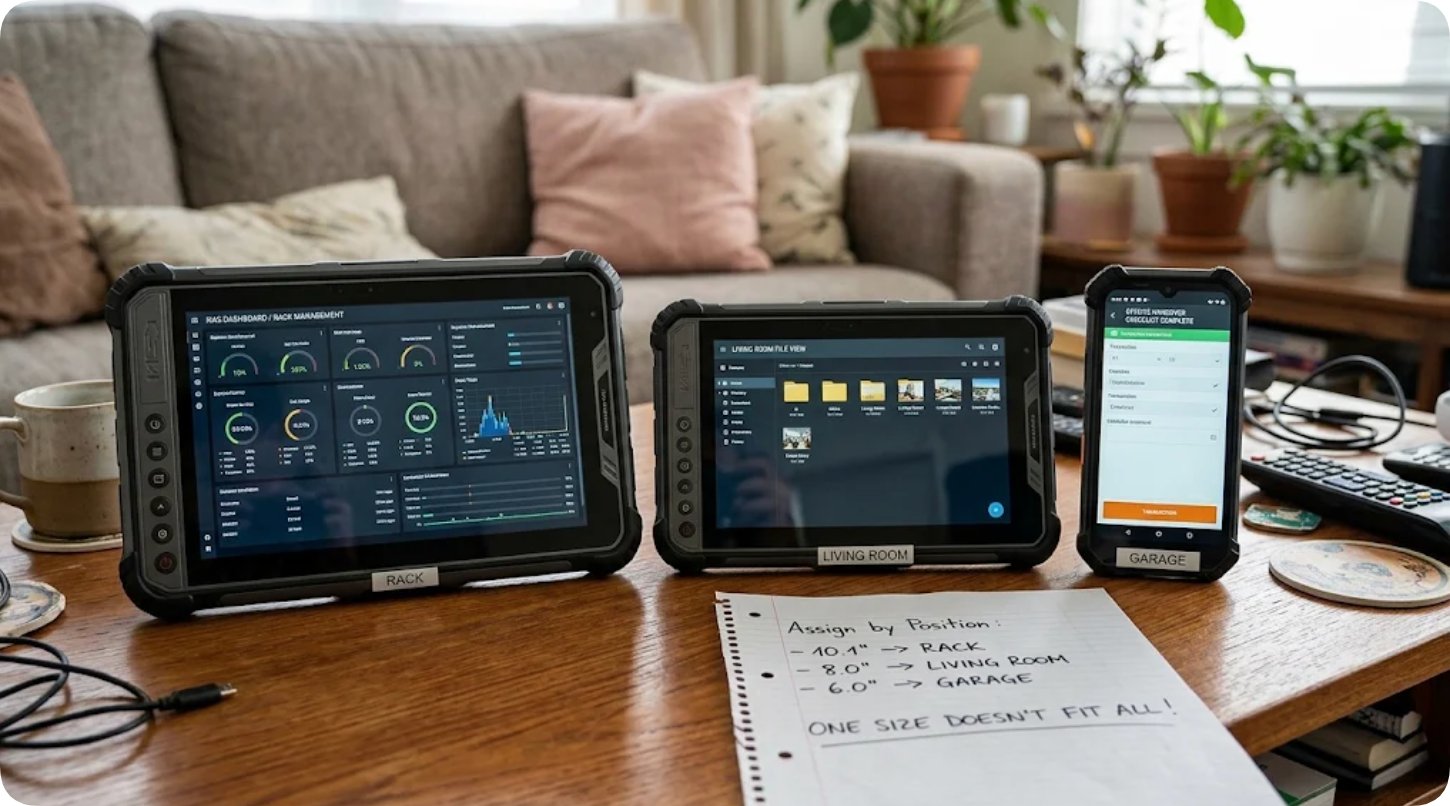 Complete setup: ST11-J, ST9-M, and SH6 staged together following handover rules.
Frequently Asked Questions
1. Can multiple rugged terminals access the same NAS safely without configuration conflicts?
Yes. Assigning full administrative configuration rights exclusively to the rack-side terminal while keeping secondary units on read-only status or verification views prevents unintended setting changes.
2. Is a 1000-nit sunlight-readable display necessary for indoor NAS monitoring?
No. Standard 400- to 450-nit IPS displays provide clear visibility in indoor rooms and utility spaces, reserving optional 1000-nit panels for direct outdoor sunlight exposure.
3. Why is a rugged handheld like the SH6 well suited for doorway or mobile drive checks?
Yes, because one-handed handling, IP67 sealing, 1.5-meter drop resistance, and wet/glove touch support match mobile transfer conditions. Larger tablets are better suited to stationary stands or seated review than damp doorways.
4. Does built-in battery capacity benefit a console terminal placed near a NAS rack?
Yes. A battery-backed console keeps active monitoring sessions alive during brief power interruptions and avoids routing extra mains cables across crowded equipment shelves.