Tracing a single defect from the service bay to the permanent compliance archive shows where records can be altered, which terminal holds the authoritative version, and what safety inspectors verify during the first ten minutes of a records check. The hardware workflow examined here pairs the ST11-U Windows rugged industrial tablet, the RS50 5G rugged handheld terminal, and the Smart PDA N40 shelf reader. Every technical specification cited below comes directly from published product pages; where a manufacturer data sheet omits a field, that boundary is explicitly noted rather than assumed.
Why a Maintenance Checkbox Is Not a Clear-to-Run Decision
A bay inspection sheet proves that a technician looked at a vehicle; a release decision proves that an authorized supervisor accepted the operational risk of dispatching that vehicle into service. Even when both entries share a single line on a clipboard, they serve separate legal functions. Any driver or mechanic can tick an observation box when spotting a fault, whereas dispatch clearance demands a secondary review by personnel authorized to ground the coach. Fleet operations that archive only the initial observation end up with binders full of accurate defect notes and zero documented proof of why a vehicle was cleared to leave the yard.
Closing that compliance gap starts with workflow architecture rather than hardware procurement, which is why the Fleet & In-Vehicle Operations Application Solutions framework serves as the baseline before comparing device specs. Depot managers must first define which step in the chain becomes binding and who holds sign-off authority, then assign each industrial device to the exact stage where its screen size, wireless radio, or barcode engine prevents record tampering.
ST11-U: Keeping Bay Observations and Release Dispositions Side by Side
The 10.1 Windows Rugged Industrial Tablet ST11-U Wholesale provides the widest display in this three-device ecosystem, and physical screen width directly improves audit integrity. Its 10.1-inch IPS panel renders at 1200 × 1920 resolution with 450 nits brightness, allowing two columns of a defect ledger to sit side by side: the original bay observation on the left and the supervisor's final disposition on the right. Auditors can immediately verify that the clearance entry did not overwrite or erase the mechanic's initial wording.
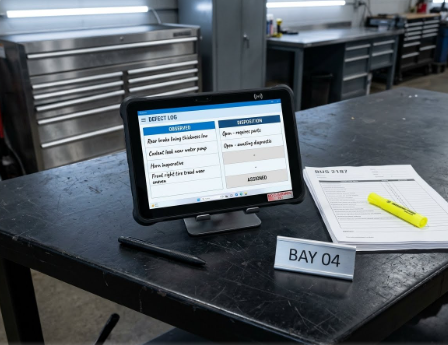
The 10.1-inch ST11-U display keeps raw bay observations visible alongside formal dispatch release sign-offs
Under the hood, the ST11-U runs Windows 11 Pro on an Intel Core i5-1235U processor (with an optional i7-1255U configuration), paired with 8GB or 16GB of RAM and 128GB to 512GB M.2 2242 SATA SSD storage. That desktop-class throughput matters at busy transit hubs because release logs span rolling multi-week vehicle histories rather than isolated single-bus forms. Published options include TPM 2.0 hardware security, a 1D/2D barcode scanner, UHF RFID, and NFC. Built for garage environments, the chassis carries IP54 ingress protection, MIL-STD-810G certification, a 1.2-meter drop rating, a -20°C to 55°C operating range, and a removable 7.6V 6000mAh battery rated at roughly 5.5 hours.
RS50: Binding Every Bay Observation to a Verified Vehicle Asset Tag
The RS50 5G Rugged Handheld Terminal 6.3 Inch anchors accountability at the exact second a defect is spotted. Its product sheet specifies an optional 2D barcode engine accurate to 3 mil alongside optional 13.56MHz NFC supporting ISO14443A, ISO14443B, and ISO15693 protocols. In daily depot practice, a technician scans the chassis asset tag before entering a single word, locking the observation to a unique fleet ID instead of relying on a smudged route number or transposed license plate.
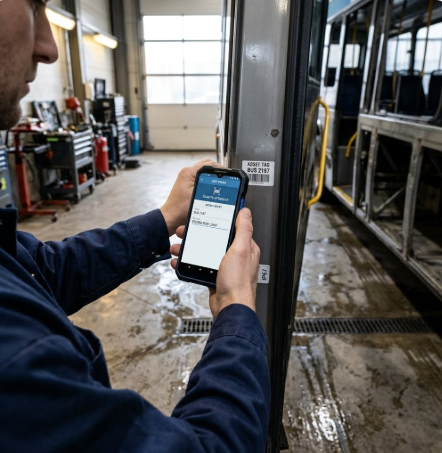
Scanning the vehicle asset tag with the RS50 binds defect notes to an immutable unit ID and location timestamp
Engineered for outdoor wash bays and wet step boards, the RS50 features IP67 sealing, a 1.2-meter drop rating, and a -10°C to 50°C operating temperature window. Its 6.3-inch IPS screen displays at 1080 × 2340 resolution, powered by a UNISOC UIS7885 octa-core 2.7GHz processor with an integrated 8T NPU, 8GB RAM, 128GB ROM (expandable via microSD up to 512GB), and a removable 3.8V 4800mAh battery. Wireless connectivity spans 5G SA/NSA, dual-band Wi-Fi, Bluetooth 5.0, and high-precision GNSS with independent Beidou and RTK support—giving auditors verifiable proof of both when and where a pre-trip check occurred.
Smart PDA N40: Dedicated Spare-Parts Tracking at the Stockroom Shelf
The N40 Smart Industrial Handheld PDA Factory serves as the dedicated stockroom terminal in the workflow. Rather than pulling the supervisor's Windows tablet or the bay technician's 5G handheld away from active vehicles, parts clerks use the N40 to scan replacement components off the shelf and link each part number directly to an open defect ticket and bay assignment. Published hardware specifications include a standard 1D/2D barcode scanning engine, a Cortex-A53 quad-core 2.0GHz processor, Android 10.0, 2GB RAM, and 16GB storage expandable via microSD up to 128GB.
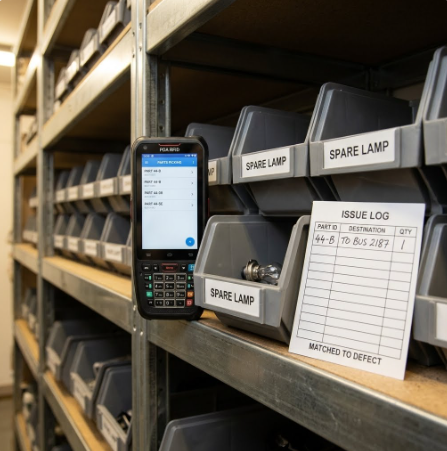
The Smart PDA N40 ties issued replacement components directly to active bay work orders without slowing dispatch sign-offs
Because the published N40 product page omits explicit IP ratings, battery mAh figures, screen dimensions, and unit weights, those unverified fields are excluded from the matrix below rather than estimated. What the page confirms is support for optional data-capture modules, custom software integration, OEM logo branding, and CE, FCC, and RoHS certifications. For stockroom teams outfitting multiple parts counters, a focused barcode terminal that links inventory to work orders cleanly outperforms over-specifying expensive 5G field hardware for indoor shelf duty.
Three Devices, Three Distinct Record Boundaries
The matrix below compares only specifications published across all three product pages on a common baseline. Rather than ranking one device above another, it clarifies which operational record each terminal is built to write without creating conflicting edits:
| Published Specification | ST11-U Rugged Tablet | RS50 5G Handheld | Smart PDA N40 |
|---|---|---|---|
| Operating System | Windows 11 Pro | Android 13.0 / Harmony OS 6.1 | Android 10.0 |
| Processor Architecture | Intel Core i5-1235U (optional i7-1255U) | UNISOC UIS7885 octa-core 2.7GHz | Cortex-A53 quad-core 2.0GHz |
| Memory & Storage | 8GB/16GB RAM, 128–512GB M.2 2242 SATA SSD | 8GB RAM + 128GB ROM, microSD to 512GB | 2GB RAM + 16GB ROM, microSD to 128GB |
| Barcode & RFID Capture | Optional 1D/2D scanner, UHF RFID, NFC | Optional 2D engine (3 mil), NFC, fingerprint | Standard 1D/2D scanning engine |
| Expansion & Interfaces | M.2 2242 SATA slot, modular capture ports | MicroSD, dual Nano-SIM, pogo pin dock | MicroSD (TF) expansion card slot |
Look closely at the operating system and data-capture rows. The ST11-U delivers a full Windows desktop capable of running fleet ERP ledgers alongside optional UHF RFID; the RS50 pairs 5G cellular connectivity and RTK positioning with high-precision 2D barcode scanning; and the N40 provides a dedicated 1D/2D scan engine with zero cellular overhead. When a depot writes final release dispositions on the Windows tablet, captures bay observations on the 5G handheld, and logs parts issuance on the shelf reader, all three records reconcile cleanly by asset ID and part number. Allowing every terminal to edit the same database field simply produces three conflicting versions of a single defect.
Enforcing Sign-Off Separation and Audit Readiness
Returning to the flickering second-row reading light: the RS50 binds the observation to the coach's asset tag with a GPS timestamp, the N40 logs the replacement bulb issued from inventory, and the ST11-U displays the supervisor's disposition alongside the original defect line. Yet none of that hardware prevents an unverified dispatch unless depot rules enforce one critical field: who accepted the fault, what operational restriction applies (such as daytime-only routing until parts arrive), and when that restriction expires. A practical depot rule dictates that the mechanic who logs a defect cannot close it—the RS50 ticket remains open until an authorized reviewer on the ST11-U enters a completed repair ID or a time-bound conditional release.
During the first ten minutes of a regulatory inspection, auditors rarely ask to see rugged hardware specs—they pull a vehicle number and request its maintenance folder. When that folder contains a timestamped RS50 asset scan, an N40 parts-issuance log, and an ST11-U dual-column disposition export, compliance is proven in seconds. Fleet managers planning hardware rollouts can review available form factors in the Hotus Smart Hardware Products Manufacturer Catalog, verify technical alignment via Hotus Product Comparisons & Technical Insights, and see how parallel transport workflows are structured in the fleet management comparison written for transport operations.
Frequently Asked Questions (FAQ)
1. Does an initial bay defect note count as an auditable vehicle release decision?
Yes, separating them is essential because an initial defect note only proves a technician observed a fault, whereas an auditable release decision records the authorized reviewer's name, conditional operating restrictions, and expiration timestamp in a distinct disposition field.
2. Why is the ST11-U rugged tablet best suited for holding final dispatch dispositions?
Yes, the ST11-U features a 10.1-inch 1200 × 1920 IPS screen running Windows 11 Pro with optional TPM 2.0 security, allowing supervisors to view the original bay observation and the final release disposition side by side without overwriting the initial record.
3. Can the Smart PDA N40 replace the RS50 5G handheld terminal for bay inspections?
Yes, keeping them in separate roles prevents workflow gaps because the N40 is built as a stockroom 1D/2D barcode reader with 2GB RAM and no cellular radio, whereas the RS50 combines IP67 sealing, 5G connectivity, RTK positioning, and 3-mil 2D scanning to bind defect notes to specific vehicles in wet bays.
4. How should fleet procurement teams handle unpublished specifications on a device data sheet?
Yes, procurement teams should exclude unpublished metrics from baseline comparison tables and verify missing values—such as the N40's unlisted IP rating and battery capacity—directly with the manufacturer before assigning the unit to harsh outdoor environments.
The video below demonstrates rugged tablet and handheld PDA barcode scanning workflows for commercial vehicle fleet inspection and maintenance tracking.