RT80, HTNJ08B and HTXUK10A-55: What a Performance Test Can Actually Carry Between Three Rugged Tablets
A field team that runs one benchmark across a fleet wants one number it can hand to a buyer. The RT80, HTNJ08B and HTXUK10A-55 make that awkward. They share an IPS resolution and a rugged label, but they do not share an operating system, a battery strategy or a sealing rating. A result collected on one of them is still useful; it just has to be labelled with the machine that produced it. This article separates the readings that travel from the readings that stay at the bench, and shows where the test sheet has to carry a second column.
We define a "portable" reading here in a narrow sense: a number that keeps its meaning when it is written next to a different model. A screen resolution is portable because 1200 x 1920 pixels describes the panel itself. A runtime in hours is not portable unless the battery, the operating system and the radio load are named in the same line. The Industrial Three-Proof Application Solutions page explains where these machines are used; the question below is what a measurement is allowed to claim once it leaves that site.
💡 Why One Test Sheet Produces Three Different Kinds of Number
A bench run measures a machine under a fixed load. A field run measures a machine plus a site: the radio it can see, the light it is read under, the battery it started with and the gloves on the hand holding it. The three units in this comparison sit at different points on that scale. RT80 is a 5G Android tablet with an 8T NPU and a sealed 10000mAh cell. HTNJ08B is an eight-inch Windows tablet with a removable 3500mAh pack. HTXUK10A-55 is a ten-inch Windows tablet with a removable 6000mAh pack. Feed them the same scan loop and the loop is the same; the machine underneath it is not.
That is why the first column of the sheet should be the protocol, not the product. Write down what was repeated, how many times, and what counted as a pass. Only then add the model name. A reader who sees a runtime without the radio band and the screen brightness has no way to tell whether the number describes the hardware or the test day.
In practice the protocol column holds four lines: the task loop, the count of repeats, the radio state and the light condition. The task loop might be a pallet label scanned at a fixed distance, a form opened and signed, or a reading keyed into a maintenance record. The count matters because a ten-cycle run and a hundred-cycle run stress the battery and the thermal envelope differently. Radio state separates an online sync from an offline capture that uploads later. Light condition is not decoration either: a 400-nit panel and a 560-nit panel read differently at the same doorway, and a test run in a dark office says nothing about a midday yard. When all four lines are written down, the model column can be compared across rounds instead of across impressions.
The Panel Numbers That Survive a Model Change
All three units use a 10-point capacitive IPS touchscreen at 1200 x 1920. That is a genuine shared figure, and it is the cleanest row on the sheet: an integrator designing a form can size fields against the same pixel grid whichever unit ends up in the kit. Brightness is where the row splits. RT80 is rated at 400 nits, HTNJ08B at 560 nits and HTXUK10A-55 at 550 nits. A reader who writes "1200 x 1920, 400 nits" and files it under the fleet has quietly made a claim about one unit that the other two do not meet.
Both Windows tablets are specified for stylus and wet-hand operation, and HTNJ08B adds a 7H hardness rating. RT80's panel is described as G+G ten-point touch. These are not competing numbers; they are different properties. The useful move is to keep resolution in the shared column and put brightness, touch layer and stylus support in a model column where nobody can mistake them for fleet-wide facts.
📡 RT80: Where the Reading Includes the Radio
The RT80 5G Rugged Tablet HarmonyOS Android 13 runs Android 13.0 or Harmony OS 6.1 on a UNISOC UIS7885 octa-core at 2.7GHz with an 8T NPU, 8GB RAM and 128GB storage, expandable by microSD to 512GB. Its 3.8V 10000mAh battery supports Power Delivery fast charging but is not described as removable. Connectivity is where a field test gets its own fingerprint: 5G SA/NSA, 4G full netcom, dual-band Wi-Fi 802.11ac, Bluetooth 5.0, GNSS and an independent Beidou plus RTK positioning chain.

A throughput or positioning test on this unit has to record the band and whether the RTK chain had a fix. Run the same loop with Wi-Fi only and the number changes for a reason that has nothing to do with the processor. The 48MP rear camera and optional 2D engine, NFC and fingerprint module are listed as optional, so a benchmark that assumes them present is testing a configuration, not the base model. The 251 x 170 x 14.6mm body is under 650g, and IP67 sealing with a Type-C port plus a 12-pin Pogo docking interface completes the physical picture.
HTNJ08B: A Runtime Number That Means Something Else
The HTNJ08B 8 Inch Waterproof Rugged Tablet pairs an eight-inch 560-nit panel with a Pentium N6000 quad-core, Windows 10 or 11 Pro, and a 7.6V 3500mAh removable battery. It carries IP67, MIL-STD-810G, a 1.22m drop rating and an operating window from -20 to 55 degrees Celsius. Physical interfaces are unusually complete for its size: USB Type-A, Type-C, mini HDMI, RJ45 Ethernet, audio, DC in, TF and SIM slots, plus a 12-pin Pogo pin.
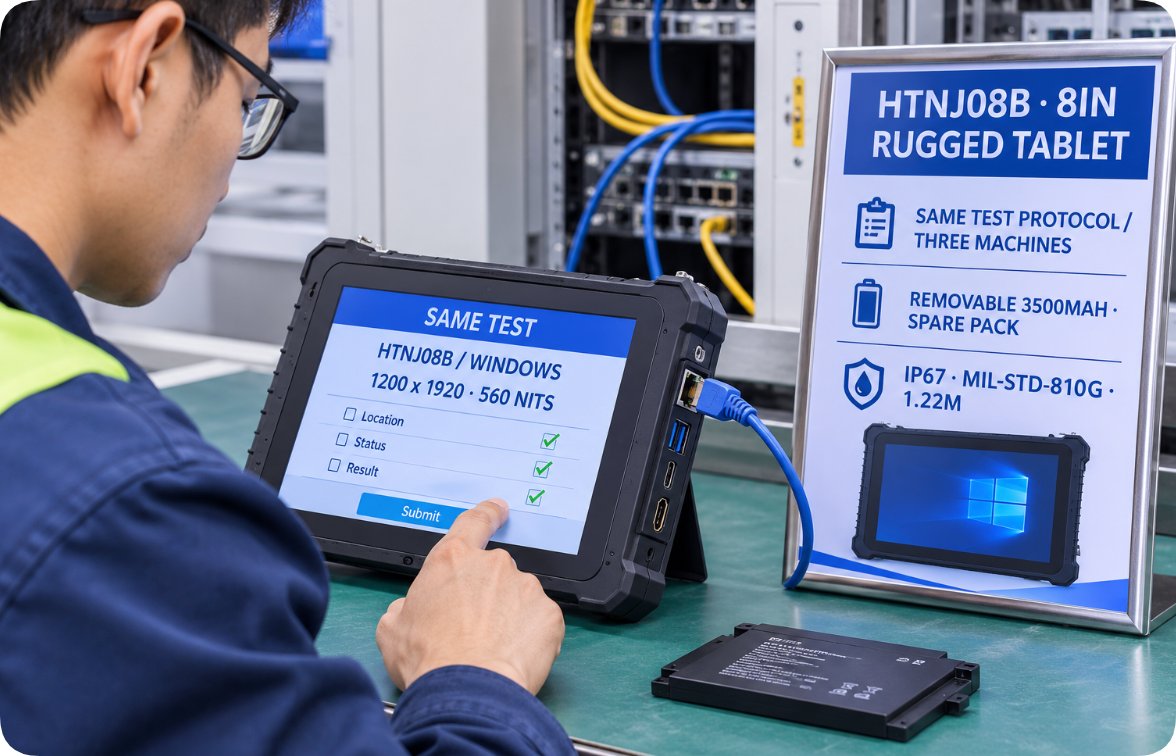
The removable pack is the detail that breaks a naive runtime comparison. A crew can carry a spare and swap it between jobs, so "hours per shift" for this unit can describe a workflow rather than a single charge. Writing that figure beside RT80's single sealed cell would tell a buyer that one battery is better, when the real difference is whether the battery can be exchanged at all. The published weight is a gross figure of about 1.8 kilograms with the carton included, so it is not placed in the same weight row as a bare-unit number.
HTXUK10A-55: The Same Windows Job in a Larger Body
The HTXUK10A-55 10 Inch Rugged Tablet PC Supplier is the third machine on the sheet. It ships with 8GB RAM and 256GB storage, a 10.1-inch 550-nit panel, Windows 10 or 11 Pro, and a 7.6V 6000mAh removable battery described as 45.6Wh with quick charging. Its processor is listed only as an industrial quad-core on the specification table, so no chip model is asserted here. Protection is IP65 with MIL-STD-810G and a 1.2m drop rating; the body is 268.9 x 176.8 x 18mm at about 1150g.

Because it shares Windows and a removable battery with HTNJ08B, this is the one unit where an application-level test result is most likely to carry across models. A scanning app, a form and a signature workflow behave the same way on both. The sealing difference still matters: IP65 on this unit and IP67 on the HTNJ08B describe different exposure limits, and a washdown procedure validated on one should not be copied to the other without a new check.
What the Three Machines Put on One Table
The table keeps the columns that have a real value for all three and moves the rest into notes. Where a field has a different published basis, it is named rather than averaged. That is the only way a comparison stays honest when the products are not built to the same brief.
| Row on the sheet | RT80 | HTNJ08B | HTXUK10A-55 |
|---|---|---|---|
| Display and resolution | 10.1in IPS, 1200 x 1920, 400 nits | 8in IPS, 1200 x 1920, 560 nits | 10.1in IPS, 1200 x 1920, 550 nits |
| Operating system | Android 13.0 / Harmony OS 6.1 | Windows 10 Pro / 11 Pro | Windows 10 Pro / 11 Pro |
| Battery and exchange | 3.8V 10000mAh, PD fast charge, not listed as removable | 7.6V 3500mAh, removable | 7.6V 6000mAh, 45.6Wh, removable, quick charge |
| Sealing and drop | IP67 | IP67, MIL-STD-810G, 1.22m | IP65, MIL-STD-810G, 1.2m |
| Radio and positioning | 5G SA/NSA, 4G, Wi-Fi 5, BT5.0, Beidou + RTK | Wi-Fi 5, BT4.2, 4G options | Dual-band Wi-Fi, Bluetooth, 4G LTE, BDS/GPS/GLONASS |
| Weight basis | Under 650g, bare unit | About 1.8KG, gross with carton | About 1150g, bare unit |
The weight row is the clearest lesson. Two figures are bare-unit weights and one is a gross weight with the carton included. They are printed in one row only so the basis is visible; no one should read them as a ranking. The same restraint applies to the network row: the RT80's 5G and RTK chain have no counterpart on the two Windows units, so a field test that depends on them is not a shared test.
Where the Two Windows Units Do Share a Result
Our Rugged Industrial Tablet PC Manufacturer & Wholesale includes both Windows machines, and that is where a transferable result is most plausible. HTNJ08B and HTXUK10A-55 run the same Windows Pro generations, accept the same class of 1D/2D scanner, UHF RFID, fingerprint, NFC and TPM2.0 options, and list the same -20 to 55 degree operating window. A workflow timed on one is a reasonable starting estimate for the other, provided the panel size and battery capacity are written alongside it.
RT80 sits outside that group. Its Android and Harmony OS builds, 8T NPU and independent Beidou plus RTK chain make it a different execution environment even though the screen grid matches. A test of a vision or positioning task on RT80 should stay labelled RT80; the result cannot be carried into a Windows ticket just because both units have the same pixel count.
The interface list draws another boundary. HTNJ08B carries a full RJ45 Ethernet port, a mini HDMI output and a USB Type-A socket alongside Type-C, which lets a bench test wire it into a fixed station without an adapter. HTXUK10A-55 lists dual-band Wi-Fi, Bluetooth, 4G LTE and satellite positioning but no wired Ethernet row. A test that times a large upload over a dock is therefore a test of one chassis, not of the pair. Keeping that row explicit saves the buyer from discovering it after the units are already on site, when a wired backhaul turns out to be available on only one of the two desks.
What a Buyer Should Ask Before the Test Day
Start with the column headings. Ask which of the three machines the reported brightness belongs to, whether the runtime assumed a swappable pack, and whether the network test used 5G, Wi-Fi or 4G. Those three questions settle most of the ambiguity that a single summary number hides. For the full set of chassis options, the Hotus Smart Hardware Products Manufacturer Catalog lists the wider range these units come from.
A second question is whether the optional capture modules were fitted. Barcode, RFID, fingerprint and NFC appear as options on all three, and a loop that scans a pallet label is only comparable if the same engine type sat in each unit. Record the configuration on the same line as the result, and the sheet stays useful when the fleet changes.
We also write the starting state of the pack into the header. On the HTNJ08B and HTXUK10A-55 a fresh removable battery and a pack already deep into a shift are two different tests, and the crew swaps them at different moments. On the RT80 there is no swap to make, so the sealed cell starts every run at whatever the charger left it. Without that one line, a supervisor comparing two rounds sees a runtime gap and reaches for the wrong explanation. The same header carries the ambient temperature, because the two Windows units publish a -20 to 55 degree window while RT80 publishes no equivalent figure on its specification table. A measurement taken at a cold loading door belongs in the Windows column with the temperature attached, not in a fleet average.
If one figure has to survive a model change, use the pixel grid: 1200 x 1920 across all three. If one figure has to be retired from a shared sheet, use runtime in hours, because battery exchange, radio load and operating system all rewrite it. A worked example of a field sheet that kept its rows honest is this IQC bench check on three rugged tablets, which separated incoming inspection from in-use measurement.
A protocol that names its machine, its radio band and its battery state is slower to write and far easier to reuse. That is the trade a field team makes when the fleet is not uniform, and it is the reason this comparison refuses to publish a single winner.