A cold store is the one environment where a radio specification stops being about radio. The temperature is the first fact, and it is the fact that decides everything else: a lithium cell loses usable capacity in the cold, a screen that works in a warehouse aisle becomes sluggish in a freezer, and a device carried in from the loading dock spends its first ten minutes fogged over while the moisture in the warm air condenses on the cold screen. The second fact is the shelving. A pallet of frozen goods stacked four high is a wall of cardboard, film and frozen product between a reader at one end of the aisle and a tag at the other, and the second fact is what separates a reader that can count a room from one that can count a rack.
Three Hotus units are compared here against two enterprise handhelds sold specifically into cold chain and logistics. The R366C-S is the long-range UHF reader, built on the Impinj E710 module with a quoted 10 to 20 metre read distance and a rate of nine hundred tags per second, carried on a 10000mAh battery, and it is the only one of the three Hotus units here with an explicitly published operating range of minus 10 to 50 degrees. The U9000 is the general-purpose handheld at IP67, with an optional UHF module quoted beyond 1.5 metres, and the Palm-sized miniPC is the 800-gram Windows machine that runs the warehouse system, the label printer interface and the office screens on the dock side of the door. Facing them are the Unitech HT730 Plus, whose documentation names cold chain as an application and pairs it with an IP65 and IP67 rating and a hot-swappable battery, and the Zebra TC53e-RFID, which integrates a UHF reader into a 6-inch enterprise handheld carrying IP65 and IP68, MIL-STD-810H and a 1.8-metre drop rating.
Two boundaries should be drawn before any comparison is attempted. On the two competitor handhelds, the published record is a specification sheet for a general-purpose device rather than a cold-chain device, and no operating temperature figure appears in it — which means the comparison on low-temperature behaviour rests almost entirely on the Hotus side, and this article will not invent a figure for either competitor. And none of the three Hotus units carries a food-safety or hygienic-zone certification; a cold store that requires one is looking at a different procurement conversation entirely.
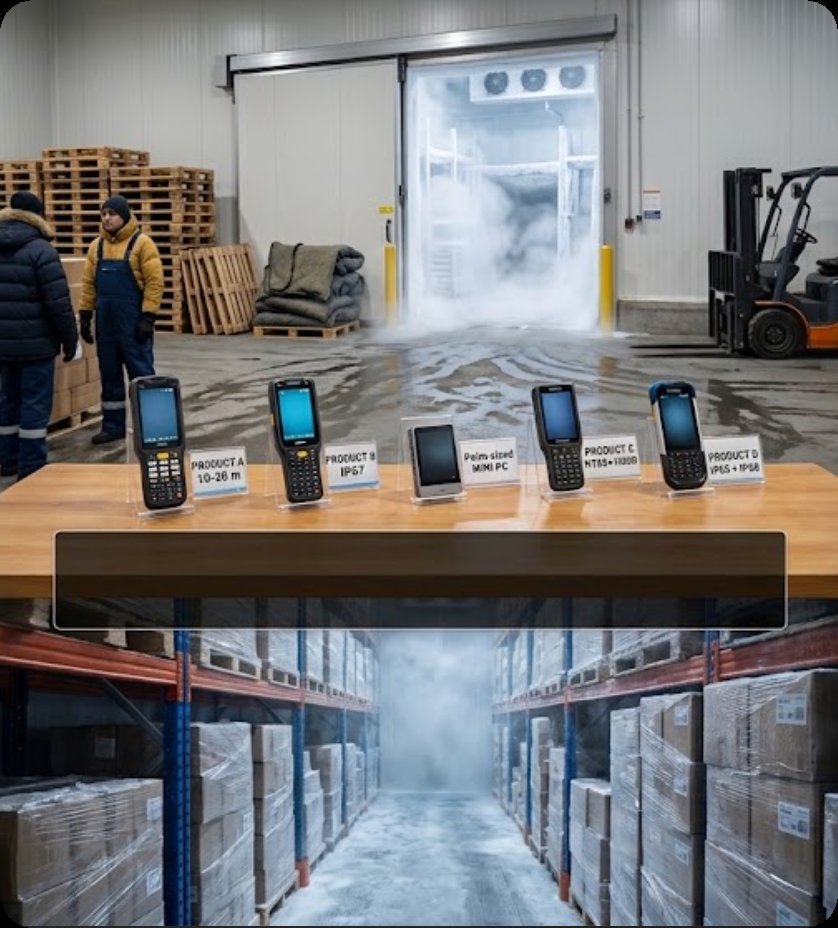
Level One: The Door Is the Hardest Part
Every cold store has a door, and the door is where a device is tested. A worker comes in from a loading dock at plus five degrees, walks through a doorway into a minus eighteen-degree chamber, and the warm moisture in the air they were carrying condenses on every cold surface immediately. On a screen that means a fogged panel; on a sealed chassis it means water that was never intended to be present; on a pair of gloves it means a device that is being operated with a wet hand before the first ten seconds are up.
The U9000 addresses this in the only way a handheld can, which is by being sealed rather than by being clever. Its published rating is IP67 with CE, FCC, RoHS and ISO 9001, and its touch panel is Corning Gorilla Glass with multi-touch that supports both gloves and wet hands — the wet-hand support matters more in a cold store than in any other environment, because condensation is exactly what the operator is holding. The housing measures 178 by 78 by 24mm, and the 5.0-inch IPS panel at 720 by 1280 is protected by that glass.
What the U9000 does not publish is an operating temperature range. That is a real omission for this scenario rather than a technicality, and it is the single most useful thing a buyer should ask a vendor to put in writing. A device rated only for a domestic or office environment — somewhere between zero and fifty degrees — is a device that will be operated at the edge of its specification every time a worker spends an hour in a minus eighteen chamber, and the failure will present as a screen that responds late or a battery that reports a third of its capacity.
Two other details belong with the U9000 in a freezer. Its 3.7V 4800mAh polymer battery is removable, with more than twelve hours of working time, more than three hundred and fifty hours of standby and a recharge inside four hours — a figure that is workable but not generous, and a cold store that runs two shifts should be carrying spare packs rather than expecting a bench charger to keep up. And it runs Android 9.0, which is old enough to matter: a considerable number of enterprise warehouse and cold-chain applications now ship as Android 11 or later, and the two-to-three-year support window that most vendors give for Android enterprise releases has already closed for a 9.0 device.
The camera deserves a note because it is the feature that gets used when the scanner fails. An 8-megapixel autofocus rear camera with flash, anti-shake and macro is enough to photograph a damaged pallet, a torn film or a temperature label, and it is the only practical way to raise a disputed delivery with a buyer. That is why the U9000 remains sensible for a small cold store where the stock volume does not justify a dedicated inventory reader.
Level Two: The R366C-S and the Question of Range
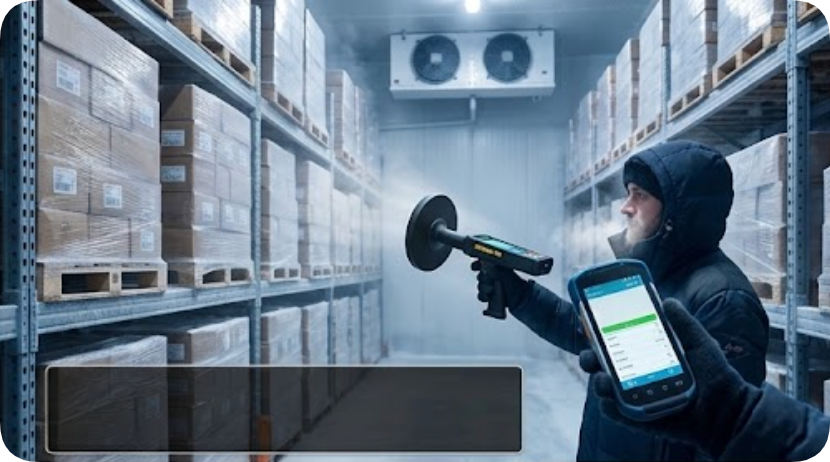
The Hotus R366C-S is the unit that exists because of the shelving. Its UHF engine is the Impinj E710, running EPC Class1 Gen2 on ISO 18000-6C with a 4dBi antenna, and the published figures are a read distance of 10 to 20 metres and a tag rate of nine hundred per second or better. On a two-metre aisle that is not a marginal capability; it is the difference between reading a rack from the walkway and reading it from the far end of the room.
That range figure is the whole argument, and it should be tested rather than assumed. A UHF reader reads a passive tag by illuminating it with a radio signal and collecting the reply, and the reply is what gets attenuated. Frozen product packed tight, cardboard, film wrap and metal racking all take their cut, and a freezer full of wet cardboard is a worse propagation environment than a dry one. A 20-metre figure measured against an open tag in a car park says very little about a tag on a pallet in a minus eighteen chamber, which is why the sample-evaluation offer in the documentation is the correct thing for a buyer to use.
The radio bands are stated as FCC 902 to 928MHz, ETSI 865 to 868MHz and SRRC 840 to 845 and 920 to 925MHz, with support for custom frequencies in other countries. The R366C-S also carries an optional 2D barcode engine at three-mil precision, and that combination is the practical answer to a cold store where only part of the stock is tagged. A pallet of retail cartons with printed barcodes and a pallet of bulk product with an asset tag are both ordinary, and a device that reads both is more useful than a faster reader that reads one.
Battery is where the R366C-S is genuinely strong, and the reason is stated plainly in its documentation: UHF reading draws substantial current. A 3.8V 10000mAh removable pack with Power Delivery fast charging delivers ten to twelve hours of mixed scanning plus cellular transmission, and because it is removable a spare can be swapped in under a minute. The chassis is 170 by 79 by 22.6mm at under 700 grams, with a 5.5-inch IPS HD+ panel at 720 by 1440, a 16-megapixel autofocus rear camera with flash and an optional 8-megapixel front camera, dual PSAM slots, two nano-SIM slots, a TF slot and Type-C with OTG and PD.
Its processor is a Qualcomm SM6225 octa-core at 2.4GHz on Android 13.0 with 4GB of RAM and 64GB of storage expandable to 256GB, and connectivity is 4G LTE, dual-band Wi-Fi 6 ready, Bluetooth 5.1 and GPS, GLONASS and BeiDou. That is a current platform rather than a legacy one, and it is the second reason this device is the one to specify for a site that is going to run the same fleet for four years.
The honest limit here is the certification, not the specification. The published certification list is CE, FCC and RoHS with ISO 9001 — no IP rating and no drop rating appear for this model, and the operating range of minus 10 to 50 degrees with storage from minus 40 to 70 and 5 to 95 percent humidity is stated. A minus ten degree operating floor is appropriate for a chilled warehouse and a loading dock, and it is narrower than a full deep-freeze specification would be. An operator whose chambers run at minus twenty-five needs a vendor to state the figure in writing, because the published one stops at minus ten.
It is also worth being clear that this unit is a reader, not a general-purpose terminal. There is no scanning of ordinary barcodes unless the 2D engine is fitted, no gloves-and-wet-hand touch claim on the display, and its 720 by 1440 panel is a data-review screen rather than a working interface. It is the device for counting a room, and it should be paired with one that does everything else — which is exactly what the U9000 is for.
Level Three: The Dock Side of the Door
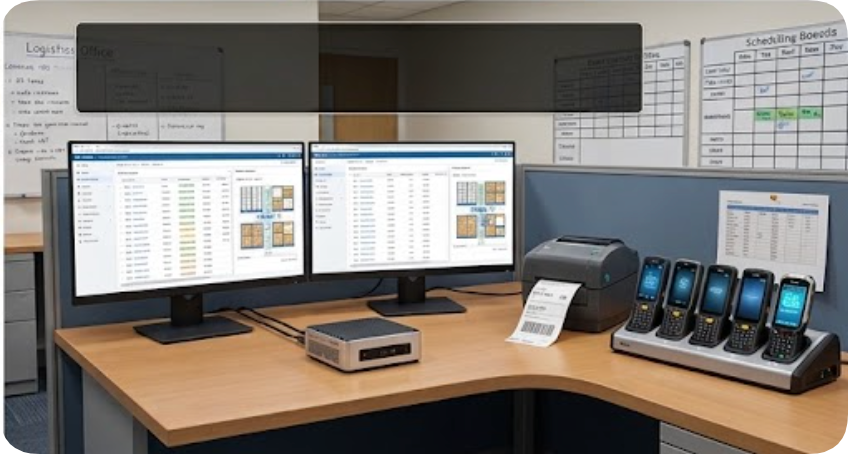
The third position is not in the cold at all, and leaving it out would make this comparison dishonest. A cold chain operation is a system with a warm half: a dispatch office where a WMS client runs, a label printer that has to talk to it, a camera wall or a pair of screens showing what is about to leave, and a charging bench for a fleet of handhelds that spend most of their lives at minus eighteen.
The Palm-sized miniPC is built for that desk, and the reason it is 113 by 113 millimetres is that it fits behind a monitor or inside a cabinet at a dispatch station. It runs 12th Gen Intel Alder Lake processors from a Core i3-1215U up to an i9-12900HK with up to fourteen cores and twenty threads, and it accepts either dual SO-DIMM DDR4 at 3200MT/s up to 64GB or onboard dual-channel LPDDR5 at 5200MT/s. Storage is one M.2 2280 PCIe NVMe slot and one M.2 2242 slot that accepts PCIe or SATA3.0, with the documentation quoting expansion to four terabytes, and the chassis is PC plus ABS at 800 grams net.
Output is triple display: two HDMI 2.1 ports at 4096 by 2304 and 60Hz plus a full-function Type-C carrying 10Gbps, 8K at 60Hz and Power Delivery. I/O is five USB 3.2 Type-A ports, a 2.5G RJ45 Ethernet port, M.2 Wi-Fi 6 with Bluetooth 5.2 and dual FPC antennas, a 3.5mm audio jack and a DC jack. BIOS features include TPM 2.0, auto power-on, a real-time clock with timed power-up, UEFI diskless boot support and an LED status indicator, and the operating systems are Windows 11 and Linux on a DC 19V 3.42A input.
Those figures matter for one specific reason: auto power-on and RTC timed power-up. A dispatch station that comes up by itself at six in the morning is a different operating model from one that needs a keyboard, and a mini PC small enough to live in a cabinet with two screens and a printer interface is what makes that possible. TPM 2.0 matters too where the site runs a locally-hosted WMS.
What this machine is not is a cold-store device. It carries CE, FCC and RoHS with ISO 9001, and the page does not publish an operating temperature range, an IP rating or a cooling configuration. It belongs on the warm side of the door, and saying so plainly is more useful than implying it could go into the chamber.
Unitech HT730 Plus and Zebra TC53e-RFID
The Unitech HT730 Plus is listed in the enterprise handheld tier with a 4-inch WVGA panel at 480 by 800 and 400 nits, protected by a TFT-LCD that accepts gloves up to four millimetres, wet hands and a three-millimetre stylus. The processor is a Qualcomm Snapdragon 4490 octa-core at 2.4GHz with 6GB of RAM and 128GB of UFS storage, running Android 14 upgradable to 16 with GMS and AER certification. Sealing is IP65 together with IP67, with a 1.8-metre drop rating rising to 2.4 metres with a bumper, a 6700mAh hot-swappable battery holding the application for about a minute during a swap, and a 2D scanning engine. The listed applications include logistics and warehousing, manufacturing, cold chain and field service, at $550 to 850.
Two of those figures are directly relevant to a cold store. The document names cold chain as a target application, which means the touch behaviour — gloves, wet hands and a stylus on a four-inch panel — is a design input rather than a feature list item, and in a condensation environment the wet-hand claim is the one that earns its place. And a hot-swappable battery that keeps the application alive for about a minute during the change is the standard a shift-based operation should hold every device in that class to.
The Zebra TC53e-RFID is the same architecture with the reader built in. It carries a 6-inch FHD+ panel at 2160 by 1080, a Snapdragon 4490 octa-core at 2.4GHz, 6GB or 8GB of RAM with 64GB or 128GB of storage, Android 14 upgradable to 18, IP65 and IP68, MIL-STD-810H, 1.8-metre drop resistance and a thousand 0.5-metre tumbles. The battery is a 4680mAh or 7000mAh PowerPrecision+ pack that is hot-swappable, the scanning is SE55 1D and 2D, and the RFID variant integrates the UHF reader. The price band is $700 to 950, rising to $850 to 1,200 for the RFID configuration.
Neither device publishes a read distance or a tags-per-second figure for its RFID engine, and neither publishes an operating temperature range. That is the substance of the difference between them and the two Hotus handhelds: the Zebra is a general enterprise platform with a reader in it, while the R366C-S is a reader with the platform attached, and the published 10 to 20 metre and nine-hundred-per-second figures belong only to the latter. On ingress the two competitor machines are ahead of one of the Hotus units — the U9000's IP67 matches the Unitech's combined IP65 and IP67 rating — and the R366C-S is the one Hotus product in this comparison with no published ingress rating at all.
Read the other way, the competitor platforms are ahead on operating system currency, on certification completeness, and on the software ecosystem that a warehouse deployment depends on. Android 14 or 16 with GMS and AER is a different world from Android 9.0, and an operator who has to run one application across a mixed fleet will find that difference real before they find the read-range difference real.
Choosing by Where the Device Is Used
The table below maps each unit to the position it fits rather than to a specification tier, because a cold store operation has three distinct jobs and they want different machines. Counting stock in a racked aisle, handling an exception at the dock with gloves on, and running the system that ties the two together are three separate decisions, and one model chosen for all three is wrong in at least one.
One practical note belongs with all five devices. In a freezer the operator's hands are cold, which makes a capacitive touch panel less responsive and a push-button scan key more reliable, and it makes gloves a condition rather than a choice. The published glove and wet-hand support on the U9000, the Unitech and the Honeywell-class devices in this market is a differentiator in a cold store than it is anywhere else, and a device specified only by its screen size and its processor will be specified wrongly.
🎯 Specification Summary and Selection Matrix
| Hotus R366C-S | Qualcomm SM6225 octa-core 2.4GHz; Android 13.0; 4GB+64GB, TF to 256GB | 5.5-inch IPS HD+, 720x1440, multi-touch capacitive | 3.8V 10000mAh removable, PD fast charging, 10-12 hours, hot-swap | Impinj E710 UHF, EPC Gen2, 4dBi, 10-20m, at least 900 tags/s; optional 2D at 3mil | CE, FCC, RoHS, ISO 9001; operating -10 to 50 degrees, storage -40 to 70, 5-95% RH | 170 x 79 x 22.6mm, under 700g; 16MP rear AF camera; dual PSAM, dual nano-SIM, Type-C PD/OTG; 4G LTE, Wi-Fi 6 ready, BT 5.1, GPS/GLONASS/BeiDou |
| Hotus U9000 | Cortex-A53 quad-core 2.0GHz; Android 9.0; 2GB+16GB, up to 3GB+32GB | 5.0-inch IPS, 720x1280, Corning Gorilla Glass, multi-touch with gloves and wet hands | 3.7V 4800mAh removable, over 12 hours working, over 350 hours standby, under 4h charging | Optional 1D linear and 2D imager engines; optional NFC 2-5cm, optional UHF 840-960MHz over 1.5m, optional LF | IP67; CE, FCC, RoHS, ISO 9001 | 178 x 78 x 24mm; 8MP rear AF camera with macro and anti-shake; dual PSAM, micro SIM, TF, pogo pin; 2G-5G WWAN, dual-band Wi-Fi, quad-satellite positioning |
| Hotus Palm-sized miniPC | 12th Gen Intel Alder Lake, i3-1215U to i9-12900HK, up to 14 cores / 20 threads; Windows 11 or Linux | Triple output: 2x HDMI 2.1 at 4096x2304 plus Type-C at 8K | DC 19V 3.42A input | Not applicable | CE, FCC, RoHS, ISO 9001; no IP rating or temperature range published | 113 x 113mm, 800g, PC+ABS; dual SO-DIMM DDR4 to 64GB or LPDDR5; M.2 2280 NVMe plus M.2 2242, expansion to 4TB; 5x USB 3.2, 2.5G RJ45, Wi-Fi 6; TPM 2.0, auto power-on, RTC timed power-up |
| Unitech HT730 Plus | Qualcomm Snapdragon 4490 octa-core 2.4GHz; Android 14 upgradable to 16; 6GB+128GB UFS; GMS and AER | 4-inch WVGA 480x800, 400 nits, glove to 4mm, wet hand, 3mm stylus | 6700mAh hot-swappable, application held about 1 minute during the swap | 2D scanning engine | IP65 and IP67; 1.8m drop, 2.4m with bumper | Applications listed include logistics, manufacturing and cold chain; $550-850 |
| Zebra TC53e-RFID | Qualcomm Snapdragon 4490 octa-core 2.4GHz; Android 14 upgradable to 18; 6GB/8GB + 64GB/128GB | 6-inch FHD+ 2160x1080 | 4680mAh or 7000mAh PowerPrecision+ hot-swappable | SE55 1D and 2D; RFID variant integrates the UHF reader; read distance and tag rate not published | IP65 and IP68, MIL-STD-810H, 1.8m drop, 1000 tumbles at 0.5m | $700-950, RFID configuration $850-1,200 |
| Bulk counting a racked aisle where tags sit behind pallets and film | R366C-S | Published 10 to 20 metre read distance and 900-plus tags per second with a 10000mAh pack, and the only Hotus unit here with a stated operating range of minus 10 to 50 degrees |
| Exception handling at the dock with gloves and condensation on the screen | U9000 | IP67, Gorilla Glass with glove and wet-hand touch, an 8-megapixel camera for a disputed delivery, and a hot-swappable-style removable 4800mAh pack |
| The dispatch desk running the WMS, the label printer and the office screens | Palm-sized miniPC | Triple 8K output, 2.5G networking, TPM 2.0, and auto power-on with RTC timed power-up in an 800-gram chassis |
| A site that needs a named cold-chain application and glove, wet-hand and stylus input | Unitech HT730 Plus | Cold chain is named in the application list, with IP65 and IP67 and a hot-swappable battery that holds the app during a change |
| A mixed fleet that needs a current Android release, full ingress certification and an integrated reader | Zebra TC53e-RFID | Android 14 to 18, IP65 and IP68, MIL-STD-810H and a hot-swappable 7000mAh pack in a 6-inch enterprise platform |
An operator who is counting stock in a racked freezer and has not yet fixed a system for it should start with the R366C-S, because the read-distance figure is the one number that decides how many hours a count takes. An operator whose problem is exceptions and disputed deliveries at the dock will find the U9000 cheaper and better suited, and can pair it with the Palm-sized miniPC on the warm side of the door. The two competitor handhelds are ahead in operating system currency and in published ingress certification, and an operator who is replacing a Zebra estate or needs a specific cold-chain application supported should not pretend otherwise — but neither of them publishes a read distance, and on the question that dominates cold-store productivity, only the R366C-S does.
Cold chain operators running the same handheld fleet across a distribution centre and a retail depot can compare chassis sizes in the industrial PDA and RFID handheld range, while sites running a local system server beside the dispatch line should look at the related mini PC range. Every other device-versus-device breakdown in this catalogue sits in the device comparison archive.