Wind Turbine Inspection Devices: Ingress Rating, Screen Light and the Tower Climb
A wind farm is not a single environment either, but it fails in a different way from a refinery or a harbour. A refinery breaks electronics with certificates; a harbour shakes it off a crane. A wind farm does something quieter: it puts a technician on a ladder eighty metres up a steel tower in the rain, hands them a device, and expects a photograph of a bolt. The three questions that follow from that are how much water the device survives, whether the screen can be read against a sky, and what happens when the battery dies halfway up.
Three Hotus units are compared here against two Getac tablets that set a higher bar on two of those three. The ST11-M is the 10.1-inch Windows unit with a detachable magnetic keyboard, RS232 and RJ45 on the same chassis, and the widest cold rating in the group at minus 20 to 55 degrees. The ST13-U is the 13.3-inch Windows 11 workstation with the largest battery in the comparison at 60.8Wh and Wi-Fi 6. The U9000 is the 5-inch Android handheld with IP67 sealing and an optional UHF RFID reader reaching beyond 1.5 metres. Facing them are the Getac UX10, which carries IP66 and IP68 together with a 1000-nit screen, and the Getac T800, an 8.1-inch IP65 tablet with dual hot-swappable batteries.
Two boundaries should be drawn before any comparison is attempted. First, the published figures for the two Getac units come from a published specification sheet, while the Hotus figures come from product pages; neither vendor publishes an ingress figure for salt-spray exposure, immersion duration or wind-driven rain at height, so any comparison on that axis stops at the IP code itself. Second, none of these five devices carries a climbing safety certification, and none of them should be treated as a fall-arrest system — they are carried, not worn.
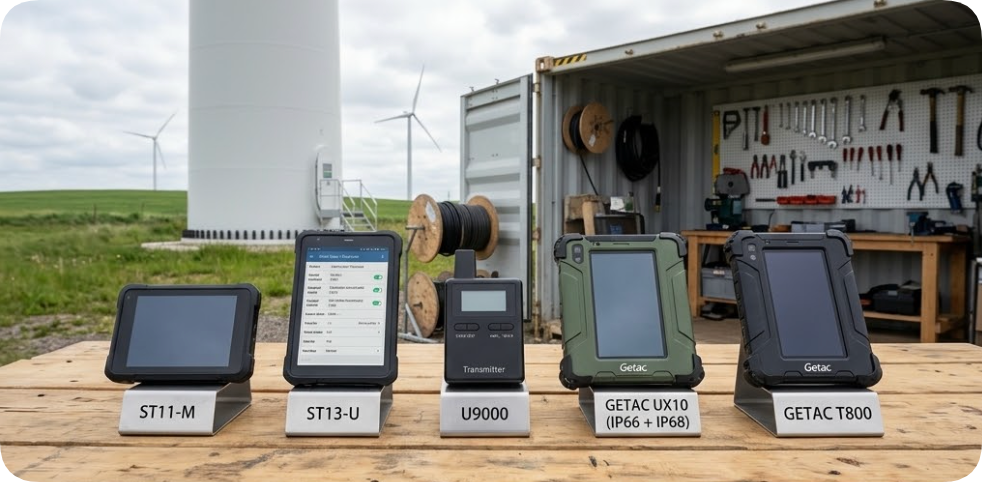
Ingress Is the Question That Cannot Be Deferred
IP65 means dust-tight and protected against water jets. IP66 adds protection against powerful water jets. IP68 means protection against continuous immersion in water to a manufacturer-stated depth and duration. Those are different promises, and on a tower in coastal wind they are not interchangeable: a jet from a pressure washer aimed at a nacelle door for two minutes is an IP66 problem, while a hatch left open in a squall with the device inside is an immersion problem that only an IP68 figure addresses.
The Getac UX10 is the only unit in this comparison with both an IP66 and an IP68 rating. That combination is the reason it exists in this comparison at all, because the three Hotus units top out at IP65 on two tablets and IP67 on the handheld. IP67 is a meaningful step up from IP65 — it covers temporary immersion — but it is not the same claim as IP68, and the difference is a depth and duration figure the vendor has to publish rather than a shape somebody drew on a spec sheet.
There is a practical way to read this without treating it as a knockout. An inspection device that lives in a vehicle, is carried to the tower base, and spends the climb in a backpack has a very different exposure profile from one that is mounted inside a nacelle or lashed to a ladder at height. The first is a device that will get rained on. The second is a device that has to survive being handled by gloved hands in a wet enclosure. Both are within IP65 or IP67 for most of a working day; neither is within IP65 for a winter walk-up on a coastal site.
The honest position is that the Hotus units here carry lower ingress ratings, and that an operator who intends to leave a device in an exposed nacelle during a storm season should be looking at an IP68 unit regardless of which brand it comes from. What the lower rating does not do is change the day-to-day calculation: rain on a screen during a two-hour climb does not require immersion protection, it requires a rating that stops water getting in through the bezel.
Hotus ST11-M: The Tower-Base Workstation
The Hotus ST11-M is the unit for the ground floor of the operation — the container at the tower base where the day's work orders are opened, results are written up and the device is charged overnight. Intel Core i5-8200Y dual core at 1.30GHz boosting to 3.90GHz with UHD Graphics 615, running Windows 10 Pro with Home, IoT, Windows 11 Pro and Ubuntu Kylin options, 8GB of RAM and 256GB of storage standard with a 16GB, 512GB or 1TB SSD option.
Its screen is 10.1-inch IPS at 1200 by 1920, quoted at 430 nits typical and 450 maximum, with an optional 1000-nit sunlight-readable panel. That option matters more on a wind farm than the headline figure suggests: a turbine base is usually in the open with no shade, and the crew screen that an engineer reads at the end of a climb is often a laptop on a folding table in direct sun. The standard panel is adequate for a container interior; the high-brightness panel is the one to specify if the device spends its life outdoors.
Protection is IP65 with MIL-STD-810G certification and 1.2-metre drop resistance, with an operating range of minus 20 to 55 degrees — the widest cold rating in this comparison, and the number that matters in a northern winter where a device left in a vehicle can drop well below zero overnight. The battery is a removable 7.6V 6000mAh pack at 45.6Wh, charging in about four hours and quoted at seven and a half hours of use with about four days of standby.
The interface list is what separates it from the two Getac units. HDMI, SIM, TF, earphone, DC, two USB 3.0 ports, RJ45 and RS232, plus a pogo connector on the bottom carrying USB 2.0, charging and RS232. Connecting an inverter or a weather station over RS232 and a site network over Ethernet from one device is the difference between one box and two, and on a wind farm where the nacelle controller and the met mast both feed the same record, that is a real reduction in equipment rather than a convenience.
The detachable magnetic keyboard is the feature that turns this into a workstation: at the tower base it is a laptop for writing a report, and in the nacelle it is a tablet. It weighs 1150 plus or minus 50 grams at 268.9 by 176.8 by 18mm, and it is the heaviest and thinnest of the three Hotus units at once, which is a consequence of the 10.1-inch panel rather than a design choice.
Two things it does not do. It has no IP66 or IP68 figure, so it is not the device for an exposed nacelle in a storm season. And at 6000mAh it is the smallest pack of the three Hotus units here, which on a full climb-and-descend day with a stop at a second turbine is the figure that limits it — a spare pack in the vehicle solves this, and the pack is removable, which is the part that matters.

Hotus ST13-U: The Longest Day
The Hotus ST13-U is the largest screen and the largest battery in this comparison, and those two facts are related to the same problem. Intel Core i5-1235U at ten cores and twelve threads reaching 4.4GHz at 15W, with an optional i7-1255U, on Windows 11 Pro, paired with 8GB or 16GB of RAM up to 64GB and M.2 SATA SSD storage from 128GB to 512GB.
Battery is where this unit separates. A removable 7.6V 8000mAh pack gives 60.8Wh, the largest capacity here, with a 6000mAh option for buyers who prefer the lighter spare. Storage runs from minus 40 to 60 degrees, and the operating range is minus 20 to 55 degrees with IP65 sealing and 1.2-metre drop resistance. For a technician doing three turbines in a day the 60.8Wh pack removes the midday charge from the schedule, which on a wind farm means removing a walk back to the vehicle.
The 13.3-inch IPS panel runs at 1920 by 1080 with 400 to 450 nits, ten-point touch supporting stylus and wet-hand operation. This is the only 1920 by 1080 panel in the comparison, and the reason to care is a nacelle interior: a SCADA trend view or a blade-survey overlay is being read at arm's length in a cramped space, and 1080 vertical pixels on a 13.3-inch diagonal is materially more readable than 1920 by 1200 on 10.1 inches.
Connectivity is the second differentiator. Wi-Fi 6 on the Intel AX201 with Bluetooth 5.2, global 4G LTE on the SLM770A module, and BeiDou, GPS and GLONASS positioning — a combination that matters when the site network is a point-to-point link back to the operations building and the tower base has no cellular coverage at all.
The honest limits are the brightness and the size. At 400 to 450 nits standard with no high-brightness option recorded, this is the dimmest panel in the comparison against the Getac UX10's 1000 nits, and unlike the ST11-M there is no published upgrade path to close that gap. And at 331.7 by 203.2 by 19.5mm weighing 1450 plus or minus 50 grams, it is not a device that goes up a ladder comfortably — it is a nacelle and base-cabin device that travels in a case.
Hotus U9000: The Reader That Counts Without Looking
The Hotus U9000 Handheld PDA is the only device here whose job is not to show a screen. A Cortex-A53 quad core at 2.0GHz on Android 9.0 with 2GB of RAM and 16GB of storage, expandable to 3GB and 32GB, driving a 5.0-inch 720 by 1280 IPS panel under Corning Gorilla Glass with glove and wet-hand touch support.
The scanning configuration is what a tower inspection actually runs on. A 1D linear engine is listed alongside Mindeo SE966 and Honeywell N4313 options; a 2D imager is available as Honeywell N5703, N6603 or 6602. The rear camera is 8 megapixel with autofocus, flash, anti-shake and macro. An optional UHF RFID reader operates at 840 to 960MHz over more than 1.5 metres, compliant with EPCglobal Class1 Gen2 and ISO 18000-6C, with NFC at 13.56MHz over 2 to 5 centimetres and low-frequency 125/134.2kHz also optional.
That RFID figure is the reason this device is in the comparison rather than a general-purpose handheld. A tower inspection is largely a counting exercise — every bolt, every fastener, every instrument on the asset list has to be confirmed present and correct — and a label reader that reaches 1.5 metres means a technician can confirm a fastener from a ladder rather than climbing down to read a tag. That is a productivity argument, not a specification argument, and it is the strongest one this device makes.
It also carries the highest ingress rating on the Hotus side: IP67, with CE, FCC, RoHS and ISO 9001. IP67 covers temporary immersion, which for a device that spends its life in a technician's pocket on an exposed tower is closer to the right claim than IP65. The battery is a removable 3.7V 4800mAh polymer pack with more than 350 hours of standby and more than twelve hours of working time, recharged in under four hours, at 178 by 78 by 24mm.
Wireless is unusually complete for a handheld: dual-band 2.4 and 5GHz Wi-Fi, 2G through 5G WWAN, and quad-satellite positioning across GPS, Galileo, GLONASS and BeiDou. Expansion covers two PSAM slots, a micro SIM, a TF card and a pogo pin, with Type-C USB and OTG as the wired interface.
What it cannot do is run Windows. Android 9.0 is old enough to matter — a great many enterprise field applications and any desktop-derived utility will not install on it — and the 720 by 1280 screen has no sunlight-readable option recorded. This is a data-capture terminal that syncs to a system, not a device a technician writes a long report on, and buying it for that second purpose is a mistake.
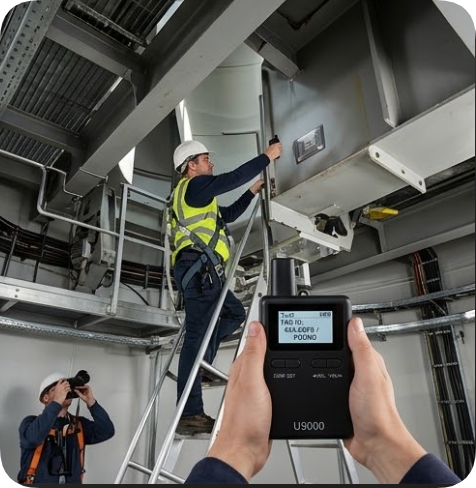
Getac UX10 and T800: Where the Bar Is Set
The Getac UX10 is quoted at a 10.1-inch WUXGA panel at 1920 by 1200 with 1000 nits under a LumiBond sunlight-readable construction offering multi-touch and a digitiser, on Intel Core Ultra 5 or 7 200V processors reaching 48 TOPS of AI compute, with 16GB or 32GB of LPDDR5X and 256GB up to 2TB of PCIe NVMe SSD storage on Windows 11 Pro. Sealing is IP66 with MIL-STD-810, at $2,000 to 3,000.
The AI compute figure is the part that has no counterpart here. None of the three Hotus units publishes an NPU TOPS number, and on a wind farm the applications that would use it are blade-surface inspection, thermal anomaly detection and camera-based gear-box monitoring. Whether that is a purchase justification depends entirely on whether the operator already runs such software — a vendor specifying a TOPS figure is describing a capability, not an outcome.
The 1000-nit panel and the IP66 rating are the two figures that change a specification conversation directly. Brightness removes the "specify the high-brightness option" caveat that applies to the ST11-M, and IP66 moves the ingress position a full step. Both are real advantages on an exposed site, and neither is offset by anything in the Hotus range at a comparable class.
The Getac T800 is the lower-cost route into the same family: an 8.1-inch 1280 by 800 panel at 600 nits, Intel Atom x7-Z8700 quad core at 1.6GHz boosting to 2.4GHz, 4GB LPDDR3 and 64GB of flash on Windows 10 Pro, IP65 with MIL-STD-810G and 1.2-metre drop resistance, with a 4200mAh standard battery and a 2100mAh expansion pack that is hot-swappable. At $1,200 to 1,800 it sits between the Hotus units and the UX10.
Hot-swapping is the capability worth naming, because none of the three Hotus units can do it. All three have removable batteries, which means swapping takes a few seconds of downtime per changeover; a hot-swap means swapping in under a second without powering down. On a device running a continuous logging application — vibration trending, blade-cycle counting — that difference decides whether a battery change is a break in the record or an invisible event.
Choosing by Where the Device Actually Is
The table below maps each unit to the position it fits rather than to a specification tier, because a wind farm operation has four distinct places where the work happens and they do not want the same hardware. The tower base, the outside climb, the nacelle interior and the nacelle exterior are four different exposure and reading environments, and the device that is correct in one is frequently wrong in another.
One practical note belongs with all five. On a tower, an engineer rarely uses a device at its maximum brightness, and rarely at its minimum either — the setting that works is established in the first ten minutes of the climb and then survives the whole day. Whatever the panel figure says, the useful measure is legibility at arm's length with the screen at an angle to direct sun, and that has to be tested on an actual tower rather than on a bench under office lighting.
🎯 Specification Summary and Selection Matrix
| Hotus ST11-M | Intel Core i5-8200Y dual core, 1.30GHz to 3.90GHz; Windows 10 Pro with Home/IoT/11 Pro/Ubuntu options | 10.1-inch IPS, 1200x1920, 430 typical / 450 max nits, optional 1000-nit panel | 7.6V 6000mAh removable, 45.6Wh, about 7.5h use, about four days standby | IP65, MIL-STD-810G, 1.2m drop, -20 to 55 degrees | 1150g, 268.9 x 176.8 x 18mm | RJ45 and RS232 on the same chassis; detachable magnetic keyboard; optional UM960 high-precision GPS |
| Hotus ST13-U | Intel Core i5-1235U, 10 cores to 4.4GHz, 15W; optional i7-1255U; Windows 11 Pro | 13.3-inch IPS, 1920x1080, 400-450 nits | 7.6V 8000mAh removable, 60.8Wh; optional 6000mAh | IP65, 1.2m drop, -20 to 55 degrees, storage -40 to 60 | 1450g, 331.7 x 203.2 x 19.5mm | Largest battery and only 1080p panel; Wi-Fi 6 on Intel AX201, Bluetooth 5.2; optional Honeywell N4680 scanner |
| Hotus U9000 | Cortex-A53 quad core 64-bit 2.0GHz; Android 9.0; 2GB+16GB up to 3GB+32GB | 5.0-inch IPS, 720x1280, Corning Gorilla Glass, glove and wet-hand touch | 3.7V 4800mAh removable, over 12h working, over 350h standby, under 4h charging | IP67; CE, FCC, RoHS, ISO 9001 | 178 x 78 x 24mm; weight not published | Optional UHF RFID 840-960MHz over 1.5m, EPCglobal Gen2; 2D imager options; 8MP rear camera with macro |
| Getac UX10 | Intel Core Ultra 5/7 200V, up to 48 TOPS AI; Windows 11 Pro | 10.1-inch WUXGA 1920x1200, 1000 nits LumiBond, multi-touch and digitiser | Not captured in the comparison source | IP66, MIL-STD-810 | Not captured in the comparison source | 16GB/32GB LPDDR5X, 256GB to 2TB PCIe NVMe; $2,000-3,000 |
| Getac T800 | Intel Atom x7-Z8700 quad core, 1.6GHz boosting to 2.4GHz; Windows 10 Pro; 4GB LPDDR3 + 64GB | 8.1-inch 1280x800, 600 nits sunlight-readable IPS | 4200mAh standard plus 2100mAh expansion, hot-swappable | IP65, MIL-STD-810G, 1.2m drop | Not captured in the comparison source | $1,200-1,800; the only unit here with hot-swap battery exchange |
| Tower base container: work orders, report writing, overnight charging | ST11-M | Detachable magnetic keyboard turns the tablet into a workstation, and RJ45 plus RS232 connect an inverter and a met mast to one device |
| Three-turbine day where a midday charge is not available | ST13-U | 60.8Wh is the largest pack here, storage tolerates -40 degrees, and 13.3 inches at 1080p reads a SCADA trend in a cramped nacelle |
| Counting bolts and instrument tags up a tower or inside a nacelle | U9000 | UHF RFID reaching past 1.5m confirms a fastener from a ladder; IP67 is the highest ingress on the Hotus side |
| Exposed nacelle work where ingress rating and screen brightness both have to be top tier | Getac UX10 | IP66 plus a 1000-nit panel; nothing in the Hotus range matches either figure at this class |
| Continuous logging where a battery change must not interrupt the record | Getac T800 | Hot-swappable expansion pack swaps in under a second; the three Hotus units need a power-down |
An operator whose devices spend their life in a container and a vehicle can run the ST11-M and the U9000 without accepting an ingress compromise, and the argument for reaching past this group is brightness, continuous logging or an exposed nacelle. An operator whose technicians read screens on open nacelle roofs in direct sun, or whose application already consumes edge AI compute, is in a different procurement conversation, and the Hotus figures in this comparison will not win it. Stating that plainly is more useful than a comparison that implies otherwise.
Utilities running the same inspection regime across both towers and substations can compare chassis sizes in the rugged tablet lineup, while teams counting assets and labels rather than reading screens sit in the industrial PDA and RFID handheld range. Every other device-versus-device breakdown in this catalogue is in the device comparison archive.