Operational Reality Check: An aircraft line maintenance shift does not conclude when the final bolt reaches specified torque. It concludes when official logs are signed, component traceability is verified, and the incoming crew can fully reconstruct every action performed on a specific airframe at a precise hour. Walking into any operational hangar during a heavy turnaround reveals distinct technical roles supported by specialized hardware: an engineer at a diagnostic bench cross-referencing fault messages against technical manuals, a release inspector executing airframe safety checklists, and a stores coordinator verifying component serial numbers.
Evaluating these requirements demonstrates why general-purpose consumer electronics fail on the ramp, necessitating purpose-built industrial tablets and handheld terminals as outlined in our Field Service Application Solutions.
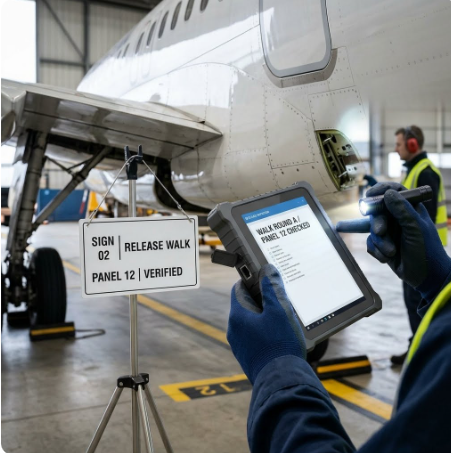 Hangar environment: deploying rugged terminals for live diagnostic work packages and digital maintenance sign-offs.
Why the Apron and Hangar Floor Break Consumer Electronics
Line maintenance environments present extreme physical hazards. Summer aprons create intense direct solar glare that renders glossy screens unreadable; active ramps expose equipment to jet blast, hydraulic fluids, aviation fuel vapors, and washdown water. Hangar floors test structural durability with dropped tools and heavy rolling stands. Standard office laptops fail rapidly under these conditions, making ingress ratings and robust housing essential baseline criteria for procurement teams.
However, selecting hardware involves balancing conflicting demands: sunlight-readable high-nit panels and fully sealed enclosures add weight and power draw, whereas ultra-light devices often sacrifice battery capacity and display estate. Analyzing maintenance operations by splitting them into distinct functional roles provides a practical framework for hardware selection.
The Maintenance Record as an Auditable Deliverable
Under strict continuing airworthiness regulations, maintenance actions remain legally incomplete until documented. Technicians replacing components must log part numbers, serial numbers, operational dates, and specific maintenance manual references to satisfy regulatory audits. Deferred defects, repetitive inspections, and airworthiness directive compliances demand absolute data integrity, making the point-of-work computing device an integral link in the compliance chain.
Consequently, hardware evaluation must prioritize factors beyond display brightness. Physical network ports (such as RJ45 Ethernet) ensure stable communication on secure hangar networks where Wi-Fi congestion or dropouts are unacceptable. Integrated biometric fingerprint sensors and Trusted Platform Module (TPM) chips provide strict user attribution for official maintenance sign-offs.
At the Bench: The 10-Inch Windows Enterprise Terminal
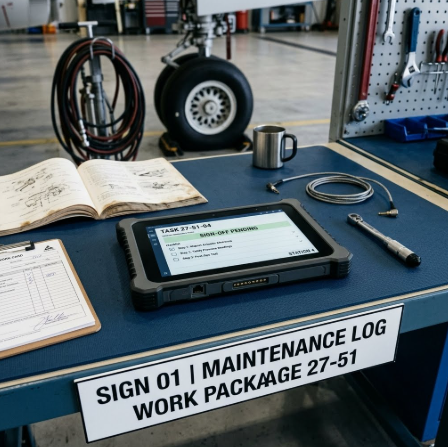
Diagnostic tasks performed at fixed maintenance benches or mobile carts—such as reviewing interactive troubleshooting manuals and authorizing work packages—require reliable processing power and stable wired connectivity. The HTNJ10B 10 Inch Enterprise Rugged Tablet is engineered for this role, operating full Windows 10 Pro or Windows 11 Pro on an Intel Pentium N6000 quad-core processor. This architecture ensures native compatibility with legacy MRO client software and digital signature middleware without requiring translation layers.
The 10.1-inch display delivers 1200 × 1920 resolution at 560 nits with 7H surface hardness and 10-point capacitive touch. Built to withstand harsh environments, the chassis features an IP67 waterproof rating, MIL-STD-810G certification, and a 1.22-meter drop resistance. Physical interfaces include a dedicated RJ45 Ethernet port, USB Type-A, USB Type-C, mini HDMI, Pogo pin connectors, and optional 1D/2D barcode scanners, NFC modules, and fingerprint readers.
Walking the Airframe: The 8-Inch Inspection Tablet
Airframe release inspectors require mobile computing solutions to examine access panels, fluid levels, fasteners, and mandatory placards during pre-flight walkarounds. The HTNJ08B 8 Inch Waterproof Rugged Tablet delivers identical N6000 processing performance, Windows Pro architecture, IP67 sealing, and MIL-STD-810G durability within a compact 8-inch form factor.
 Mobile inspection: reviewing digital compliance checklists directly against aircraft fuselage structures.
The 8-inch screen size provides an optimal balance: large enough to display inspection checklists without excessive scrolling, yet compact enough to hold securely against the airframe alongside flashlights and inspection tools.
Parts Traceability: UHF RFID Handheld Terminals in Stores
Component traceability requires verifiable part and serial numbers linking installed hardware to approved manufacturing sources. Manual bin-by-bin verification in busy parts stores is slow and prone to human error. The R530C Octa Core UHF RFID Barcode PDA features an embedded 40 × 40 mm ceramic UHF antenna supporting EPC Class 1 Gen 2 protocols, achieving read ranges up to 2 meters across FCC, ETSI, and SRRC frequency bands.
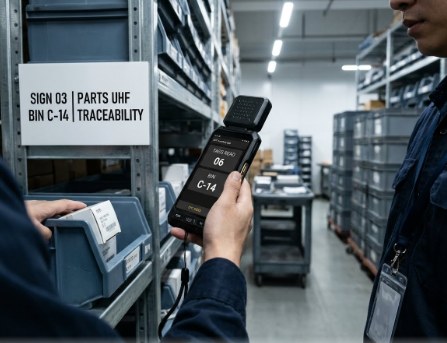 Inventory control: scanning multiple component bins simultaneously using integrated UHF RFID technology.
This capability allows logistics personnel to scan entire storage racks instantly without unsealing individual packaging containers. Operating on Android 11 with upgrade pathways to Android 13, it weighs under 500 grams while packing a 6000 mAh internal battery for full-shift inventory management. For harsh outdoor logistics applications, explore alternative options via the Field Maintenance Industrial Hardware Solutions Supplier portfolio.
Comparative Hardware Assessment
Evaluating alternative market offerings, such as Minno's Intrepid W10 Pro and the Conker NS65, highlights different engineering priorities. While Minno provides a 700-nit display tailored for bright outdoor flight deck and chart viewing, and Conker offers an ultra-compact Windows handheld with an integrated Honeywell 2D imager, procurement managers must align device features with strict MRO software requirements and network security protocols. Detailed cross-vendor analysis is available in the Hotus Product Comparisons & Technical Insights directory.
Master Technical Specification Matrix
| Specification Parameter | HTNJ10B (654) | HTNJ08B (650) | R530C (1165) | Minno W10 Pro | Conker NS65 |
|---|---|---|---|---|---|
| Operating System | Windows 10/11 Pro | Windows 10/11 Pro | Android 11 (Upg. to 13) | Windows 11 Pro / IoT | Windows 10/11 IoT |
| Display Specifications | 10.1", 1200×1920, 560 nits | 8", 1200×1920, 560 nits | 6", 1080×2160 | 10.1", 1200×1920, 700 nits | 6.5", 720×1600, 500 nits |
| Processor Architecture | Intel Pentium N6000 | Intel Pentium N6000 | Qualcomm SDM450 | Unpublished in brief | Intel N5100 2.8GHz |
| Ingress & Drop Rating | IP67, MIL-STD-810G, 1.22m | IP67, MIL-STD-810G, 1.22m | Unpublished on datasheet | MIL-STD-810H | IP67, MIL-STD-810H, 1.5m |
| Battery Architecture | 3500 mAh removable | 3500 mAh removable | 6000 mAh internal | Hot-swappable pack | 4000 mAh swappable (~6h) |
| Data Capture Modules | Opt. 2D, UHF, NFC, Fingerprint | Opt. 2D, UHF, NFC, Fingerprint | UHF to 2m, Opt. 2D, NFC, PSAM | Opt. 2D & Fingerprint | Honeywell N4680 2D, Opt. NFC |
| Device Weight | ~2.1 kg gross | ~1.8 kg gross | <500 g | Unpublished | 470 g |
| Standard Warranty | 3 Years | 3 Years | 3 Years | US Support Tier | 3-Year Relax Tier |
Frequently Asked Questions
1. Why is an RJ45 Ethernet port critical for hangar maintenance terminals?
A wired connection guarantees stable data synchronization with secure hangar MRO servers. Wireless networks on large hangar floors frequently experience interference and dropouts, making physical Ethernet docking essential when updating live, compliance-critical work packages.
2. How does UHF RFID technology improve aircraft parts store management?
UHF RFID enables bulk component reading from up to 2 meters away. Logistics personnel can scan multiple storage bins simultaneously without unsealing packaging, dramatically reducing inventory audit times and eliminating manual logging errors.
3. Are consumer-grade tablets suitable for line maintenance operations on the apron?
No. Consumer devices lack military-grade drop resistance, professional IP67 ingress sealing against hydraulic fluids and rain, and essential physical security ports like TPM 2.0 required for auditable maintenance sign-offs.
4. Why do maintenance engineers prefer full Windows operating systems over mobile OS platforms?
Full Windows environments ensure native compatibility with legacy MRO software and digital signature middleware. Technicians can run official interactive maintenance manuals and compliance clients without relying on unstable application translation layers.
5. What role do biometric sensors play in aircraft maintenance record chains?
Biometric fingerprint readers provide uncompromised user attribution for official log entries. Ensuring that every maintenance sign-off is directly tied to a certified technician satisfies strict aviation auditing and continuing airworthiness standards.