A meter reader's job is not to read a number. It is to produce a record that will still stand up six months later when a customer disputes a bill, and the number in that record is only one part of it. The reader also has to show which meter was read, that the meter has not been opened or re-sealed since, that the display belongs to that meter rather than the one on the next wall, and that the person who photographed it was standing in front of it. None of that is in a number field. All of it is in a photograph, which is why the camera specification on a handheld is a compliance specification and not a feature, and why the units in this comparison are judged first on what they can prove rather than on what they can compute.
Three Hotus units are compared here against two enterprise handhelds sold into utilities and field service. The K401 is the 4.2-inch handheld at under 300 grams with a 20-megapixel rear camera, IP67 sealing and a 5200mAh pack that changes without powering down. The RT81 is the 10.1-inch Windows-class tablet, also with a 20-megapixel autofocus rear camera, IP67 sealing, a 10000mAh battery and an optional independent BeiDou module with RTK. The HCAR5000 MI is the 2.4-kilogram desktop unit that holds the archive, runs the reports and receives the day's uploads. Facing them are the Honeywell CT45, whose documentation names public utilities among its applications and pairs it with IP67, MIL-STD-810H and a hot-swappable 5000mAh battery, and the Unitech EA660, a 6-inch FHD+ unit with Gorilla Glass Victus, IP65 together with IP68 and a 5000mAh hot-swappable battery.
Two boundaries should be drawn before any comparison is attempted. On the two competitors, the published record is a general enterprise specification rather than a meter-reading one, and neither publishes a camera resolution, a storage capacity figure or a stated operating temperature for this configuration — so this article will not attach figures to them that the record does not contain. And none of the three Hotus units carries a utility-specific certification; a utility that requires a named metering integration approval is having a different conversation, and one that requires it should ask for it in writing before purchasing.
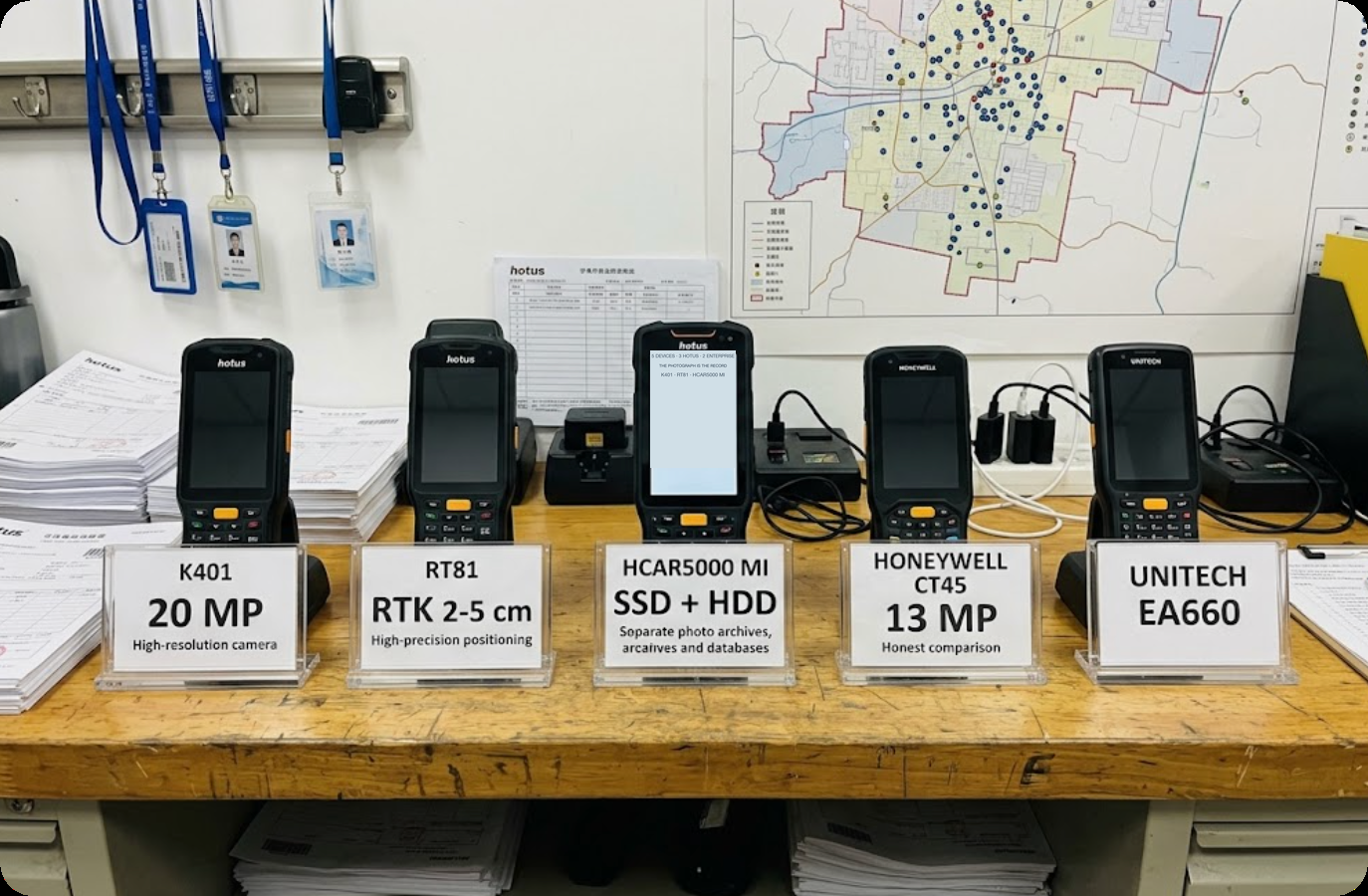
The Camera Is the Compliance Specification
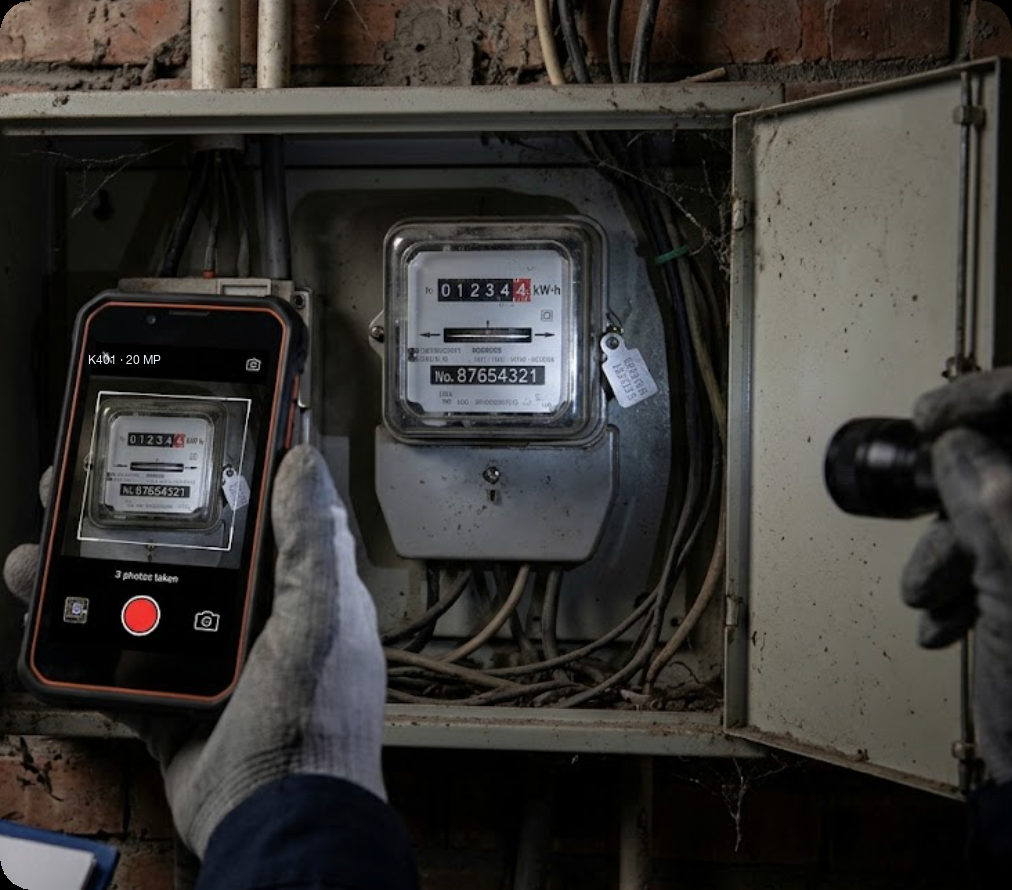
A meter photograph has to do a specific and demanding job. It has to contain the meter body and its serial or asset number, the register or counter, the seal, and enough of the surrounding installation to establish where the meter is. That means the camera has to resolve small engraved or printed characters at an angle, in bad light, often with the reader crouched in a dark pit or standing under a stair with a torch in the other hand. It also means the image has to be timestamped and associated with the meter identity automatically, because an unattributed photograph is worth very little when a bill is challenged.
The HOTUS K401 is built around that job. The rear camera is 20 megapixels with autofocus and the front is 5 megapixels, which is the highest resolution in this comparison on the device most likely to be pointed at a meter. The processor is an MT6769 octa-core 64-bit at 2.0GHz on Android 13 with 6GB of RAM and 64GB of storage, expandable through microSD to 256GB in many configurations, and the documentation is explicit that the storage is intended to hold offline data caching — which is the other half of the job, because a reader who loses signal in a plant room still has to file the record when they get out.
Storage on the K401 is specified at 64GB with microSD expansion, and its connectivity is dual-band Wi-Fi across the full IEEE 802.11ac stack including fast roaming, Bluetooth 5.0 with BLE, 4G LTE with 3G and 2G fallback and GPS. That is a full enterprise radio set, and the honest observation is that a reader working a residential round uses very little of it, while a reader working a substation or an industrial park uses all of it.
Where the K401 earns its place in this specific comparison is weight and handling. The published figure is under 300 grams, with a 4.2-inch IPS panel at 720 by 1280 and capacitive multi-touch set for finger operation, glove use and stylus input. A reader carrying a device up a stairwell or across a yard for a full round notices that figure every single day, and it is the reason the K401 is a handheld rather than a tablet strapped to the forearm.
Two details on this unit deserve a buyer's attention rather than a spec sheet's. The 5200mAh battery is removable and the documentation states that swapping a depleted pack does not power the terminal down, because a small internal reserve keeps the system alive for two to three minutes during the exchange — that is a hot-swap claim in substance even though it is not called one. And the 3.5mm audio jack is omitted by design to improve sealing, with audio routed through a speaker rated above 95dB, a noise-cancelling microphone and a receiver tuned for calls in noisy surroundings. For a reader standing beside a transformer hum or in a pump room that is the right trade, and it is also a decision a buyer needs to know about before the first complaint arrives from an operator who wanted to plug in earphones.
Ingress protection on the K401 is IP67 — dust-tight and immersed to one metre for thirty minutes — with drop testing to MIL-STD-810G methodology at 1.5 metres onto concrete, and the touch panel is Corning Gorilla Glass. No operating temperature range is published, which for a utility that reads meters on an exposed facade in December is the figure to ask for in writing.
The Tablet Case: When the Work Is More Than One Number
A meter reading is a small job, and a tablet is not the right answer to it. What a tablet answers is the job that surrounds it: a valve inspection with twenty assets on one site, an outage where a technician needs the schematic and the asset history at the same moment as the photograph, or a remote support call where the tablet is looking at the same asset the office is asking about. That work is real and it is not the reading itself, which is why the right comparison is between a tablet and a handheld rather than a tablet and a handheld alone.
The Hotus RT81 carries a Qualcomm SM6115 octa-core at 2.0GHz on Android 16, which is the current platform among the three Hotus units here and a differentiator when applications have to be kept current. Memory is 4GB and 64GB with an 8GB and 128GB option, expandable through microSD to 256GB. The display is a 10.1-inch IPS at 1200 by 1920 and 400 nits with G+G ten-point capacitive touch, which is double the K401's area and the difference between reading a number off a screen and reading a table off a screen.
Its protection is IP67 with 1.2-metre drop resistance, operating from minus 10 to 50 degrees with storage from minus 40 to 70 and 5 to 95 percent humidity — and this is the only one of the three Hotus units in this comparison with a published temperature range at all, which makes it the one to specify where the work moves between a heated building and an outdoor yard in the same shift.
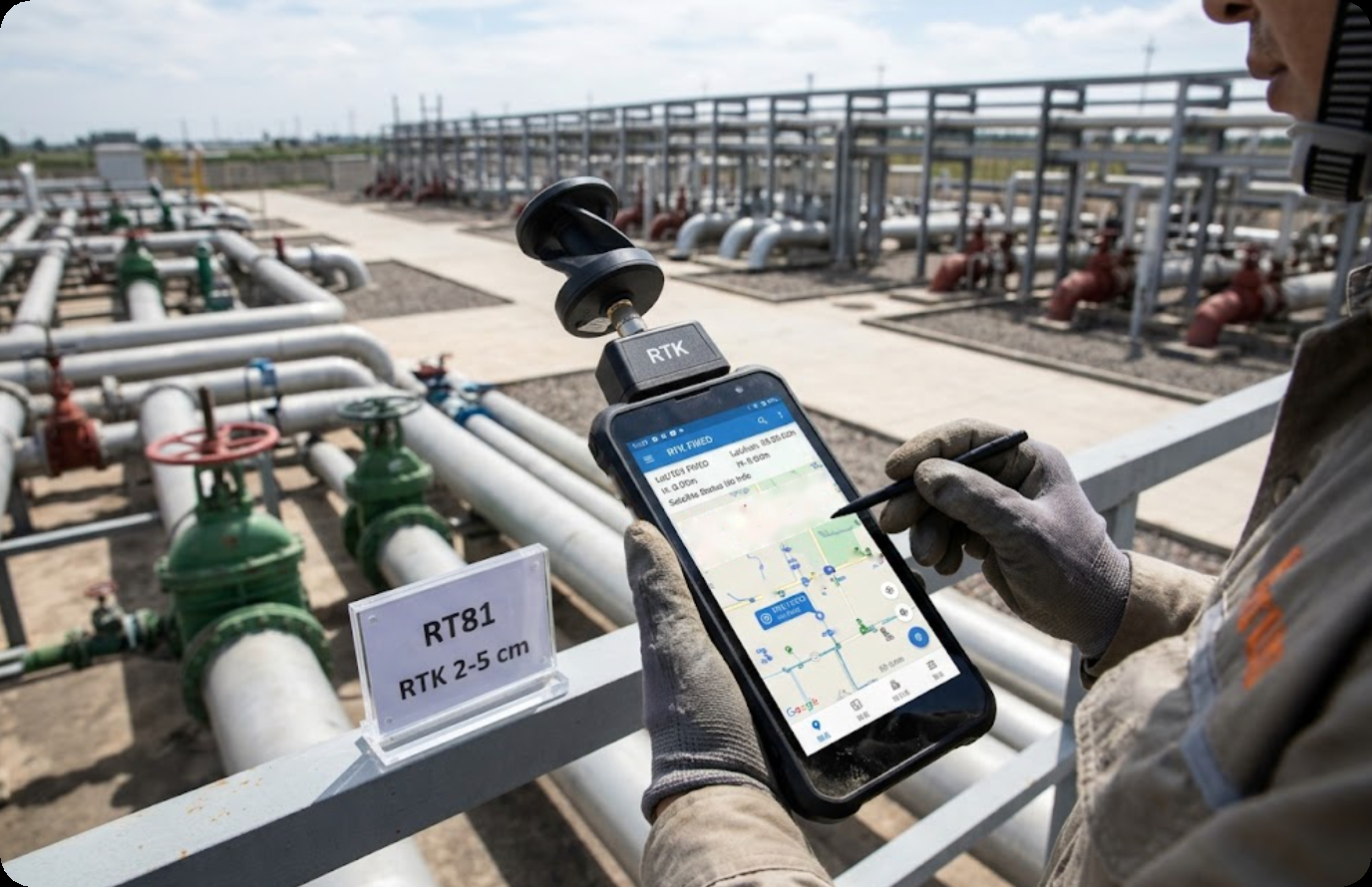
The camera matches the K401 rather than beating it: a 20-megapixel autofocus rear with LED flash and an 8-megapixel front, with dual 2-watt stereo speakers and dual microphones with noise reduction. Battery is 3.8V 10000mAh with Power Delivery fast charging, and the specification table records it as removable while the summary table on the same page describes it as non-removable — a contradiction in the source material that a buyer should resolve with the vendor rather than assume. Connectivity is 4G LTE with separate CN and EAU regional variants, dual-band Wi-Fi 6 ready, Bluetooth 5.0, GPS, GLONASS and Galileo, plus an independent BeiDou module with RTK quoted at 2 to 5 centimetres horizontally without relying on an external base station in many regions, receiving corrections over 4G.
That positioning module is the feature that turns a tablet into an asset-management device rather than a reading device. A meter reading only needs to know where the meter is; a utility that is building a record of its own assets — which valve, which pole, which cabinet, which surface-mounted box — needs to know where the worker stood when the photograph was taken. The RT81's documentation names utilities among the applications for the RTK option explicitly, and the 12-pin pogo docking port, dual nano-SIM, optional 2D engine at three-mil precision, optional NFC reading at two to three centimetres and an optional capacitive fingerprint sensor make it the closest thing in this comparison to a mobile asset station.
The weight is 252 by 170 by 14.6 millimetres at under 650 grams, and it is a ten-point touch device that the documentation describes as working with industrial gloves. That is the whole trade in one line: the RT81 can do the work a handheld cannot, and it is heavier and larger, so a round of two hundred readings is not the job it is best at.
The Office End: What the Record Becomes
The photograph and the reading arrive somewhere, and that somewhere has to hold several years of them and answer a question about one of them quickly. This is the least glamorous part of a meter reading operation and it is the part that determines whether an argument can be settled in ten minutes or escalated for a month.
The HCAR5000 MI is the unit for that end of the workflow. It carries AMD Ryzen 5000H series processors — the Ryzen 9 5900HX, Ryzen 7 5800H and Ryzen 5 5600H — with Radeon graphics, and the memory is dual-channel DDR4 at 3200MHz expandable to 64GB. Storage is the part that matters for an archive: M.2 2280 SSDs from 128GB to 1TB combined with 2.5-inch 7200rpm hard disks at 500GB or 1TB, so a photographic archive and a transactional database can sit on different media, which on spinning disks is not a preference but a design decision.
Output is multi-display via DisplayPort 2.0b and a full-function Type-C carrying video, so the archive view, the billing view and the exception queue can run side by side. I/O is an RJ45 Gigabit Ethernet port, three USB 3.0, two USB 2.0, the DisplayPort output, the Type-C, a 3.5mm audio jack and dual 3.5mm microphone and audio combo jacks — five USB ports in total, which is what makes it usable as the hub that a dock, a label printer and a set of readers charge and sync from. Operating systems are Windows 10 and 11 with Linux soft-route support.
The chassis measures 202 by 212 by 65 millimetres at 2455 grams, and it carries CE, FCC and RoHS with ISO 9001 — with no IP rating, no operating temperature range and no cooling configuration published. That is the correct boundary to state: this machine belongs on a desk in an office or a vehicle-mounted cabinet, not in a pit, and the honest way to describe it is that it is the warm side of the same job the other two devices are built for.
Honeywell CT45 and Unitech EA660: Where the Certification Is
The Honeywell CT45 is listed in the enterprise handheld tier with a 5-inch HD panel at 1280 by 720 under Gorilla Glass with glove and wet-hand touch, a Qualcomm QCM6490 octa-core at 2.7GHz, 6GB or 8GB of RAM with 128GB storage plus microSD, and Android 13 upgradable to 16. Protection is IP67 with MIL-STD-810H and 1.5-metre drop resistance, the battery is a 5000mAh pack that is hot-swappable, the engine is FlexRange with standard and long-range options, and the camera is quoted at 13 megapixels. The listed applications include retail, logistics, medical, field service and public utilities, at $700 to 1,000.
Three things about that record matter for this comparison. It names public utilities, which makes it a product sold into this work rather than adapted to it. It carries enterprise certifications, which is what a regulated utility's procurement process tends to ask about first. And its 13-megapixel camera is below the 20 megapixels on both Hotus handhelds here — a real difference for the photograph that has to resolve a serial number in bad light, and the clearest single specification gap in this comparison.
The Unitech EA660 is the 6-inch class: FHD+ at 2160 by 1080 on Gorilla Glass Victus at 630 nits, the same Snapdragon 4490 octa-core at 2.4GHz, 6GB or 8GB with 128GB UFS, Android 15 with GMS and AER certification, IP65 together with IP68, 1.5-metre drop rising to 1.8 metres with a bumper, a 5000mAh hot-swappable battery and an SE4710 2D engine, at $450 to 650. Its listed applications include retail, hotel, logistics, medical and manufacturing.
The EA660's advantage in this comparison is its screen. A 6-inch FHD+ panel at 630 nits is materially better for reading a meter register under a dark canopy or in a bright meter room than the 4.2-inch 720 by 1280 panel on the K401, and 630 nits is above every Hotus display in this comparison — the RT81's 10.1-inch panel is quoted at 400. For a photo-verification workflow where the operator is checking a capture before submitting it, that is not a minor specification.
Read against each other, the two competitors are stronger than the Hotus group in three places: ingress certification depth, with the EA660 carrying IP68 and the CT45 carrying an explicit MIL-STD-810H rating alongside IP67; operating system currency with GMS and AER certification on both; and screen quality on the EA660. They are weaker in two: camera resolution, at 13 megapixels against 20, and weight-class options, because the published figures for the CT45 are not in the record available here. Neither publishes a temperature range for this configuration, which is the same gap as the Hotus side.
Choosing by What the Record Has to Prove
The table below maps each unit to the part of the record it is responsible for rather than to a specification tier, because a meter reading operation has three separate deliverables and they are argued over separately. The photograph that identifies the meter, the data that survives the trip back to the office, and the archive that answers a dispute six months later are three different problems, and buying one device for all three is how an operation ends up with a fleet that is good at one of them.
One practical note belongs with all five devices. A photograph of a meter is taken once, in thirty seconds, in whatever light there is, by an operator who is cold or in a confined space — and it is the only piece of evidence that survives if the reading is disputed. Whatever the processor is for, the setting that decides whether the record holds up is the one established in that thirty seconds, which means the lens, the autofocus and the screen used to check the frame matter more than any figure on a datasheet.
🎯 Specification Summary and Selection Matrix
| Hotus K401 | MT6769 octa-core 64-bit 2.0GHz; Android 13; 6GB+64GB, microSD to 256GB | 4.2-inch IPS, 720x1280, capacitive multi-touch set for finger, glove and stylus | 20MP rear; 5MP front | 5200mAh removable; system held alive 2-3 minutes during a swap; Type-C 2.0 with OTG | IP67 (1m for 30 minutes); MIL-STD-810G 1.5m drops; Gorilla Glass; no operating temperature published | Under 300g; professional 1D/2D engine; NFC; dual-band Wi-Fi 802.11ac with roaming, BT 5.0 BLE, 4G LTE with fallback, GPS; speaker above 95dB with noise-cancelling microphone; 3.5mm jack omitted by design for sealing |
| Hotus RT81 | Qualcomm SM6115 octa-core 2.0GHz; Android 16; 4GB+64GB or 8GB+128GB, microSD to 256GB | 10.1-inch IPS FHD 1200x1920 at 400 nits, G+G ten-point touch working with industrial gloves | 20MP rear autofocus with flash; 8MP front | 3.8V 10000mAh removable per the specification table, PD fast charging | IP67; 1.2m drop; operating minus 10 to 50 degrees, storage minus 40 to 70, humidity 5-95% non-condensing | Under 650g, 252 x 170 x 14.6mm; 4G LTE with CN and EAU variants, dual-band Wi-Fi 6 ready, BT 5.0, GPS/GLONASS/Galileo plus optional independent BeiDou with RTK at 2-5cm; 12-pin pogo, dual nano-SIM, dual 2W speakers, dual MIC noise reduction; optional 2D at 3mil, optional NFC, optional FAP20 fingerprint |
| Hotus HCAR5000 MI | AMD Ryzen 9 5900HX / 7 5800H / 5 5600H with Radeon graphics; Windows 10/11 or Linux soft route | Multi-display via DP 2.0b and full-function Type-C with video | Not applicable | Not applicable | CE, FCC, RoHS, ISO 9001; no IP rating, no temperature range, no cooling configuration published | 202 x 212 x 65mm at 2455g; DDR4 3200 to 64GB; M.2 2280 SSD 128GB-1TB plus 2.5-inch 7200rpm HDD 500GB/1TB; RJ45, 3x USB 3.0, 2x USB 2.0, audio jack and dual combo jacks |
| Honeywell CT45 | Qualcomm QCM6490 octa-core 2.7GHz; Android 13 upgradable to 16; 6GB/8GB + 128GB + microSD | 5-inch HD 1280x720 Gorilla Glass with glove and wet-hand touch | 13MP rear | 5000mAh hot-swappable | IP67, MIL-STD-810H, 1.5m drop | FlexRange scanning engine, standard and long-range; applications listed include retail, logistics, medical, field service and public utilities; $700-1,000 |
| Unitech EA660 | Qualcomm Snapdragon 4490 octa-core 2.4GHz; Android 15 with GMS and AER; 6GB/8GB + 128GB UFS | 6-inch FHD+ 2160x1080 at 630 nits, Gorilla Glass Victus, glove and wet-hand and stylus touch | Not published in the comparison source | 5000mAh hot-swappable | IP65 and IP68, 1.5m drop rising to 1.8m with a bumper | SE4710 2D engine; applications listed include retail, hotel, logistics, medical and manufacturing; $450-650 |
| A residential or commercial round where the reader carries the device all day | K401 | Under 300 grams, a 20-megapixel rear camera for the identifying photograph, IP67, and a battery that swaps without powering the terminal down |
| Asset and outage work where the record needs to know where the worker stood, and where the work moves between indoors and outdoors | RT81 | Optional independent BeiDou with RTK at 2-5cm, the only published temperature range among the three Hotus units, Android 16, and a 10.1-inch screen for tables and schematics |
| The office or vehicle cabinet that stores the archive and answers a disputed bill | HCAR5000 MI | DDR4 to 64GB with SSD and HDD on separate media for archive and database, dual display output, five USB ports for docks and printers, and dual 4K video |
| A utility whose procurement requires enterprise certification and a named public-utilities deployment | Honeywell CT45 | Public utilities is a listed application, with IP67, MIL-STD-810H, hot-swappable battery and FlexRange scanning |
| A utility that wants a brighter, larger screen for checking a captured photograph before submitting it | Unitech EA660 | 6-inch FHD+ at 630 nits on Gorilla Glass Victus with IP65 and IP68, hot-swappable battery and Android 15 with GMS and AER |
A utility running ordinary meter reading should look at the K401, because under 300 grams and a 20-megapixel camera are the two figures that decide whether a hundred readings a day produce evidence that holds up. A utility that also runs asset and outage work should take the RT81, because the RTK option and the published temperature range turn a reading device into something that can be trusted to say where it stood. The archive question is settled by the HCAR5000 MI on the warm side of the same desk. The Honeywell CT45 and the Unitech EA660 are the two units to approach on certification depth and screen quality — and a buyer should be honest that both are ahead on ingress rating and operating-system currency, while both sit below the Hotus group on the one figure this particular job turns on.
Utilities running the same device fleet across metering, asset inspection and vehicle-based network termination can compare chassis sizes in the industrial PDA and RFID handheld range, while a control room or vehicle cabinet running the reporting and archive end should look at the related mini PC range. Every other device-versus-device breakdown in this catalogue sits in the device comparison archive.