Container Gate Hardware Selection: Matching UHF Readers, Printing PDAs, and Windows Tablets to SOLAS VGM Handover Points
What a Container Gate Must Reconcile Before the Barrier Opens
A drayage truck pulls onto the apron carrying a booking reference, a container ID, a high-security seal code, and a declared cargo weight entered by separate parties hours earlier. Gate clerks must validate every field while the diesel engine idles and a queue builds behind the loop detector. Sending an inspector out to the chassis to transcribe eleven characters by hand destroys lane throughput, so optical capture handles the initial pass while a secondary radio or barcode check links that digital string to physical hardware. Our Access Control & Ticket Validation Application Solutions guide examines how this exact multi-factor verification logic governs high-volume entry checkpoints.
Gross mass verification introduces an additional layer of operational friction. Driving a coupled rig across a weighbridge produces a gross combination weight that includes the tractor, fuel load, chassis, and occasionally a second twenty-foot box on a tandem trailer. International Maritime Organization (IMO) guidelines mandate deducting those tare weights individually and strictly prohibit dividing a combined twin-container scale reading in half. While the Terminal Operating System (TOS) executes that subtraction, the resulting weight ticket must reach the driver's cab before the rig clears the lane—and ahead of the ocean carrier's VGM cut-off, which routinely closes hours earlier than the physical yard receiving deadline.
Because optical capture, radio tag reading, receipt printing, and exception resolution occur at distinct physical positions along the lane, treating gate hardware as a single all-in-one purchase leads to daily workflow bottlenecks. Each device earns its place only when it completes its assigned handover without forcing an operator to walk back across active truck lanes.
Three Gate Handover Points, Three Purpose-Matched Devices
Gate operations break down into three physical zones:
- The Apron Safety Line: Inspectors verify door markings, e-seals, and chassis transponders from a safe stand-off distance beside the trailer.
- The Weighbridge & Driver Window: Scale readings convert into printed VGM slips and interchange receipts handed directly to the driver for signature.
- The Gate Control Booth: Clerks manage TOS exception queues, carrier booking holds, and appointment windows across full multi-hour shifts.
Comparing five published hardware datasheets clarifies how specialized architectures divide these duties. The R366C-S delivers long-range UHF RFID capture in a pistol-grip form factor, the R860-S integrates a 57 mm thermal printer directly into an RFID handheld, and the ST9-J provides an x86 Windows tablet built for continuous booth desktop sessions. By contrast, the SEUIC AUTOID 20 targets lightweight close-range optical imaging, while the SDK Embedded Systems SD-RT10RS serves as a heavy vehicle-mounted tactical console. Matching specifications to the exact zone prevents costly misdeployments—such as buying high-nit booth displays for shaded offices while deploying short-range scanners along wide truck lanes.
Why the ISO 6346 Check Digit Only Catches Transcription Errors
Under ISO 6346, every intermodal container carries an eleven-character identifier comprising a three-letter owner prefix, one equipment category letter (U for freight containers, J for detachable equipment, or Z for trailers and chassis), a six-digit serial number, and a final check digit. Alphabetical characters convert to numerical equivalents starting at A = 10 while omitting multiples of eleven (11, 22, and 33). Each of the first ten values is multiplied by an ascending power of two ($2^0$ through $2^9$, from 1 to 512), summed, and divided by 11; the remainder supplies the eleventh character (with a remainder of 10 represented as 0).
For example, the standard specimen container number CSQU3054383 yields a weighted sum of 6185 across its first ten characters. Dividing 6185 by 11 leaves a remainder of 3—matching the final printed digit. Altering any single letter or numeral shifts that remainder, enabling automated OCR engines and terminal software to flag mistyped serials before they corrupt a manifest, aligning with Bureau International des Containers (BIC) data-integrity standards.
However, arithmetic validation has strict operational limits at a busy terminal gate. A valid check digit does not confirm that the owner code holds an active BIC registration, nor does it prove that the container sitting on the chassis matches the equipment listed on the bill of lading. A valid container ID copied from the wrong booking document still passes modulus-11 verification, and containers remarked under a new owner prefix require a newly calculated check digit. Software arithmetic validates a text string; physical seal reads and certified weight tickets validate the actual cargo box.
Reading E-Seals and Chassis Tags Safely at the Truck Line
Long-range UHF RFID eliminates the safety hazard of inspectors climbing onto wet chassis frames or walking between idling trailers to scan door plates. Built around an Impinj E710 UHF engine paired with a 4 dBi antenna, the R366C-S Impinj E710 UHF RFID Industrial Reader captures tags from 10 to 20 meters away at speeds exceeding 900 tags per second, with an optional 2D barcode imager capable of resolving 3-mil codes. Housed in an ergonomic pistol-grip chassis weighing under 700 g, it runs on a 2.4 GHz SM6225 octa-core processor with 4 GB RAM, 64 GB storage, a 5.5-inch 720 × 1440 touch screen, and a removable 10,000 mAh PD fast-charging battery built for continuous yard sweeps.
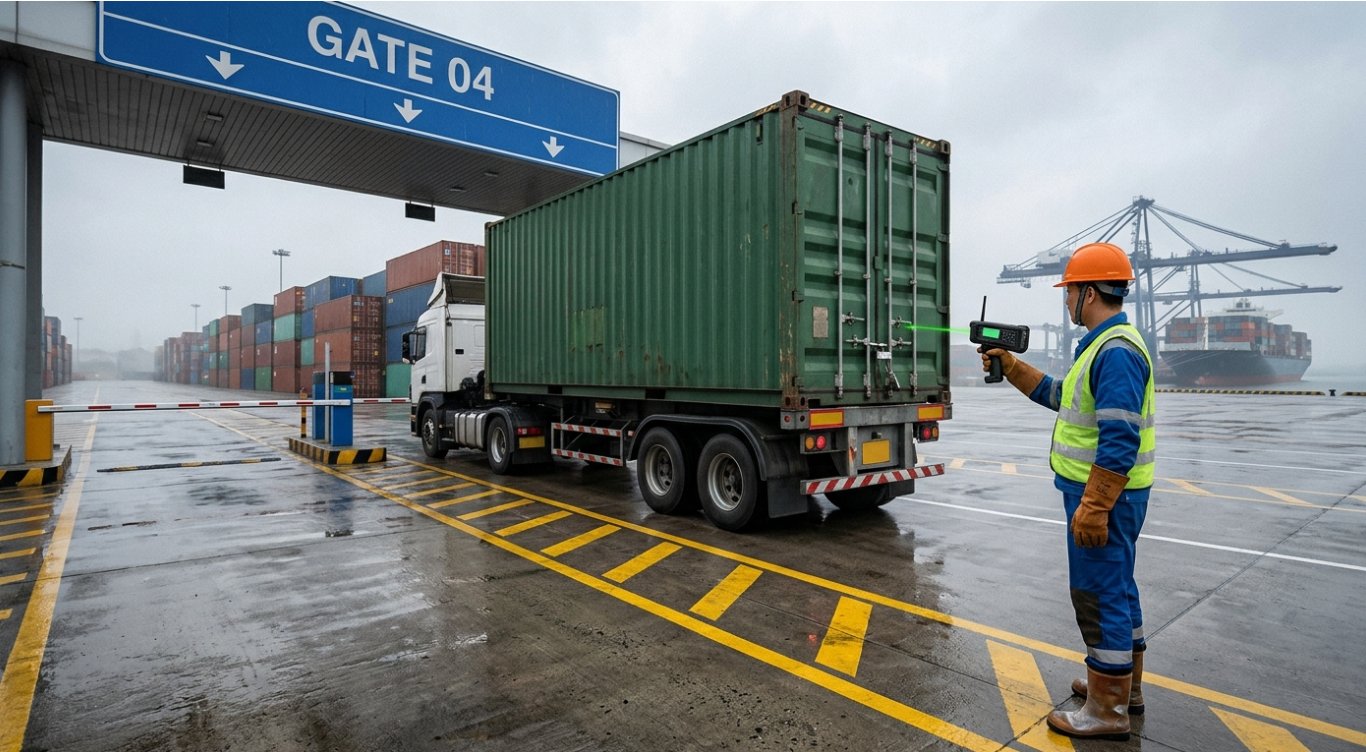
That 10-to-20-meter stand-off read range is unmatched among the five devices compared here, allowing gate staff to sweep chassis transponders and electronic container seals in a single trigger pull as trucks slow for the barrier. Terminal planners should also note two practical deployment details from the datasheet: the R366C-S operates from -10°C to 50°C without a published IP ingress rating—meaning lanes subjected to high-pressure washdowns require protective holsters or sheltered positions—and while its 10,000 mAh battery is removable, swapping cells requires a brief device reboot rather than live hot-swap continuity.
Issuing Certified VGM Weight Slips at the Driver Window
At the weighbridge or driver window, digital scale data must become a physical interchange document immediately. The R860-S Industrial PDA with Thermal Printer integrates a 57 mm thermal receipt and adhesive label printer (70 mm/s print speed, 30 mm roll capacity) directly above a 40 × 40 mm ceramic UHF antenna (up to 2 m range) and an optional 2D imager. Powered by a 2.0 GHz SM6115 octa-core processor with 4 GB RAM, 64 GB storage, and a 5.5-inch 720 × 1440 display, its removable 5,600 mAh battery delivers over 350 hours of standby time and recharges in 3 to 4 hours with built-in over-temperature and over-voltage safeguards.
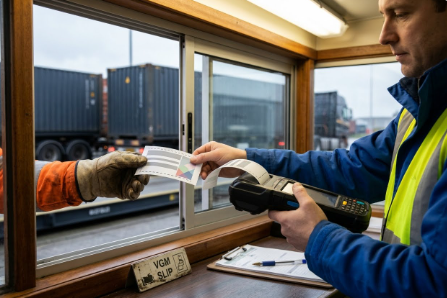
SOLAS authorizes two VGM calculation methods: Method 1 weighs the packed, sealed container on a calibrated scale, whereas Method 2 sums individual cargo items, dunnage, securing materials, and the door-stenciled container tare (applicable only to uniform packaged freight). Enforcement tolerances vary by national maritime administration—for instance, the UK Maritime and Coastguard Agency enforces a ±5% or 500 kg threshold, whichever is greater. While the scale hardware and TOS calculate net VGM against carrier cut-offs, equipping window clerks with the R860-S eliminates trips to a stationary office printer by printing the VGM receipt and capturing the driver's sign-off in a single stop. Like the R366C-S, its datasheet omits an IP rating, so outdoor lanes exposed to driving rain should use sheltered booths or protective sleeves.
Managing Exception Queues Inside the Gate Control Booth
Resolving booking discrepancies, customs holds, and missed appointment slots remains an x86 Windows workstation task across most port terminals. Built around a quad-core Intel Celeron N5100 processor (1.10 GHz base, 2.80 GHz burst) running Windows 10 Pro (with Windows 11 Pro available), the 8 Inch Windows Industrial Tablet ST9-J Manufacturer unit gives booth clerks full desktop TOS compatibility in a 700 g mobile chassis. Its 8-inch 1200 × 1920 IPS screen ships at 400 nits standard—with a 1,000-nit sunlight-readable panel available for sun-facing glass booths—and includes a removable 7.7V 5,000 mAh battery providing roughly 7 hours of active runtime.
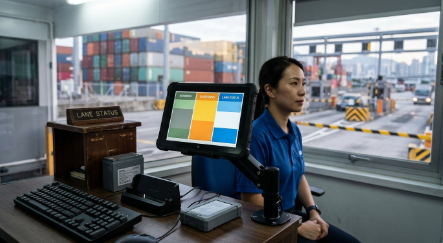
Certified to IP65 and MIL-STD-810G with 1.2-meter drop survivability and a -20°C to 55°C operating envelope, the ST9-J integrates Wi-Fi 5, Bluetooth 4.2, global 4G LTE, and multi-constellation GNSS (BDS, GPS, GLONASS, plus optional UM960 high-precision positioning). By comparison, the rival SDK SD-RT10RS steps up to a sixth-generation Intel Core i7-6600U, up to 16 GB DDR3, an AES-256 encrypted 2 TB SSD, a standard 1,000-nit 10.4-inch (1024 × 768) display, and a 37-pin military circular connector. While the SDK panel excels as a permanently bolted vehicle or tactical console, the lighter, docked ST9-J fits gate booth clerks who need native Windows client software and rapid battery swaps without military-vehicle cabling overhead.
Specification Breakdown Across Five Industrial Terminals
The table below compares verified datasheet parameters across all five devices, recording capture engines, default display configurations, computing platforms, and declared environmental tolerances without mixing incompatible weight or pricing metrics:
| Device Model | Published Data Capture & Output | Display Panel | Compute Platform | Declared Environmental & Build Specs |
|---|---|---|---|---|
| R366C-S | Impinj E710 UHF (10–20 m w/ 4 dBi, ≥900 tags/s); optional 2D imager (3 mil) | 5.5" IPS, 720 × 1440 | SM6225 octa-core 2.4 GHz, 4 GB + 64 GB | -10°C to 50°C, <700 g, 10,000 mAh removable battery; no IP rating listed |
| R860-S | 57 mm thermal printer (70 mm/s); ceramic UHF up to 2 m; optional 2D imager (3 mil) | 5.5" IPS, 720 × 1440 | SM6115 octa-core 2.0 GHz, 4 GB + 64 GB | -10°C to 50°C, >350 h standby, 5,600 mAh removable battery; no IP rating listed |
| ST9-J | No built-in barcode/RFID or print engine listed | 8" IPS, 1200 × 1920, 400 nits (1,000 nits optional) | Intel Celeron N5100, Windows 10 Pro (Win 11 Pro optional) | IP65, MIL-STD-810G, 1.2 m drop, -20°C to 55°C, 700 g |
| SEUIC AUTOID 20 | AI 1D/2D imaging scan engine, 16 MP rear camera, NFC | 6" FHD+, 2160 × 1080, 600 nits | QCM6490 octa-core 2.7 GHz, Android 14 GMS, up to 12 GB + 256 GB | IP65 & IP68, MIL-STD-810H, 285 g, SafeSwap battery, 5G & Wi-Fi 6E |
| SDK SD-RT10RS | No integrated scan engine; 37-pin circular connector, 2 × USB 2.0 | 10.4" LCD, 1024 × 768, 1,000 nits sunlight readable | Intel Core i7-6600U 2.6 GHz, up to 16 GB DDR3, up to 2 TB AES-256 SSD | MIL-STD-810G, two-piece aluminum chassis, optional GPS & rubber bumpers |
Viewing these specifications side by side underscores why an Logistics & Warehouse Industrial Hardware Solutions Supplier treats gate automation as a sequential workflow—pairing long-range radio reads, on-the-spot thermal printing, and persistent Windows booth clients rather than forcing one handheld to perform every role.
Capability Gaps and Operational Trade-Offs to Plan Around
An accurate procurement audit requires acknowledging where competing terminals hold clear advantages and what none of these five devices can execute independently:
- Ingress Sealing & Washdown Exposure: Neither the R366C-S nor the R860-S publishes an IP rating, whereas the ST9-J carries IP65 and the SEUIC AUTOID 20 achieves both IP65 and IP68. Open lanes exposed to heavy rain or pressure washing require protective pouches or covered booths for the two Android handhelds.
- Standard Daylight Brightness: The ST9-J ships at 400 nits standard with 1,000 nits offered as an optional build, while the SDK SD-RT10RS provides 1,000 nits out of the box and the SEUIC unit offers 600 nits. Sun-facing booths must specify the 1,000-nit ST9-J configuration explicitly on the purchase order.
- Weight & Hot-Swap Continuity: At 285 g with SafeSwap live battery replacement, Android 14 GMS, and Wi-Fi 6E, the SEUIC AUTOID 20 weighs less than half as much as the R366C-S or ST9-J—a major ergonomic benefit for clerks walking lanes solely to scan close-range barcodes.
- Software-Level Compliance Logic: None of these five devices calculates ISO 6346 modulus-11 check digits, verifies BIC owner registrations, subtracts tractor tares, or enforces carrier VGM cut-off timestamps natively. Those rules reside entirely inside the Terminal Operating System; the hardware captures the tag, prints the ticket, and hosts the user interface.
Pre-Launch Gate Verification Blueprint
Before opening a newly equipped gate lane, operations managers should walk the truck path and verify each handover checkpoint against the table below:
| Handover Point | Records Reconciled | Assigned Hardware | Boundary Limitation (Requires TOS/SOP) |
|---|---|---|---|
| Apron Safety Line | OCR container ID, chassis RFID tag, e-seal serial | R366C-S UHF RFID Reader | Cannot confirm BIC owner registry or bill-of-lading match |
| Weighbridge & Driver Window | Net VGM figure, container number, driver signature | R860-S Thermal Printing PDA | Cannot verify scale calibration or tractor/chassis tare deduction |
| Gate Control Booth | Carrier booking slot, exception queue, VGM cut-off clock | ST9-J Windows Industrial Tablet | Cannot physically confirm the trailer outside matches the screen record |
Frequently Asked Questions (FAQ)
1. Does a valid ISO 6346 eleventh check digit prove that a container matches its shipping booking?
No. The ISO 6346 check digit only verifies mathematical consistency across the preceding ten characters to catch OCR or typing errors; terminals must still cross-check the container ID against the electronic seal, weighbridge ticket, and carrier booking manifest.
2. Which handheld reader is built for long-range container seal and chassis tag scanning at the gate lane?
The R366C-S UHF RFID industrial reader is built specifically for stand-off gate capture, delivering a 10-to-20-meter read range with its Impinj E710 engine and 4 dBi antenna at speeds of at least 900 tags per second.
3. How does the R860-S speed up SOLAS VGM weight slip handovers at the weighbridge window?
The R860-S combines a 57 mm thermal printer (70 mm/s) with RFID and optional 2D barcode scanning in a single handheld, enabling gate clerks to print weight slips and obtain driver signatures right at the truck window without walking back to an office printer.
4. Why should gate booths deploy an x86 Windows tablet like the ST9-J instead of an Android PDA?
Gate booths run desktop Terminal Operating System (TOS) clients, multi-tab exception queues, and carrier booking portals that require native x86 Windows architecture, which the Intel N5100-powered ST9-J supports alongside IP65 durability and an optional 1,000-nit screen.
The video below demonstrates industrial UHF RFID reading, mobile thermal receipt printing, and rugged tablet workflows in logistics yard operations.