🛡️ Where Three Hotus Rugged Windows Units Fit a Utility Workday
A utility crew's day is a chain of small proofs: a pole photographed before the climb, a transformer label scanned at the base, a switching order confirmed from the truck, and a GIS record updated before the next stop. The hardware that survives this routine is not the fastest tablet on the market; it is the one that boots the utility's own software, reads a screen at noon, and shrugs off a drop onto gravel. Hotus builds three rugged Windows tablets that cover those jobs at three working positions: the HTXUK10A-55 for long patrol days, the HTNJ10B for substation benches, and the HTNJ08C for one-hand climbing work. You can explore our rugged tablet lineup to see how they sit beside the rest of the range.
💡 Why Distribution Crews Refuse to Give Up Windows on the Pole
Most grid operators did not choose Windows casually. Their GIS clients, SCADA viewers, outage-management consoles, and asset-inspection forms were written for desktop Windows, often in .NET, and many of them still have no Android build at all. A field tablet that runs Windows 10 or 11 Pro installs those programs directly, joins the utility's domain, and inherits the same group policies as the office fleet, so a crew device is auditable the day it arrives. All three Hotus units ship with Windows 10 Pro or Windows 11 Pro and an optional TPM 2.0 module, which is what lets IT treat a pole-top tablet like any other managed endpoint. The 10-point capacitive touch layers also accept stylus input and wet-hand operation, because rain and linemen's gloves are not optional conditions.
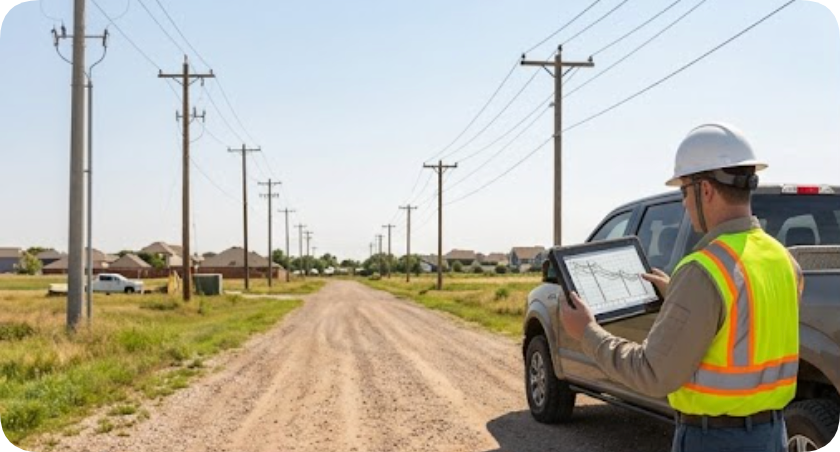
HTXUK10A-55: The Long-Day Patrol and Survey Unit
The HTXUK10A-55 is the unit you hand to the inspector who spends the shift away from the truck. It pairs a 10.1-inch IPS touchscreen at 1200 by 1920 with 550 nits of brightness, so a feeder map stays legible against an open sky, and an Intel industrial quad-core processor with Intel UHD graphics drives the GIS client without stutter. The standard 8 GB of RAM and 256 GB of storage extend over M.2 when a district loads its own map caches. Its 7.6-volt 6000 mAh removable battery holds 45.6 watt-hours and charges quickly, which is the difference between one battery lasting a patrol and the crew swapping packs at lunch. The chassis is rated IP65 with MIL-STD-810G certification and a 1.2-meter drop rating, and it tolerates minus twenty to fifty-five degrees Celsius. Positioning comes from BDS, GPS, and GLONASS, weight is about 1150 grams, and an optional 1D/2D scanner, UHF RFID, fingerprint reader, or 13.56 MHz NFC reader turns it into an asset-capture terminal.
HTNJ10B: The Substation Bench Unit with Wired Diagnostics
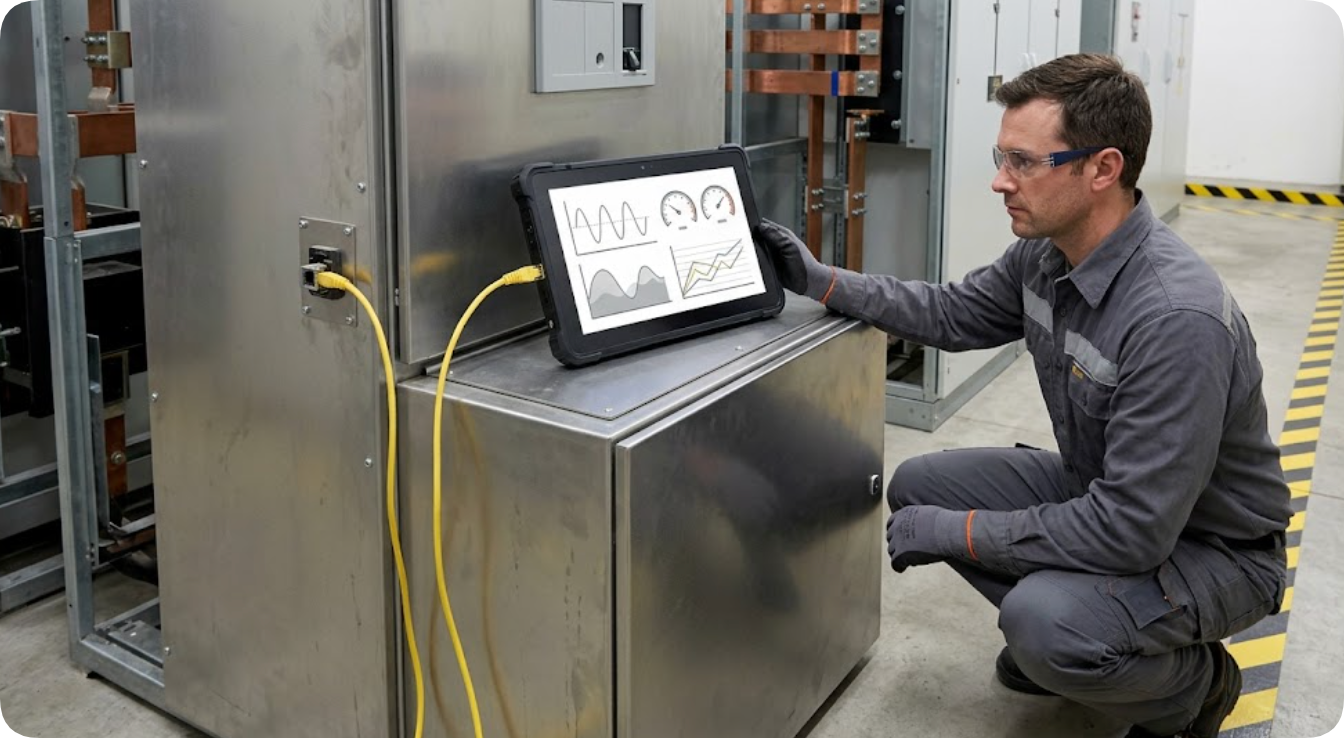
The HTNJ10B covers the other half of the day, where the work happens at a bench, a cabinet, or a relay panel and the network has to be physical. Its Intel Pentium N6000 quad-core processor bursts to 3.3 GHz, and the port row is what makes it a service tool rather than a display: USB Type-A, USB Type-C, Mini HDMI, RJ45 Ethernet, a TF slot, a SIM slot, a 12-pin pogo connector, and a DC input. A technician can plug straight into a substation switch, pull logs at line rate, and drive a test bench over Ethernet without a bag of adapters. The 10.1-inch panel runs at 1200 by 1920 with 560 nits and a 7H hardness cover glass, the 3500 mAh battery is removable, and the body carries IP67 with MIL-STD-810G, a 1.22-meter drop rating, and the same minus twenty to fifty-five degree window. The same optional scanner, RFID, fingerprint, and NFC modules apply, and Windows 10 or 11 Pro keeps the utility's diagnostic suite native.
📱 HTNJ08C: The Compact Climb-and-Close Bucket Unit
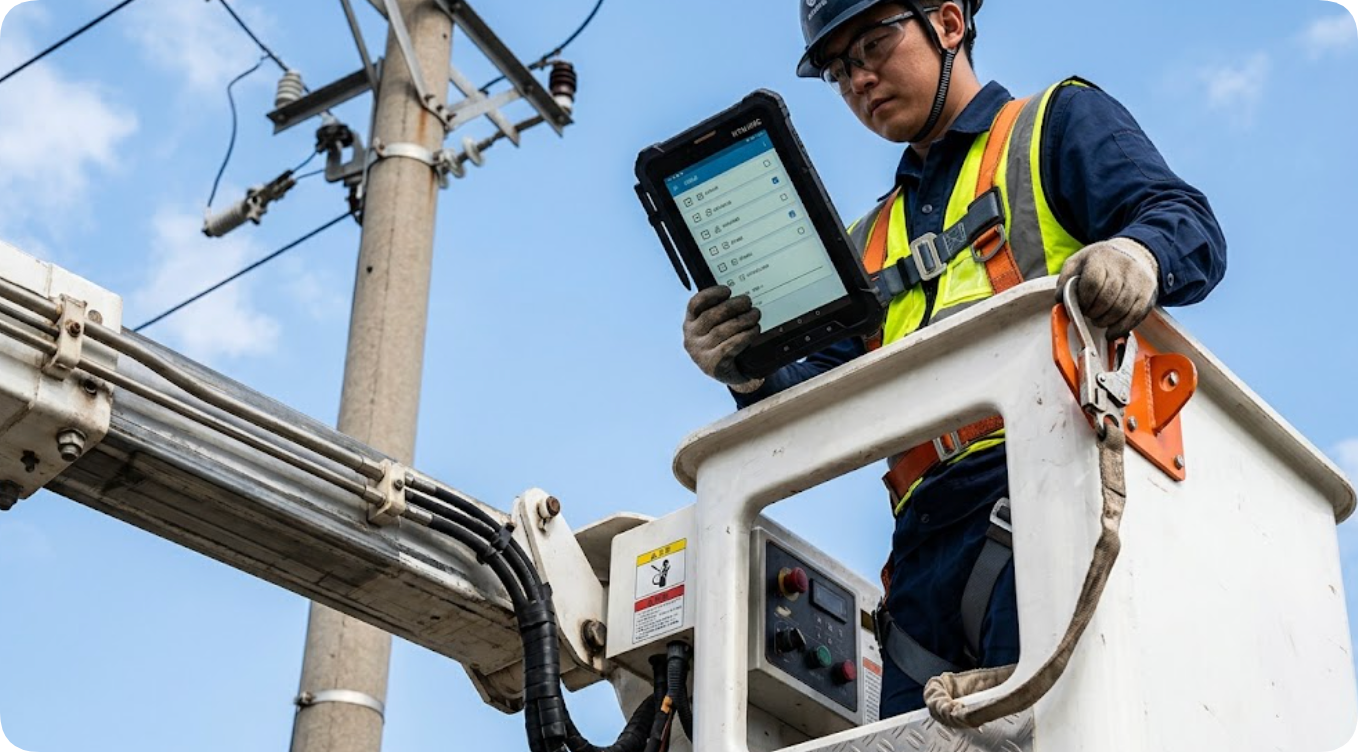
The HTNJ08C is the tablet for the hand that is holding something else. At eight inches and about 1.8 kilograms it fits through a bucket-truck harness and stays readable in one hand, yet it keeps the full 1200 by 1920 resolution at 560 nits so a switching order is legible mid-climb. The Intel N100 quad-core processor bursts to 3.4 GHz and, unlike the HTNJ10B, it pairs Wi-Fi 6 with Bluetooth 5.0, which matters when a crew rides newer truck routers. The port row repeats the HTNJ10B's layout, including RJ45 and the 12-pin pogo, the 3500 mAh battery is removable, and the IP67, MIL-STD-810G, 1.22-meter drop, and minus twenty to fifty-five degree ratings match its sibling. For crews whose only Windows work is a form and a photo, this is the unit that disappears into a bag until needed.
🏆 Xplore XSlate B10: Battle-Tested Hardware at Project Pricing
The Xplore XSlate B10 is the veteran in this comparison, and it earns the respect. Its 10.1-inch IPS panel runs at 1366 by 768 with 500 nits, an Intel Core i5-5350U drives 8 GB of DDR3L memory, and 128 to 256 GB of SSD storage carries the fleet image. The chassis is rated IP65 with MIL-STD-810G and a five-foot drop, a Wacom active pen suits as-built sketches, and an optional external battery stretches runtime toward twenty hours, which utilities have relied on for long outage assessments. The honest trade is age and cost: the platform centers on a processor generation that has long left production, the panel resolution is the lowest in this group, and pricing starts around 2,799 dollars per unit, which turns a ten-truck depot into a capital project rather than a line item.
Wortmann TERRA PAD 1090 INDUSTRY: A Brighter Panel on an Aging Core
Germany's Wortmann AG brings the TERRA PAD 1090 INDUSTRY, and its headline number is real: the 10.1-inch panel runs 1920 by 1200 at 1000 nits, nearly twice the brightness of either Hotus 10-inch unit, which is a genuine advantage in open-pit or desert service. It also keeps features that Windows service teams still ask for, including a hot-swap battery, a modular barcode scanner, and a port row with USB 3.0, RJ45, RS-232 serial, and Micro-HDMI. The compromises sit behind the glass: the processor is a fourth-generation Intel Core i5, paired with 4 GB of RAM and a 128 GB SSD, which is a thin margin for a modern GIS client plus a browser plus a VPN client. European pricing around 2,300 to 2,739 euros reflects its industrial positioning, and IP65 with MIL-STD-810G matches the durability class rather than leading it.
| Item | Hotus HTXUK10A-55 | Hotus HTNJ10B | Hotus HTNJ08C | Xplore XSlate B10 | Wortmann TERRA PAD 1090 |
|---|---|---|---|---|---|
| Screen | 10.1" 1200x1920, 550 nits | 10.1" 1200x1920, 560 nits | 8" 1200x1920, 560 nits | 10.1" 1366x768, 500 nits | 10.1" 1920x1200, 1000 nits |
| Processor | Intel industrial quad-core | Intel Pentium N6000, 3.3 GHz | Intel N100, 3.4 GHz | Intel Core i5-5350U | Intel Core i5 (4th gen) |
| Memory | 8 GB + 256 GB, M.2 ext. | RAM + SSD, M.2 ext. | RAM + SSD, M.2 ext. | 8 GB DDR3L + 128-256 GB | 4 GB + 128 GB |
| Battery | 6000 mAh removable, 45.6 Wh | 3500 mAh removable | 3500 mAh removable | Optional ext. battery, ~20 h | Hot-swap battery |
| Protection | IP65, 810G, 1.2 m | IP67, 810G, 1.22 m | IP67, 810G, 1.22 m | IP65, 810G, 1.5 m | IP65, 810G |
| Operating temp | -20 to 55 deg C | -20 to 55 deg C | -20 to 55 deg C | Not published | Not published |
| Standout ports | USB, dual-band Wi-Fi, 4G | RJ45, pogo, Mini HDMI | RJ45, pogo, Wi-Fi 6 | USB, dock | RJ45, RS-232 |
| Positioning | BDS / GPS / GLONASS | GNSS via 4G model | GNSS via 4G model | GPS | GPS |
| Weight | ~1150 g | ~2.1 kg gross | ~1.8 kg gross | Heavy-class | Heavy-class |
| Price | On request | On request | On request | From ~$2,799 | ~EUR 2,300-2,739 |
Where the Hotus Trio Genuinely Trails the Incumbents
Credibility requires the other column too. The Xplore XSlate B10 carries a five-foot drop rating against 1.2 and 1.22 meters for the Hotus units, and its optional external battery still outlasts a single 6000 mAh pack on a sixteen-hour storm response. The Wortmann panel at 1000 nits outshines the 550 and 560 nit Hotus screens in direct alpine or desert sun, and its RS-232 port connects relay test sets that no current Hotus tablet addresses without a USB adapter. Wortmann also proves hot-swap power in this class. What the incumbents do not bring is a current Intel platform with Windows 11 Pro headroom, published operating ranges down to minus twenty degrees, and optional TPM 2.0 at Hotus's fleet-deployment pricing, which is available on request.
🏟️ Match the Device to the Route, Then Talk to Hotus
The selection logic is route-first, not spec-first. Patrol and survey routes that live outdoors all day belong to the HTXUK10A-55, whose large battery and triple-constellation positioning remove the two failures that end a patrol early. Bench and cabinet work belongs to the HTNJ10B, where the RJ45 port and pogo rail turn a tablet into a service terminal. Bucket and climb work belongs to the HTNJ08C, which keeps full resolution in a one-hand frame. Depots that also run digital signage, control-room dashboards, or back-office kiosks can standardize the same Windows image across a related mini PC lineup, so one IT team maintains one software stack. Hotus pricing is quoted by configuration and volume on request, and recent deployment notes sit in the comparison archive for buyers who want the full decision record.