Parking enforcement lives or dies by what an officer can do standing at a windshield in the rain: read a plate, check a permit, issue a citation, and move on. The handheld is the whole workstation. This comparison puts three Hotus industrial PDAs next to two established rugged handhelds to show where each one fits a curb-side shift.
Hotus brings a 6-inch map device, a pocket keypad, and a printer-built unit. Casio and Winmate answer with certified, drop-tested handsets. None of them is universal, so the right pick follows the task in front of the officer rather than the brand on the box.
A parking shift is a string of thirty-second stops. An officer chalks a tire, walks the plate, checks the meter or the permit app, and either moves on or writes a notice. When the list runs to a few hundred spaces, the device in hand decides whether the day ends on time or in a backlog of handwritten slips.
The work scales by setting. A municipal meter patrol covers a downtown grid; a university force walks a campus of permit lots; an airport authority checks employee and short-stay bays by the thousand. The device requirements barely change across those jobs, but the volume does, and that is precisely why battery life and a built-in printer matter more than a marginally brighter panel.
Where the Hotus R530C, R350C and R860-S Meet Parking Enforcement
The three Hotus units do not fight each other so much as cover different moments of a single citation. The R530C is the screen you read a map and a plate photo on. The R350C is the keypad you tap without looking. The R860-S is the one that prints the slip before you walk away. Each section below treats one role, then the two competitors show what a certified alternative looks like.
🖥️ The 6-Inch Screen Built for Plate and Map Work
The R530C PDA puts a 6.0-inch FHD plus screen, 1080 x 2160, in front of the officer, the biggest of the trio and the one to use when a plate crop or a permit record needs room to breathe in sunlight. Inside, a Qualcomm SDM450 octa-core chip runs Android 11 and can move to Android 13, backed by 2 GB of RAM and 16 GB of storage with a 4 GB and 64 GB option. A 6000 mAh battery covers a long shift, and dual-band Wi-Fi, 4G LTE, and four-constellation GNSS hold the link on any street. The chassis also accepts an optional 2D scanner, NFC, and a UHF RFID reader that pulls tags from two meters, so a parking sticker or a permit chip lands in one scan.
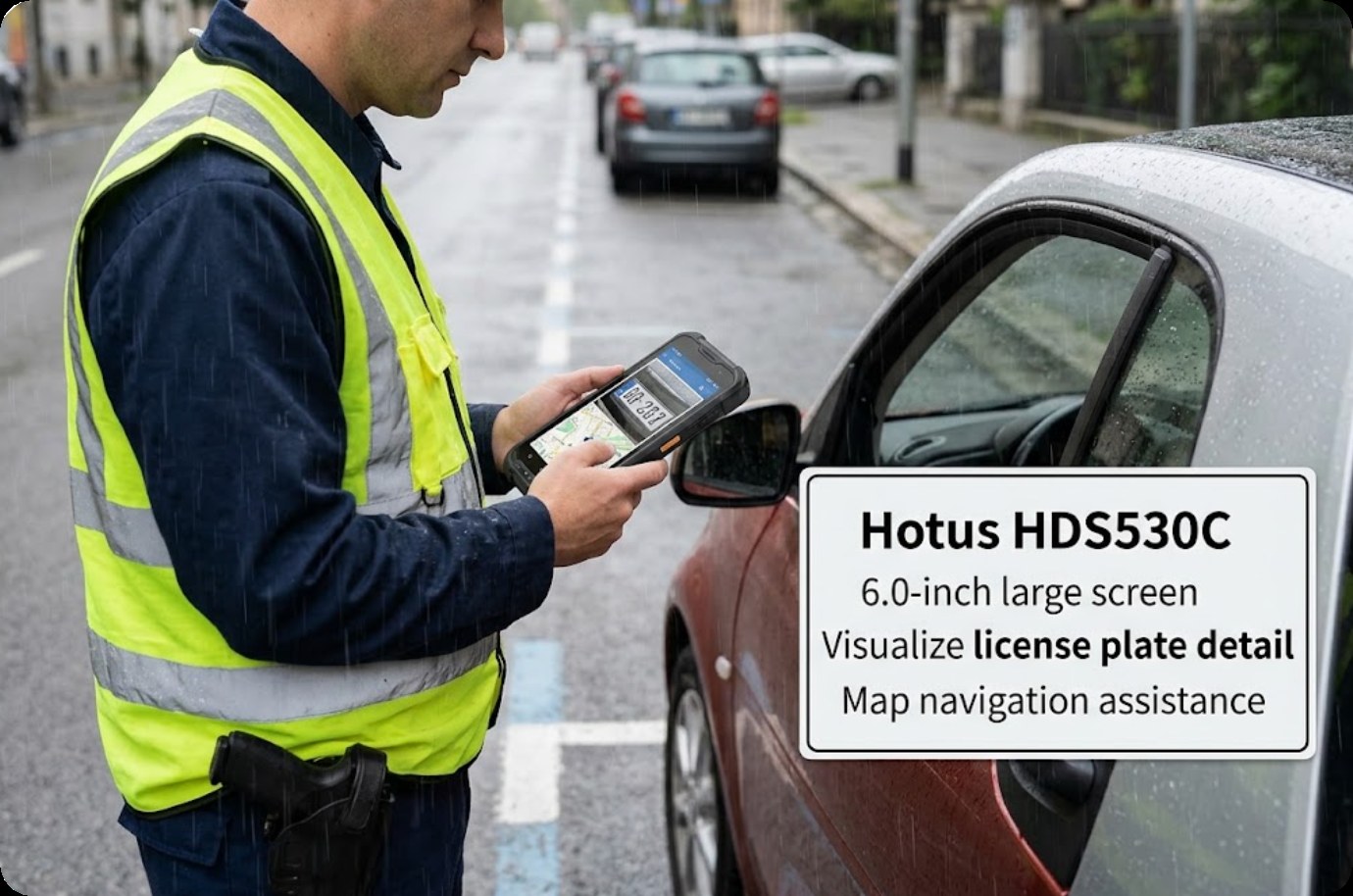
For a closer look at the model, see the R530C PDA product page.
The Pocket Keypad for Gloved, Eyes-Up Entry
The R350C PDA is the pocket model at under 300 grams with a 4.0-inch HD panel, and its advantage is the physical keyboard: a full 0-to-9 layout with delete, back, enter, function, star, and hash, plus two side scan keys. A gloved officer types a plate or a ticket code without touching the on-screen layer. A Qualcomm QCM2290 runs Android 13 with 4 GB of RAM and 64 GB of storage, and the camera, scanner, and NFC choices match the other two. It is also the only Hotus unit of the three to publish hard figures: dust-and-water resistance rated IP67, survival from a 1.5 m fall, and a Gorilla Glass screen.
For specifications, open the R350C PDA product page.
The Unit That Prints the Ticket on the Spot
The R860-S PDA is the odd one out in the best way: it builds a 70 mm per second thermal printer into the body, so a citation or a temporary permit prints where the stop happens instead of back at the office. The printer defines the body, wrapping a Qualcomm SM6115 octa-core engine on Android 16 with 4 GB of memory and 64 GB of space, a 5.5-inch HD plus view, and a 5600 mAh pack you can pull out and still trust for over 350 standby hours. It keeps the same optional 2D scanner, NFC, and UHF RFID reader as its siblings, and it adds four PSAM slots for secure card work at the curb. Where the other two end a stop with a digital record, this one ends it with paper in hand.
Every port, the PSAM bays, and the printer path are laid out on the R860-S PDA product page.
Casio IT-G660: A Mid-Range Specialist
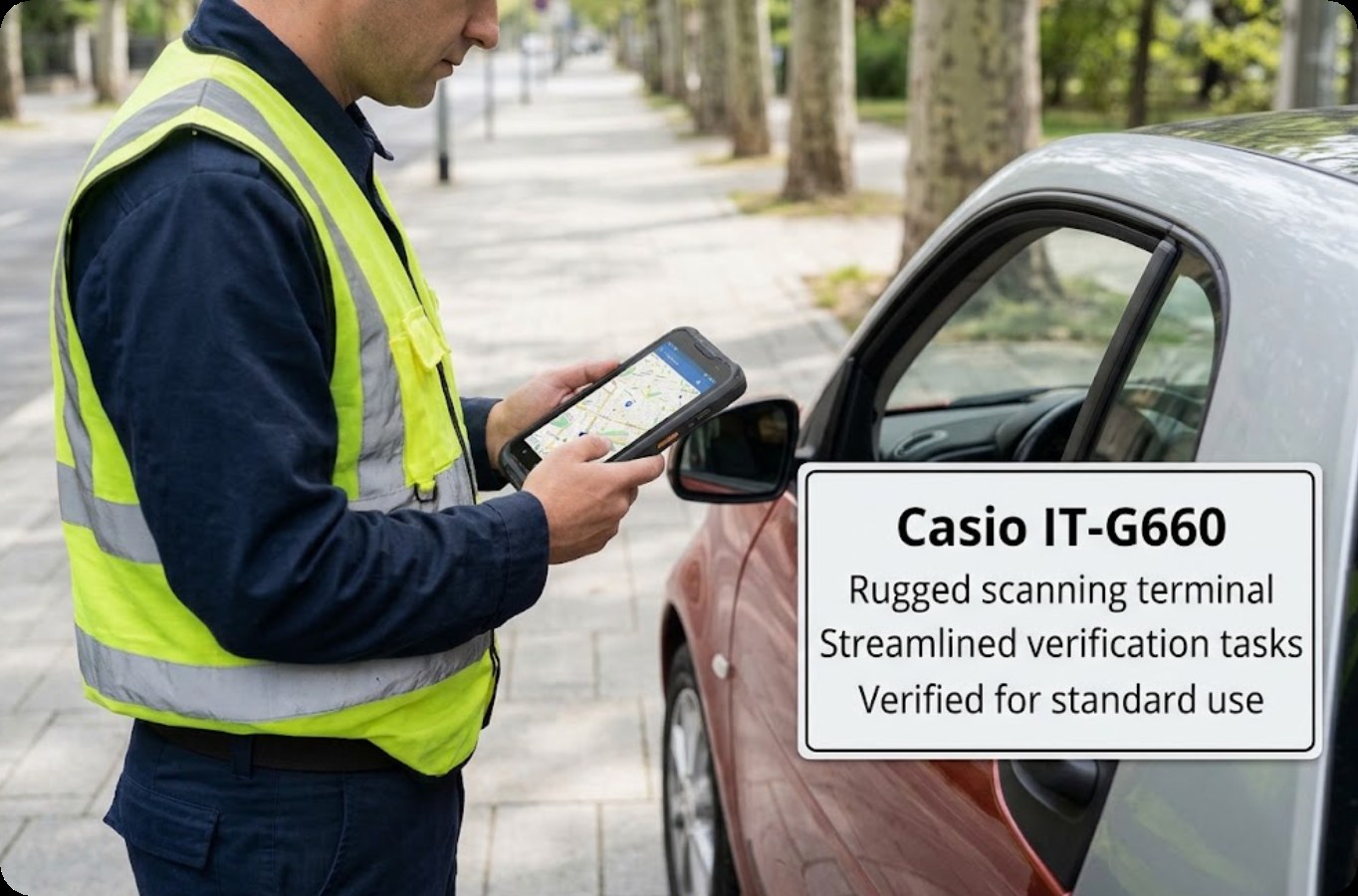
Casio pitches the IT-G660 as a 5.5-inch Full-HD mid-tier handset built on a 2.7 GHz Qualcomm QCM6490, mating 6 GB of memory with 128 GB of storage beneath Android 13. It publishes IP67, MIL-STD-810G, and a 1.5-meter drop rating, and it reads codes through Digimarc and DPM marks that defeat cheaper scanners. A 5000 mAh removable battery, a 16 MP camera, and 5G with Wi-Fi 6 round it out. For a department that wants one certified device and nothing more, it is a tidy answer that needs no explanation to a purchasing officer.
Winmate TC705: Certified Tough at the Top End
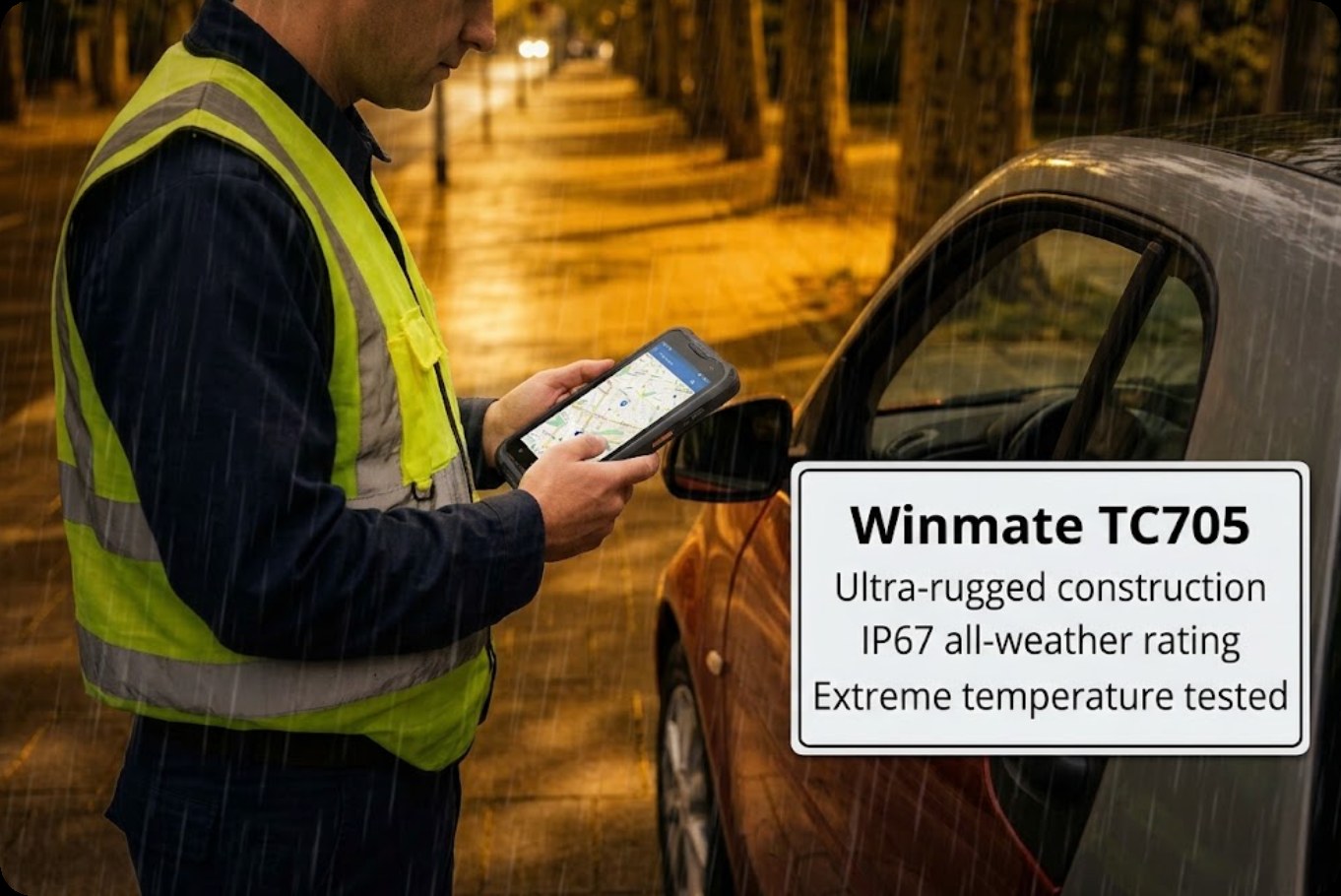
Winmate's TC705 pushes further: a 5-inch FHD plus panel, the same QCM6490, up to 8 GB of RAM and 256 GB of storage, Android 14, IP68, MIL-STD-810H, and a hot-swap battery so a shift never ends at a charger. It adds programmable keys, biometric unlock, dual SIM with eSIM, and an optional barcode engine, aimed at fleets that standardize on a single hardened platform across many field roles. The trade is weight and price, but for all-weather duty it is the most defended enclosure in this group.
| Device | CPU | Memory and storage | Display | Comms | OS | Battery | Protection | Positioning |
|---|---|---|---|---|---|---|---|---|
| Hotus R530C | SDM450 octa 1.8 GHz | 2 GB and 16 GB, to 4 and 64 GB | 6.0-inch 1080 x 2160 | Wi-Fi, BT 4.2, 4G, GNSS | Android 11 to 13 | 6000 mAh fixed | Not published | Map and plate screen |
| Hotus R350C | QCM2290 quad 2.0 GHz | 4 GB and 64 GB | 4.0-inch 480 x 800 | Wi-Fi, BT 5.0, 4G, GNSS | Android 13 | 4000 mAh removable | IP67, 1.5 m drop | Gloved keypad entry |
| Hotus R860-S | SM6115 octa 2.0 GHz | 4 GB and 64 GB | 5.5-inch 720 x 1440 | Wi-Fi, BT 5.0, 4G, GNSS | Android 16 | 5600 mAh removable | Not published | On-spot thermal print |
| Casio IT-G660 | QCM6490 octa 2.7 GHz | 6 GB and 128 GB | 5.5-inch 2160 x 1080 | 5G, Wi-Fi 6, GNSS | Android 13 | 5000 mAh removable | IP67, MIL-STD-810G, 1.5 m | Mid-range certified |
| Winmate TC705 | QCM6490 octa 2.7 GHz | up to 8 GB and 256 GB | 5.0-inch FHD plus | 5G, Wi-Fi 6, eSIM | Android 14 | Hot-swap removable | IP68, MIL-STD-810H | High-end certified |
Where the Hotus Pages Stay Quiet on Ratings
Honesty matters here. Only the R350C publishes a numeric durability rating on its product page; the R530C and R860-S describe a rugged-grade shell without a specific IP or drop figure. Casio and Winmate, by contrast, print IP67 or IP68 and a MIL-STD number as a selling point. If your procurement requires a certified enclosure on every device, the two competitors answer on paper today, and Hotus would need to supply test reports per model. The R860-S printer and the R530C screen still win their own roles regardless, but the rating gap is real and worth stating up front.
In practice, most municipal specs ask for an IP rating on paper, but the daily failure mode is not the enclosure. It is the battery dying mid-route, the scanner choking on a bent plate, or the printout smearing at the third car. A certified shell helps the purchase order clear; a working screen and a working printer clear the street.
You can review the full handheld family on the handheld PDA lineup page.
Matching Each Role to the Right Device
| Curb-side task | Recommended Hotus | When to pick a competitor |
|---|---|---|
| Reading a plate photo and a map at the car | R530C | Choose Winmate TC705 when a certified IP68 body is mandatory |
| Entering a citation code in gloves, eyes up | R350C | Stay with R350C; its IP67 rating already clears most municipal specs |
| Printing the slip before walking away | R860-S | No competitor here prints on board; keep the R860-S |
| Standardizing one hardened fleet device | R350C or R530C | Pick Casio IT-G660 or Winmate TC705 for a single certified platform |
Enforcement does not end at the curb. Plates, permits, and citations flow into a back-office system, and the handheld is the first capture point. A device that files a plate photo, a geotag, and a permit scan in one tap spares the clerk an hour of re-keying later. Hotus ships the R530C and R350C with SDK hooks that push that record straight to municipal software, which counts for more than a spec-sheet edge once the fleet is live.
Bringing the Right Handheld to the Curb
Three jobs, three shapes. Pick the R530C when the screen does the work, the R350C when hands stay in gloves, and the R860-S when the ticket has to print now. Casio and Winmate earn a look when a certified rating is non-negotiable for every unit on the route. See the rugged tablet lineup for larger field computers, or browse more device comparisons before you standardize.
Picture the rainy Friday cycle: plates glare under sodium light, gloves are mandatory, and the notice has to survive a windshield in a storm. The R350C takes the code without a glance, the R530C confirms the spot on a map, and the R860-S leaves a dry paper slip before the next car. That is the whole job, done in one breath at each stop.