A Discharge Photo Is Not Yet Evidence: Waterproofing Field Data for Environmental Compliance
This technical comparison evaluates three advanced Hotus mobile platforms—the RT80, HTQ10A, and U1—alongside specialized competitive alternatives: the Remdun EM-R18 explosion-proof handheld and the BNN BN-800 ultra-high-frequency RFID reader. While competitor devices excel in niche operational scenarios, environmental monitoring involves distinct challenges ranging from explosive atmospheres to bulk asset tagging. Discerning where each hardware category provides genuine utility is essential for regulatory compliance.
Comparative Analysis: Hotus RT80, HTQ10A, and U1 vs. Remdun EM-R18 and BNN BN-800
The Hotus RT80 is engineered as a high-precision positioning and imaging tablet, featuring a UNISOC UIS7885 octa-core processor with an 8-TOPS neural processing unit, a 10.1-inch full-HD display, a 48-megapixel autofocus rear camera with LED flashlight, an optional 8-megapixel macro lens, and an independent Beidou plus RTK module delivering centimeter-level coordinate accuracy. The Hotus HTQ10A serves as an all-weather, long-shift recording tablet powered by a Qualcomm octa-core platform, a 10.1-inch full-HD display supporting gloved and wet-hand input, a 13-megapixel rear autofocus camera, a removable 10,000 mAh battery, and IP67 ingress protection conforming to MIL-STD-810G standards across a -20°C to 55°C operating range. The Hotus U1 provides a compact, modular handheld form factor with a 5.5-inch HD screen, a 13-megapixel autofocus camera, removable 4,700/5,000 mAh batteries, IP67/IP66 sealing with a 1.5-meter drop rating, and a versatile modular matrix supporting thermal imaging, RTK modules, ID card reading, and UHF RFID data capture.
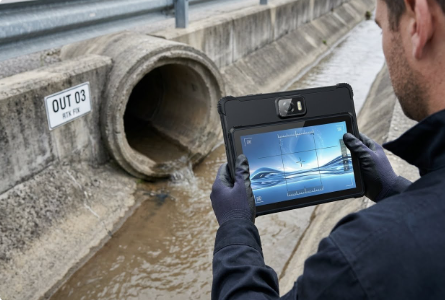
Hotus rugged mobile computing platforms deployed during precision environmental outfall inspections
The Critical Moment of Shutter Release
At the discharge point, evidentiary validity depends entirely on optical resolution and positional integrity. The RT80 distinguishes itself with an independent Beidou and RTK positioning architecture operating separately from the main system processor. This distinction is vital when inspecting complex industrial facilities where multiple stormwater and process outfalls discharge within meters of one another. Standard GNSS positioning frequently exhibits multi-meter drift, placing inspection crews near the correct manhole, whereas RTK-corrected coordinates pinpoint the exact outfall channel. For detailed guidance on geospatial accuracy in field workflows, consult the Land Survey & Field Mapping Application Solutions resource. Furthermore, the RT80’s 48-megapixel rear camera and optional macro lens capture critical micro-details, such as valve serial numbers or structural hairline fractures in concrete seals.
Conversely, the HTQ10A Android Rugged Tablet IP65 Rated specializes in broad contextual framing. While its 13-megapixel rear autofocus camera and LED flash do not resolve microscopic surface defects at arm's length like the RT80 macro module, its expansive 10.1-inch full-HD display enables inspectors to capture the entire channel geometry, flow trajectory, and surrounding topographical landmarks within a single cohesive frame. Featuring Gorilla Glass and wet-hand touch recognition, it maintains usability during heavy precipitation. Specific configuration parameters can be verified on the RT80 5G Rugged Tablet HarmonyOS Android 13 technical overview page. For confined valve chambers or narrow catwalks, the U1 provides an ergonomic 5.5-inch handheld form factor optimized for secure one-handed operation.
Post-Capture Workflows: Preserving Data Integrity After Leaving the Outfall
Evidentiary reliability degrades as digital assets move further from the point of capture. Field operations do not conclude upon sealing sample bottles; inspectors must reconcile image files with chain-of-custody logs, assign precise spatial readings to specific discharge points, and maintain device uptime through evening reporting sessions. The HTQ10A excels in this phase through its removable 3.8V 10,000 mAh battery supporting rapid hot-swapping, allowing field personnel to swap power packs instantly without tethering cables across makeshift field desks. Its wide -20°C to 55°C operating temperature range ensures reliable performance during cold-weather winter sampling campaigns.
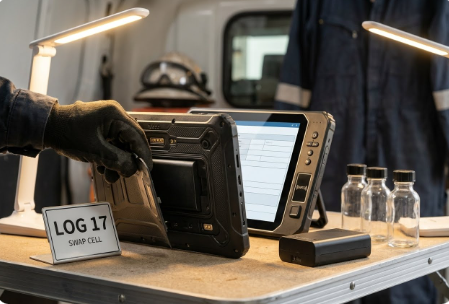
Field inspectors utilizing rugged tablets for post-capture data reconciliation and chain-of-custody logging
The U1 Series 5.5 Inch Industrial Smart PDA supports seamless shift rotations via Type-C fast charging and swappable battery architectures. Its core advantage lies in functional modularity: a single U1 chassis can integrate thermal imaging, RTK modules, biometric fingerprint sensors, or UHF RFID readers, eliminating the need to carry disparate single-purpose instruments across complex industrial sites. While the RT80 also features a 10,000 mAh battery with Power Delivery fast charging, its internal battery design emphasizes extended single-charge runtime rather than toolless hot-swapping.
Geospatial Verification: Proving Outfall Provenance Weeks Later
Regulatory bodies frequently audit environmental files weeks or months after initial data collection. The central question remains: can the digital file conclusively verify the exact outfall source? High-resolution images of turbid effluent are legally insufficient if multiple discharge pipes converge within a shared drainage basin. The RT80 addresses this through its dedicated Beidou and RTK module, enabling native geotagging with centimeter-accurate spatial metadata. While the U1 can be configured with an RTK module upon purchase, RTK integration is a specific hardware option rather than a default baseline. Standard models like the HTQ10A rely on multi-constellation GNSS (BDS, GPS, GLONASS) suited for general site navigation rather than sub-meter outfall differentiation.
Procurement teams must acknowledge that raw mobile hardware does not inherently provide file-level cryptographic audit trails. Device coordinates and camera timestamps confirm capture parameters, but maintaining an unbroken chain of custody requires pairing rugged hardware with secure, validated environmental database management systems.
Comparative Technical Specifications
The structured matrix below aligns published device specifications with core environmental monitoring workflows:
| Evaluation Metric | Hotus RT80 | Hotus HTQ10A | Hotus U1 |
|---|---|---|---|
| Form Factor | 10.1-inch 5G Tablet | 10.1-inch Android Tablet | 5.5-inch Industrial PDA |
| Rear Camera Optics | 48 MP AF + LED; Optional 8 MP Macro | 13 MP AF + LED | 13 MP AF + LED |
| Positioning Architecture | GNSS + Independent Beidou & RTK | BDS / GPS / GLONASS | GPS/GLONASS/BDS; RTK Optional by Variant |
| Power Subsystem | 10,000 mAh, PD Fast Charge | 10,000 mAh Removable, Quick Swap | 4,700/5,000 mAh Removable, Type-C |
| Environmental Ratings | IP67; Operating -10°C to 50°C | IP67, MIL-STD-810G; -20°C to 55°C | IP67/IP66, 1.5m Drop; Temp. Unlisted |
| Modular Add-ons | 2D Scan, NFC, Fingerprint | 1D/2D Scan, NFC, UHF RFID, Fingerprint | Thermal, RTK, ID Card, UHF RFID |
Evaluating Niche Competitors: Explosion Proofing and Bulk RFID Reading
Specialized applications demand specific hardware validations. The Remdun EM-R18 is a 5.5-inch handheld featuring an Ex ib IIC T4 Gb explosion-proof certification. Within classified industrial environments where flammable gases or volatile chemical vapors present explosion hazards, certified intrinsically safe hardware is legally mandatory. Standard Hotus devices do not carry formal explosion-proof ratings; thus, facilities operating inside classified hazardous zones must select specialized intrinsically safe terminals.
Conversely, the BNN BN-800 addresses bulk asset management, featuring an integrated UHF RFID module with a circularly polarized antenna capable of reading over 1,000 tags per second at ranges up to 18 meters. For operations managing thousands of tagged monitoring wells, sample drums, or chemical containers, dedicated long-range RFID readers dramatically accelerate inventory audits. Selecting hardware must therefore be strictly governed by site-specific operational mandates rather than generalized feature lists.
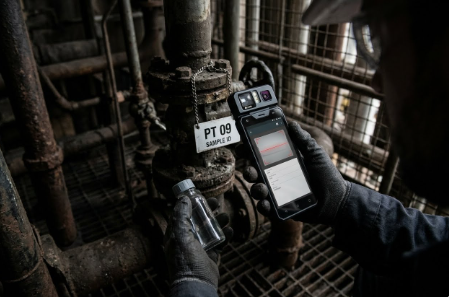
Specialized handheld data collectors and rugged tablets deployed across diverse environmental field conditions
Frequently Asked Questions (FAQ)
1. Yes, high-precision RTK positioning is essential for separating adjacent outfalls during environmental inspections.
Precise RTK module integration guarantees centimeter-level geospatial accuracy, enabling environmental inspectors to definitively differentiate between closely spaced discharge pipes and drainage channels where standard multi-meter GNSS drift would cause ambiguity.
2. Yes, swappable high-capacity batteries directly eliminate workflow interruptions during extended field data collection shifts.
Rugged mobile devices featuring toolless hot-swappable battery systems, such as the HTQ10A and U1, allow field crews to replace depleted power cells instantly in remote outdoor environments without powering down operating systems or halting documentation workflows.
3. Yes, hazardous classified zones require specialized explosion-proof certifications that standard rugged tablets cannot provide.
Operations within classified explosive atmospheres (such as Ex ib IIC T4 Gb rated zones) legally mandate certified intrinsically safe hardware to prevent electrical ignition risks, meaning facilities operating in such areas must select explosion-proof terminals like the Remdun EM-R18.
4. Yes, structured data capture hardware combined with rigorous chain-of-custody protocols transforms a field photograph into legally defensible regulatory evidence.
Deploying high-resolution optics, accurate RTK geotagging, and secure database synchronization guarantees that captured field imagery satisfies rigorous regulatory standards, ensuring seamless audit defense during compliance reviews.
The video below demonstrates rugged tablet and handheld PDA deployment, field data collection workflows, and environmental inspection best practices.