Hotus RT82, HTNJ10C, and R366-S: Division of Labor Across Walked Territory
The three Hotus units divide inspection responsibilities to match actual field workflows. The RT82 accompanies inspectors on foot to capture defect photographs and high-precision coordinates. The HTNJ10C remains stationed in hi-rail cabs and section offices to manage Windows-based track geometry and compliance software. The R366-S is suspended via shoulder strap to scan trackside barcode plates and NFC switch tags.
Federal Safety Standards and the Inspector on Foot
Inspectors covering complex curves, grade crossings, and water-adjacent tracks endure grueling 8-to-10-hour shifts away from vehicles. Regulations assume absolute precision, meaning defect entries demand the same rigor as physical track repairs. Precise spatial referencing prevents compliance failures, establishing why mapping-grade hardware is critical for railroad maintenance.
RT82: Deviation Notes, Camera Flash, and 5G Connectivity
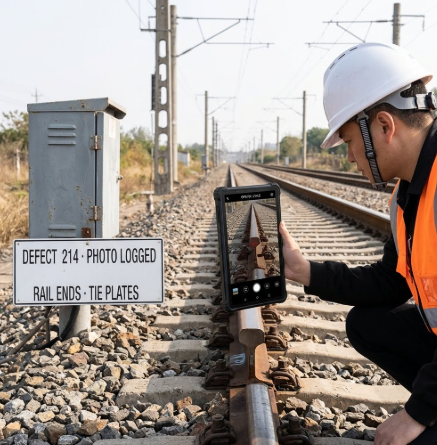
The RT82 5G WiFi 6E Rugged Enterprise Tablet handles outdoor field data capture. Its rear 20MP autofocus camera with high-intensity flash captures rail-end mismatches, cracked tie plates, and fouled ballast shadowed under bridges. GNSS support spans GPS L1/L5, GLONASS, Galileo, and BeiDou, with optional RTK centimeter-level positioning. Powered by the Qualcomm QCM6690 platform, the unit maintains a stable 5G uplink to upload signed compliance logs before returning to the depot. A 10000mAh battery easily sustains multi-hour shifts, though its 400-nit display is the dimmest in this evaluation.
Deploying the Hotus RT82 rugged tablet for real-time track geometry and defect mapping
HTNJ10C: Windows Compliance Tools for the Section Office
The HTNJ10C Windows Industrial Tablet Computer runs legacy track analysis software that requires standard Windows environments. Driven by an Intel N100 processor running Windows 10 or 11 Pro, its 10.1-inch display delivers 560 nits with 7H surface hardness, supporting active stylus and wet-hand touch input during rainstorms. IP67 sealing, MIL-STD-810G certification, and a 1.22-meter drop threshold withstand rough cab environments, while an onboard RJ45 port links directly to wired depot networks. Its 3500mAh battery is compact and removable, allowing inspectors to carry charged spares in door pockets.
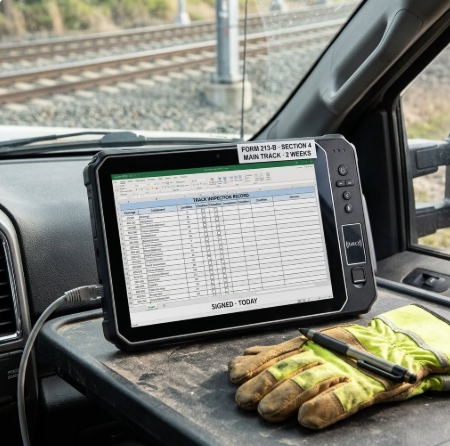
The HTNJ10C Windows industrial tablet operating in section offices and hi-rail cabs
R366-S: Barcode Plates and NFC Turnout Tracking
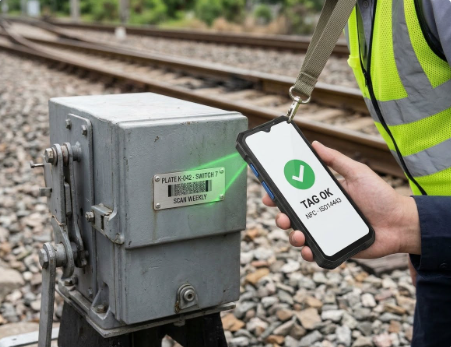
Weighing under 300 grams, the R366-S 5.5 Inch 2D Barcode PSAM Industrial PDA is lightweight and optimized for shoulder straps. Its high-performance 2D engine reads damaged switch barcode plates down to 3mil precision, while the 13.56MHz NFC reader instantly verifies ISO14443 and ISO15693 tags mounted on switch machines and signal boxes. Dual ISO 7816 PSAM slots secure crew credentials, and a 4600mAh battery supports rapid USB Power Delivery swaps. Android 13 on an octa-core platform maintains seamless barcode scanning throughout full-shift walks.
Scanning switch plates and NFC turnout tags using the ergonomic Hotus R366-S handheld PDA
CENAVA W10Y and Motorola MC9400: Competitive Hardware Benchmarks
The CENAVA W10Y offers exceptional display performance with a 10.1-inch screen reaching 700 nits, an Intel Core i5-10210Y processor, IP68 sealing, and MIL-STD-810H drop compliance. However, its 1208g bare weight is nearly double the RT82, and its 5550mAh internal battery provides limited runtime. The Motorola Solutions MC9400 provides a keyboard-first handheld layout featuring a 4.3-inch 600-nit display, hot-swappable 7000mAh battery, 12-foot concrete drop rating, and an SE58 long-range imager. However, its base configuration is WLAN-only (requiring the MC9450 variant for 5G), restricting real-time upload capabilities outside yard Wi-Fi coverage. For comprehensive categorizations of rail hardware duties, consult the Field Maintenance Industrial Hardware Solutions Supplier guide.
Comprehensive Hardware Specification Matrices
The tables below contrast display parameters, operating systems, power architectures, and wireless connectivity across all evaluated units:
| Unit Model | Display & Brightness | Operating System | Battery Architecture | Wireless Connectivity |
|---|---|---|---|---|
| Hotus RT82 | 10.1in (1200×1920), 400 nits | Android 16 | 10000mAh, fixed | 5G + Wi-Fi 6E |
| Hotus HTNJ10C | 10.1in (1200×1920), 560 nits | Windows 10/11 Pro | 3500mAh, removable | 4G LTE + Wi-Fi 6 |
| Hotus R366-S | 5.5in (720×1440) | Android 13 | 4600mAh, removable | 4G LTE, dual SIM |
| CENAVA W10Y | 10.1in (1920×1200), 700 nits | Windows 11 | 5550mAh, fixed | Wi-Fi 6E, cellular optional |
| Motorola MC9400 | 4.3in (800×480), 600 nits | Android (upgradeable) | 7000mAh, hot-swap | WLAN only (5G on MC9450) |
| Unit Model | Data Capture Modules | Ports & Physical Expansion |
|---|---|---|
| Hotus RT82 | Optional 2D scanner (3mil), NFC, RTK GPS | Nano-SIM ×2, TF card, Type-C (PD), Pogo |
| Hotus HTNJ10C | 1D/2D scanner, UHF RFID, fingerprint, NFC, TPM 2.0 | Mini HDMI, USB-A, USB-C, RJ45, DC-in, Pogo |
| Hotus R366-S | Optional 2D scanner, NFC, dual PSAM slots | Type-C with PD, Nano-SIM ×2, TF to 256GB |
| CENAVA W10Y | 2D, UHF RFID, LF 125kHz, fingerprint, RTK optional | Gigabit RJ45, RS232 DB9, Micro HDMI, Type-C |
| Motorola MC9400 | SE58 long-range imager, 58-key physical keypad | USB 2.0 pogo, MicroSD to 2TB |
Frequently Asked Questions (FAQ)
1. Do rugged enterprise tablets ensure real-time compliance reporting during track inspections?
Yes, rugged enterprise tablets equipped with high-speed 5G connectivity enable inspectors to upload signed inspection records, photographic evidence, and precise RTK GNSS coordinates directly from the field before returning to the depot.
2. Can rugged Windows industrial tablets run legacy track geometry and compliance software?
Yes, Windows-based industrial tablets running standard desktop operating systems natively execute legacy track geometry programs and section office compliance databases required by federal safety regulations.
3. Are lightweight industrial PDAs effective for scanning damaged switch barcode plates and NFC turnout tags?
Yes, ergonomic industrial PDAs feature high-precision 2D scan engines capable of reading damaged barcode plates down to 3mil resolution alongside robust NFC readers for tracking switch points and signal hardware.
4. Do rugged mobile devices withstand extreme weather and physical abuse on railway ballast?
Yes, certified IP67/IP68 environmental sealing and MIL-STD-810G/H drop protection ensure robust operation under heavy vibration, dust, moisture, and extreme thermal swings encountered across walked railway territories.
The video below demonstrates railway track inspection workflows, rugged enterprise tablet operation, and ballast defect logging procedures.
Matching the Hardware to the Railway Territory
Let operational requirements dictate hardware selection. Inspectors filing photographic logs and RTK coordinates utilize the RT82, while Windows-centric section offices deploy the HTNJ10C. Turnout-heavy territories issue lightweight R366-S PDAs to every walker. For complete compliance engineering paths, review the Industrial Three-Proof Application Solutions documentation.