- Select Language
RS50 5G Rugged Handheld Terminal | 6.3" FHD+ ...
R366-S Thin 5.5-inch Industrial PDA | Qualcomm Oct...
P8 Series 8-Inch Rugged Industrial Tablet PC Mobi...
P11 Series Next-Gen Enterprise Rugged Industrial ...
RT80 5G Rugged Tablet | 10.1" FHD 400nit | Un...
️ X8 Series Handheld Label & Thermal Printing ...
As an industry analyst covering the convergence of personal computing and home cinema, I’ve watched the landscape shift dramatically over the past 18 months. The old model—a stationary, living-room-bound console tethered to a single screen—is losing ground to a far more fluid, high-performance ecosystem. What we’re seeing now is a surge in demand for hardware that can drive AAA titles at max settings yet remain compact enough to slip into a backpack. This isn’t just about portability for its own sake; it’s about building a dedicated, high-fidelity entertainment hub that moves seamlessly from a desk to a campsite without compromise. Consumers are abandoning single-purpose devices in favor of versatile, rugged solutions that deliver consistent performance across both gaming and cinematic experiences. That’s exactly why products like the Hotus ST11-J, the Hotus HT500, and the ST11-U matter—they are the hardware response to this behavioral shift. If you’re serious about building this kind of flexible setup, start by exploring dedicated gaming entertainment solutions to understand what the ecosystem really offers.
The global home entertainment market now sits at over $250 billion, with gaming claiming a growing share of that pie. The primary driver isn’t raw console power anymore—it’s ecosystem flexibility. Consumers want a single device that can stream 4K HDR content, run a game server, and process real-time video for a projector, all while being small enough to pack in a bag. Major players are pivoting from monolithic consoles to PC-based systems that offer backward compatibility and mod support. That shift opens a massive opportunity for compact, high-performance computing units paired with portable display technology. The old barrier—needing a bulky desktop tower—is disappearing, replaced by demand for ruggedized, industrial-grade components that handle the thermal stress of gaming without the noise of a full-size fan array. This is a market that rewards adaptability over brute force.
The technology fueling this shift is the miniaturization of high-TDP processors. We’re no longer sacrificing performance for size. Modern mini PCs now support DDR5 RAM and PCIe 4.0 storage, loading games faster than many older desktops. This trend is reinforced by advances in wireless display technology, enabling high-bitrate 4K streaming to projectors without a physical HDMI cable. The Hotus HT500 exemplifies this shift, integrating a powerful DLP projection engine with wireless connectivity that turns any wall into a 120-inch gaming screen. It eliminates the latency and clutter that plagued wireless gaming setups just a few years ago.
Consumer behavior has fundamentally changed. The home is no longer just a place to relax—it’s a workspace, a gym, and a theater. People want a single device that serves as a workday workstation and a weekend gaming rig. That requires hardware durable enough to move frequently and powerful enough to handle diverse workloads. The ST11-U addresses this with a ruggedized form factor and industrial-grade I/O, making it suitable for both a permanent home theater setup and a portable gaming station for LAN parties. It bridges the gap between the fragility of consumer electronics and the robustness needed for daily transit.
Industry standards are finally catching up to consumer expectations. HDMI 2.1 and USB4 are becoming baseline requirements for new hardware, ensuring users can achieve 4K at 120Hz or 1440p at 165Hz without bottlenecks. This is critical for gaming, where input lag can ruin immersion. The ST11-J, with its robust processor and integrated graphics, is engineered to meet these standards, delivering a smooth, tear-free experience whether paired with a high-refresh-rate monitor or a low-latency projector. This standardization means consumers no longer have to choose between visual fidelity and responsiveness.
Hotus has structured its product line to address these three trends directly. The ST11-J is positioned as the core gaming engine—a compact, powerful unit designed to sit discreetly beside a TV or projector, handling the heavy lifting of game rendering and streaming. Its best use case is a permanent or semi-permanent home theater setup where raw processing power is the priority. The Hotus HT500 is the mobile companion, a portable projector that eliminates the need for a large display, turning any space into an instant cinema for backyard movie nights or gaming on the go. The ST11-U serves as the versatile hybrid, offering the same processing prowess as the ST11-J but in a ruggedized chassis that withstands travel bumps, making it the best choice for those who want a single device for both work and play.
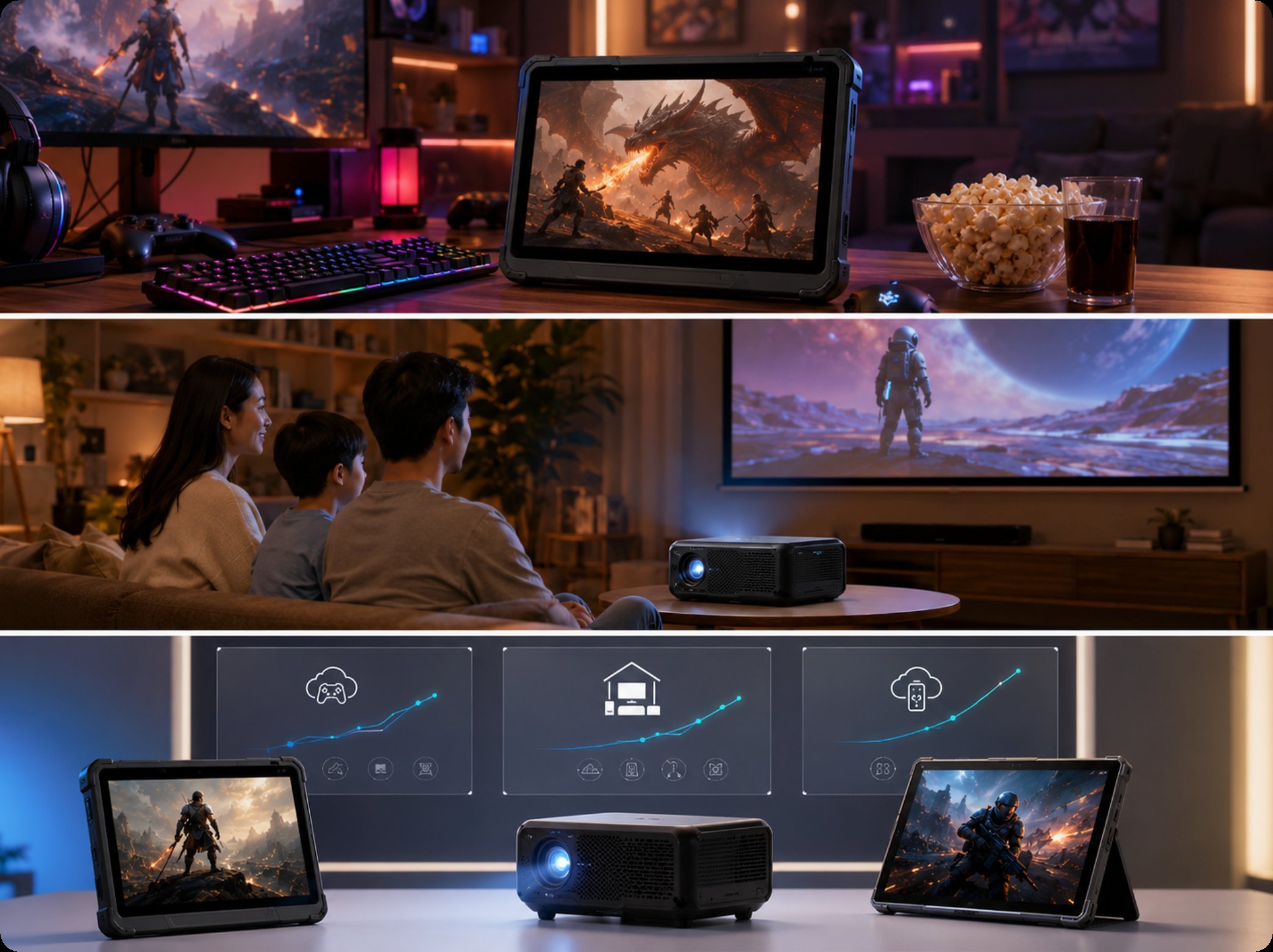
When we look at the Hotus HT500, its role in the ecosystem becomes clear. It’s not just a projector—it’s a gateway to large-format entertainment without the physical limitations of a TV. By integrating wireless connectivity and a high-lumen DLP engine, it allows the ST11-J or ST11-U to output a cinematic experience anywhere. The ST11-U, meanwhile, is the workhorse. Its rugged design means it can be mounted behind a TV, placed in a media cabinet with poor ventilation, or tossed into a backpack for a weekend trip. It’s the most durable option for users who refuse to be tethered to a single room.
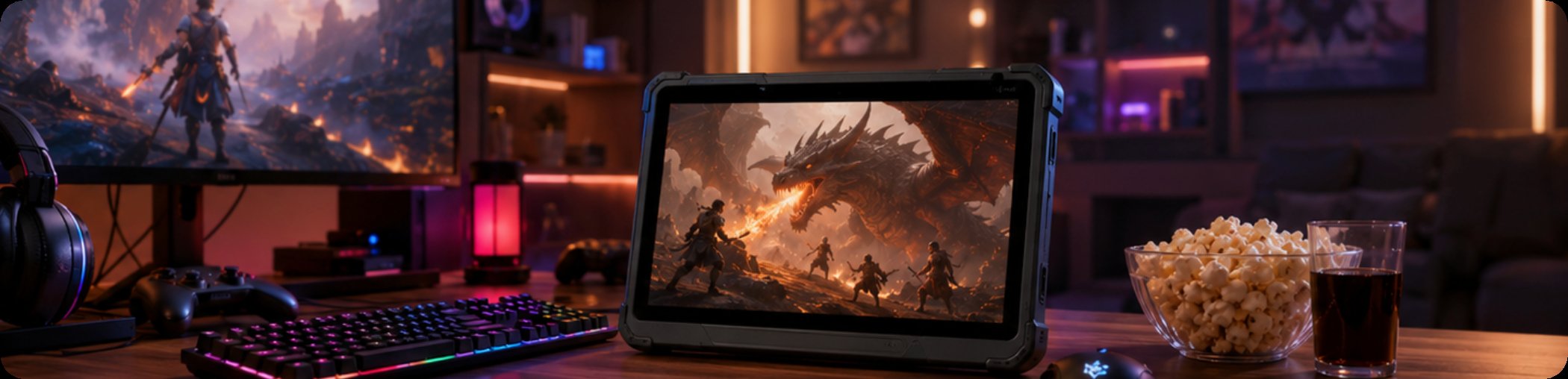
For the user who prioritizes a dedicated, high-performance gaming rig that stays in one place, the ST11-J offers the best price-to-performance ratio. It’s the ideal partner for the Hotus HT500 in a home theater setup, providing the processing power needed for modern game engines. The ST11-U is the choice for the mobile gamer or the professional who needs a reliable system that can survive the rigors of travel. To see the full range of these powerful units, browse the ST11-J series for more details on the core models.
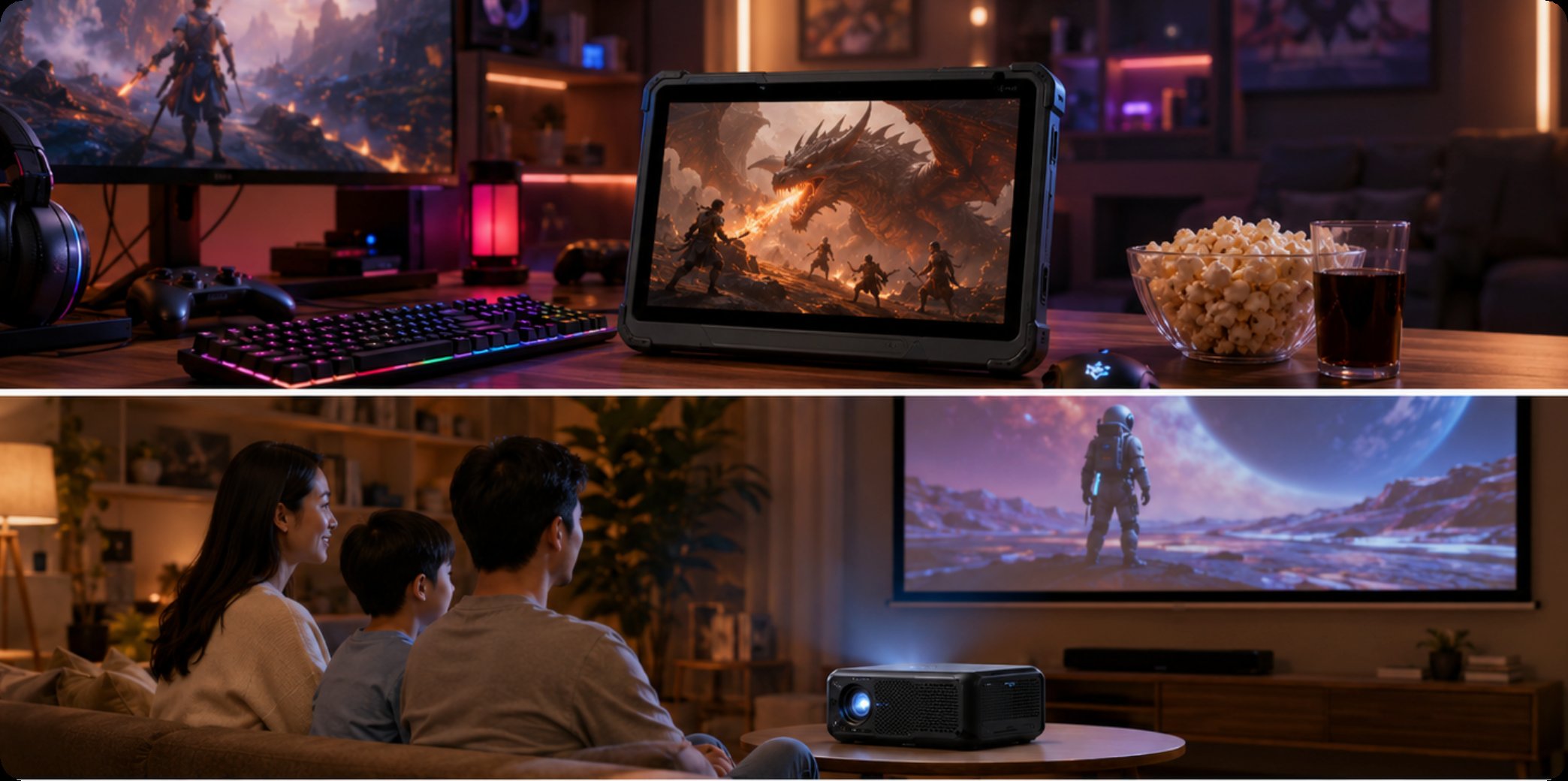
| Feature | ST11-J (Gaming Engine) | Hotus HT500 (Display Companion) | ST11-U (Rugged Hybrid) |
|---|---|---|---|
| Primary Position | Desktop/Home Theater Core | Portable Wireless Projector | Industrial/Mobile Workstation |
| Processor Type | High-Performance (Intel N150 or similar) | Integrated DLP Processing | High-Performance (Intel N150 or similar) |
| Memory Support | DDR4/DDR5 (High Capacity) | N/A (Dependent on source) | DDR4/DDR5 (High Capacity) |
| Protection Rating | Standard (Desktop use) | IP5X (Dust resistant lens) | IP65 (Dust & Water resistant) |
| Best Use Case | 4K Gaming, Streaming, Workstation | Outdoor Cinema, Mobile Gaming | Field work, Travel, Rugged gaming |
| Connectivity | USB-C, HDMI 2.1, Ethernet | HDMI, USB-C, Wi-Fi 6 | USB-C, HDMI 2.1, RS232, Ethernet |
| Weight | Lightweight (Under 2kg) | Ultra-portable (Under 1kg) | Lightweight (Under 2kg) |
Selecting the right hardware depends entirely on your primary use case. If your goal is to build a dedicated home theater that rivals a commercial cinema, the ST11-J combined with the Hotus HT500 is the optimal duo. The ST11-J handles the complex rendering, while the HT500 provides the massive, high-quality image. If you’re a digital nomad or a gamer who frequently travels, the ST11-U is non-negotiable—its rugged build ensures it survives drops and dust, while its processing power keeps your gaming library accessible. For those who need a single device for both work (CAD, data analysis) and play, the ST11-U again offers the best balance of durability and performance. The key is to prioritize your environment: stationary and safe (ST11-J), mobile and demanding (ST11-U), or display-focused (HT500).
Looking ahead, the lines between these categories will blur further. Expect mini PCs with integrated AI co-processors that can upscale games in real-time, similar to DLSS, but on the device itself. Portable projectors like the HT500 will likely achieve native 4K resolution and higher brightness levels, making them viable alternatives to TVs even in bright rooms. The ST11-U form factor will become the standard for premium mobile computing, with more manufacturers adopting rugged designs as consumers demand longevity from their electronics. The ecosystem is moving toward a fully wireless, high-fidelity future where your computing power is in your pocket, and your display is any flat surface.
Now is the time to evaluate your current setup. If you’re still tethered to a bulky desktop or a console that lacks upgradeability, consider transitioning to a modular mini PC system. Start by defining your primary use case: is it stationary gaming, mobile gaming, or home cinema? Once you have that clarity, choose the Hotus product that fits that niche. For a deeper dive into how these systems can be configured for your specific needs, explore our mini PC solutions to see the full range of configurations available. The future of entertainment is compact, powerful, and portable—it’s time to build your hub.