Ask a retailer where compliance lives and the answer is usually a certificate on a piece of hardware. Ask an auditor the same question and the answer is a transaction record, because that is what they open first. Of course the hardware met the standard when it was tested, but that is a question nobody disputes; what the auditor needs is proof that the specific transaction being queried was handled correctly, with the right price charged, the card data handled in the approved way, the receipt carrying the required fields, and any refund authorised. A till is not compliant in the abstract; it is compliant for the four hundred transactions it processed on a Tuesday in March, and the evidence for each one is created at a different point in the process by a different piece of kit. Scan accuracy is a pricing obligation, card handling is a data protection obligation, receipt content is a tax obligation, and refunds are a fraud control. None of these map neatly onto one device, which is why device-by-device compliance checklists keep failing stores that were, on paper, fully certified. What follows is organised the way an audit actually proceeds: along a single transaction, from the moment an item is scanned to the moment the unit is retired. Start with retail POS and barcode scanning hardware if you are rebuilding a checkout standard, then work through the eight points below.
The Scan: When a Price Becomes a Legal Number
The first obligation attaches at the scan, where a barcode stops being an identifier and becomes a price the customer is legally entitled to rely on. Most jurisdictions treat a shelf price or a scanned price as a representation, and the gap between the two is the retailer's problem rather than the system's. That makes scan accuracy a compliance metric rather than a productivity one, and it changes what matters in a scanner: first-pass read rate on damaged, curved or poorly printed labels, behaviour under bright or low light, and whether a failed scan is recorded as a failure or silently resolved by a manual key-in. Manual entry is where pricing disputes are born, because an override that nobody logs is indistinguishable from an error that nobody noticed. The X501 Handheld PDA is specified for this step because the read rate holds up on the labels that actually cause trouble at the till, and because failed reads can be surfaced as exceptions rather than absorbed as keystrokes.

An X501 scanning an item, with a visible 2-dollar gap between the scanned price and the shelf price beside it: a pricing compliance scenario captured in real time, not reconstructed later.
The Payment Moment: Where Card Data Must Not Sit
The second obligation carries the largest penalty and is narrower than most retailers assume. Card data rules do not require the terminal to be a fortress; they require the primary account number not to exist in places it should not: no full track data in local storage, no card numbers in application logs, no cached screenshots of a payment screen, and a clear boundary between the payment application and everything else on the same machine. That last point is where mixed-use devices cause problems, because a till that also runs inventory, scheduling and a browser has a far larger attack surface than the payment function needs. The question to ask is whether the payment path can be isolated, and whether the vendor will state in writing what is persisted locally.
The Receipt That Outlives the Shift
The third obligation is often discovered late, because it is a tax rule rather than a payments rule. Receipts are not customer convenience; they are records with a retention period, mandatory content, and in many markets a format the tax authority must be able to read. The fields that cause trouble are rarely the total: they are the tax identifier, the sequential transaction number, the tax breakdown by rate, and the seller identification. A receipt missing any of these is a defective record however clearly it prints, and one that cannot be reproduced later is defective however it looked on the day. Receipt generation has to be treated as a document-producing function with its own storage and retrieval path, not as a printer attached to a till.
Refunds, Voids and the Paper Trail Nobody Files
The fourth obligation sits in the reverse direction, and it is the one that internal audits find weakest. A sale generates a record automatically because the till has to produce one. A refund does not, unless the process insists on it, and a void can be used to erase the evidence of a transaction entirely if the system permits it. The control is not to forbid refunds, which would be absurd in retail, but to require that every reversal carries an authoriser, a reason code, and a link back to the original transaction. Where this breaks down in practice is on mobile: when a refund is processed away from the counter, on a handheld in an aisle or at a collection point, the authorisation step is the one that gets skipped. The Handheld PDA F505 is used for exactly this workflow, because the reversal carries the same identity and reason-code requirements on the shop floor that it does at a fixed till.

An X501 running a refund authorisation on the shop floor, with the manager, reason code and original transaction captured on the device, the same workflow the F505 is specified for.
End-of-Day Counts and the Variance Log
The fifth obligation is reconciliation, and it is where the difference between a tidy store and a defensible one becomes visible. A till that balances is not evidence of anything; a till that was counted, against a system-expected figure, with the difference recorded and explained, is. Variance logs are unglamorous and they are the first thing an auditor asks for after any cash discrepancy, because a store that logs a two-unit difference every shift for six months is a store with a measurable, stable, explainable process, while a store that always balances perfectly is a store that may simply not be counting. The device implication is modest but real: the till needs to produce a clean, exportable end-of-day figure without manual transcription, because anything retyped is a place for errors to enter and for disputes to start.
| Transaction stage | The obligation | Evidence required | Device capability that matters |
|---|---|---|---|
| Scan | Charged price matches shelf price | Read rate; logged exceptions | Reads damaged labels; surfaces failed scans |
| Payment | Card data not persisted | Written retention statement | Payment path isolated |
| Receipt | Tax-compliant record | Mandatory fields; retrievable | Structured receipt storage |
| Refund or void | Reversal is authorised | Authoriser, reason code, original link | Identity capture on mobile |
| End of day | Counted and reconciled | Variance log explained | Exportable totals |
| Patching | Software is current | Patch state; window logged | Remote update, no downtime |
| Retirement | Data is erased | Certificate of erasure | Encryption; verifiable wipe |
Patch Tuesday on a Live Till
The sixth obligation is the one that turns a compliance project into an operations problem. Software has to be patched, but a till cannot be taken out of service during trading hours, and a store with forty locations cannot send an engineer to each one every month. The result in many estates is a patch backlog that nobody schedules, which converts a manageable task into an audit finding. What makes it solvable is a host that can be managed remotely, updated inside a defined window, and reported on afterwards: which units are current, which are behind, and which were updated when. The HCAR5000 MI is the back-office host specified for this pattern, because it runs the store server role with enough headroom to be maintained and monitored without interrupting the tills that depend on it. The compliance point is not that patching is virtuous; it is that an estate which cannot produce its patch state on request has a finding waiting to happen.
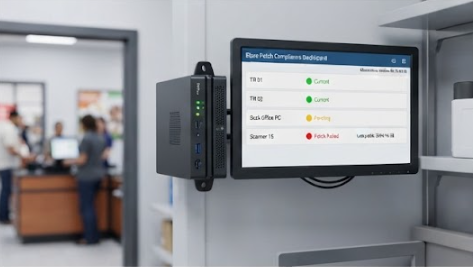
An HCAR5000 MI running the back-office role, with patch state and maintenance windows reported across the estate rather than tracked on a spreadsheet.
Retiring a Unit Without Retiring the Data
The last obligation arrives at the end of the hardware's life, and it catches stores during refresh cycles. A decommissioned till is not inert: it has processed card transactions, held customer records and cached receipts, and disposing of it without erasure is a data protection incident rather than an IT tidy-up. The control is simple and worth doing properly: encryption at rest, so a wiped device is unreadable by construction, and a documented erasure with a certificate per unit. Plan for it at purchase rather than at disposal, because retrofitting encryption to an estate that never had it is far more disruptive than specifying it at the start.
Specifying for the Record, Not the Certificate
Together the points produce a specification quite unlike a device checklist: what evidence each stage produces, who creates it, and whether it can be retrieved twelve months later without a reconstruction exercise. That is a harder way to buy than comparing certifications, but it is the only one that survives an audit, because the auditor is not interested in the device and never was. Our rugged handheld tablets are specified against these stages rather than a single standard, and the pattern is documented in a convenience chain rollout where the transaction record drove the hardware choice. Stores that specify this way tend to find the audit shorter, because the questions the auditor asks are the ones the specification already answered.