WTR PRO AMD and Palm-sized miniPC: The Kiosk Stopped Being a Screen
The specification sheet most buyers still use for digital signage was written for a different object. It asks about panel size, brightness, viewing angle and unit price, because the thing being bought used to be a display with a media player bolted behind it. That object is disappearing. What is being installed now is a networked computer that happens to have a screen attached, running local inference, joined to a fleet of hundreds or thousands of similar units, and holding a network position that the IT department rather than the marketing department is answerable for. Those three changes are not refinements to the old specification, they are a different category of purchase, and buyers who keep quoting brightness and bezel width are optimising for a device that no longer exists. If you are rewriting a signage standard this year, begin with digital signage and kiosk solutions and then read the three shifts below before you compare a single panel.
💡 Why the Buying Spec Sheet Aged Badly
The standard signage tender document has not changed much in a decade, and the mismatch is now large enough to cause real failures. It still treats the media player as a commodity component whose only job is to loop a video file, which means it is specified by price and left out of every other conversation. Yet the player is now the part that decides whether the queue analytics run, whether the price updates arrive before the promotion starts, and whether the unit can be patched when a vulnerability is published on a Friday afternoon. A tender that spends four pages on optical bonding and half a page on the compute module has its priorities exactly inverted relative to how these deployments actually fail. The symptom is familiar to anyone running a large estate: the screens are fine, the content is fine, and what breaks is everything the tender never asked about.
Playback Boxes Give Way to Local Compute
The first shift is that the box behind the screen stopped being a playback device. Signage networks increasingly run work that cannot be done by looping a file: footfall counting from an overhead camera, queue-length estimation that changes what is displayed, age or demographic estimation for content selection, shelf-gap detection in retail, and object recognition for wayfinding. All of that has to happen on the unit, partly because sending video to a central server is expensive and slow, and partly because in a great many jurisdictions sending images of people off the premises is a data protection problem rather than an engineering one. That requirement changes the specification completely. What matters is sustained compute under continuous load, memory headroom for a model that will be updated several times, and thermal behaviour in an enclosure with no fan. The WTR PRO AMD is specified for exactly this pattern, because it is built as a computer that tolerates being sealed inside a cabinet and running inference all day, rather than as a player that happens to have spare capacity.
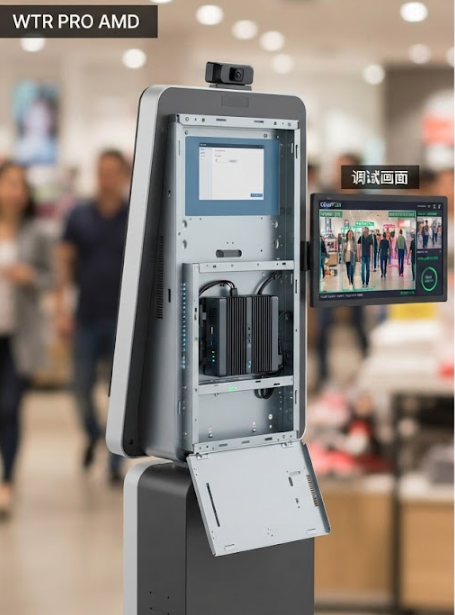
A WTR PRO AMD handling on-device analytics inside a sealed enclosure, with the display reduced to an output rather than the point of the installation.
One Unit Was Easy, Three Thousand Are Not
The second shift is about scale, and it is the one that hurts operators who grew from a pilot. Ten units can be managed by hand: someone visits them, someone swaps a card, someone notices when one goes dark. Three thousand cannot, and the failure mode is not that the work gets tiring, it is that the estate becomes unmeasurable. An operator who cannot answer how many units are currently running the correct build, or how many have been silent for more than a day, is operating blind, and blindness at that scale converts a small problem into a large one before anyone is aware of it. Scalability in this context has little to do with raw performance and everything to do with density, power draw and manageability: how many units fit in a cabinet, how much heat each one adds to an enclosed space, whether the platform exposes the telemetry a fleet tool needs, and whether a failed unit can be identified and scheduled without a site visit. The Palm-sized miniPC is chosen for estates at this scale because the physical footprint and thermal profile let operators put far more compute into the same enclosure space, which is the constraint that binds long before processor speed does.
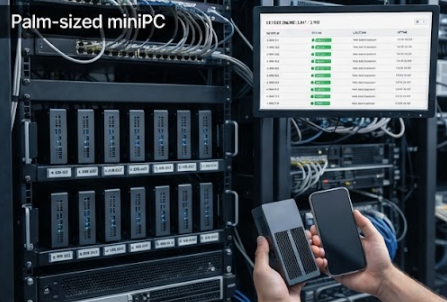
Palm-sized miniPC units mounted at density inside an enclosure, where footprint and heat per unit decide how much compute fits in the space available.
Marketing Owned the Poster, IT Owns This
The third shift is organisational, and it is the one that most often arrives as a surprise. A signage network used to be a marketing asset: it showed campaigns, it was updated when the campaign changed, and it sat outside the systems that mattered. Once the unit runs applications, holds customer-facing transactions, carries a network address and processes camera input, it becomes an endpoint that the IT department is accountable for, with everything that implies about patching, access control, logging and asset inventory. The hardware consequences are concrete. A device that cannot be remotely patched is a device that will eventually be quarantined. One with no secure boot or no disk encryption will fail an internal audit regardless of how well it displays content. And a touch panel used for transactions needs to be treated as a point-of-interaction device, with the tamper and hygiene considerations that follow. The SH5-W is specified into estates that have made this transition, because it is built for unattended operation under IT ownership rather than for occasional supervised use.
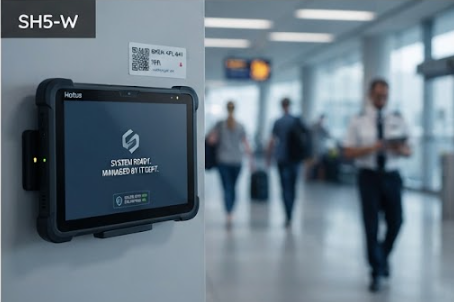
An SH5-W running as a managed endpoint in an unattended position, patched and inventoried like any other device on the network.
🚀 Latency Became a Content Problem
A consequence of running real work on the unit is that latency stopped being a network statistic and became a content defect. When the display reacts to what a camera sees, a delay between trigger and response is not a technical imperfection, it is the difference between a useful interaction and one that feels broken. The same applies to content carrying live information: a departure board, a queue position, a price that changed thirty seconds ago. Buyers used to static playback tend to evaluate latency by asking whether a video starts promptly, which has almost no bearing on whether the estate can support anything interactive. The useful measurement is the round trip from sensor to displayed change under production load, on the actual hardware in the actual enclosure, because thermal throttling in a sealed cabinet will quietly double it.
☁️ Remote Hands Replaced the Van Roll
The economics of a large estate are dominated by the cost of sending someone to a site, and that cost has risen while hardware prices have fallen. Operators who track it report that a single truck roll to a distant location can exceed the cost of the device being serviced, which inverts the usual logic about specifying cheap hardware and accepting higher failure rates. The shift is towards platforms diagnosable and largely repairable from a desk: out-of-band management that survives an operating system failure, telemetry detailed enough to distinguish a network fault from an application fault from a power fault, and hardware reliable enough that replacement is an exception rather than a routine. Van rolls never disappear, but an estate that treats them as the default response has a structural cost problem rather than a maintenance problem.
What the New Shortlist Actually Asks
Putting the three shifts together produces a shortlist quite unlike the traditional one. Instead of beginning with panel properties, it begins with the questions that decide whether the deployment survives its second year.
| Old question | Why it no longer decides | What replaces it |
|---|---|---|
| Panel size and brightness | Now commodity choices | Enclosure heat dissipation under sustained load |
| Media player price | The player now carries the load | Sustained inference performance under continuous load |
| Unit reliability | Relevant, but unmeasurable at pilot scale | Fleet telemetry and out-of-band management |
| Content update frequency | Static schedules are the easy case | Sensor-to-display latency under load |
| Who owns the hardware | Marketing cannot own network endpoints | Patchability, secure boot, disk encryption, asset inventory |
| Cost per unit | Ignores the dominant cost | Expected truck rolls per unit per year |
🔮 Specifying for the Next Refresh
The argument for rewriting the standard is not that the old criteria were wrong, but that they now select for the wrong failure modes. A buyer comparing panels will get a good panel, and will discover eighteen months later that the estate cannot be patched, cannot be measured, and cannot run the analytics that justified the investment. That is a procurement failure rather than a technical one, and it is entirely avoidable by asking the three questions in a different order: what has to run locally, how many units will there be, and who is accountable for them once they are live. Our rugged mini PC solutions range is built around those three questions rather than around panel specifications, and the deployment pattern described above is the one recorded in a signage estate where compute, not display, set the specification. Buyers who make the shift early tend to find the refresh cycle gets cheaper rather than more expensive, because the hardware stops being replaced for reasons that were never really about the hardware.