- Select Language
The F505 Handheld PDA is a compact, high-performan...
The U9000 handheld PDA combines advanced barcode s...
R530C 6.0-inch Industrial PDA | Qualcomm Octa-core...
The R501 PDA combines a powerful MT6762 Octa-Core ...
Full SpecificationsModel Hotus SH5‑WOperating ...
R350C 4-inch Industrial Handheld PDA | Qualcom...
R530C 6.0-inch Industrial PDA | Qualcomm Octa-core...
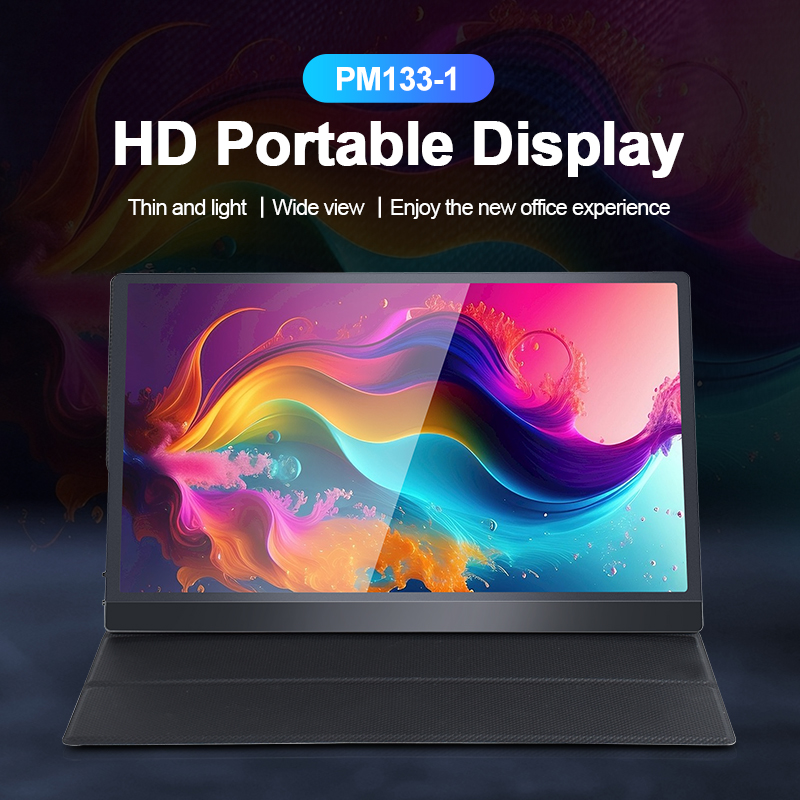
The PM133-2 is a 13.3-inch portable monitor featur...
A security operations centre runs on two things that a normal desktop specification sheet never mentions. The first is the wall. A rack-mounted or DIN-rail mounted unit has to survive being bolted into a cabinet that is already at 45 degrees, and it has to keep running while the room loses its air conditioning for an hour. The second is the field wiring. Cameras, access-control panels, intercom stations and alarm units all arrive on serial lines, and someone has to terminate them. A machine with three USB ports and two displays is not wrong for this room, but it is a different product category from what the room actually needs.
This comparison sets three Hotus mini PC units against one Taiwanese industrial box that was designed for that cabinet from the first day. The honest finding is that the two groups answer different questions, and the comparison is worth reading mainly because the gaps are clear. The Palm-sized miniPC brings triple 8K output and a four-bay storage chassis in 800 grams. The HCAR5000 MI brings Ryzen 5000H performance on a 2.5-kilogram chassis with one network port. The WTR PRO AMD brings two 2.5GbE ports, four SATA bays and a metal body. Against them, the AAEON BOXER-6648-ARS brings six COM ports, eight digital I/O lines, a 10 to 35 volt input range and a fanless aluminium chassis designed for DIN rail mounting.
None of the three Hotus units publishes a COM port count, a digital I/O specification, a wide-voltage input range or a DIN rail mounting option. That is not a complaint about the hardware; it is a statement about which category each product was designed for, and it is the single most useful thing in this comparison.
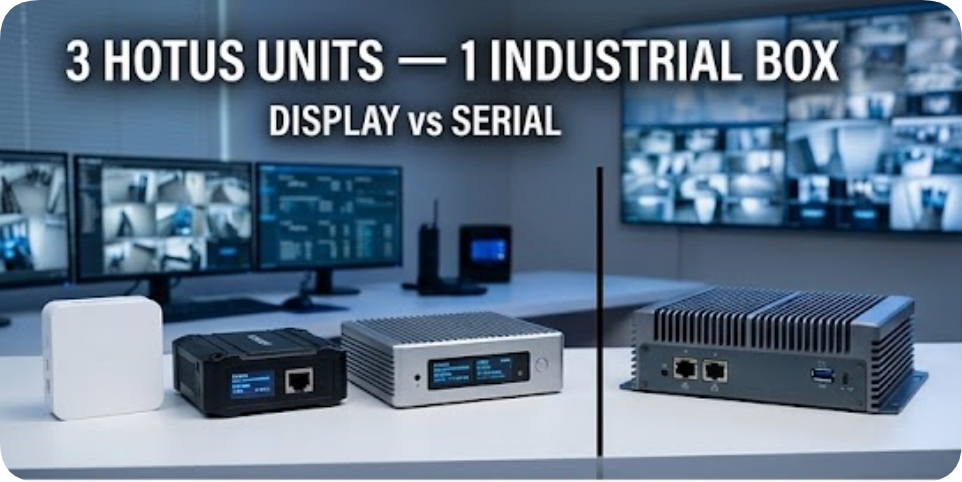
The Palm-sized miniPC is the unit that fits where the other two will not. At 800 grams in a PC+ABS case, it takes the least rack or shelf space of any machine here, and it is the only one of the three that can be mounted directly behind a monitor. Storage is the surprise: two M.2 2280 NVMe PCIe 3.0x4 slots plus two 2.5-inch SATA 3.0 bays, which is up to 4TB of NVMe and 8TB of SATA in a machine the size of a paperback. Display output is the other: two HDMI 2.1 ports and one Type-C port, each quoted at 8K@60Hz, so a three-display wall or a video-wall controller runs on native ports rather than through add-in cards.
The processor line runs from an i3-1215U up to an i9-12900HK, with dual-channel DDR4 3200 or DDR5 5200 memory to 64GB. Connectivity is five USB 3.2 Type-A ports, one 2.5G Ethernet port, Wi-Fi 6 and Bluetooth 5.2, and the Type-C port carries 10Gbps data alongside display and power delivery, which removes a dock from the parts list. Certification is CE, FCC and RoHS.
Two limits should be stated plainly. The case is PC+ABS rather than aluminium, and while the page mentions low-power processors and quiet operation, it does not claim a fanless variant as standard — a fanless build is described as something to confirm with sales. For a room where every machine runs twenty-four hours, that is a question worth asking before signing off, not after.
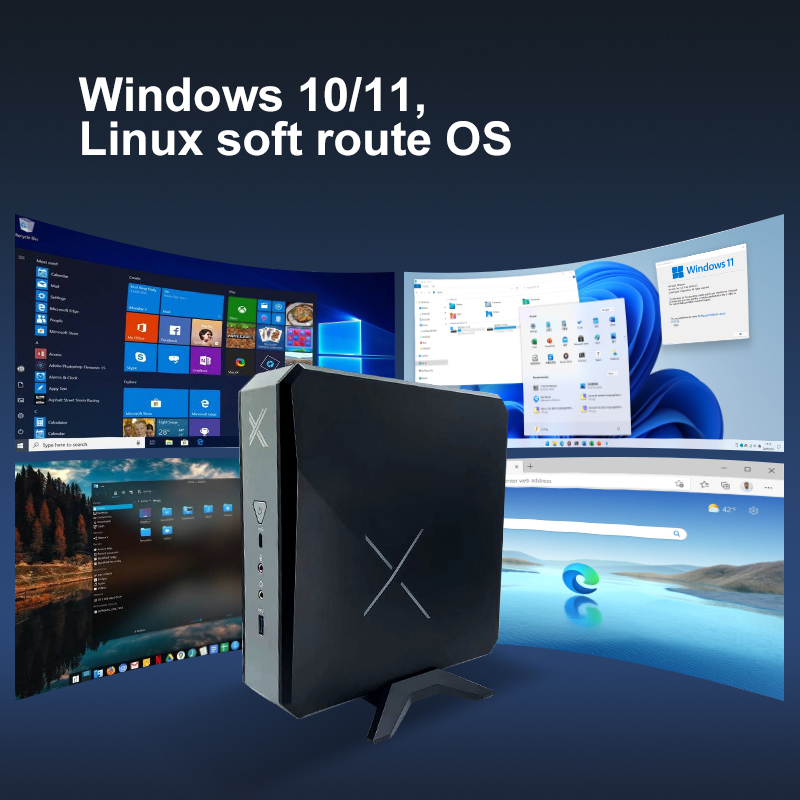
The HCAR5000 MI is the performance option of the three. It carries AMD Ryzen 5000H processors in 5900HX, 5800H and 5600H variants with Radeon Vega10 or Radeon graphics, DDR4 3200 memory to 64GB, and storage from a 128GB SSD through to a 1TB 2280 SSD, with 500GB and 1TB 7200rpm hard drives available where capacity matters more than latency. Operating systems listed are Windows 10, Windows 11 and a Linux soft-router build.
The port arrangement is where it differs from the other two. There is one RJ45 port — a single gigabit network interface, not two — alongside three USB 3.0 ports, two USB 2.0 ports, one DisplayPort 2.0b output, a Type-C port with video function, and three 3.5mm jacks covering audio, microphone and combo. The chassis measures 202 by 212 by 65mm and weighs 2455 grams, roughly three times the Palm-sized miniPC.
For a control room, that single network port is the specification that matters most. A machine that also routes, records and serves, or one that must be dual-homed onto a physical network and a management network, needs two interfaces. The HCAR5000 MI does not offer a second port on the published specification, so a deployment of that shape either accepts one interface or specifies a different unit.
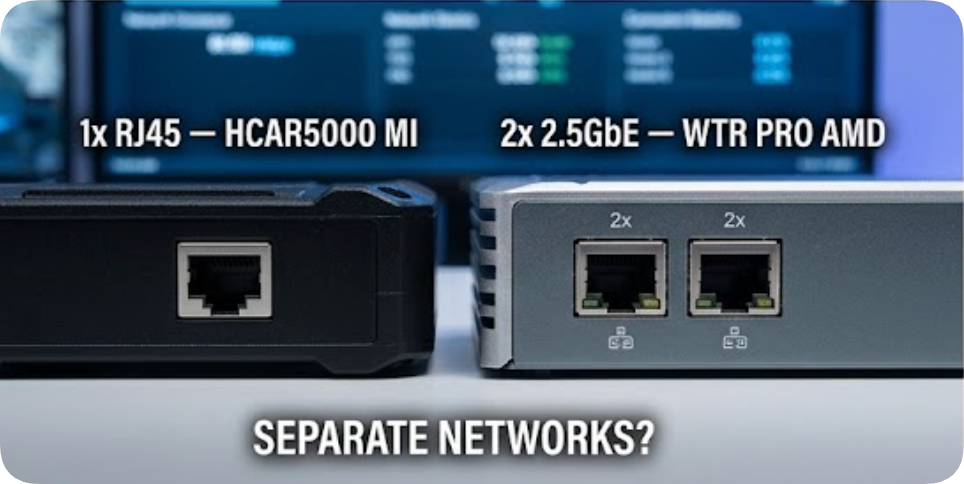
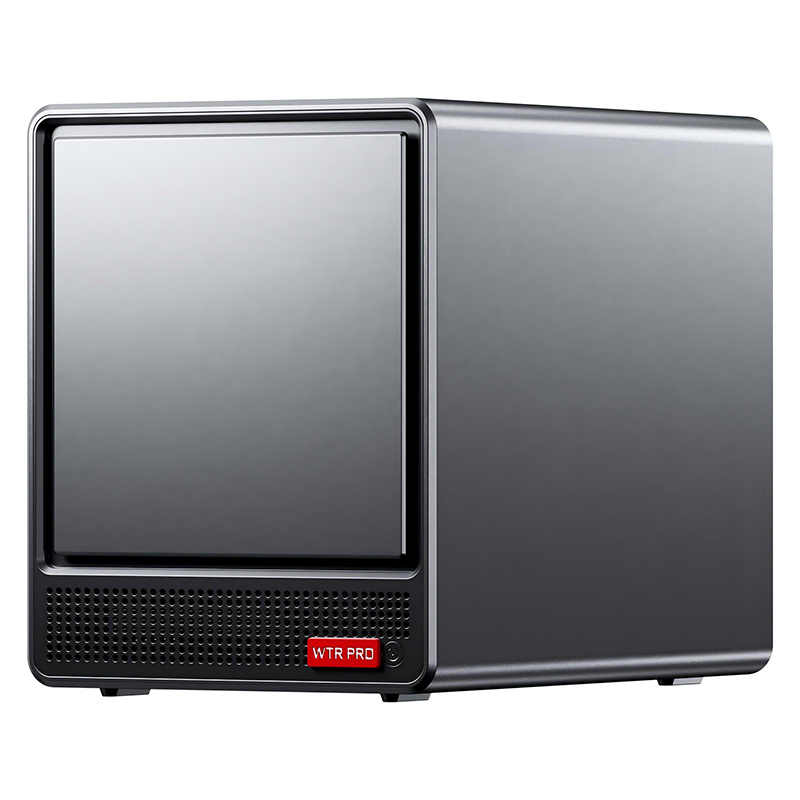
The WTR PRO AMD is the network and storage unit. It runs AMD Ryzen 7 5825U or an Intel N100, with Radeon or Intel UHD graphics, and the network specification is the headline: two 2.5GbE ports plus Wi-Fi 6. For a room where camera traffic and a management network need to be kept apart, two physical 2.5-gigabit interfaces is the clean answer, and it is the only one of the three Hotus units that provides it.
Storage follows the same brief. The page describes a high-performance four-SATA version supporting up to four SATA drives, which makes the unit suitable as a local media server or a network-attached storage appliance in a small server room, and a metal chassis is used for heat dissipation. Display output covers three screens through one HDMI port, one DisplayPort port and one Type-C port, quoted as triple 4K. A 120W DC adapter at 19V and 6.32A supplies power.
The figure to note is 5 kilograms, and it is quoted without a stated tolerance in the way the other two pages quote theirs. The body is 22.8 by 15 by 18.5cm. A metal chassis of that mass is fine on a shelf but is not a shelf-free or DIN-mounted option, which is exactly the position the AAEON unit occupies in this comparison.
The AAEON BOXER-6648-ARS is listed as a fanless industrial mini PC from Taiwan, positioned at the premium end at $1,200 to $2,000. Its processor options are Intel Core Ultra 9 285 or 285T, Ultra 7 265 or 265T, and Ultra 5 225 or 225T on Series 2, with an Intel H810 or Q870 chipset and up to 64GB of DDR5.
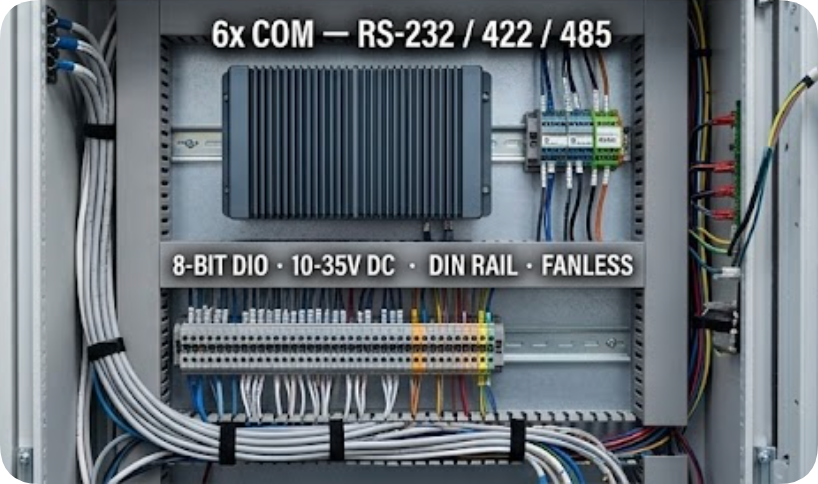
The interfaces are what separate it from everything above. It carries six COM ports supporting RS-232, RS-422 and RS-485, an 8-bit digital I/O block, dual HDMI 2.0 outputs, dual 2.5GbE ports plus a gigabit LAN port, dual M.2 SSD slots and dual 2.5-inch SATA bays, and Wi-Fi 6E with Bluetooth. Input is 10 to 35 volts DC, which covers vehicle, battery and industrial supply rails without a separate converter. The chassis measures 264 by 81 by 156mm, weighs 3.5 kilograms, is fanless by design, and supports both DIN rail and wall mounting.
Stated applications include industrial automation, machine vision, edge AI, intelligent transport, IoT gateway work and outdoor monitoring. Six serial ports plus digital I/O is the part that has no equivalent in the Hotus lineup: those two features together are what let a single box terminate camera and access-control wiring, read a dry-contact alarm, and drive a display, with no USB-to-serial adapters and no power conditioning.
| Palm-sized miniPC | Intel 12th Gen Core, i3-1215U to i9-12900HK, up to 12 cores and 16 threads | 1x 2.5G Ethernet, Wi-Fi 6, Bluetooth 5.2 | Not published; no COM or digital I/O listed | 2x HDMI 2.1 plus 1x Type-C, each quoted at 8K@60Hz | DC jack; PC+ABS case, 800g; fanless not claimed as standard | Not published on the product page |
| HCAR5000 MI | AMD Ryzen 5000H, 5900HX or 5800H or 5600H, Radeon Vega10 | 1x RJ45 | Not published; no COM or digital I/O listed | 1x DP 2.0b plus 1x Type-C with video | 202 x 212 x 65mm, 2455g; mounting not published | Not published on the product page |
| WTR PRO AMD | AMD Ryzen 7 5825U or Intel N100 | 2x 2.5GbE, Wi-Fi 6 | Not published; no COM or digital I/O listed | 1x HDMI, 1x DP, 1x Type-C, quoted as triple 4K | 22.8 x 15 x 18.5cm, 5KG metal chassis, 120W DC adapter | Not published on the product page |
| AAEON BOXER-6648-ARS | Intel Core Ultra 9 285 or 285T, Ultra 7 265 or 265T, Ultra 5 225 or 225T, Intel H810 or Q870 | 2x 2.5GbE plus 1x gigabit LAN, Wi-Fi 6E, Bluetooth | 6x COM RS-232/422/485 plus 8-bit digital I/O | 2x HDMI 2.0 | 10-35V DC input, fanless, 264 x 81 x 156mm, 3.5Kg, DIN rail or wall mount | $1,200-2,000 (about CNY 8,600-14,000) |
| Behind a large display or inside a tight wall cabinet | Palm-sized miniPC | 800g PC+ABS body and triple 8K output from two HDMI 2.1 ports plus Type-C, with four storage bays |
| Compute-heavy decoding or analytics at a workstation | HCAR5000 MI | Ryzen 5000H with Radeon Vega10 graphics and DDR4 to 64GB; accept the single RJ45 if one network is enough |
| Camera traffic on one network, management on another | WTR PRO AMD | The only Hotus unit with two physical 2.5GbE ports, plus the four-SATA version for local storage |
| Serial devices and alarm lines arriving on RS-232 or RS-485 | AAEON BOXER-6648-ARS | Six COM ports, 8-bit digital I/O and a 10-35V input range; the other three publish none of these |
| Cabinet-mounted, fanless, running 24 hours a day | AAEON BOXER-6648-ARS | Fanless by design with DIN rail or wall mounting; confirm the Hotus fanless variant with sales before committing |
Three questions will decide a control room purchase, and none of them is answered by a processor list. The first is thermal behaviour over twenty-four hours: a fanless aluminium chassis dissipates heat differently from a plastic one with a fan, and the comparison is not close enough on paper to skip a site test. The second is the firmware and driver layer, because six COM ports are worth nothing if the vendor's driver set is not on the approved equipment list of the security integrator. The third is the four to seven year replacement cycle that most control rooms actually plan for, which is longer than the published warranty on any machine in this comparison and longer than the hardware generation everyone is currently quoting.
What the published figures do support is a straightforward split. If the requirement is display output, storage expansion and a machine small enough to sit behind a panel, the Hotus units are competitive and one of them is unusually capable on both counts. If the requirement is cabinet-mounted fanless operation with field-wired serial and alarm inputs on wide-voltage power, the AAEON BOXER-6648-ARS is the only unit here that claims those features at all, and it should be priced against the total cost of adapters and converters the alternatives would need.
Readers running other deployments can review the full mini PC lineup for other chassis sizes, and rooms that also need a rugged panel for the floor or the gate can look at the related rugged tablet range. Further device comparisons across the catalog are collected in the device comparison archive, which is the right place to start when a room has to run both a display wall and a panel on the floor.