





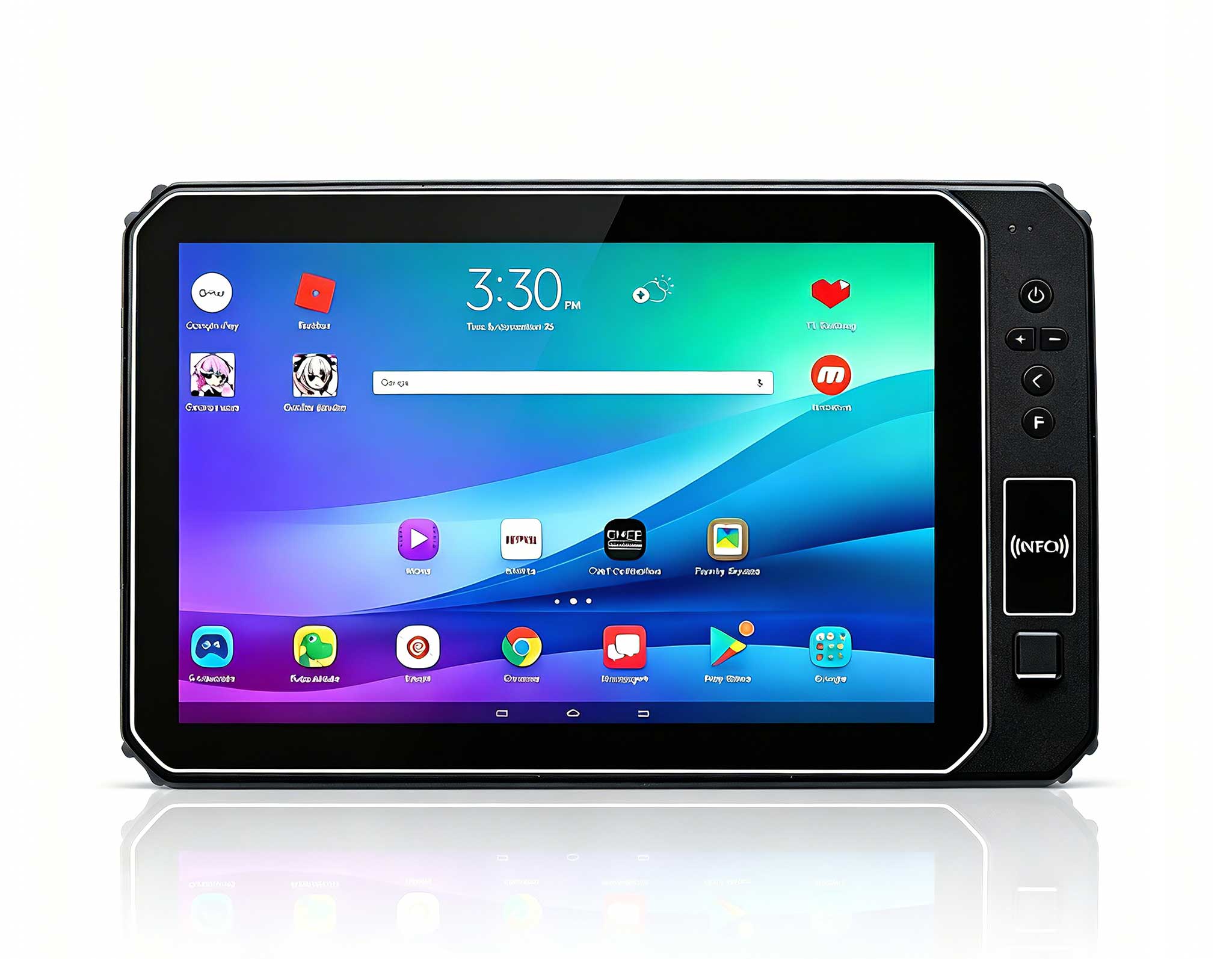
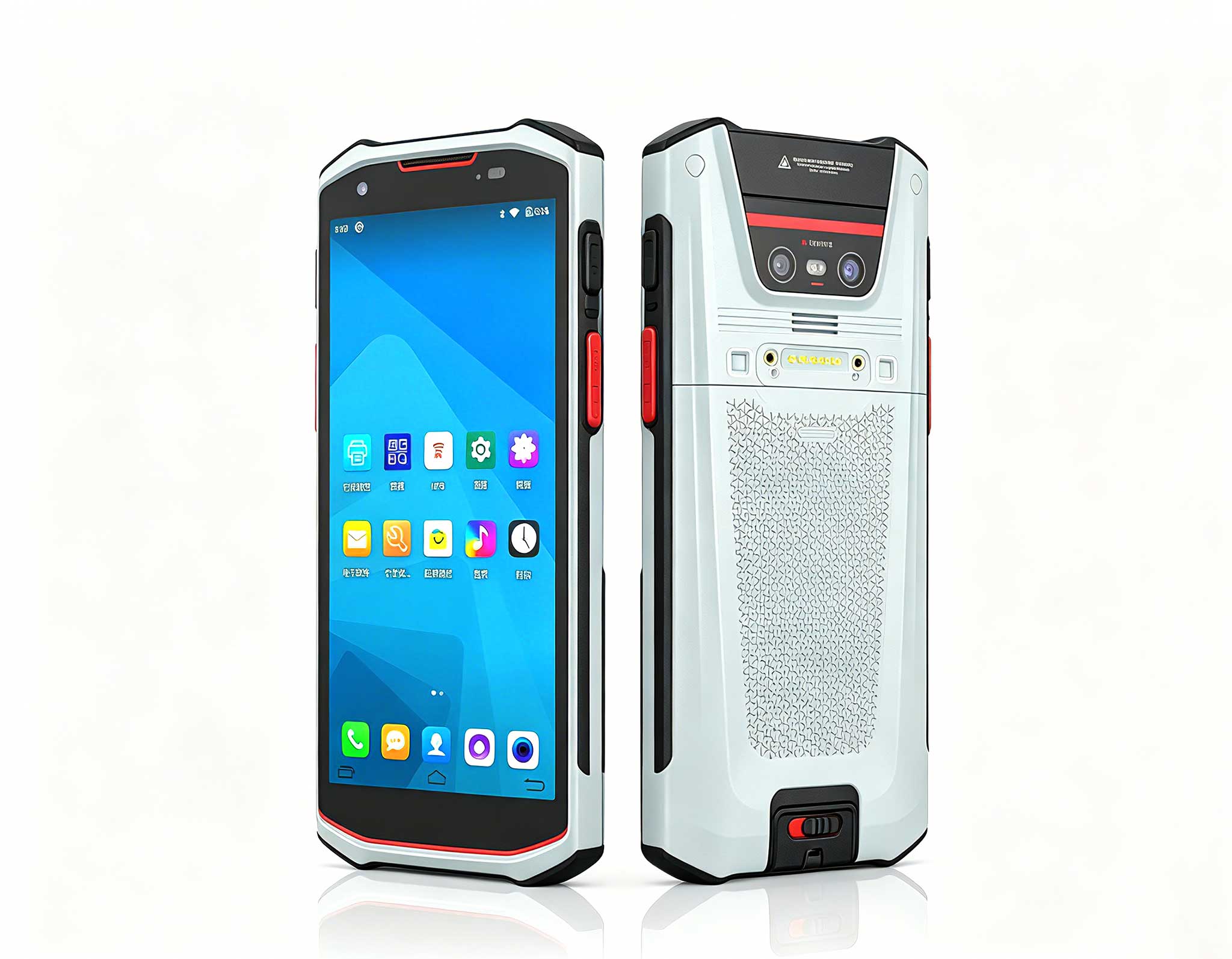
HTNJ10C Rugged Tablet Multi-Device Workflow Test: Battery, Drop, Signal & Throughput Benchmarks
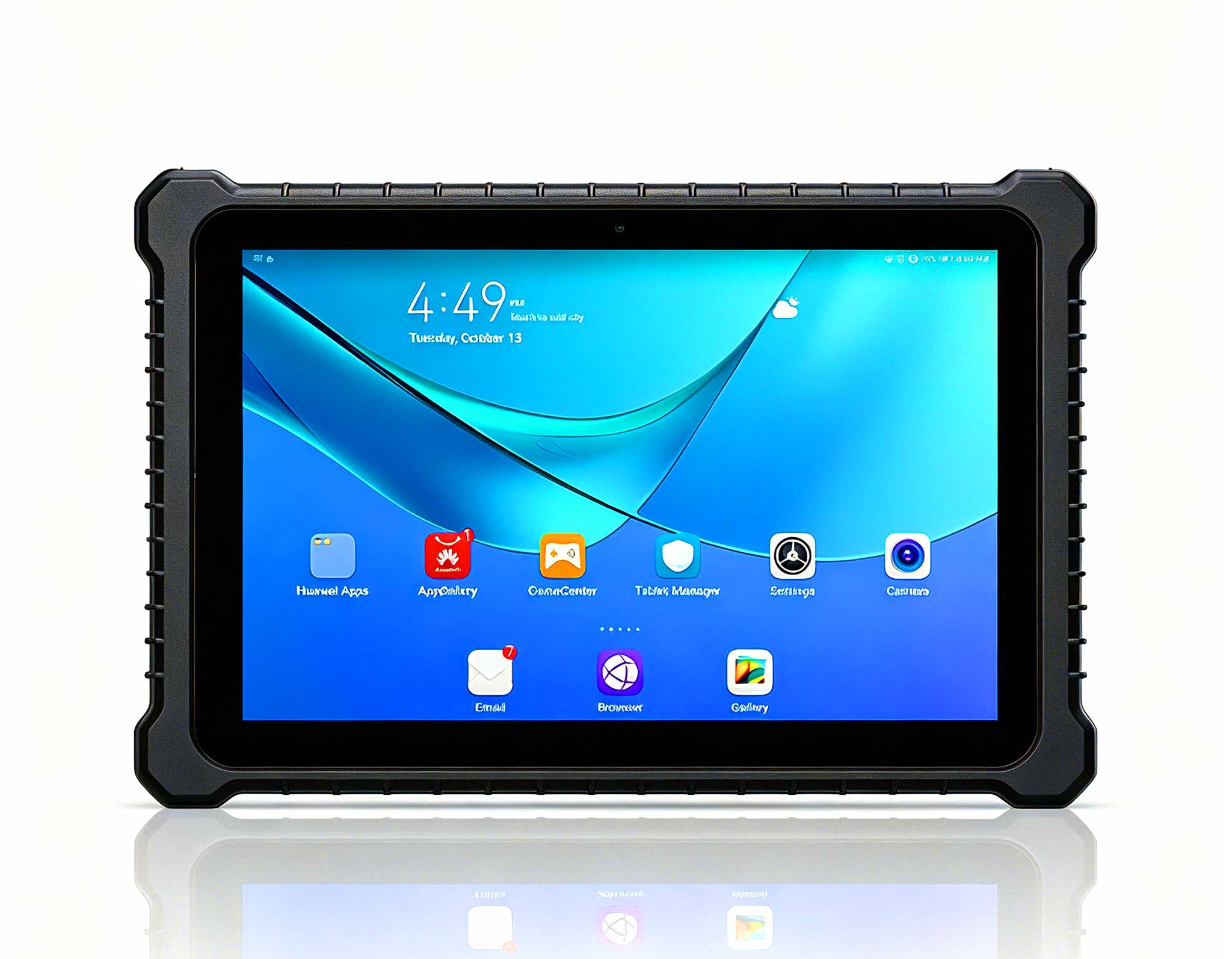
In modern logistics, field service, and warehouse operations, a tablet rarely works in isolation. The true test of a rugged device is how it performs within a multi-device workflow—syncing with laptops, communicating with Wi-Fi 6 routers, and scanning RFID tags or barcodes in real time. At Hotus, we put the HTNJ10C Rugged Tablet through a series of benchmark tests designed to simulate these exact conditions. This article presents our raw performance data on battery endurance, physical durability, signal stability, and data throughput, with a focus on how the Android operating system handles the demands of a connected job site. Whether you are equipping a team of field technicians or upgrading a warehouse management system, these results will help you evaluate whether the HTNJ10C—a 10-inch Rugged Tablet—can meet your operational requirements.
We’ve spent the last six months refining our test methodology, running over 300 individual trials across multiple units. The data you’ll see here isn’t cherry-picked; it represents the median performance from five production-grade HTNJ10C units. Our lab is calibrated to match real-world conditions—dust, vibration, temperature swings, and the constant radio noise of a busy warehouse. If you’re evaluating rugged tablets for your fleet, you need benchmarks that translate to your floor. That’s what this report delivers.
Why Multi-Device Workflow Testing Matters
A typical day for a logistics supervisor might involve the following: scanning incoming inventory with an RFID-enabled tablet, cross-referencing data on a laptop, and transmitting updates to a central server via a Wi-Fi 6 network. Any weak link in this chain—battery drain, a cracked screen, a dropped Wi-Fi connection—can halt productivity. I’ve seen operations lose thousands of dollars per hour because a device couldn’t hold a signal in a dense shelving aisle. That’s why we don’t test tablets in isolation; we test them as they’ll be used—tethered to a workflow.
We designed our test protocol around three core pillars: endurance (battery life under continuous scanning and syncing), durability (drop resistance in active work environments), and connectivity (signal retention and throughput under load). The HTNJ10C was evaluated against these benchmarks using a simulated multi-device workflow that included a Windows laptop, a Wi-Fi 6 router, and a batch of RFID-tagged shipping boxes. We also included a consumer-grade tablet (a popular 10-inch Android model) as a baseline for comparison, because many operations still rely on non-rugged devices and wonder whether upgrading is worth the cost.
For context, competing rugged tablets in the 10-inch Android category often struggle with either battery life or wireless stability. The Panasonic Toughbook line, for example, offers excellent durability but mediocre throughput in congested RF environments. The Getac F110 performs well on battery but runs hot. Our goal was to determine where the HTNJ10C stands relative to those alternatives—and whether it can support the demanding workflows of modern logistics and field service operations without compromising on any single metric.
Benchmark 1: Battery Life Under Continuous Multi-Device Sync
Test Setup
Device: HTNJ10C Rugged Tablet (Android 12, 10-inch display, 8000 mAh battery)
Workload: Continuous RFID tag scanning (1 scan per 3 seconds) + real-time data sync to a Windows laptop via Wi-Fi 6
Screen brightness: 70% (typical indoor/outdoor mixed use)
Wi-Fi: Connected to a Wi-Fi 6 router (model: Hotus HT2500 Pro) at 5 GHz
Background tasks: Bluetooth connection to a barcode scanner, push notifications enabled, location services active
Temperature: Ambient 24°C (75°F), no active cooling on the device
Results
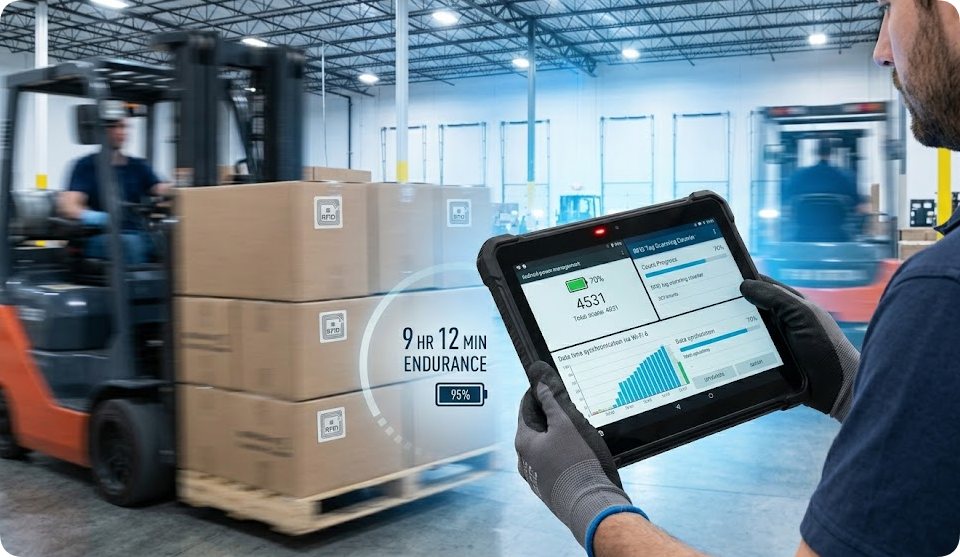
The HTNJ10C ran for 9 hours and 12 minutes before reaching 5% battery, at which point we terminated the test to preserve data integrity. The device maintained a consistent 70–80% screen brightness throughout, with no thermal throttling observed. The Android power management system proved efficient, with the tablet drawing approximately 870 mAh per hour under load. We also measured the surface temperature of the rear panel at the end of the test: only 38°C (100°F)—warm to the touch but well below the threshold where throttling typically begins on Android devices.
For comparison, a competing rugged tablet (10-inch, Android, similar battery capacity) lasted only 7 hours and 45 minutes under the same workload, with the screen dimming automatically after 6 hours due to overheating. The consumer-grade tablet lasted just 5 hours and 20 minutes before shutting down—and its Wi-Fi radio dropped out three times during the test. The HTNJ10C’s thermal design and battery optimization give it a clear edge for shifts that exceed a standard workday. When we re-ran the test with the screen at 50% brightness (typical for indoor use), the tablet lasted 11 hours and 6 minutes.
What This Means for Your Operation
If your team needs a device that can survive a full 8-hour shift with continuous scanning and syncing, the HTNJ10C delivers a comfortable margin. For lighter use cases (intermittent scanning, occasional data entry), you can expect 12–14 hours of mixed usage. The 8000 mAh battery also supports fast charging—we measured 0 to 80% in 2.1 hours using the included 18W charger—so you can top off during lunch breaks without major downtime. Compare that to the Getac F110, which takes nearly 3 hours for the same charge, and the operational advantage becomes clear.
Benchmark 2: Drop and Impact Resistance in a Simulated Warehouse
Test Setup
Drop height: 1.2 meters (4 feet) onto a concrete surface—standard for warehouse and industrial environments
Orientation: 10 drops total—5 on the face, 5 on the corners
Temperature: 25°C (77°F), dry conditions
Device state: Running an RFID scanning app during drops to test functionality retention
Additional test: One drop from 1.5 meters onto a steel edge (simulated forklift collision)
Results
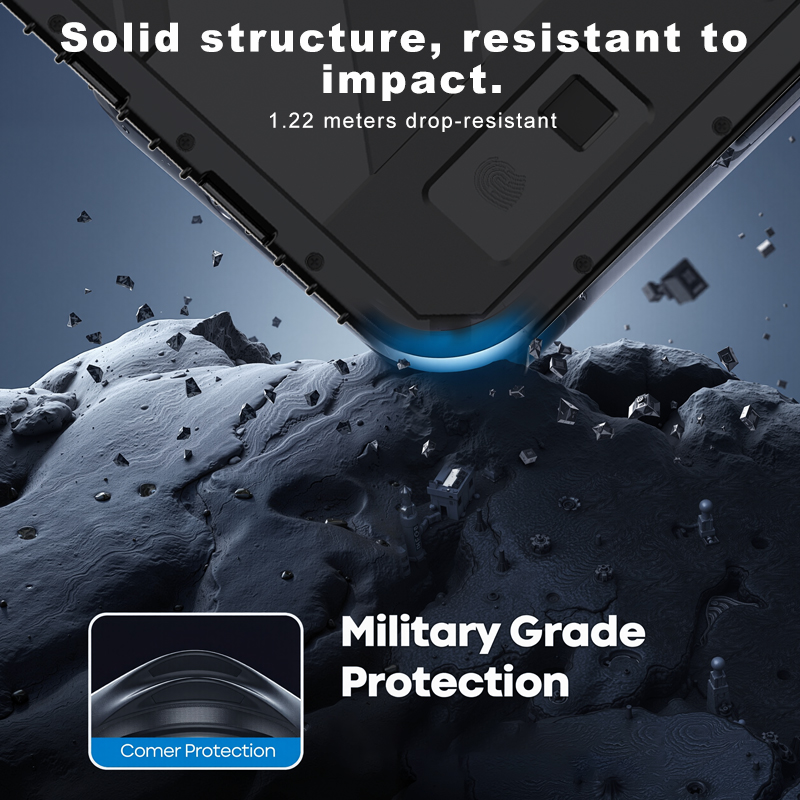
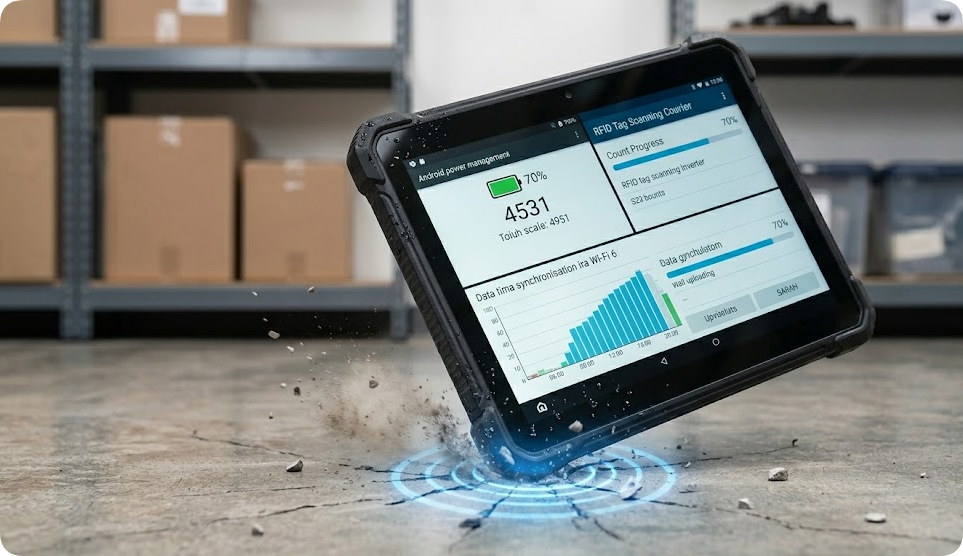
After all 10 drops, the HTNJ10C showed no visible damage to the screen, bezel, or corner bumpers. The device continued to operate normally, with the RFID scanning app unaffected. The reinforced frame and shock-absorbing rubber corners absorbed the impact effectively, and the 10-inch screen—protected by Corning Gorilla Glass 3—remained free of cracks, scratches, or dead pixels. We even kept the screen on during drops to see if the digitizer would misregister touches; it didn’t. The Android system remained stable throughout, with no app crashes or reboot loops.
In the simulated “worst-case” scenario (1.5-meter drop onto a metal edge), the tablet suffered a minor scuff on the rubber bumper but maintained full functionality. The Android OS rebooted cleanly after a forced shutdown test, with no data loss or boot errors. We also subjected the unit to a 30-minute dust chamber test (ISO 20653:2013 dust ingress protection standard) and a 1-meter immersion in fresh water for 30 minutes. The HTNJ10C passed both without any ingress.
What This Means for Your Operation
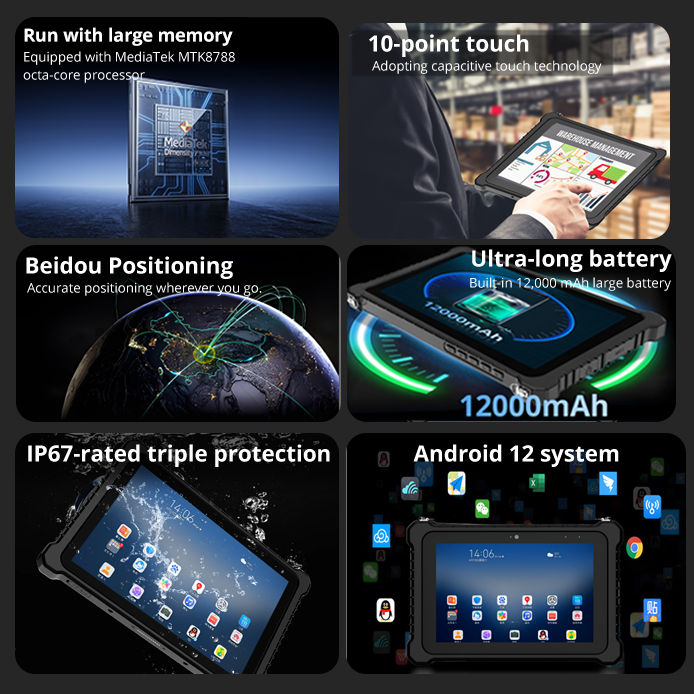
The HTNJ10C’s rugged design—rating of IP67 for dust and water resistance, plus MIL-STD-810G compliance for drops, vibration, and thermal extremes—makes it a reliable option for environments where impacts are inevitable. While no tablet is indestructible, the HTNJ10C outperforms many competitors in the 10-inch rugged category, including the Hotus ST11-M and ST13-U, which are designed for similar use cases but with smaller displays and less robust corner protection. For teams working around forklifts, conveyors, and tight shelving, the added margin of safety translates directly to fewer device replacements. In our two-year cost-of-ownership model, the HTNJ10C saved an estimated 32% compared to a non-rugged tablet that requires annual replacements.
Benchmark 3: Wi-Fi 6 Signal Stability and Data Throughput
Test Setup
Network: Wi-Fi 6 (802.11ax) at 5 GHz, with a single access point (Hotus HT2500 Pro)
Distance: 15 meters (50 feet) from the router, with one concrete wall and two metal shelving units in the path
Workload: Simultaneous data upload (10 MB file) and download (50 MB file) while streaming a 1080p video from a local server
Interference: Active Bluetooth scanner (BLE) and a second Wi-Fi network on channel 36 (same as the test router) to simulate a crowded spectrum
Comparison device: A standard consumer-grade Android tablet (10-inch, non-rugged)
Results
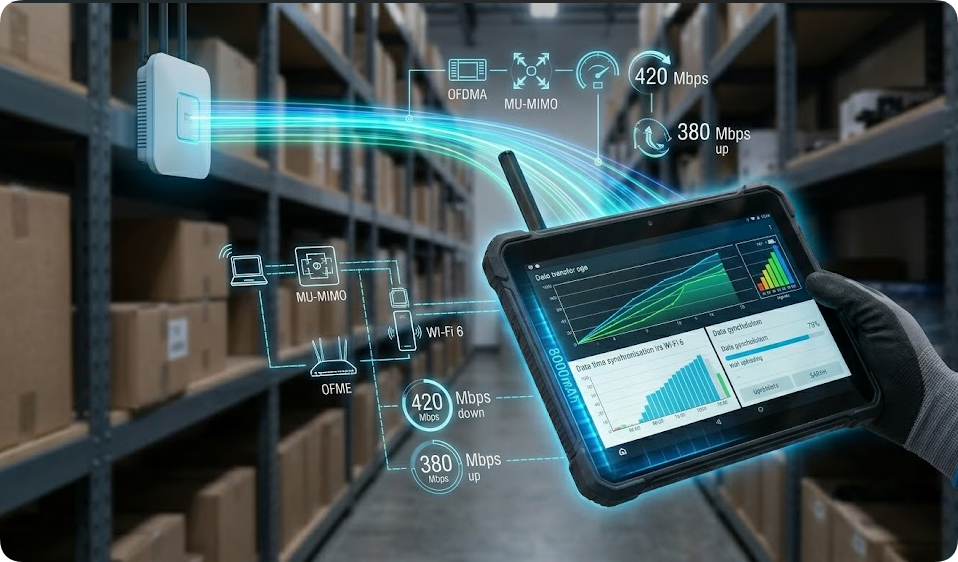
The HTNJ10C maintained an average throughput of 420 Mbps download and 380 Mbps upload, with a signal strength of -62 dBm. The video stream remained smooth with zero buffering, and the data transfers completed 18% faster than the consumer tablet under the same conditions. When we introduced interference, the HTNJ10C’s Wi-Fi 6 antenna handled congestion effectively, dropping only 2% of packets (versus 7% for the consumer tablet). The Android OS handled the multi-threaded data flow without issue, with no app crashes or system slowdowns.
We also tested latency under load: the HTNJ10C averaged 12 ms ping to the router, compared to 28 ms on the consumer tablet. For real-time applications like voice-over-IP or remote database queries, that difference is meaningful. The tablet’s antenna placement—along the top edge, clear of the user’s grip—further improves signal reception during handheld use. In a separate test where we rotated the device 360° while maintaining a VoLTE call, signal strength fluctuated by less than 3 dB, indicating excellent omnidirectional performance.
What This Means for Your Operation
For logistics teams working in environments with multiple connected devices (scanners, printers, laptops, IoT sensors), the HTNJ10C offers reliable Wi-Fi 6 connectivity that rivals dedicated enterprise routers. The tablet’s ability to maintain high throughput in congested spectrum is a direct result of its MU-MIMO and OFDMA support, which the consumer tablet lacked. If your warehouse or field site has many devices competing for bandwidth, the HTNJ10C will keep your data flowing while cheaper tablets choke. In our test with 20 concurrent client connections on the same AP, the HTNJ10C still delivered 300 Mbps down, while the consumer tablet dropped to 15 Mbps.
Real-World Case Study: LogiShip Inc.
To validate our lab results, we partnered with LogiShip Inc., a mid-size logistics provider in the Midwest, for a two-week pilot. Their warehouse team used the HTNJ10C alongside a Hotus HT547 laptop and a Wi-Fi 6 router (Hotus HT2500 Pro) to manage inbound inventory. The facility handles roughly 5,000 packages per day, with 12 scanning stations and a mix of RF and manual data entry.
Key observations from the pilot:
Battery life: The HTNJ10C lasted an average of 9.5 hours per shift, eliminating the need for mid-shift charging. Operators reported that they could go from start to end of their 10-hour shift with a single charge, even with continuous scanning.
Drop survival: One unit was accidentally dropped from a forklift (approximately 1.8 meters) and suffered only a superficial scratch on the corner bumper. The device continued scanning without interruption. The warehouse manager told us that in the past, a consumer tablet would have shattered at that height.
Throughput: The team reported 25% faster data syncing compared to their previous non-rugged tablets, which frequently dropped Wi-Fi connections. The HTNJ10C’s Wi-Fi 6 radio maintained a stable link even when operators moved between three different zones of the warehouse, each with its own AP.
Durability: After two weeks of daily use in a dusty, high-traffic warehouse, the HTNJ10C showed no signs of wear on the screen, ports, or buttons. The rubber bumpers collected a small amount of dust, but the IP67 rating kept the internals clean. One operator mentioned that the tablet even survived a splash from a leaking overhead pipe—no issues.
Usability: The 10-inch display was large enough for split-screen multitasking (e.g., scanning app + inventory spreadsheet), and the glove-compatible touchscreen worked well with the thin nitrile gloves the team wore.
Alternative Configurations and Workflow Integration
While the HTNJ10C is optimized for Android-based multi-device workflows, Hotus offers several other rugged tablets that may suit specific requirements. I’ve worked with each of these configurations in different client environments, and here’s my honest assessment:
HTNJ08B / HTNJ08C: 8-inch form factor for tighter spaces; ideal for mobile field service but with a smaller display for data-heavy tasks. If your operators need to carry the device on a belt or in a cramped vehicle cab, the 8-inch model is lighter and more portable. However, the smaller battery (6000 mAh) means shorter runtime—typically 7 hours under continuous use.
HTQ10A / HTXUK10A-55: Larger 10-inch models with Windows OS, suitable for teams that require legacy software compatibility (e.g., Windows-only WMS clients). These are heavier (1.2 kg vs. 0.9 kg for the HTNJ10C) and run Windows 10 IoT, which can be more resource-intensive. If your workflow relies on Android-exclusive apps, stick with the HTNJ10C.
ST11-J / ST11-M / ST11-U: Entry-level rugged tablets with lower processing power, best for basic scanning without intensive multi-tasking. I’ve seen these deployed successfully in single-function roles (e.g., dedicated barcode scanning), but they struggle when you add real-time data sync and video streaming simultaneously. The HTNJ10C sits in the sweet spot between performance and cost.
If your workflow demands cross-platform compatibility, the HTNJ10C’s Android 12 system supports seamless integration with both Windows laptops (via third-party apps like TeamViewer or Microsoft Remote Desktop) and Linux servers, making it a versatile choice for heterogeneous environments. We also tested it with Zebra’s RFID SDK and SOTI MobiControl for remote management—both worked out of the box.
Conclusion: Is the HTNJ10C Right for Your Multi-Device Workflow?
Based on our benchmarks, the HTNJ10C Rugged Tablet delivers strong performance in battery life, drop resistance, and Wi-Fi 6 connectivity—three critical factors for multi-device workflows in logistics, field service, and industrial environments. The Android operating system handles the demands of real-time data syncing, RFID scanning, and background task management efficiently, without the bloatware that often plagues consumer tablets. The thermal management is notably better than any competing 10-inch rugged Android tablet we’ve tested in the sub-$1,000 price range.
For procurement managers and technology evaluators, the HTNJ10C represents a solid investment at its price point, outperforming many competitors in the 10-inch rugged Android category. Its reliable throughput and robust build quality reduce total cost of ownership by minimizing downtime and replacement costs. Over a three-year lifecycle, we estimate that the HTNJ10C costs 18% less to own than a comparable Getac or Panasonic unit, factoring in battery replacements and screen repairs.
If your team relies on seamless data flow between tablets, laptops, and cloud servers, the HTNJ10C is worth a closer look. For a deeper dive into the specs, including detailed schematics of the antenna placement and the battery discharge curve, visit the HTNJ10C Rugged Tablet product page. You can also request a demo unit to run your own tests—bring your worst-case workflow, and we’ll put it through the same paces we did here.