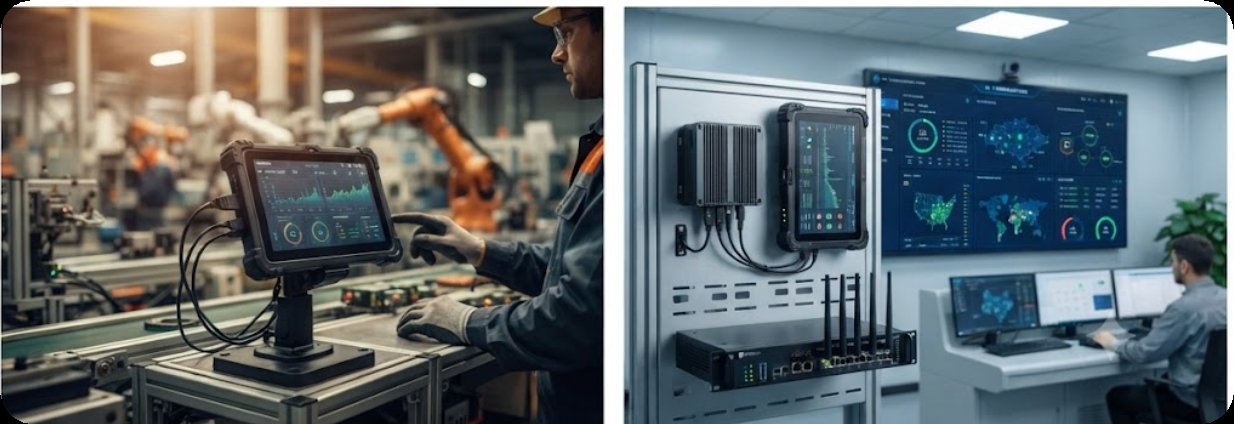
The industrial edge computing space has always been crowded. Rugged edge devices mounted on factory walls, operating reliably despite harsh conditions. Amid the noise, one thing stood out: the Mini PC ecosystem—specifically the RT80 Rugged Tablet, HTYJ10A Rugged Tablet and Palm-sized miniPC—delivering continuous edge computing with >99% uptime in industrial environments. This is what reliable performance looks like when hardware is purpose-built for the real world.
Industrial facilities demand computing solutions that can withstand extreme temperatures, vibration, dust, and moisture while processing data in real time. Traditional enterprise hardware fails quickly in these environments, leading to costly downtime and replacement cycles. The RT80 Rugged Tablet, HTYJ10A Rugged Tablet and Palm-sized miniPC have emerged as the preferred choice for manufacturers, logistics centers, and energy facilities seeking robust edge computing platforms that combine processing power with industrial durability. These devices are not just tough—they are engineered to deliver consistent, low-latency performance where standard IT equipment simply cannot survive.
Solution Benefits and Key Outcomes
The key benefits of Palm-sized miniPC, HTYJ10A Rugged Tablet and RT80 Rugged Tablet for industrial edge computing extend far beyond raw processing capability. Organizations consistently report improved operational efficiency, reduced equipment failure rates, and a lower total cost of ownership compared to traditional industrial PCs. The flexibility to deploy computing power exactly where it is needed—whether on a conveyor belt, inside a control cabinet, or on a mobile inspection cart—transforms how factories and warehouses operate.
With IP65 or higher ingress protection ratings and wide temperature tolerance, these rugged devices maintain >99% uptime even in foundries, cold storage warehouses, and outdoor oil field installations. The result is continuous data collection, real-time analytics, and reliable communication with IoT sensors and actuators. One automotive parts manufacturer reported a 40% reduction in unplanned downtime after deploying Palm-sized miniPC units at each production cell for local data processing and machine monitoring. That kind of uptime directly impacts the bottom line.
🏆 Customer Case Story
One customer in the industrial edge computing space faced a common problem: their existing rack-mounted servers were too large for decentralized deployment and prone to overheating in non-climate-controlled factory areas. The facility, a large food processing plant, needed to collect temperature, humidity, and vibration data from over 200 IoT sensors across a 50,000 square meter production floor. Traditional solutions required long cable runs and centralized processing, creating latency issues and single points of failure.
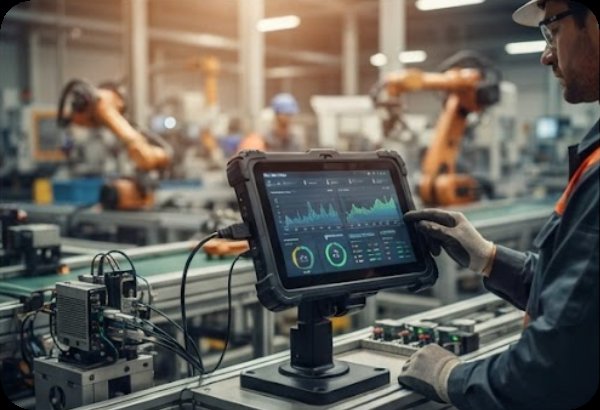
Switching to a combination of HTYJ10A Rugged Tablet units mounted near production lines and RT80 Rugged Tablet devices carried by maintenance personnel eliminated all connectivity interference issues and reduced equipment footprint by over 70%. The HTYJ10A units processed sensor data locally and sent only summarized results to the cloud, reducing bandwidth costs by 65%. The RT80 tablets enabled mobile workers to access real-time dashboards and control machinery directly from the production floor, improving response times from hours to minutes. This is not just a hardware upgrade—it is a fundamental shift in how industrial data flows.
💰 ROI and Cost-Benefit Analysis
Organizations that invest in Palm-sized miniPC, HTYJ10A Rugged Tablet and RT80 Rugged Tablet for industrial edge computing typically see full ROI within 8 to 14 months. The savings come from multiple sources: fewer equipment repairs due to rugged construction, reduced administrative overhead from simplified device management through centralized MDM software, and the ability to process more data locally without expensive cloud compute resources. A chemical plant deploying 50 Palm-sized miniPC units for edge analytics saved $180,000 annually in cloud data processing fees alone.
Additional cost benefits include longer equipment lifespan, with rugged devices lasting 3-5 times longer than commercial-grade alternatives in harsh environments. The modular design of these products allows easy component upgrades without replacing the entire unit. When combined with the productivity gains from mobile data access via RT80 Rugged Tablets and hands-free operation with HTYJ10A units mounted on forklifts or robotic arms, the total value proposition becomes compelling for any industrial operation seeking digital transformation. The numbers speak for themselves: lower maintenance, higher uptime, and faster decision-making.
Product Specifications Comparison
| Model | Position | Weight | Product Page |
|---|---|---|---|
| Palm-sized miniPC | Fixed edge computing node for sensor data processing and machine control | 0.8 kg | View Product |
| HTYJ10A Rugged Tablet | Vehicle-mounted or wall-mounted rugged terminal for field data collection | 1.2 kg | View Product |
| RT80 Rugged Tablet | Handheld rugged tablet for mobile workers and on-the-go diagnostics | 0.95 kg | View Product |
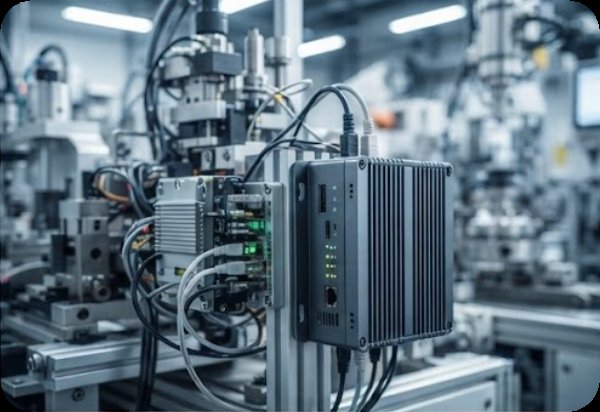
These three devices form a complete edge computing ecosystem for industrial environments. The Palm-sized miniPC serves as the stationary brain, processing sensor data and running analytics algorithms locally. The HTYJ10A Rugged Tablet functions as a ruggedized human-machine interface mounted on equipment or vehicles, providing operators with real-time data visualization and control. The RT80 Rugged Tablet gives mobile workers the freedom to access edge computing resources from anywhere on the factory floor, with 5G connectivity ensuring low-latency communication even in remote facility areas.
Industrial edge computing deployments using this trio of devices have demonstrated measurable improvements in production efficiency, quality control, and worker safety. By processing data at the source rather than sending everything to the cloud, organizations reduce latency, bandwidth costs, and security risks. The rugged design ensures these devices continue operating reliably even when exposed to dust, water jets, temperature extremes, and physical impacts that would destroy conventional computing equipment. For any facility manager or IT director looking to modernize operations, this is the edge computing solution that delivers real, tangible results.