Nearly every edge business case is written the same way: take the hardware price, divide by the expected life, compare it against the saving, and present the answer in a slide. It is a defensible method and it systematically understates the value, because it treats the equipment as the thing being bought when the thing actually being bought is an hour of production that did not stop. Working backward changes which questions get asked. Instead of asking what a node costs, ask what one hour of stopped output costs, then ask how many of those hours the node removes, and only then look at the invoice. A plant that runs this calculation in the other order frequently reaches a different shortlist entirely. If you are building the case, start from dedicated industrial edge computing solutions and write down your hourly loss figure before you look at a single price.
Counting Backward From the Loss
The arithmetic is not exotic. A line that ships a known value per hour, multiplied by the hours lost per year to unplanned stops, produces a number that dwarfs any hardware budget within about two steps of multiplication. Once that number is on the page, the conversation changes shape. A node that removes four hours of unplanned stoppage per year is not a device with a price tag; it is a device with a payback period measured in weeks. The method also exposes the purchases that never should have been made, because plenty of edge hardware removes no detectable hours at all and only adds management surface. Counting backward is the cheapest way to tell the two apart before money moves.
Where the Clock Actually Starts
Most downtime estimates start the clock at the moment a machine stops, which is the wrong start. The clock starts when the fault begins and nobody knows, which can be hours earlier on a line running a slow drift in temperature or vibration. This detection gap is where edge computing earns most of its return, because local inference notices the drift while it is still a warning rather than a failure. The repair duration, which everyone measures, is usually the smaller half of the loss. The detection delay, which almost nobody measures, is usually the larger half, and it is the half that moving compute next to the machine actually compresses.
The Smallest Node Against the Tariff
Detection requires compute that sits close enough to the sensor to see the drift in real time, and close usually means inside the cabinet beside the machine rather than in a rack two corridors away. The Palm-sized miniPC fits that constraint because it is small enough to share an enclosure with the controller and efficient enough to run without a fan, which matters in a cabinet that already has a thermal problem. Against an hourly loss figure, the argument is straightforward: a unit costing a fraction of one hour of output, sitting next to the assets that produce that output, is the cheapest insurance on the floor. The usual objection is that a small box cannot do much inference, which was true several generations ago and is not true now.
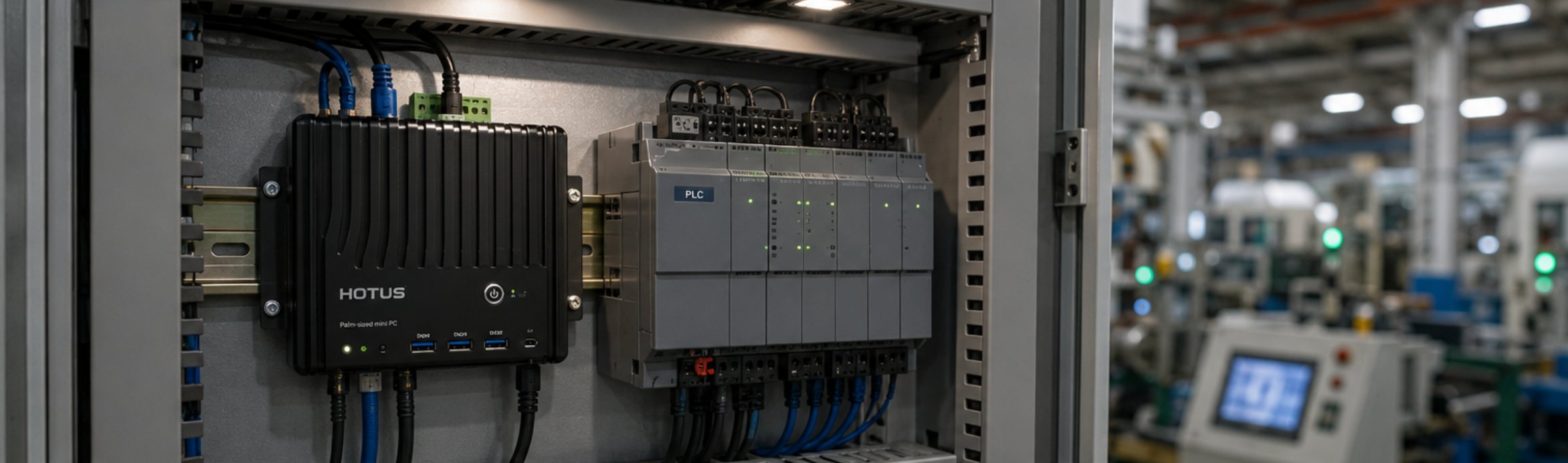
A Palm-sized miniPC sharing an enclosure with a machine controller, where local inference catches drift before it becomes a stoppage.
An Android Panel for the Rounds
Detection only converts into saved hours if someone acts on it, and the person who acts is usually walking a route rather than sitting at a console. That is a different purchase from the node, and it is frequently bought from a different budget line by a different team, which is why the two halves of the system so often fail to connect. The HTQ10A Android Rugged Tablet is the unit specified for the rounds themselves: an Android panel that runs the inspection and alerting application, survives a full shift in a plant environment, and keeps the technician moving rather than walking back to a fixed terminal. When the alert reaches the person who can act on it while they are still near the asset, the detection gap and the response gap both shrink at once.
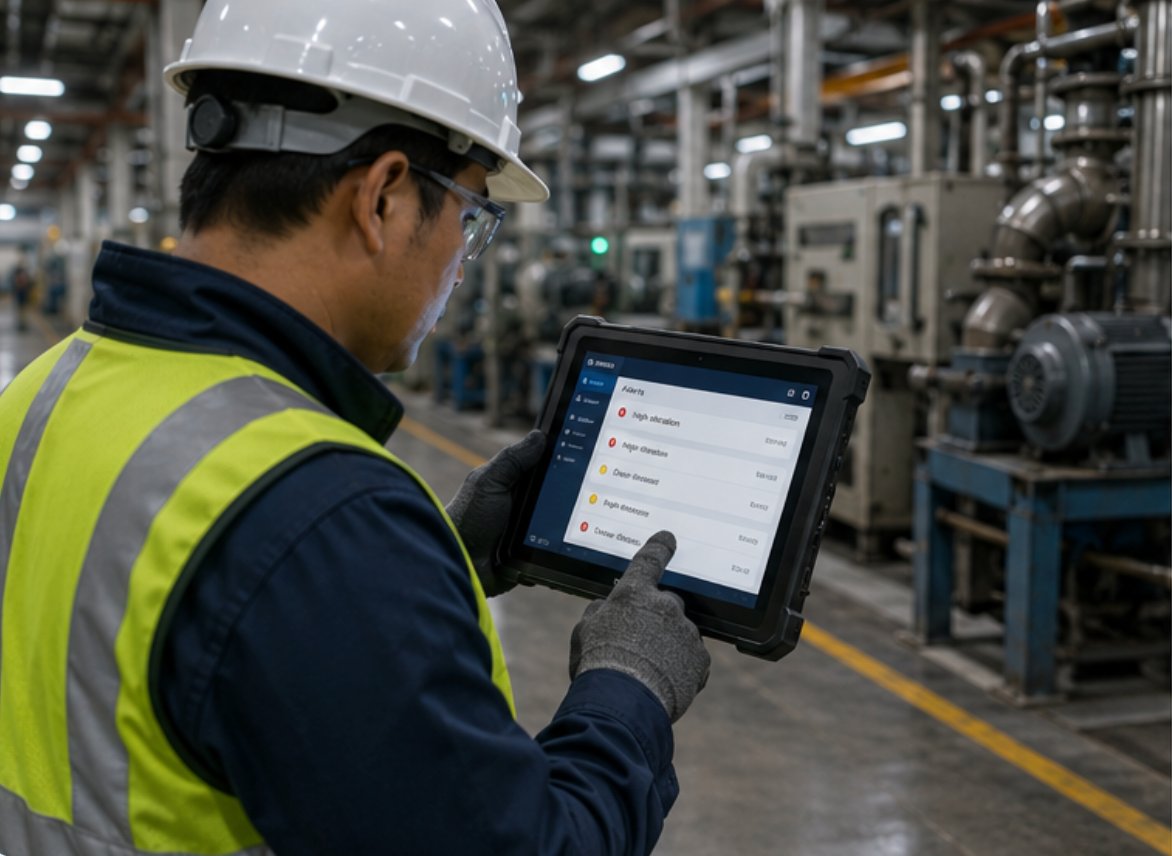
A technician working a maintenance route with the HTQ10A, where an alert reaches the person who can act on it while they are still near the asset.
When 5G Earns Its Line Item
The expensive radio is the easiest thing to over-buy and the easiest thing to under-buy, and the tariff test settles it. High-bandwidth, time-critical work such as streaming live inspection video from a moving technician justifies the premium link, because the alternative is a technician who has to stop, find a fixed point, and upload later. Steady, low-volume work such as a sensor reading every few seconds does not. The RT82 Rugged Tablet carries the 5G link and its premium belongs on the routes where the hourly loss figure is highest and the work is live. Buying that capability for every route is how a sound case turns into an indefensible one.
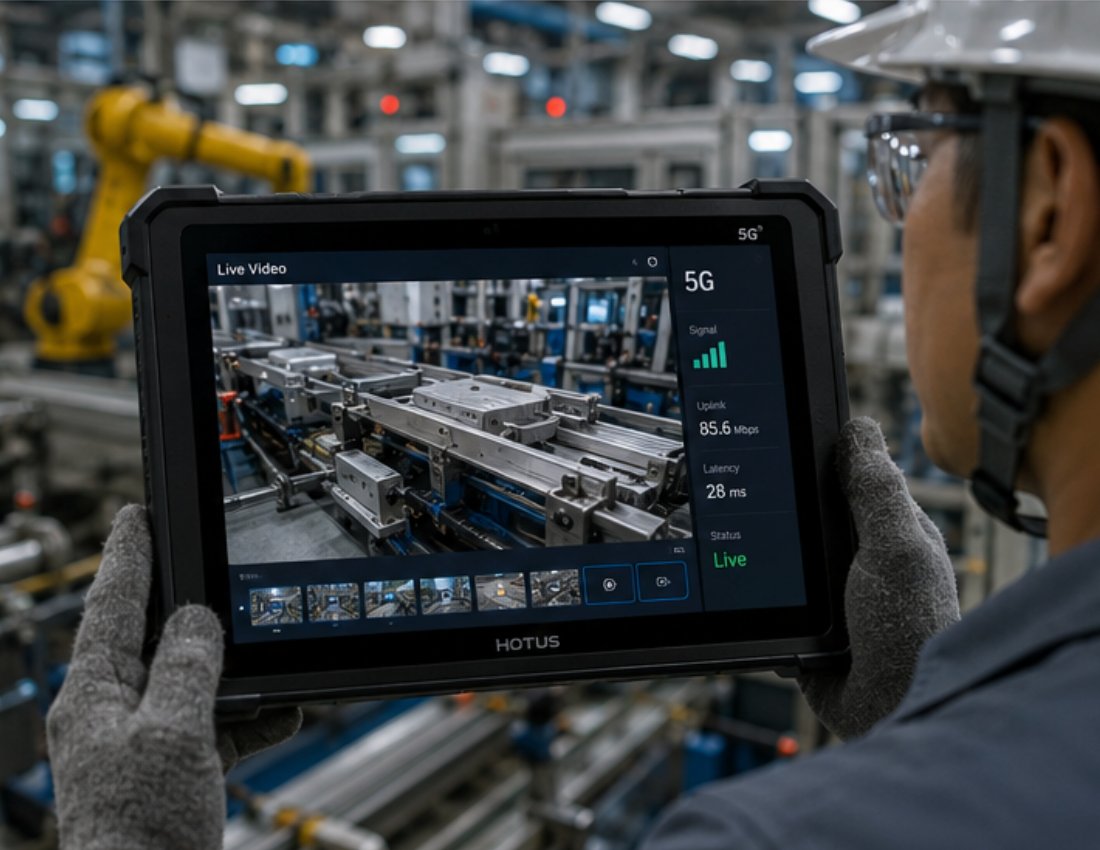
An RT82 streaming live inspection video from the line, where the premium radio is justified by the value of the hour it protects.
The Break-Even Table
The table below runs the backward calculation for four representative failure modes. The hourly loss column is what the plant loses while the asset is down; the detection column is how much of that loss the local node removes by catching the fault earlier; the hardware column is the annualised cost of the equipment that removes it; and the final column is how long the hardware takes to pay for itself against that saving.
| Failure mode | Hourly loss | Hours removed per year | Annualised hardware cost | Payback period |
|---|---|---|---|---|
| Bearing drift on a packaging line | high | 6 to 9 | low (one node) | weeks |
| Vision misalignment on inspection | high | 4 to 6 | low (one node) | weeks |
| Missed readings on manual rounds | medium | 3 to 5 | mid (panel per route) | months |
| Live video blocked by poor coverage | high | 2 to 4 | high (premium radio) | months |
Costs That Never Reach the Invoice
Three costs routinely vanish from these models and then reappear in year two as a budget overrun. The first is integration: getting a new node to talk to an existing historian or maintenance system is engineering time, and it is rarely quoted by the hardware vendor. The second is management surface: every additional device type is another image to patch, another spare to stock, another configuration to drift. The third is the human one, which is training, because the best alerting system in the world returns nothing if the technician has never been shown what the alert means. None of these invalidate the method; all three mean the payback period in the table is optimistic by some margin, and a case that survives that haircut is a case worth approving.
Running the Numbers Across a Whole Site
The practical way to use this is one asset at a time rather than one plant at a time. Pick the four or five failure modes that actually cost money, write the hourly figure next to each, and ask what equipment would remove how many hours. Where the payback is measured in weeks, buy. Where it is measured in years, do not. That discipline produces a mixed fleet rather than a uniform one, which is the correct outcome and the one most procurement processes resist. Our industrial mini PC solutions cover the cabinet-side compute while the rugged panel range covers the routes, and where industrial workloads land in 2026 maps the same hardware against the architecture question. Send us your hourly loss figures and your worst five failure modes and we will tell you which of them hardware can actually shorten.