The record button on a conference system is the smallest control in the room and the one with the longest legal tail. Press it and the conversation stops being a conversation and becomes a personal data file: it has subjects, it has a retention clock, it can be requested, and it can be demanded as evidence. Most organisations discover this at the worst possible moment, usually when someone in another department asks for a copy of a meeting nobody remembered was recorded, or when a dispute turns on a file that was deleted on a schedule nobody wrote down. The hardware does not create the obligation, but it decides how hard the obligation is to meet. This article follows the file from the moment the button is pressed to the moment it is provably gone, and shows what each step requires of the equipment. If you are specifying rooms, begin with dedicated video conferencing solutions and then read your retention policy before you read the camera specification.
The Button That Starts a Legal Obligation
A recording is not the same category of object as a live call. A live call ends and, in principle, leaves nothing behind. A recording persists, which means it acquires a lawful basis for processing, a retention period, an access path, and a deletion requirement. Different regimes phrase these differently, but the shape is consistent: data protection rules in Europe, sector rules in finance and healthcare, and employment rules nearly everywhere all converge on the same expectation that recorded people were told, the file is kept only as long as it is needed, and it can be produced or destroyed on request. None of that is exotic. What makes it hard is that these duties attach at the moment of capture, long before anyone in legal or IT knows the file exists.
🔍 Consent Is a Design Problem Too
Consent is usually discussed as a policy question, which is why it so often fails as an engineering one. A notice that appears on a wall display in ten-point type satisfies nobody, and a verbal announcement at the start of a call is impossible to evidence afterwards. What works is boring and physical: a visible indicator that stays lit for the duration of the capture, an entry in the meeting invitation that is generated automatically rather than typed by the organiser, and a join experience that tells a remote participant before their audio starts. The last of these matters most, because the remote participant has no way to see the light in the room. If a system cannot do that without custom development, that is a specification finding, not a policy gap.
Where the File Lands Matters More Than the Camera
Once the file exists, the question that determines everything downstream is where it is stored. A capture that lands on a cloud tenant under an enterprise agreement inherits that agreement's retention, encryption, and access controls. A capture that lands on a local disk inside a room host inherits none of them and becomes an unmanaged copy of a regulated file, sitting in a device behind a monitor with no inventory entry and no deletion schedule. The HCAR5000 MI is specified for this role because the host is the point where that decision is enforced: local storage can be encrypted at rest and, where policy requires it, disabled entirely so that capture is only possible into the managed destination. Choosing a host on processor performance alone is how an organisation ends up with excellent video and an ungoverned archive.
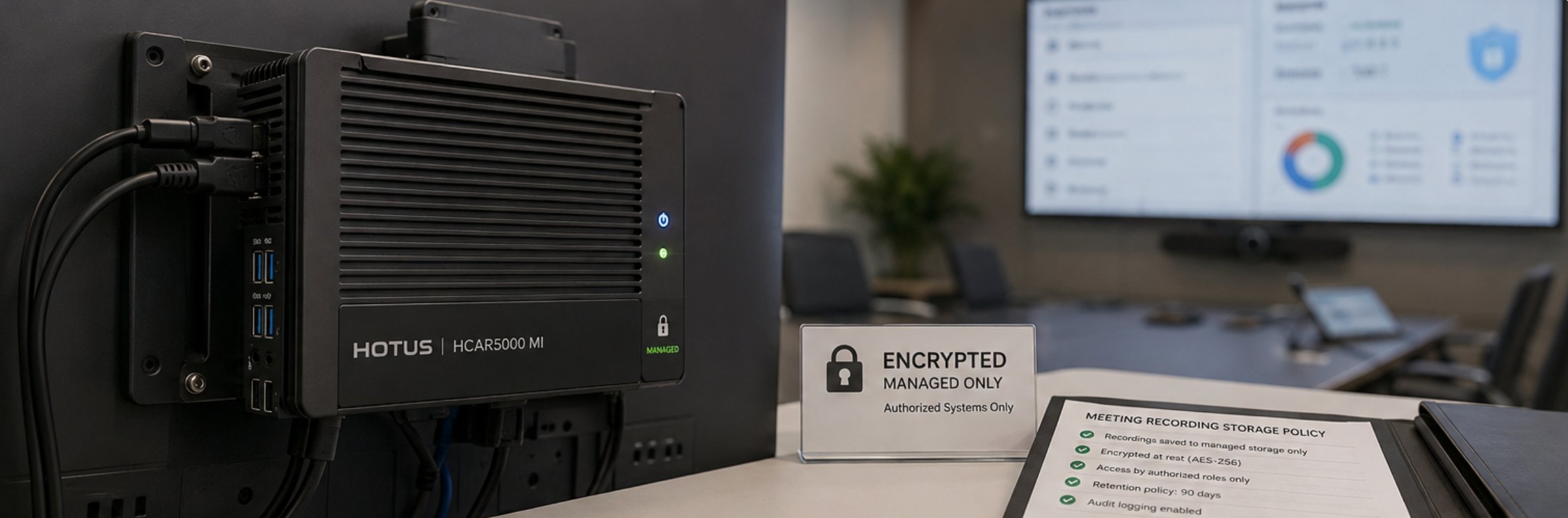
An HCAR5000 MI room host configured so capture writes only to the managed destination, with local storage encrypted and under inventory control.
A Panel That Can Start a Capture by Accident
The control surface is where policy quietly loses to muscle memory. A presenter holding a tablet is holding the record button, and a tap that starts a capture unintentionally creates a file that nobody knows about, which is the worst possible state: an unmanaged recording with no consent record and no retention clock. The SH6 rugged tablet is the unit most often deployed as the roaming control point precisely because it travels with the presenter, and that mobility is a governance question as much as an ergonomics one. The mitigations are unglamorous and effective: a confirmation step before capture begins, a persistent on-screen indicator while it runs, and a policy that the primary control surface is not the one in a walking presenter's hand.
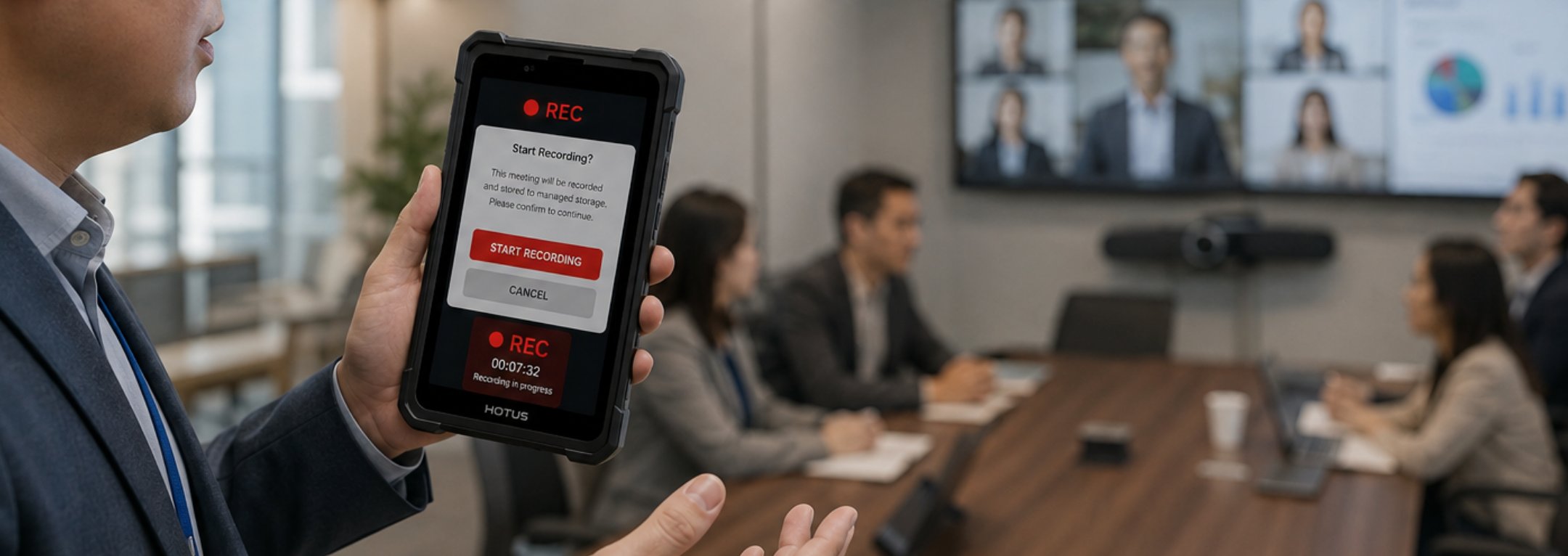
An SH6 used as the roaming control point, where a confirmation step and a persistent indicator prevent a capture nobody intended to start.
Retention Clocks Nobody Set
Recordings accumulate faster than any policy anticipates, because a room that hosts six meetings a day generates a file per meeting and nobody feels responsible for the total. Default retention in most platforms is either indefinite or governed by a tenant-wide setting that was chosen years ago for a different purpose, and both outcomes are indefensible under a reasonably strict reading of data minimisation. The fix is to set the clock per category rather than per tenant: a routine internal standup may warrant thirty days, a client negotiation may warrant a contractual period, and a disciplinary conversation may warrant something else entirely. The table maps the categories to what each one demands.
| Capture category | Typical retention | Who must approve access | Deletion trigger |
|---|---|---|---|
| Routine internal meeting | 30 days | organiser | automatic expiry |
| Client or supplier negotiation | contract term plus margin | account owner | contract closure |
| Regulated financial disclosure | statutory period | compliance function | statutory expiry |
| HR or disciplinary conversation | employment limitation period | HR plus legal | case closure |
| Training or briefing capture | until superseded | content owner | new version published |
Access Requests Meet an Export Nobody Tested
A data subject request for a recording arrives as an email to a general inbox and turns into a frantic search across a platform nobody has queried before. What makes it painful is rarely the policy; it is that the export path has never been exercised. Someone discovers that the file exists in two places, that the export requires a role nobody holds, or that the recording contains participants whose identities were never logged. Testing the export once a quarter, with a named owner and a recorded result, converts an emergency into a task. It also surfaces the duplicate copies that accumulate when a host keeps a local cache nobody disabled.
The Deletion Record That Closes the Loop
Deletion without evidence is not deletion in any sense a regulator will accept. Automatic expiry is the mechanism that does the work, but the artefact that satisfies an audit is the record: what was destroyed, when, under which retention rule, and on whose authority. A system that expires files silently leaves the organisation unable to prove it complies, which is the same position as not complying at all. Where a host keeps local storage, the erasure procedure for that device at end of lease has to be part of the same record, tied to the asset tag rather than to the room name.
🔮 Writing the Capture Policy Before the Next Rollout
The pattern across all of this is that the compliance burden sits in the places a hardware evaluation rarely looks: where the file lands, who can start one, how long it lives, whether it can be exported, and whether its destruction can be proven. Camera resolution and speaker tracking are the easy half of the decision and the half that appears on every comparison sheet. The other half is a configuration choice made once and then inherited by every meeting for the next five years. Our rugged mini PC solutions cover the room host while the rugged handheld tablets cover the control surface, and how hybrid work redrew the meeting room covers why one device no longer fits every space. Send us your retention categories and your access approval rules and we will tell you which of them the hardware can enforce rather than merely permit.