Branding a rugged tablet under your own name is straightforward until the first customs officer, distributor audit or corporate buyer asks for evidence. Then the program lives or dies on a folder of documents, and the suppliers who can produce that folder on demand are the ones worth shortlisting. This guide walks through the file set an OEM or ODM buyer should assemble around three representative hardware bases: the ST11-U as the 10.1-inch Windows flagship class, the SH6 as the compact 6-inch Windows handheld, and the HTNJ10C as the expandable 10.1-inch workhorse. Each checkpoint below names the document, why it exists and what a weak answer looks like. For the manufacturing side of the relationship, start with the OEM and ODM programme overview.
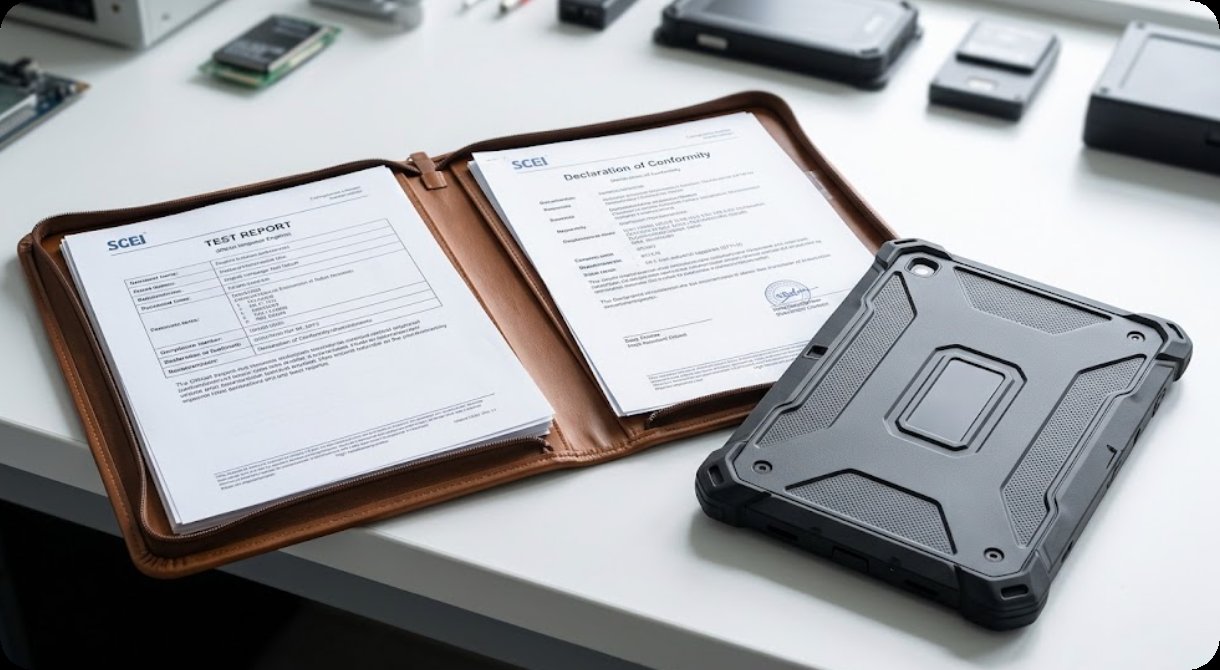
Safety Reports Before Branding Decisions
The first documents in the folder predate any logo. Before a distributor accepts a branded device, they expect independent evidence for the battery and the enclosure: cell test reports for the removable packs, and drop or impact evidence behind the ruggedness claims. The hardware bases differ in exactly the ways that shape this file. The ST11-U carries a 7.6V 6000mAh removable lithium pack rated 45.6Wh; the SH6 runs a 3.8V 5000mAh removable cell; the HTNJ10C uses a 7.6V 3500mAh removable pack. Three different chemistries and capacities mean three separate report sets, and a buyer who consolidates them into one generic certificate will be asked to separate them sooner or later. Ask the manufacturer for the report that matches each specific pack, not a family-level summary, because auditors read part numbers before they read headlines.
Ingress Ratings and the Evidence Behind Them
Sealing claims are the easiest place for a programme to inherit risk silently. The three bases publish different levels, and each level is a separate engineering commitment. The ST11-U is documented at IP65 with IP67 and IP68 buildable as options, supported by MIL-STD-810G certification and a 1.2-metre drop rating, with the full build sheet published on the ST11-U rugged industrial tablet page. The SH6 and the HTNJ10C are both documented at IP67 with MIL-STD-810G; the sealed 6-inch build is specified on the SH6 rugged industrial tablet page. A buyer's file should contain the test reports behind whichever level the branded product will claim on its own packaging, because the moment your brand prints "IP67", your company owns that claim in every market you ship to. The weak answer to watch for is a datasheet without a report; the strong answer is a report whose sample description matches the configuration you actually ordered, since an optional gasket or port cover can change the rating between two builds of the same shell.
✅ Radio and Regulatory Paperwork per Market
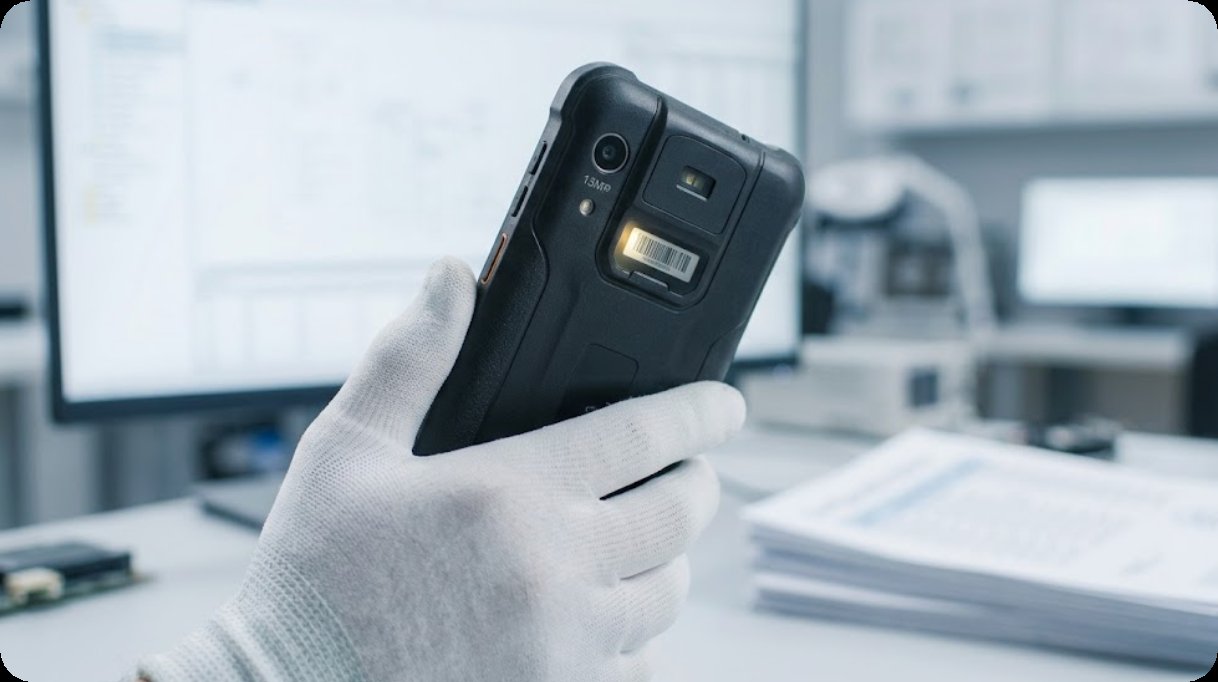
Every wireless capability inside the enclosure adds a page to the regulatory section. The SH6 in particular is built for field data work, with a 13MP rear autofocus camera, an optional 1D/2D scanner module and Bluetooth-class radios that vary by configuration, while both 10.1-inch bases carry standard wireless sets for Windows deployments. For each destination market, the folder needs the radio approval certificate for the exact frequency configuration being shipped, a declaration of conformity listing the applicable directives, and labelling artwork that matches what the regulations require on the case. Market rules change often enough that a file assembled for last year's shipment should be re-checked, not reused. Buyers configuring variants for different regions should also keep a configuration matrix mapping each SKU to its approval documents, because a mixed pallet with two radio builds is a classic audit finding when the mapping exists only in someone's inbox.
⚖️ Change Control Between Build Generations
An OEM programme is a moving target: a panel source changes, a cell supplier rotates, a screw specification is revised. Each of those events can alter compliance evidence, which is why the change-notification procedure belongs in the folder next to the certificates themselves. This is also where the three bases show their different personalities. The HTNJ10C is designed for serviceability, with standard RAM plus SSD storage that supports M.2 expansion and a 2.1kg chassis built around that headroom, as documented on the HTNJ10C rugged tablet page, so its change surface is wider than the sealed SH6, whose 460g body has less room for silent substitutions. A practical requirement to write into the OEM agreement: any change to the bill of materials that touches a certified subsystem triggers written notice before shipment, with the affected report referenced by number. Programmes that skip this clause usually discover the gap when a regulator or a large end customer asks why the device in the box no longer matches the report in the file.

Labelling, Marking and Carton-Level Evidence
Compliance does not stop at the device. The carton, the marking on the case and the printed materials inside all carry obligations, and a well-run file records them as deliberately as the certificates. At minimum the folder should hold: approved label artwork for each market, photographs of the actual markings on a production sample, the rated-voltage and battery marking evidence for each removable pack, and a packing declaration consistent with the shipping configuration. The three bases illustrate why per-model files matter even inside one programme. A 1190g 10.1-inch unit with a 45.6Wh pack, a 460g handheld with a 3.8V cell and a 2.1kg serviceable tablet each land in different categories on shipping paperwork, and reusing one model's marking photos for another is the kind of shortcut that turns a routine inspection into a detained shipment.
The File as a Living Checklist
| Checkpoint | Document to hold | Weak answer | Strong answer |
|---|---|---|---|
| Battery safety | Cell and pack reports per part number | One family-level certificate | Reports matching each pack: 6000mAh, 5000mAh, 3500mAh |
| Ingress and shock | IP and MIL-STD-810G reports for the ordered build | Datasheet claims without reports | Report sample description matches the ordered configuration |
| Radio and market approval | Per-market certificates plus a SKU-to-approval matrix | One certificate reused across regions | Configuration matrix maps every SKU to its approvals |
| Change control | Written notification clause with report references | Verbal notice of substitutions | BOM changes trigger notice before shipment |
| Labelling | Approved artwork plus production-sample photos per model | Shared photos across models | Per-model marking evidence with rated pack details |
Treat the table as a living index rather than a one-time checklist: every new SKU, market or revision adds a row, and the folder grows with the programme instead of trailing it. Buyers comparing hardware bases for a multi-model programme can cross-check the published build differences under the comparison news section, where the same three families appear in side-by-side form.
Verification Habits That Keep the Folder Honest
The last habit is behavioural again. Once per programme year, pull one random shipped batch and test the folder against it: can you produce the battery report, the ingress report and the radio approval for exactly that batch within a day? The ST11-U, with its option-dependent sealing levels, the SH6, with its scanner-equipped configurations, and the HTNJ10C, with its expansion-driven change surface, each create legitimate variation between builds, and the drill exists to prove your records track that variation. A supplier who keeps the raw records as a by-product of production will pass the drill without preparation, and that supplier is the one whose OEM programme stays audit-proof as it scales. Buyers mapping the wider hardware range behind a programme family can review the manufacturer's product lines before fixing the model mix.