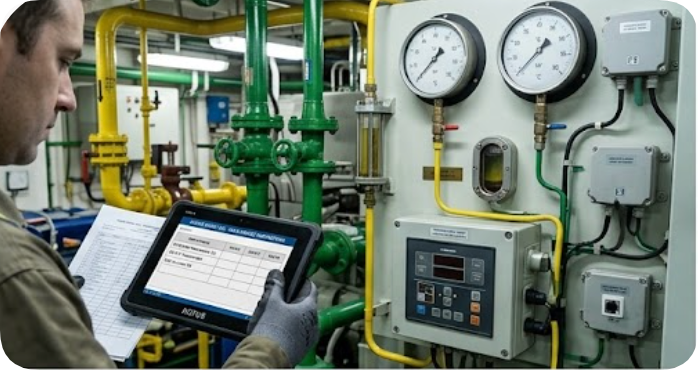
An engine room runs on rounds. Four times a watch, someone walks the compartment with a clipboard: jacket cooling water temperatures, lube oil levels, separator hours, bilge checks, greasing points. Every reading ends up on paper first, then gets re-keyed into the planned maintenance system, then gets filed. A chief engineer who was asked to justify a tablet upgrade for exactly this routine did not want a flagship pitch. What he asked for instead was a recovery schedule per unit, not a brochure. The answer was a mixed set: the HTNJ08A for the round walk itself, the HTNJ08B for the planning desk, and the HTQ10A for every post a round has to climb.
The Paper Round Sheet That Never Stops Costing
Paper looks free until you price the labor around it. A four-round day produces roughly thirty minutes of transcription per engineer per shift, which across a four-man rotation adds up to more than seventy unpaid clerical hours every month. Sheets that come out of the compartment blurred by diesel mist or soaked at the bilge get re-copied from memory, and a re-copied reading is a reading nobody can defend at the next survey. Then there is the reconciliation drag: every month the office matches hand-written hours against the maintenance plan, and every mismatch turns into an email chain.
Chip speed never decides a purchase like this. What decides it is which device removes which cost, and how soon the removal shows up in the accounts. That framing put three units on one order, each assigned to a cost the paper system kept charging month after month.
HTNJ08A: The Unit That Retires Paper
The HTNJ08A is the workhorse that replaces the clipboard itself. The engine inside is Intel's Celeron N5100, a quad-core part that bursts to 2.8 GHz and runs full Windows 10 Pro or 11 Pro, so the same planned maintenance client the office already licenses installs unmodified and logs straight onto the ship network. The 8-inch IPS panel pushes 1200 by 1920 resolution at 560 nits, bright enough to read a gauge table against the glare of engine room lighting, and the 7H hardened glass accepts wet-hand and stylus input when fingers carry oil film. Entry happens at the machine, not afterward.
The detail that sells this unit to a technical office is the RJ45 port. Docked at the control console, the HTNJ08A lands its round data straight onto the ship network without touching wireless at all, and the 12-pin Pogo Pin interface carries the same connection to a cradle. Its 3500mAh cell slides out of the bay in seconds, so a swap at the console is a pause rather than a reboot. The double-layer shell carries an IP67 sealing grade with MIL-STD-810G papers and 1.22-metre drop protection, holds that rating from minus 20 up to 55 degrees Celsius, and shrugs off a tropical compartment as easily as a winter deck crossing. At roughly 1.8 kilograms gross with a 238 by 160 millimetre footprint, it fits the console shelf a clipboard already occupies. Scan modules for 1D and 2D codes, UHF RFID and TPM2.0 security are order options, and the stores keeper can verify spare part tags on the same walk instead of a second trip.
Priced against the transcription hours alone, the HTNJ08A clears its purchase cost inside one quarter, and every survey after that runs on handwriting nobody has to decode twice.
HTNJ08B: Same Chassis, More Software Headroom
The HTNJ08B looks identical to the HTNJ08A, and that is the point. Inside the same 8-inch, IP67, 1.22-metre-rated chassis, an Intel Pentium N6000 quad-core clocks higher, bursting to 3.3 GHz, and that headroom belongs to the fleet's second user: the engineer running vibration trend curves, thermal history graphs and the full planning suite at the control room desk, not just round entry.
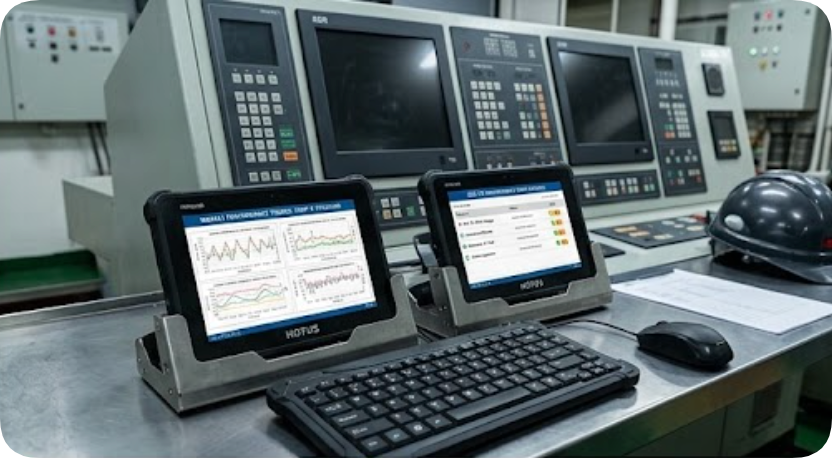
The ROI argument for the HTNJ08B is mostly an argument about everything it makes unnecessary. Because the chassis, the 3500mAh removable battery, the 19V adapter and the docking pin-out are identical to the HTNJ08A, the fleet carries one spare battery type, one cradle design and one training session instead of three. The same RJ45 port, the same USB Type-A and Type-C, the same Mini HDMI and SIM slot mean the office orders one accessory kit and fits both units. And because the HTNJ08B runs desktop-class planning software at the desk, the team does not need to buy, power and maintain a separate laptop in the engine control room. One shared spare pool and one deleted hardware line are quiet savings, but they repeat every procurement cycle.
HTQ10A: Light Enough for Ladder Watch Rounds
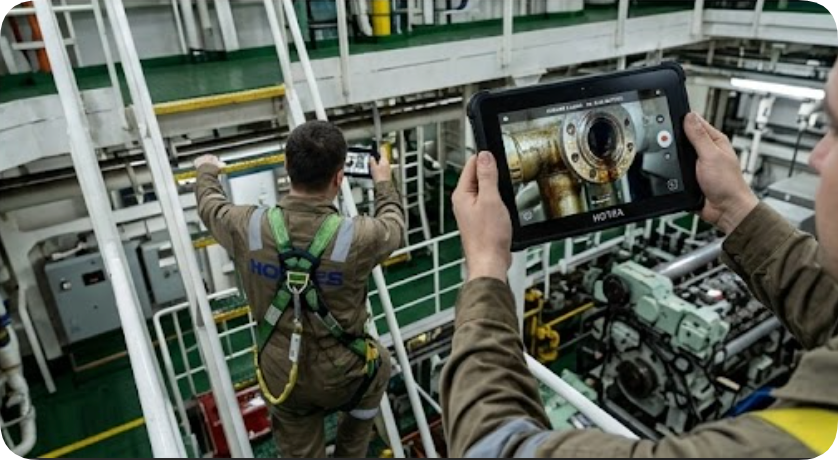
The third unit covers the part of the round the other two cannot reach comfortably. The HTQ10A weighs about 950 grams on a 275 by 178 millimetre body, which is the difference between a device an engineer clips to a belt and one he leaves on the desk before climbing the ladder to the upper platform. A Qualcomm octa-core chip clocked at 2.0 GHz drives Android 12, while the 10.1-inch full HD panel with 400 nits of brightness behind Corning Gorilla Glass answers gloved or wet fingers on the first tap.
What turns the HTQ10A into a payback line rather than a convenience is the combination of the camera and the battery. The 13MP rear autofocus camera with LED flashlight turns a leaking flange or a chafed cable run into a dated photo evidence attached to the work order, which closes the argument about when a defect appeared and who saw it first. Its 10000mAh cell supports fast charging and quick swap, outlasts any single watch on record, and deletes the spare-battery purchase for this unit entirely. An IP67 sealed chassis with MIL-STD-810G papers, 1.2-metre drop resistance, dual-band Wi-Fi, Bluetooth 5.0 and global 4G LTE rounds the unit out, and it leaves the vessel in the surveyor's bag when class inspection comes aboard.
A Spares Pool That Shrinks the Whole Budget
Fleet commonality is the part of the math that never shows up on a single-unit datasheet. The HTNJ08A and HTNJ08B share batteries, adapters, cradles and accessories, so the onboard spares locker holds one kit that fits two units. The HTQ10A stands outside that pool on purpose: its 10000mAh cell makes spare batteries for it unnecessary, so it adds capability without adding a stock line. Optional modules across the range, from barcode scanners to UHF RFID and fingerprint readers, are ordered only for the units that will use them, which keeps the configuration lean instead of paying twice for capture hardware nobody touches.
The Payback Table a Chief Engineer Can Sign
| Fleet role | Unit | Engine | Display | Battery | Field rating | ROI driver |
|---|---|---|---|---|---|---|
| Round entry at the machine | HTNJ08A | Celeron N5100 quad-core, burst 2.8GHz | 8-inch, 1200x1920, 560 nits | 7.6V 3500mAh removable | IP67, MIL-STD-810G, 1.22m, RJ45 | Deletes transcription hours |
| ECR planning desk | HTNJ08B | Pentium N6000 quad-core, burst 3.3GHz | 8-inch, 1200x1920, 560 nits | 7.6V 3500mAh removable | IP67, MIL-STD-810G, 1.22m | Replaces the ECR laptop, shares one spares pool |
| Ladder and photo rounds | HTQ10A | Qualcomm octa-core 2.0GHz, Android 12 | 10.1-inch, 1200x1920, 400 nits | 3.8V 10000mAh quick-swap | IP67, MIL-STD-810G, 1.2m, 950g | Dated photo evidence, no spare batteries bought |
The table maps roles to cost lines rather than ranking hardware. A four-man rotation kitted with one HTNJ08B, two HTNJ08A units and one HTQ10A puts a device at every post while keeping every capability single-sourced in the budget.
Twelve Months of Return, Measured in Rounds
The model the chief engineer settled on counts three things. First, transcription: at seventy clerical hours a month recovered across the rotation, the fleet pays for itself before the second quarter closes. Second, defensibility: round readings captured at the machine with timestamps and, on the HTQ10A, photo attachments, end the re-copied-entry arguments that used to surface at every class survey. Third, procurement: one shared spares pool for the two Windows units and zero spare batteries bought for the Android unit, repeated across every annual order. Twelve months in, three facts had settled the argument: no sheet was ever re-keyed, no defect timeline was disputed at survey, and no laptop was ever bought for the control room. Nothing about the walk got faster. What changed is that every round became an asset the moment it was recorded, instead of an hour waiting to be transcribed later.
FAQ: What Chief Engineers Ask Before Ordering
1. Can the HTNJ08A and HTNJ08B run our existing planned maintenance software?
Yes. Both units run full Windows 10 Pro or Windows 11 Pro, so the desktop maintenance client your office already licenses installs unmodified, and the RJ45 port puts the unit directly on the ship network at the console.2. How do the units hold up against salt air and washdown?
All three bodies carry IP67 dustproof and waterproof sealing plus MIL-STD-810G papers. Both Windows units survive drops to 122 centimetres, the Android unit to 120, and all three keep working from minus 20 up to 55 degrees Celsius.3. Will the HTQ10A really last a full watch without charging?
Its 3.8V 10000mAh removable battery is sized for longer than a single watch, and it supports fast charging and quick swap, so even a double rotation is a battery change rather than a downtime event.4. Do we need to stock different chargers and docks?
The HTNJ08A and HTNJ08B share the same 19V adapter, battery format and 12-pin Pogo Pin docking, so one spares kit covers both. The HTQ10A charges over its own fast-charge path and needs no spare batteries in stock.Every hour a round sheet spends in transcription is an hour the compartment has already paid for. The rugged tablet category page lists the complete line, the HTNJ08A, HTNJ08B and HTQ10A product pages carry current specifications and module options, the Hotus product range covers the wider catalog for other posts aboard, and the news and comparisons section collects deployment write-ups from fleets that made the same switch.