Twice a quarter, a regional distributor we supply runs a physical stock audit across its warehouse and three satellite counters. The exercise is not the daily picking that every barcode terminal handles by default; it is a full reconciliation of roughly two hundred SKUs across shelving bays, demo shelves, transit cartons and a returns cage, ending in a signed variance report for the ERP. Whoever walks the floor needs three things at once: a scanner that reads through shrink wrap, a printer for damaged shelf labels, and hardware light enough for a four-hour counting window. Those three demands are exactly where F505, R860-S and X501 divide the work between them.
Two Hundred SKUs Across Nine Shelving Bays
The audit opens at 6:30, before the counters open and the forklifts start. Nine bays, one demo wall, the transit area and the returns cage are split into zones, and each zone gets one counter with one terminal. The counting method is bin-by-bin: scan the bin's location label, then scan or key in the quantity, so the export at the end of the morning lists variance by location rather than as one grand total. The last pass logged a little over two hundred SKUs and just under nine thousand scan events — thousands of trigger presses, glove contact on every screen, and a route that keeps counters on their feet all morning. A fleet plan for this kind of programme, covering terminal classes and running costs, is laid out in our handheld PDA range.
⚖️ Barcode Truth Versus the Paper Manifest
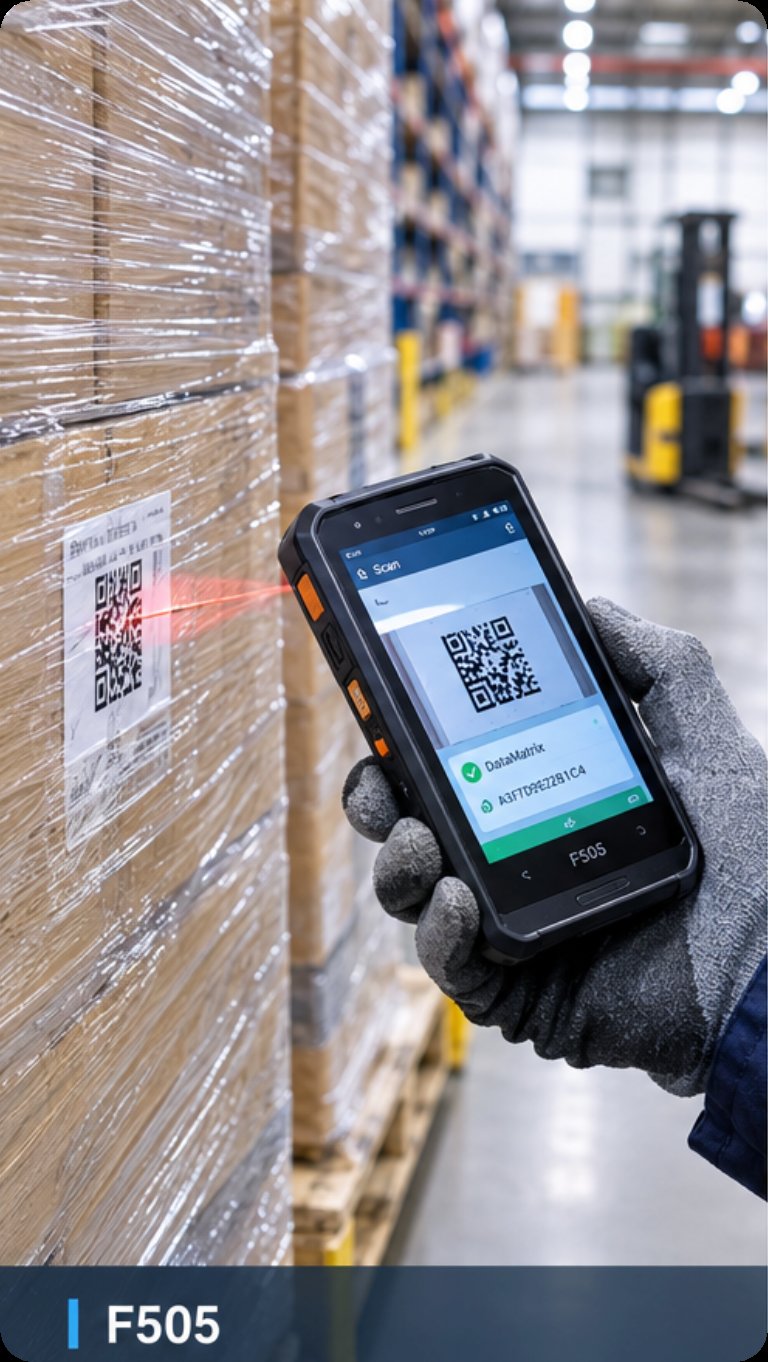
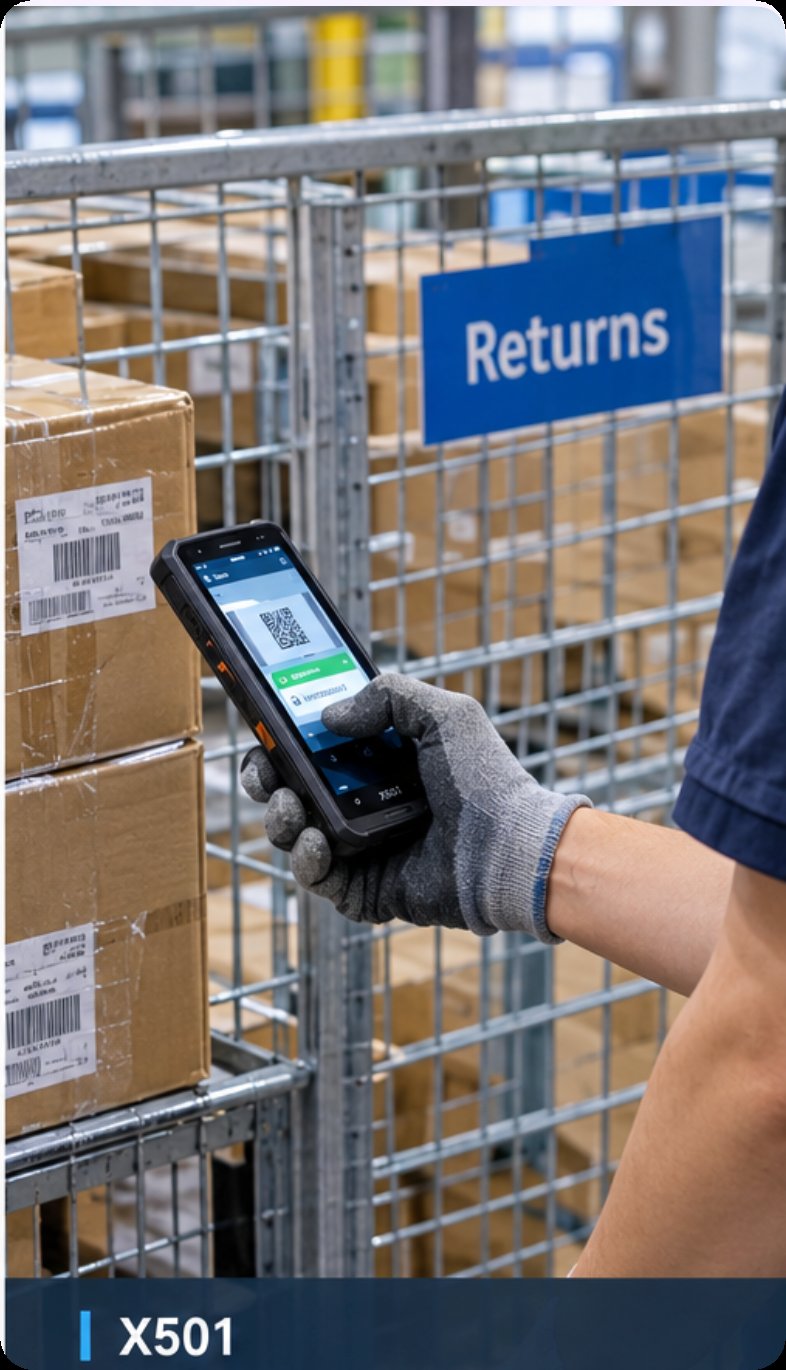
The first finding of any audit is that paper and stock disagree more often than anyone admits. Cartons shrink-wrapped in the transit area defeated the previous consumer-grade scanner until the counter tore the wrap and re-scanned. Both the F505 and the X501 carry a hardware 2D scan engine rated for 1D and 2D codes on paper and on screens, and on the wrapped pallets both read DataMatrix labels through a single layer of film without a retry, which cut a forty-minute pallet check to twelve. The X501 was the unit counters preferred for the returns cage, because it decodes the same codes as the F505 in a shell of approximately 270 grams; the F505, at approximately 285 grams, carries the same engine with a 5000 mAh battery behind it. Details for both are on the Handheld PDA F505 and X501 Handheld PDA pages.
Reprinting Damaged Shelf Labels Mid-Audit
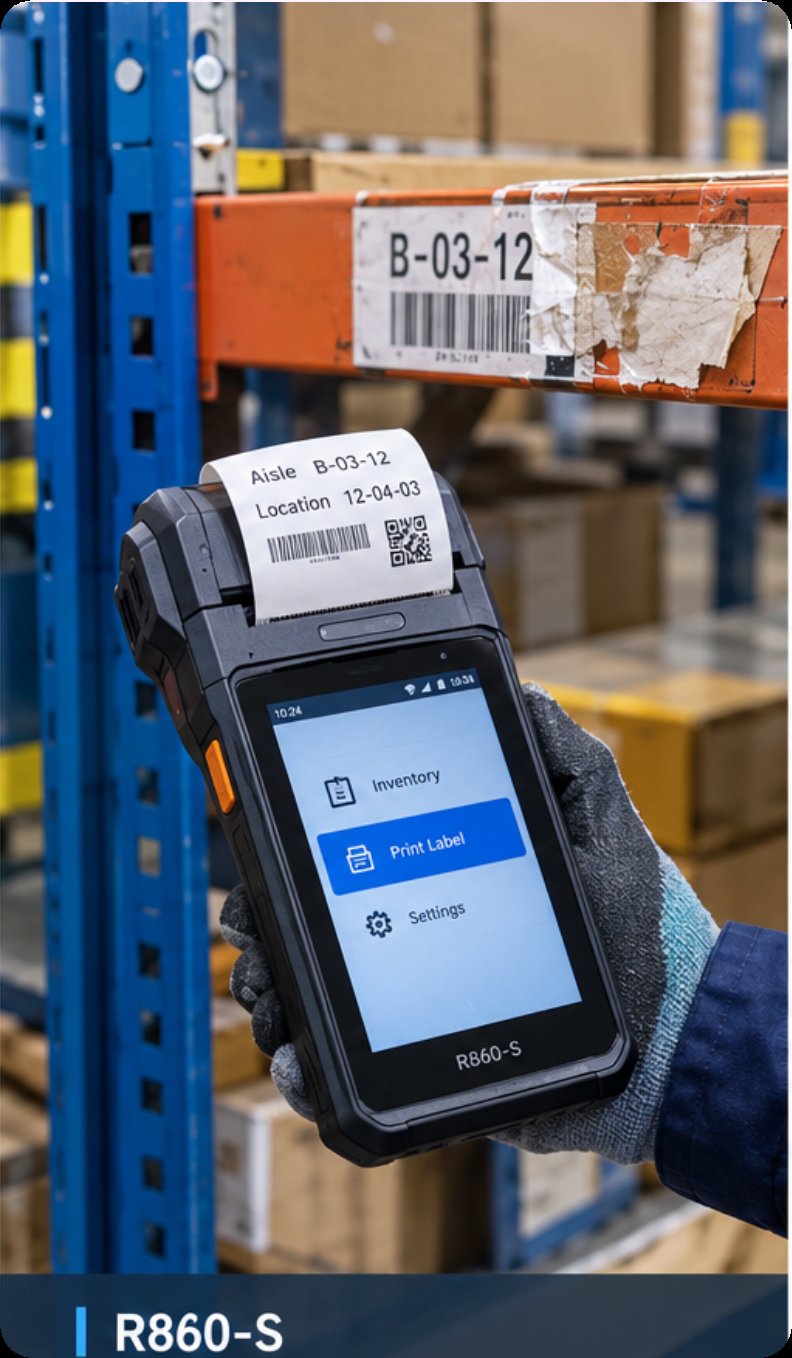
Damaged labels are where most audits stall. A shelf label that has faded or been peeled off cannot be scanned, so the counter either keys the location by hand or leaves the bin for a second pass, and both paths inject errors. The R860-S removes the walk back to the office entirely: it integrates a 57 mm thermal printer running at 70 mm/s on a 30 mm diameter roll, so the counter prints a replacement location label in about the time it takes to write one by hand. The same unit carries a built-in UHF RFID module on the EPC Class 1 Gen 2 protocol with read distances up to roughly 2 metres, which the team used to sweep the returns cage for tagged cartons instead of opening every box. At under 500 grams it is the heaviest of the three, and its 5600 mAh battery, 4 GB + 64 GB storage and Qualcomm octa-core platform running Android 16 place it closer to a mobile office than a pure scanner. The full configuration is on the R860-S PDA page.
🔋 Battery Swaps That Fit a Four-Hour Count
The counting window is deliberately kept under four hours, and none of the three terminals needs a mid-shift charge to cover it. The F505's 5000 mAh and the X501's 4500/5000 mAh removable packs are designed for quick swaps over Type-C fast charging, so the spare pool rotates between zones without the counters ever plugging in. The R860-S, with its 5600 mAh pack rated for standby beyond 350 hours, treats the audit as a light load even though it prints and scans more than the other two combined. What the distributor actually schedules is not charging but swapping: three spare packs per terminal class sit at the audit desk, and the evening routine is to return every unit to its cradle.
Weight, Gloves and the Long Aisle
The physical differences decide who carries what. Counters on the top shelves wear cut-resistant gloves, and the 5.5-inch screens on the F505 and R860-S are both specified for glove and wet-hand operation, with Corning Gorilla Glass on the F505 and X501 panels. The X501, at roughly 270 grams and 158 × 75 × 16 mm, goes to whoever draws the returns cage and the highest bays, because nine thousand trigger presses amplify every extra gram. All three share the same connectivity floor — 4G LTE, dual-band Wi-Fi, Bluetooth 5.0 and full GNSS — so variance exports reach the ERP over the warehouse network regardless of which terminal collected them, and the two lighter units keep IP67 sealing with 1.5 m drop resistance for the dock-side bays.
Specification Comparison for the Audit Fleet
The table below lines up the three terminals on the fields the distributor's procurement sheet actually tracks. All values follow the current product pages, with the R860-S listed separately wherever its printing and RFID hardware set it apart.
| Comparison Dimension | F505 | R860-S | X501 |
|---|---|---|---|
| CPU | Octa-core 64-bit, 2.0 GHz | Qualcomm SM6115 octa-core, 2.0 GHz | Octa-core 64-bit, 2.0 GHz |
| RAM & ROM | 4 GB + 64 GB, TF to 256 GB | 4 GB + 64 GB, TF to 256 GB | 4 GB + 64 GB, TF to 256 GB |
| Display | 5.5" IPS 720×1440, Gorilla Glass, glove/wet | 5.5" IPS HD+ 720×1440, multi-touch | 5.0"/5.5" IPS, Gorilla Glass, glove/wet |
| Barcode engine | Hardware 2D (1D/2D, paper & screen) | Optional 2D engine, ≥3 mil | Hardware 2D (1D/2D, paper & screen) |
| Thermal printer | — | Built-in 57 mm, 70 mm/s, 30 mm roll | — |
| UHF RFID | Optional module | Built-in, EPC C1 Gen2, ≤2 m | Optional module |
| Camera | 13 MP rear AF + 5 MP front | 20 MP rear AF + 8 MP front (optional) | 13 MP rear AF + 5 MP front |
| Battery | 3.8 V 5000 mAh removable, Type-C | 3.8 V 5600 mAh removable, PD fast charge | 3.8 V 4500/5000 mAh removable, Type-C |
| Protection | IP67, 1.5 m drop | Operating −10 °C to 50 °C | IP67, 1.5 m drop |
| Dimensions & weight | 160 × 76 × 16.5 mm, approx. 285 g | 177 × 80(73) × 45(23.8) mm, under 500 g | 158 × 75 × 16 mm, approx. 270 g |
| OS | Android 14 / 12 | Android 16 | Android 14 / 12 |
Read against the audit's three demands, the split is clean: the F505 is the trigger-work workhorse, the X501 trades a little battery for the lowest weight, and the R860-S carries the printer, the long-range RFID and the security slots that the other two optionally add. The full product range behind this fleet extends to rugged tablets and mini PCs on the same accessory logic, and buyers comparing this class across brands can see how the same questions are framed in our product comparisons and competitor analysis section.
Zone Assignments and the Recount Protocol
The last piece is procedure. Each zone's counter signs out a terminal by serial number, and any bin whose count differs from the manifest gets a second, independent recount by a different counter on a different terminal, which is why the fleet mixes units rather than standardising on one: a fault that follows the scanner is exposed immediately when the recount reads clean. The R860-S handles recounts in the transit area, where its printer re-labels cartons that arrived with unreadable barcodes. F505 and X501 units alternate between the nine bays so that no bay is always counted by the same device. At the end of the morning, the supervisor exports the variance list from each terminal, and the signed report reaches accounts the same day.