A care home's front entrance has quietly become a data checkpoint. Every visitor signs in, answers a short health questionnaire, sometimes has a temperature taken, and every resident's medication round generates a record that has to be typed somewhere before the next task starts. The staff doing this work are caregivers first and data clerks second, which is exactly why the devices they are handed matter: the wrong tablet turns a ninety-second sign-in into a three-minute queue at the door.
This page organizes the hardware decision the way a care home actually staffs its day: by post, not by specification sheet. Three Windows tablets cover the three posts where visitor and resident health data actually gets entered. The SH5-W is the pocket-size one: a 5.5-inch 1080×1920 handheld running Windows 10 Pro on an Intel Cherry Trail Z8350 quad-core, weighing 350g. The HTXUK10A-55 is the outdoor-readable one: a 10.1-inch 1200×1920 panel at 550nits with a 7.6V 6000mAh removable battery and MIL-STD-810G certification. The HTYJ10A is the powerhouse: the same 10.1-inch class screen at 560nits, but driven by 10th-generation Intel Core i5-10210Y or i7-10510Y processors for the software that will not run comfortably on anything lighter. Every figure below is published on the product pages; where a page is silent, the text says so rather than guessing.
💡 Why Visitor Screening Needs Its Own Device Plan
Visitor health data has a shape that generic office hardware fits badly. It is collected standing up, at a doorway, in bursts that follow the visiting schedule. It is collected by different people across a shift, which means the device cannot depend on one person's technique. And it is often collected outdoors as well as indoors, because drop-off points, garden entrances and ambulance bays are all part of the same checkpoint map. A device plan that ignores these conditions produces the familiar failure: the clipboard returns within a week, and the digital record quietly dies.
The staffing answer is to give each post a device matched to its posture and its software, then write the assignment down so relief staff inherit the system rather than reinventing it. The three posts below cover most care homes: the entrance desk, the grounds and garden gate, and the clinic or medication room where the heavier health records live.
🏨 The Front Desk Runs on the One-Handed Tablet
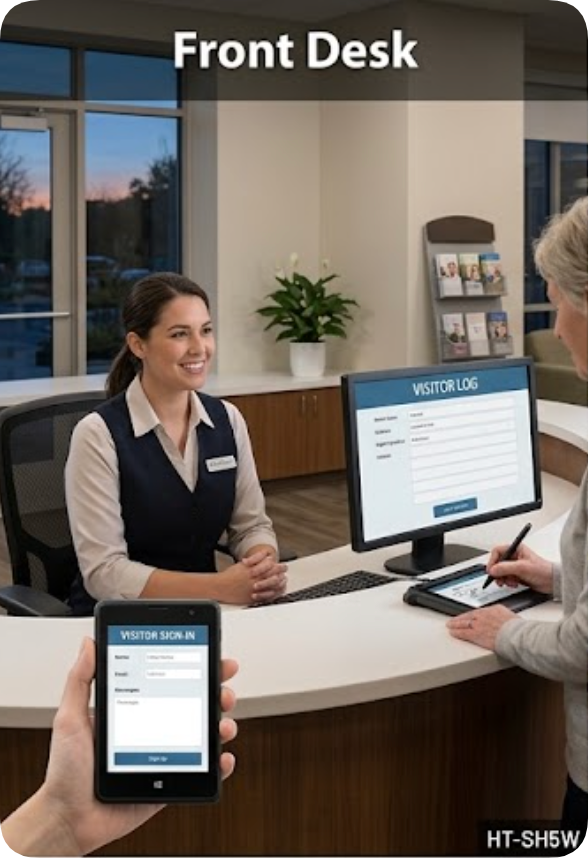
The entrance post is a standing job with one free hand, because the other hand is holding the door, the visitor's pass or a thermometer. The SH5-W is built around this posture. At 350g in a 180×87×20mm phone-style body, it is held in one palm for an entire visiting window without the wrist complaining, and its 5.5-inch 1080×1920 display is dense enough that a health questionnaire renders like a phone form rather than a shrunken desktop window. The physical profile matters as much as the screen: at this size the tablet fits a lanyard holster at the desk, so it is present at the door rather than in a drawer.
The software question settles the OS choice. Many care homes run legacy Windows applications for visitor logs and health questionnaires, and the SH5-W runs full Windows 10 Pro on its Intel Cherry Trail Z8350 quad-core (1.44GHz, bursting to 1.92GHz), so the same program the office uses runs at the door with no re-write. Connectivity covers the doorway's needs: WiFi 5, Bluetooth 4.2, optional 4G LTE, and NFC at 13.56MHz for scanning a visitor's ID card or a pre-issued pass instead of typing it.
The battery line is the one to staff honestly. The SH5-W's 3.8V 5000mAh pack is published at roughly 5.5 hours of working life with about 4 hours to charge. A full-day visiting window therefore needs either a mid-shift top-up at the desk or a rotation: one unit on charge while the other greets. That is a staffing note, not a defect, and writing it into the shift plan is what keeps the door digital after month three.
🖥️ Garden Gate and Grounds: The Sunlight-Readable Screen
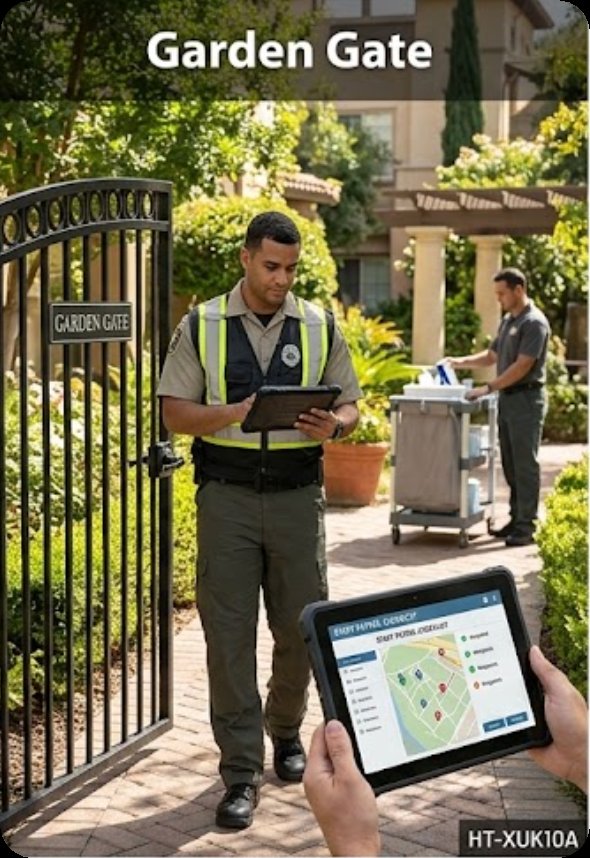
The second post is outdoors, and it defeats most office tablets for a reason that has nothing to do with ruggedness: screen brightness. A staff member checking in weekend visitors at the garden gate, or recording garden-round observations between buildings, is working against daylight. The HTXUK10A-55 answers with a 10.1-inch IPS touchscreen at 550nits, bright enough to stay readable in full sun, and its 7.6V 6000mAh removable battery (45.6Wh) is the largest cell of the three, sized for a shift that never returns indoors to charge.
The environment is also the physically hardest one, which is where this model's protection ratings earn their line in the plan: IP65 dust and water resistance, MIL-STD-810G certification and 1.2m drop resistance, with a published operating range of -20°C to 55°C. At roughly 1150g and 268.9×176.8×18mm, it is a two-handed tablet, which suits the grounds post fine: rounds involve setting the device down between entries, not holding it aloft. The optional 1D/2D barcode scanner and UHF RFID reader matter here too, because garden rounds increasingly involve scanning asset tags and checking resident wristbands rather than typing.
🔋 The Clinic Corner Needs Desktop-Class Power
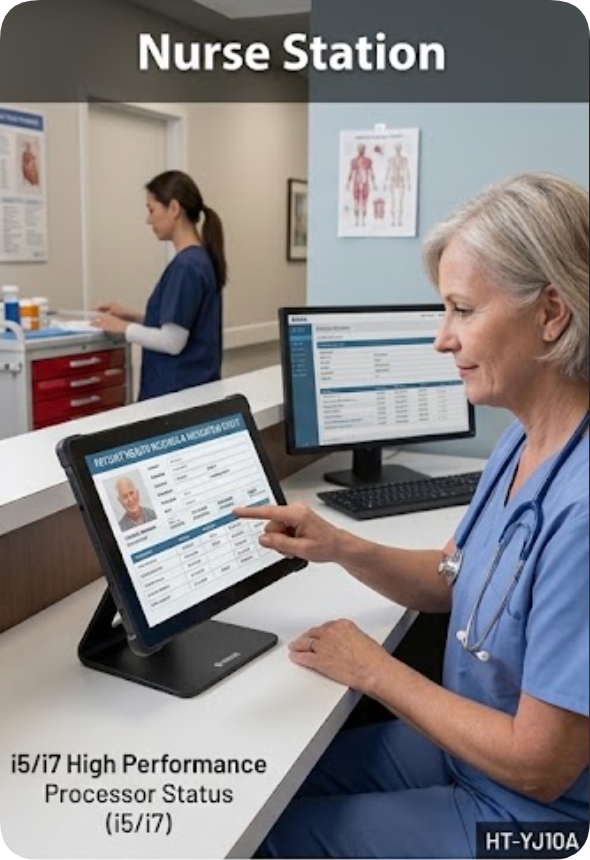
The third post is indoor and stationary but computationally hungry: the clinic room or nurses' station where resident health records, care-plan software and the day's medication reconciliation all run at once. This is the HTYJ10A's post. Its Intel Core 10th-generation i5-10210Y or i7-10510Y quad-core processors deliver desktop-class performance, which is the polite way of saying that heavy legacy health software opens when clicked instead of thinking about it. The 10.1-inch 1200×1920 touchscreen runs at 560nits, so charts and medication schedules stay legible even at the bright end of a treatment room.
Protection is published rather than implied: IP67 waterproofing, MIL-STD-810G drop resistance at 1.22m, and a double-layer solid chassis, with the same -20°C to 55°C operating range as the other two. The 7.6V 3500mAh battery is removable, and the published power figures matter at a fixed post less than they would on rounds: the clinic corner has a wall socket, and the published power adaptor specification (AC 100V~240V, DC 19V 3.42A output) means the unit can spend its day plugged in and its removable pack as the backup plan, not the primary one.
One staffing note belongs on this line: the page publishes dimensions of 28.4×19×2.5cm with a gross weight of approximately 2.1KG, so the clinic unit lives on its trolley or desk rather than travelling room to room. If a home wants one device to do both the clinic and the rounds, the honest comparison is between this model's processing headroom and the HTXUK10A-55's lighter 1150g frame and bigger battery, and the right answer depends on which software actually runs.
🔧 Battery Routines Across a 24-Hour Care Floor
Care homes run 24 hours, but visitor data does not: it concentrates in afternoon windows and medication rounds concentrate at mealtimes. That concentration is what makes the three published battery profiles workable without an elaborate charging room. The SH5-W's 5000mAh covers a visiting window and tops up at the desk between windows. The HTXUK10A-55's 6000mAh removable pack is sized for grounds duty across shifts, and its quick-charge support means a lunch-hour dock returns most of the day. The HTYJ10A's 3500mAh removable pack lives on a powered desk, with the spare cell covering the rare untethered session.
The staffing rule worth writing down: every removable battery in this plan has a named home. A charging dock labelled by post, with the spare cells rotated oldest-first, converts battery management from a daily improvisation into part of the handover checklist, which is where care homes already write things down.
The Assignment Table, With Published Figures
Condensed for the shift coordinator, this is the plan on one surface: which model rides with which post, and the published figures behind the decision. Where a page does not publish a figure, the cell says so.
| Assignment line | SH5-W | HTXUK10A-55 | HTYJ10A |
|---|---|---|---|
| Best-fit post | Entrance visitor desk | Gardens and grounds | Clinic / nurses' station |
| Processor | Intel Cherry Trail Z8350 quad-core (1.44GHz, burst 1.92GHz) | Intel industrial processor, quad-core (Celeron / Core series) | Intel Core i5-10210Y / i7-10510Y (10th Gen, quad-core) |
| Operating system | Windows 10 Pro (Home / IoT optional) | Windows 10 Pro / Windows 11 Pro | Windows 10 Pro (upgradable to 11 Pro) |
| Display | 5.5-inch 1080×1920 | 10.1-inch 1200×1920, 550nits | 10.1-inch 1200×1920, 560nits |
| Battery | 3.8V 5000mAh (19.0Wh) | 7.6V 6000mAh removable (45.6Wh, quick charge) | 7.6V 3500mAh removable |
| Published endurance | ~5.5h working, ~4h charge | Not published as hours | Not published as hours |
| Protection | IP65, 1.2m drop | IP65, MIL-STD-810G, 1.2m drop | IP67, MIL-STD-810G, 1.22m drop |
| Weight | 350g | ~1150g | ~2.1KG gross, 28.4×19×2.5cm |
| Data capture | NFC 13.56MHz; UHF RFID optional; 4G LTE optional | Optional 1D/2D scanner, UHF RFID, fingerprint, NFC, TPM2.0 | Optional 1D/2D scanner, UHF RFID, fingerprint, NFC, TPM2.0 |
Read down the first row and the staffing logic holds without any single model being "best": the lightest device guards the door, the brightest and longest-running one covers the grounds, and the most powerful one anchors the clinic. Homes that buy one model for all three posts usually discover they bought the compromise, not the plan.
The published specifications behind each line sit on the SH5-W 5.5-inch rugged handheld tablet, HTXUK10A-55 10.1-inch rugged tablet and HTYJ10A rugged tablet product pages, and the full rugged tablet range page collects the wider model families in one place.
Frequently Asked Questions
1. Can one tablet serve both the front desk and the garden gate?
A: It can, with one honest trade. The HTXUK10A-55 handles both posts comfortably: 550nits covers daylight at the gate, Windows 10 or 11 Pro runs the visitor software, and the 6000mAh removable battery outlasts a split shift. The trade is weight, at roughly 1150g against the SH5-W's 350g, which the entrance greeter feels by the end of a long visiting window.2. Why Windows rather than Android for visitor health records?
A: Because most care-facility software that handles visitor logs and resident health records was written for Windows first, and all three models here run full Windows Pro editions on Intel processors. The SH5-W proves the point in miniature: a phone-sized 350g body that still runs the same desktop application the office uses, with no re-write and no web substitute.3. The SH5-W publishes about 5.5 hours of working life. Is that enough?
A: For a visiting window, yes; for a whole shift on one charge, no. The published figure pairs 5000mAh with roughly 4 hours of charging, so the workable pattern is rotation: one unit greets while the other tops up at the desk. Homes that cannot rotate at the door should look at the larger packs on the two 10.1-inch models instead.4. What protection rating does the garden unit actually need?
A: The HTXUK10A-55 publishes IP65 with MIL-STD-810G and 1.2m drop resistance, which covers dust, rain and the drops that happen on gravel paths. The HTYJ10A goes further with IP67 and a double-layer chassis, and the choice between them is really about the software load: processing headroom for the clinic, or the bigger 45.6Wh battery for full-day rounds.Weighing these assignments against other models or other facilities is easier with context: the full HOTUS industrial hardware catalog shows where each tablet sits in the range, and product comparisons and competitor analysis cover how the Windows rugged line holds up once visitor volumes and software loads get contested in real facilities.