Cold-chain environments stress rugged handheld computers differently than a hard drop onto concrete. A unit can complete a shift without structural cracks yet return with dimmed display patches, stiff or misaligned connectors, or noticeably shortened battery runtime. Selecting a cold-storage handheld mobile computer for sub-zero freezers depends heavily on what happens during repeated transitions across the threshold—walking into cold air and returning to warmer staging or dock zones.
All three models examined here—the RS51 4G barcode terminal, the R530C UHF RFID handheld, and the R366C-S long-range UHF RFID reader—publish a −10°C to 50°C operating range, whereas working freezer aisles commonly sit around −18°C to −22°C. That boundary makes them practical for loading docks, staging lanes, and short cold-room passes rather than permanent −20°C residence. While our Rugged Industrial Tablet PC Manufacturer & Wholesale line supports broader industrial deployments, cold-chain workflows perform best when operating procedures respect published thermal limits.
Threshold Transitions, Dew Point Condensation, and Acclimation Stops
When a warm handheld enters a cold room or moves back out into humid ambient air, internal air temperatures shift faster than glass lenses, optical windows, and gasketed seams. Moisture condensing on cold scan optics or display stacks degrades barcode read reliability and forces repeated scans across successive door cycles.
Building a brief acclimation pause near the threshold—giving hardware time to stabilize before heavy scanning or battery servicing—helps limit repeated condensation cycles far more reliably than relying on surface coatings alone.
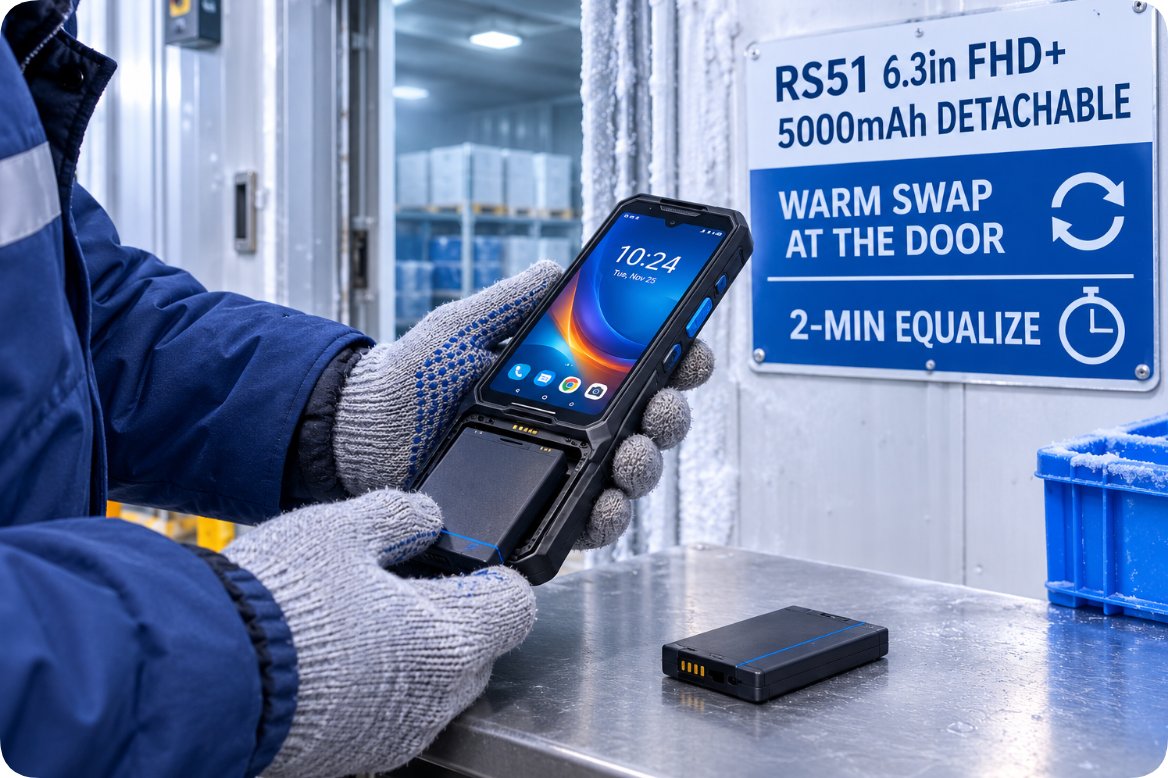
RS51: Detachable Battery Swaps at the Cold-Room Threshold
The RS51 4G Rugged Handheld Barcode Terminal features a 6.3-inch IPS FHD+ (1080 × 2340) display, Qualcomm SM6225 octa-core 2.4 GHz (11 nm) processor, Android 13, 4 GB RAM, 64 GB storage (TF expansion up to 256 GB), and a 172 × 76.6 × 16.5 mm body weighing under 500 g.
Its 5000 mAh 3.8 V battery is specified as detachable and hot-swappable, enabling operators to keep warm spare packs staged outside cold zones rather than charging a chilled cell inside a cold aisle or mating a damp pack before moisture clears. Because the 2D barcode imager (3 mil accuracy) is optional alongside NFC, buyers inspecting pallet or carton labels should specify the imager at order time.
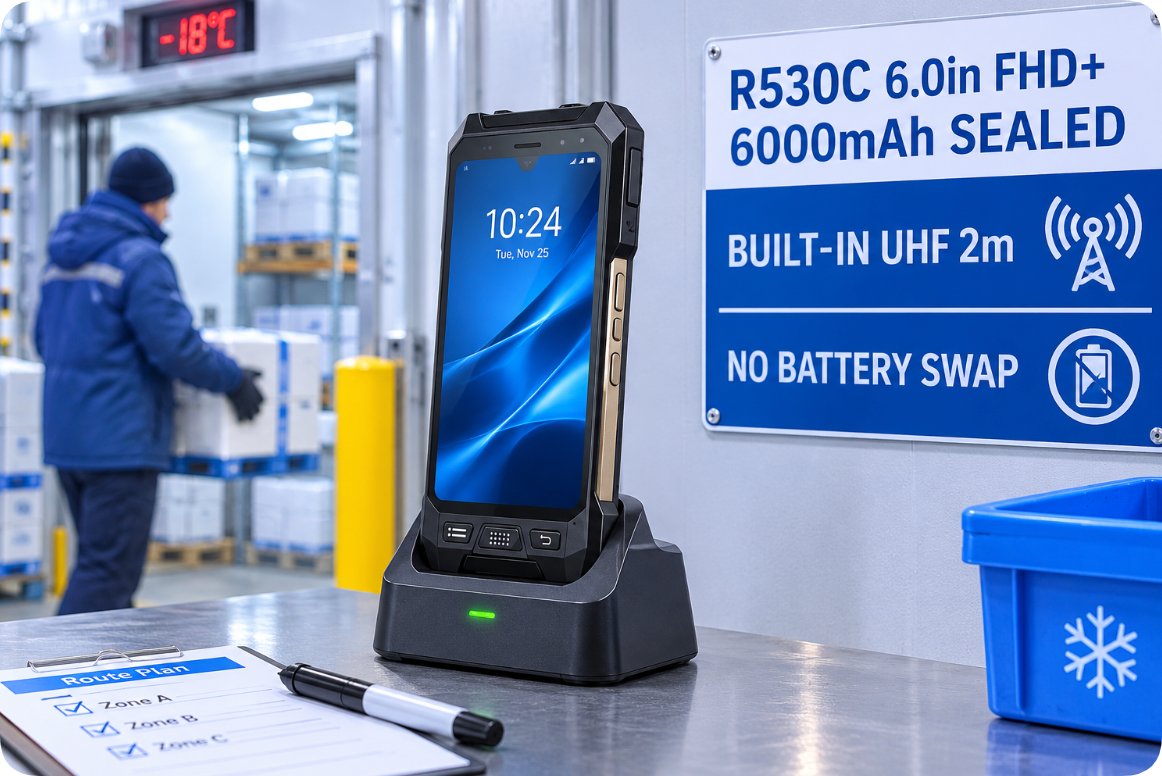
R530C: Built-In 6000 mAh Battery and Short-Range UHF Readout
The R530C Octa Core UHF RFID Barcode PDA pairs a 6.0-inch IPS FHD+ (1080 × 2160) display, Qualcomm SDM450 octa-core 1.8 GHz processor, 2 GB RAM, 16 GB storage (TF expansion up to 128 GB), and Android 11 (upgradable or customizable to Android 13) inside a 188 × 83 × 22 mm enclosure under 500 g.
Unlike the RS51, its 6000 mAh 3.8 V battery is built in and non-removable. Avoiding battery-door swaps reduces repeated openings in humid transitions on short routes that return regularly to a charging cradle, while its built-in UHF ceramic antenna reads EPC Class 1 Gen 2 tags up to roughly two meters for case-level checks (with optional 2D barcode, NFC, and PSAM).
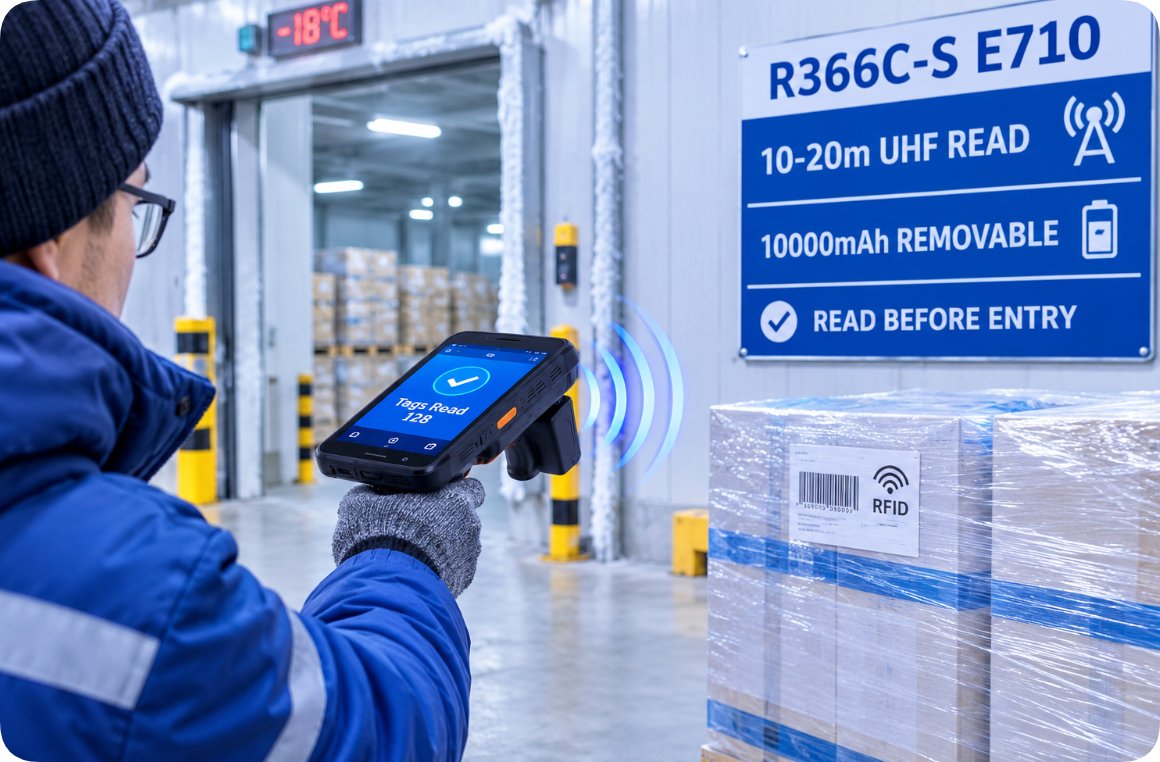
R366C-S: Long-Range Impinj E710 UHF Reading and 10000 mAh Pack
The R366C-S Impinj E710 UHF RFID Industrial Reader targets long-range inventory capture with an Impinj E710 engine and 4 dBi antenna rated for 10 to 20 meters at over 900 tags per second, paired with a Qualcomm SM6225 octa-core 2.4 GHz processor, Android 13, 4 GB RAM, 64 GB storage (TF up to 256 GB), and a 5.5-inch IPS HD+ (720 × 1440) display.
Housed in a 170 × 79 × 22.6 mm shell under 700 g with a detachable 10000 mAh 3.8 V battery and optional 2D imager or PSAM, the R366C-S lets operators capture pallet or rack RFID tags from staging aisles or doorways while minimizing prolonged exposure inside cold aisles.
Published Specifications Across RS51, R530C, and R366C-S
All three models publish a −10°C to 50°C operating range and 5% to 95% non-condensing humidity note (with −40°C storage ratings distinct from active operating limits). The table below compares published hardware fields across all three units:
| Specification | RS51 | R530C | R366C-S |
|---|---|---|---|
| Display | 6.3-inch IPS FHD+ (1080 × 2340) | 6.0-inch IPS FHD+ (1080 × 2160) | 5.5-inch IPS HD+ (720 × 1440) |
| Processor & OS | Qualcomm SM6225 octa-core 2.4 GHz; Android 13 | Qualcomm SDM450 octa-core 1.8 GHz; Android 11 (up to 13) | Qualcomm SM6225 octa-core 2.4 GHz; Android 13 |
| Memory & Storage | 4 GB + 64 GB; TF up to 256 GB | 2 GB + 16 GB; TF up to 128 GB | 4 GB + 64 GB; TF up to 256 GB |
| Battery & Swap Type | 5000 mAh 3.8 V; detachable / hot-swappable | 6000 mAh 3.8 V; built-in (non-removable) | 10000 mAh 3.8 V; detachable |
| Dimensions & Weight | 172 × 76.6 × 16.5 mm; under 500 g | 188 × 83 × 22 mm; under 500 g | 170 × 79 × 22.6 mm; under 700 g |
| Operating Temperature | −10°C to 50°C | −10°C to 50°C | −10°C to 50°C |
| Data Capture Options | Optional 2D imager, NFC | Built-in UHF (~2 m); optional 2D, NFC, PSAM | Impinj E710 UHF (10–20 m); optional 2D, PSAM |
Warming Up Before Battery Swaps and Cradle Charging
Opening a battery compartment or docking a chilled handheld while metal contacts and seals are cold and potentially damp increases contact resistance and moisture exposure risk. Allowing the chassis to return closer to ambient room temperature and dry surface moisture before swapping cells or seating charging docks protects long-term reliability.
Where shift continuity relies on battery swaps, the RS51 (5000 mAh detachable) and R366C-S (10000 mAh detachable) support warm battery rotation; where short cycles return to cradles without battery removal, the R530C's sealed 6000 mAh pack keeps battery servicing enclosed. Browse additional options in our Hotus Smart Hardware Products Manufacturer Catalog.
Matching Handhelds to Cold-Chain Roles
Cold-chain operations span dock manifest checks, staging-lane sorting, and rapid inventory reads. Rather than relying on a single device for every task, teams align screen size, scan range, and battery servicing to each role while factoring in published operating temperatures. For related hardware comparisons and compliance workflows, see our Hotus Product Comparisons & Technical Insights hub and Cold-Chain Compliance Starts With the Right Handheld: ST13-J, N60 and N40 Compared.
Best for 4G manifest checks and warm spare battery swaps at the door: RS51.
Best for 10–20 m UHF pallet reads from staging lanes or doorways: R366C-S.
Best for short sealed routes with built-in ~2 m UHF reading and no battery swap: R530C.
Frequently Asked Questions
1. Are the RS51, R530C, and R366C-S rated for continuous operation at −20°C?
All three models publish a −10°C to 50°C operating temperature range, making them suited to docks, staging lanes, and short cold-room passes rather than continuous −20°C freezer shifts.
2. How do operators reduce fogging and condensation across repeated cold-door cycles?
Operators limit dwell time inside cold zones, allow brief threshold acclimation so temperatures equalize gradually, and wait until chilled units warm and dry before swapping batteries or charging.
3. Which models support detachable batteries versus a built-in battery pack?
The RS51 (5000 mAh detachable) and R366C-S (10000 mAh detachable) support removable battery packs, whereas the R530C uses a built-in 6000 mAh battery recharged via dock or cable.
4. How do UHF RFID capabilities differ across the R366C-S, R530C, and RS51?
The R366C-S provides 10–20 m UHF RFID reading via its Impinj E710 engine, the R530C includes built-in UHF reading up to ~2 m, and the RS51 focuses on 4G connectivity with optional 2D scanning and NFC.