On a ramp at half past six in the morning, the operation runs on a simple transaction: a bag tag gets scanned, a system answers, a cart keeps moving. Ground handling crews repeat that transaction hundreds of times per rotation, and the interval between one scan and the next is measured in seconds. When an airline or a handling agent equips its ramp crews, the temptation is to order a fleet of rugged smartphones — the same devices crews can use for calls, push-to-talk, and everything else. Two of the most respected names in that category, Sonim and CAT, build genuinely tough hardware. But a ramp is not a tough place to hold a phone; it is a demanding place to capture data, and data capture is where the difference between a phone and a purpose-built terminal stops being a spec sheet detail and starts showing up in departure times.
What the Ramp Actually Asks Of a Device
Three forces shape every minute of ground operations. The first is glare: an open apron at sunrise throws low-angle light straight into any screen, and a loader leaning over a belt loader is usually reading that screen one-handed. The second is gloves: ramp agents wear insulated gloves through winter, and a touchscreen that ignores fingertips through two millimetres of leather turns every interaction into a remove-the-glove ritual. The third is rotation length: a widebody turn can run three hours, but crews work consecutive rotations, and a device that cannot swap a battery mid-shift ends the day chained to a wall socket. Add the obvious ones — jet blast, de-icing fluid, rain, a two-metre drop onto concrete — and you have the job description that every piece of industrial three-proof hardware is engineered against. The question is which category of hardware answers it.
🛡️ Where the Ultra-Rugged Phone Falls Short
Sonim's XP10 deserves its reputation. It is certified to MIL-STD-810H, IP68 and IPX9K, shrugs off six-foot drops onto concrete, operates from -20°C to 55°C, and carries a 5.5-inch Gorilla Glass Victus display with a removable 5,000mAh battery rated for 30 hours of talk time. Sonim's 3-year comprehensive warranty and Google AER certification on Android 12 make it a defensible fleet choice, and the 100dB front-facing speakers with a dedicated PTT key are genuinely useful when a wing walker needs to hear a driver over engine noise. Nothing here is a weakness. The gap appears the moment the crew member points the device at a baggage tag. The XP10 has no integrated scan engine — tag capture means launching the camera, waiting for autofocus to settle on a glossy thermal label in direct sun, often through a scratched screen protector, sometimes while the tag is still moving on a belt. Camera-based scanning works, in the way that walking works when you could be driving: each capture takes a beat or two longer, and over four hundred bags a beat or two is a departure delay. Sonim's own materials position the XP10 around voice, PTT and situational awareness — the scanning problem is simply not what the phone was built to solve.
🔋 The Battery Nobody Can Swap
CAT's S75 takes a different route to toughness: IP68 rated to five metres of submersion, IP69K against high-pressure washdown, MIL-STD-810H drop testing onto steel from 1.8 metres, and a 6.6-inch 120Hz Gorilla Glass Victus display at roughly 530 nits typical brightness. Its glove mode recognises touch through gloves up to 2mm thick, and the two-way satellite messaging via the Bullitt service is a genuinely unique capability for remote stands with patchy coverage — though it requires a subscription and only carries short text messages. The structural problem sits under the back cover, or rather under the lack of one: the 5,000mAh battery is non-removable, replaceable only by a specialist. Fifteen-watt charging helps, but a crew running back-to-back rotations cannot swap power in ninety seconds the way they can swap a pack. By late afternoon, a fleet of S75 units is either tethered to charging banks in the break room or dragging through its final rotation. For a consumer buyer that is an inconvenience; for an operation running three shifts, it is a fleet-planning constraint.
🎪 A Full Workbench of Ports at the Gate Stand
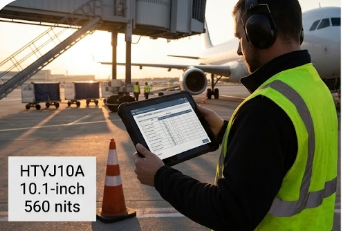
Load control is the ramp's paperwork job, and it is done standing up. The agent reconciling a loading plan wants a screen large enough to show the whole weight-and-balance sheet without zooming, bright enough to beat the sunrise, and an operating system the airline's ground software actually runs on. The Hotus HTYJ10A approaches that job from the opposite direction to a phone: a 10.1-inch Full HD IPS touchscreen at 1200x1920 pushed to 560 nits with 7H hardness glass, sealed to IP67 inside a double-layer chassis tested to MIL-STD-810G. Because it runs Windows 10 Pro with a full upgrade path to Windows 11 Pro, the legacy load control and departure control clients that airlines have run for a decade do not need rewriting — a point Android and iOS fleets cannot make. Connectivity is where the tablet stops pretending to be a consumer device: built-in RJ45 Ethernet for the gate stand's wired backhaul, USB Type-A and Type-C, Mini HDMI out for a secondary display in the break room, and a 12Pin Pogo-pin connector that mates with dedicated desktop cradles and vehicle-mounted charging docks, so the unit lives in the van's cradle between rotations instead of a driver's door pocket. Wi-Fi 6, Bluetooth 5.0, global 4G LTE and integrated BDS/GPS/GLONASS round out the radio suite, and optional 1D/2D scanning, UHF RFID, fingerprint and 13.56MHz NFC modules can be configured at the factory rather than bolted on afterwards.
Dedicated Optics for Every Tag on the Belt
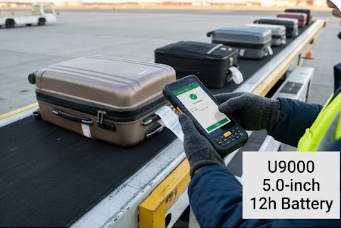
The belt loader is where scan speed becomes departure speed, and this is the Hotus U9000's home ground. Instead of borrowing the camera, the U9000 carries dedicated 1D and 2D scan engine options — including Honeywell N5703 and N6603 imagers — that read a symbology the instant it crosses the aiming pattern, no autofocus hunt, no tap-to-focus, no second attempt when glare washes out a glossy tag. The 5-inch IPS display at 720x1280 behind Corning Gorilla Glass accepts touch through gloves or wet hands, which removes the remove-the-glove ritual from every scan. The 4,800mAh battery is removable and rated beyond 12 hours of continuous work, recharging in under four hours, which turns shift change into a two-second battery swap instead of a queue at a charging cart. Honest disclosure: the U9000 runs Android 9.0 on a Cortex-A53 quad-core 2.0GHz platform with 2GB of RAM expandable to 3GB — an ageing, deliberately frozen build, which is precisely why fleets with validated scanning apps keep ordering it, and why anyone needing current Android should look at the RS50 below. For tags that never get scanned visually, an optional UHF RFID module operates across 840-960MHz compliant with EPCglobal UHF Class 1 Gen 2 / ISO 18000-6C and reads beyond 1.5 metres — the backbone for automated bag-room tunnels and RFID-tagged Unit Load Device tracking that already runs in modern logistics and warehouse operations.
5G Telemetry and Millimetre Tags in One Hand
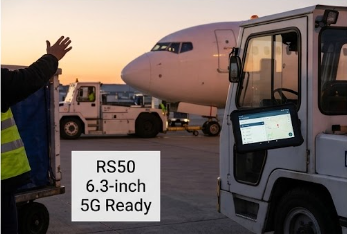
Between the belt loader and the gate stand sits the equipment operator — tugs, pushback tractors, de-icing rigs — and that crew needs a modern handheld that is both a scanner and a data terminal. The Hotus RS50 runs a Unisoc UIS7885 octa-core processor at 2.7GHz with an integrated 8 TOPS NPU, 6GB of LPDDR4X and 128GB of UFS storage expandable to 512GB, on a choice of Android 13 with optional GMS or Harmony OS — the first rugged terminal to ship Huawei's distributed operating system. Its 6.3-inch FHD+ display dwarfs the XP10's 5.5 inches and matches the S75's real estate while staying pocketable, and the optional 2D imager resolves barcodes down to 3 mil — the high-density codes printed on electronics tags and interline bag tags that consumer cameras struggle to resolve at distance. An independent BeiDou RTK positioning module delivers centimetre-grade location for equipment yard mapping, the 48MP main camera documents damage claims with evidence-grade detail, and the removable 4,800mAh battery with Power Delivery fast charging keeps multi-shift operations unbroken. IP67 sealing and a 1.2-metre drop rating cover the daily reality of a device clipped to a vest on an active ramp.
Fleet Charging and the Shift-Change Math
Fleet logistics reward the operation that can hot-swap power. The U9000 and RS50 both run removable 4,800mAh packs: a ninety-second exchange at shift change keeps the device in the field and the spent pack on a charger, and cradles and multi-bay charging cases turn a break room shelf into a rotation-ready pool. The HTYJ10A's 12Pin Pogo-pin system extends the same logic to the tablet — vehicle docks mean the load control unit charges while the van drives. Contrast that with the S75's sealed battery and even the XP10's removable-but-phone-scale pack, and the shift-change math starts to favour purpose-built hardware long before anyone compares image sensors. There is also a maintenance angle: Hotus backs its industrial line with a 3-year limited warranty and OEM/ODM customization — custom hardware branding, specialized I/O ports and software integration — the same support structure that keeps field maintenance fleets in service for years, which matters to a handling agent standardising on one device family across tablets and handhelds.
Choosing by Task, Not by Toughness
Neither Sonim nor CAT makes a bad product; both build some of the most credible rugged phones on the market, and for crews whose day is mostly voice — PTT dispatch, drivers, security patrols — the XP10 in particular is a rational pick. But ground handling is a data-capture job wearing a toughness costume. The tag that must be read through glare and gloves, the loading plan that must be legible at arm's length, the battery that must swap between rotations, and the ground software that must run unmodified — these are the requirements that sort a phone fleet from a working fleet. Build the ramp around devices built for the ramp: the HTYJ10A at the gate stand, the U9000 on the belt loader, the RS50 in the hand of every equipment operator, and the departures board takes care of itself.