HTQ10A, WTR PRO AMD and SH6: Passing Compliance Checks in a Clinical Workstation
Compliance in a clinical setting is not a paperwork exercise, and anyone who has sat through a hospital procurement review knows why. The equipment has to survive cleaning agents that would strip a consumer laptop in a week, sit metres from a patient monitor without disturbing it, and hold data that carries legal weight. I have watched sensible deployments stall at the final stage because nobody checked the sealing rating against the ward's disinfection protocol, or because the network team could not say where resident data lived. The three units I would put through that review are the HTQ10A Android Rugged Tablet on the bedside side, the WTR PRO AMD at the nursing station, and the SH6 for clinical data entry. Each one clears a different part of the checklist, and understanding which part is the difference between a deployment that passes review and one that goes back to the vendor. The same mini PC deployment logic applies whether the site is a single clinic room or a full ward.
What Inspectors Actually Look For
The published standards list is long, but an inspection usually comes down to three questions that are asked in plain language. First, can the device be cleaned the way this ward cleans things, with the chemicals this ward actually uses? Second, does it behave predictably in a room full of other electrical equipment, including devices whose failure matters far more than a rebooted screen? Third, can the facility account for the data on it, from the moment it is switched on to the moment it is retired? A vendor quote answers none of these. A datasheet answers the first two only if you read the sealing and emissions sections carefully, and the third is a configuration decision rather than a hardware one. I work backwards from those three questions.
Sealing and Cleanability at the Bedside
The bedside is the harshest position on the ward, because it is cleaned most often and by the broadest range of people. The HTQ10A is the unit I would put there: a lightweight Android tablet built on the same industrial platform as the rest of the rugged range, with the sealing that lets it be wiped down rather than treated as delicate. The practical test is not the rating number alone but the surface. A device with deep speaker grilles, exposed rubber flaps or a recessed port cover will trap residue no matter what number is printed on the back, and a ward that cannot clean a device will stop using it. What matters is that the cleaning method in the protocol matches the materials on the device, and that the person wiping it can reach every surface. If they must remove a case first, the device has already failed in practice.
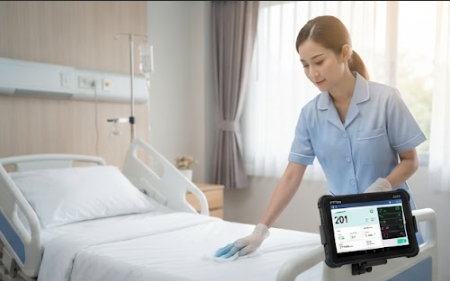
The bedside unit above is being wiped down in place, which is the only version of cleanability that survives a busy ward. A device that can be cleaned where it sits gets used; one that has to be unplugged, undressed and carried away quietly stops being deployed.
Electromagnetic Behaviour Near Other Devices
The second question is the one that catches people out, because it is invisible until something else misbehaves. A nursing station machine sits close to infusion pumps, monitors and telemetry, and the standard that governs emissions exists precisely because proximity is normal rather than exceptional. The WTR PRO AMD is positioned as the fixed station unit, and the parts of its specification that matter here are the unglamorous ones: a stable power design, a grounded chassis, and wireless modules that can be disabled at the firmware level when a site decides it wants a wired-only zone. I would not deploy a station machine without confirming that wireless can be switched off, because some clinical areas require exactly that. The review question is not whether the machine emits, since every machine does. It is whether the facility can control and document what it emits, and under what conditions.
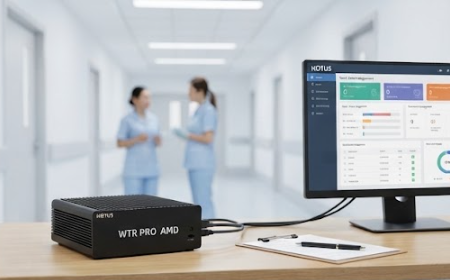
The station above shows the fixed machine doing the quiet job it is chosen for: no trailing accessories, no ad-hoc radios, and a position that keeps it out of the walking route between beds.
Data Handling Rules That Apply to the Device
The third question is the one that has changed most in the last few years, and it is now the most common reason a clinical deployment is delayed. The SH6 is the unit I would assign to clinical data entry, and its Windows platform means the data rules are familiar rather than exotic: full-disk encryption as a baseline, a managed device profile that can enforce screen lock and update policy, and remote wipe that actually works when a unit leaves the estate. What matters for review is being able to show a lifecycle, not a feature list. A facility needs to state where data resides, who can reach it, how it is destroyed, and how that is evidenced. Devices that support standard management tooling make that conversation short. Devices requiring a bespoke arrangement turn a two-week approval into a two-month one, because the security team has to invent a process. Choosing a mainstream operating system is, in this context, a compliance decision rather than a technical one.
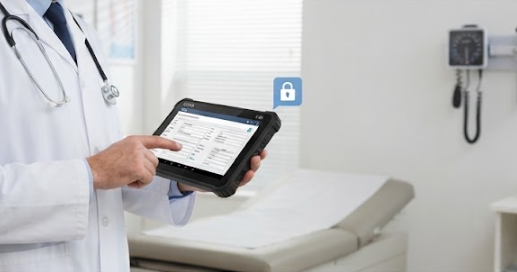
The entry unit above is in a clinical room rather than an office, which is where the data question stops being theoretical. Encryption, managed profiles and remote wipe are the three answers a security review will ask for, and all three need to be demonstrable rather than promised.
Thermal Limits in an Enclosed Room
One specification that rarely appears on a procurement form but decides real-world reliability is thermal design. Clinical rooms are often small, poorly ventilated and kept warm for patient comfort, and a fan-cooled machine in that environment will pull dust and lint through its chassis for years. The consequence is slow degradation rather than dramatic failure, which is worse in a compliance context because it is hard to evidence. Fanless designs remove the moving part and the intake, and for a fixed station machine that is usually the right trade. The review question is simpler than it looks: ask where the device will sit, and whether anyone has committed to cleaning that space. A machine specified for a ventilated enclosure but installed in a closed cupboard is a finding waiting to be written up.
A Standards Reference Table
| Review area | HTQ10A | WTR PRO AMD | SH6 |
|---|---|---|---|
| Typical position | Bedside, mobile | Fixed nursing station | Clinical data entry |
| Primary review focus | Sealing and cleanability | Emissions control at the station | Data lifecycle evidence |
| Platform | Android industrial tablet | Fanless mini PC | Windows rugged tablet |
| Management route | Standard device management profile | Wired-only option available | Mainstream enterprise tooling |
| Evidence to prepare | Cleaning protocol match | Radio control statement | Encryption and wipe record |
The table is written the way a review is actually run, from the position on the ward outwards. Read the second row down and you have the three documents a facility should have ready before the assessment. A wider view of the rugged handheld tablets range shows how the other models in the family sit around these three for sites that need a different mix.
Which Unit Suits Which Station
I would assign by the physical position first and the software requirement second. If the role involves moving between beds, the HTQ10A is the correct choice, because a device that is carried has to be light and has to survive cleaning at the point of use. If the role is anchored to one place and sits beside other equipment, the WTR PRO AMD is the better fit, because a fixed machine can trade portability for thermal headroom and a wired-only configuration. If the role is entering and reviewing records, the SH6 is right, because the management tooling around a mainstream desktop operating system is what makes the data question answerable. Many facilities need all three in one building, which is a reason to standardise on a single vendor rather than assemble a mixed estate. What I would not do is specify by unit price, because the cheaper device is the one that generates a finding in year two.
Documenting the Install for Audit
The final step is the one that determines whether the deployment is repeatable or merely survived. Every decision made above should exist as a record: which cleaning agent was tested against which surface, which rooms run wired-only and why, where encryption keys are escrowed, and who signed off the configuration. A facility that holds those records can roll the same standard into a new room in an afternoon. A related medical workstation installation guide covers the physical build side of the same rooms, which pairs naturally with the documentation set described here. The deciding question is not whether the hardware is capable. It is whether the facility can prove, on paper and in a live room, that it made deliberate choices.