Home storage has changed shape twice in ten years, and the two changes are often confused with each other. The first was physical: the tower that used to live in a spare room turned into a small box that sits on a shelf and runs quietly for years. The second is behavioural, and it is still unfolding, because a machine that was bought to hold files is now expected to run services, answer queries and keep working while nobody is watching it. I watch this transition through the hardware people actually put on the shelf, and three units sit at different points of it: the Palm-sized miniPC as the always-on host, the SH5-W as the handheld panel that makes the box legible without a desk, and the HTXUK10A-55 as the larger screen for the moments when a job needs real estate. None of them is a trend by itself. Together they describe where the category is going, which is away from a dedicated appliance and toward a small stack of general-purpose hardware. The same mini PC platform thinking runs through all three.
The Box Under the Desk Got Smaller
The first shift is the one people notice when they visit. A home server used to mean a tower with spinning disks, a fan that never stopped, and a spot on the floor where nobody would trip over it. The Palm-sized miniPC represents the other end of that evolution: a host small enough to sit on a bookshelf next to the router, drawing little enough power to stay on permanently, and quiet enough that its location stops being a design constraint. What matters for the category is not the size itself but what the size unlocks. Once the host is small and silent, it can live where the network already is, and that removes the main reason people used to abandon a home setup halfway through: logistics. A box that can be placed anywhere gets placed.
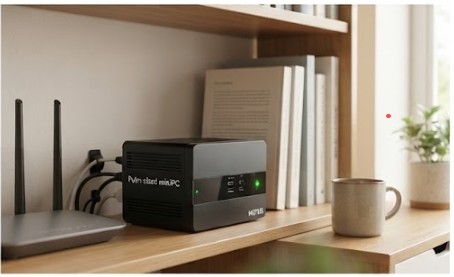
The shelf position above is the whole argument for the shift. A host that fits beside the router and disappears into the furniture gets left alone to do its job, which is the only reliability property that matters over a five-year horizon.
Local Compute Came Back for Its Own Reasons
The second shift is less visible and more consequential. For a decade the assumption was that anything heavy belonged in a data centre, and a home box only stored the results. That assumption is weakening because the workloads changed. Media transcoding, photo de-duplication, incremental backup, and increasingly small language models all run acceptably on modest local hardware, and the moment they do, the reason to send data outward disappears. I would not overstate this. A home host is not replacing a cluster. But the threshold has moved enough that a general-purpose unit does work that used to require a subscription, and that changes what people expect to buy. The interesting part is that the change is driven less by raw performance than by the fact that the software finally assumes a small always-on machine exists.
Cloud Fatigue Is Now a Buying Trigger
The third shift is commercial rather than technical, and it is the one that shows up in conversations rather than specifications. Subscription pricing for consumer cloud storage has risen steadily, features have moved between tiers, and terms have changed in ways that are hard to plan around. None of that is scandalous, but it produces a predictable reaction: people who already own the hardware start wondering why they are renting the service. The result is a wave of buyers who are not enthusiasts at all, which is new. They want a box that behaves like the cloud did, with less administration than the enthusiast era demanded. That is a demanding requirement, and it explains why the current generation of hardware emphasises setup simplicity and long-term stability over peak specification.
A Panel Instead of a Terminal Window
The fourth shift is in how people actually interact with the machine, and it is the one most often missed by hardware reviews. Administration used to mean a laptop, a browser and a terminal, which limited the audience to people who enjoyed that sort of thing. The current direction is a panel that fits in a pocket, and the SH5-W is the clearest example: a 5.5-inch handheld that can check drive health, confirm a backup finished and restart a stuck service from wherever the owner happens to be standing. That sounds like a small convenience, but it changes who maintains a system. A setup that can be checked in thirty seconds from a hallway gets checked; one that requires sitting down at a desk gets ignored until something breaks.
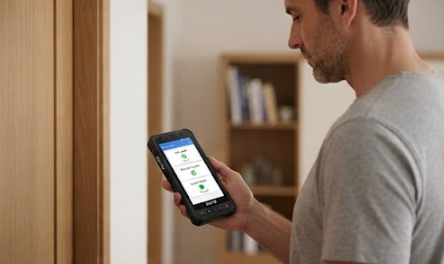
The handheld above is doing the unglamorous work that keeps a home setup alive: a quick status check, no desk required. This is the difference between a system that is maintained and one that is discovered to have failed three weeks later.
Silence and Idle Power Became Specifications
The fifth shift is that two properties which never appeared on a consumer datasheet now decide purchases. The first is acoustic, because a home host increasingly lives in a room where people also live, and a fan that is audible at night is a return. The second is idle consumption, because a machine that runs every hour of the year makes its standby draw a real running cost rather than a footnote. Neither property is dramatic, and that is why they get overlooked until the box is installed. I treat them as the practical test of whether a design was meant for continuous domestic use or adapted from an office part. A unit engineered for the shelf shows it in the details: no intake to clog with dust, no light that stays on, and a power profile that stays flat when nothing is happening.
What This Means for a Typical Setup
Put the shifts together and a current home setup looks like a small stack rather than a single purchase. The host sits by the router and handles storage and services. The handheld covers quick checks and stays charged in a drawer. The larger screen, such as the HTXUK10A-55, appears when a job needs more room: mapping a folder structure, reviewing a backup plan, or working through a migration that is painful on a small panel. What is notable is that none of these three roles requires specialised hardware any more. A general-purpose host, a handheld and a tablet cover the same ground that used to need a dedicated appliance plus a laptop. That consolidation is the actual trend, and it is why the category is drifting toward ordinary computing parts rather than away from them.
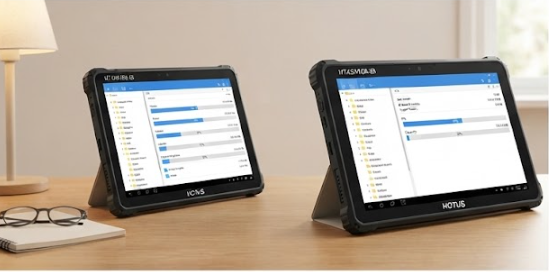
The larger screen above is deployed for the work that genuinely needs space. Treating it as an occasional tool rather than a permanent fixture is what keeps the overall stack small and the maintenance predictable.
A Direction Table
| Shift | Where it came from | Where it is going | Hardware that expresses it |
|---|---|---|---|
| Physical form | Floor-standing tower | Shelf-sized, permanently on | Palm-sized miniPC |
| Workload | Store what the cloud returned | Run the service locally | General-purpose host |
| Purchase reason | Enthusiast project | Subscription fatigue | Setup-simple platforms |
| Interaction | Desk, browser, terminal | Pocket panel, quick checks | SH5-W handheld |
| Operating demand | Performance first | Silence and idle draw | Fanless designs |
The table reads as a timeline rather than a feature list, and that is deliberate. Each row moved from a specialist answer to an ordinary one, which is the pattern that defines a category maturing. The broader rugged handheld tablets range covers the panel side of the same story for setups that want a different balance of screen size and portability.
Where the Next Two Years Point
The direction of travel is fairly clear from the shifts above, and it does not point toward more specialised appliances. It points toward small, quiet, general-purpose boxes that are assumed to be online, with panels that fit in a hand and larger screens that appear only when a task demands one. A related home server deployment walkthrough covers the physical build side of the same stack, which is the part that has actually got simpler. What I would watch over the next two years is not a specification race but a software one: the hardware is already sufficient for the jobs people want, and the remaining friction is in how quickly a new owner can get a useful system running. The deciding question is not which unit has the best numbers. It is whether the whole stack can be set up in an afternoon and then forgotten about for a year.