- Select Language
RT81 4G Rugged Tablet | 10.1" FHD 400nit | Qu...
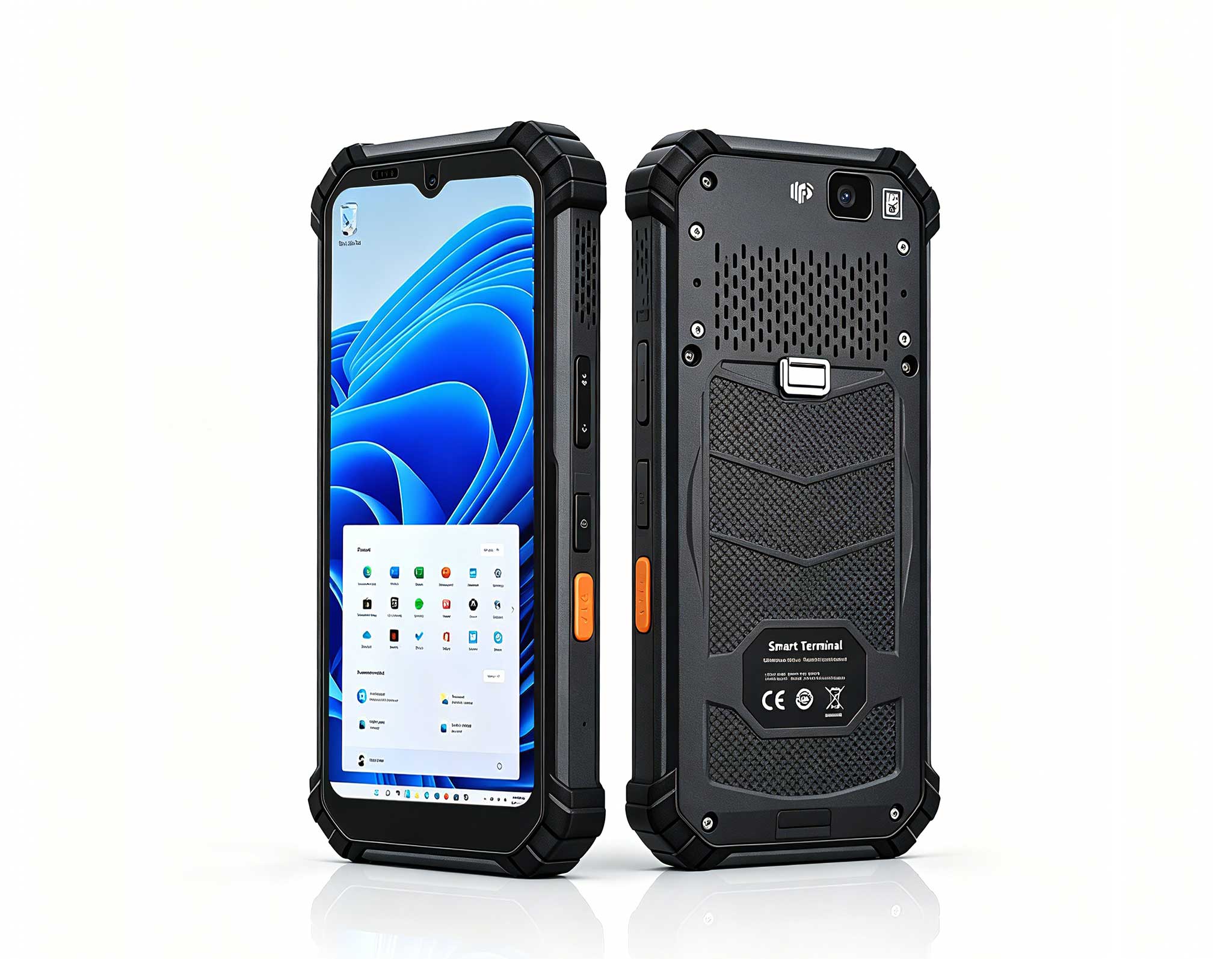
R366-S 5.5-inch Industrial PDA | Qualcomm Octa-cor...
The T80 handheld PDA combines advanced barcode sca...
The R501 PDA combines a powerful MT6762 Octa-Core ...
A produce receiving dock runs on a piece of paper that is worthless by morning. The lot number arrives with the pallet, gets weighed, gets sorted, and leaves the building on a truck. If that number breaks anywhere between the scale and the loading bay, the recall becomes a guess. This is a case study from one dock that moved three handhelds onto three separate jobs on the same lot sheet, why the scale ticket is the record that expires fastest, and where each device earns its place in the chain.
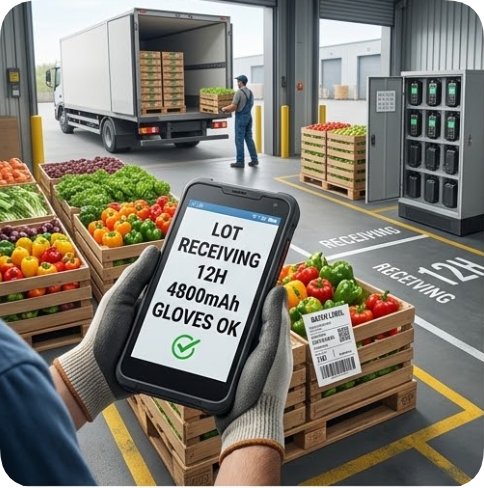
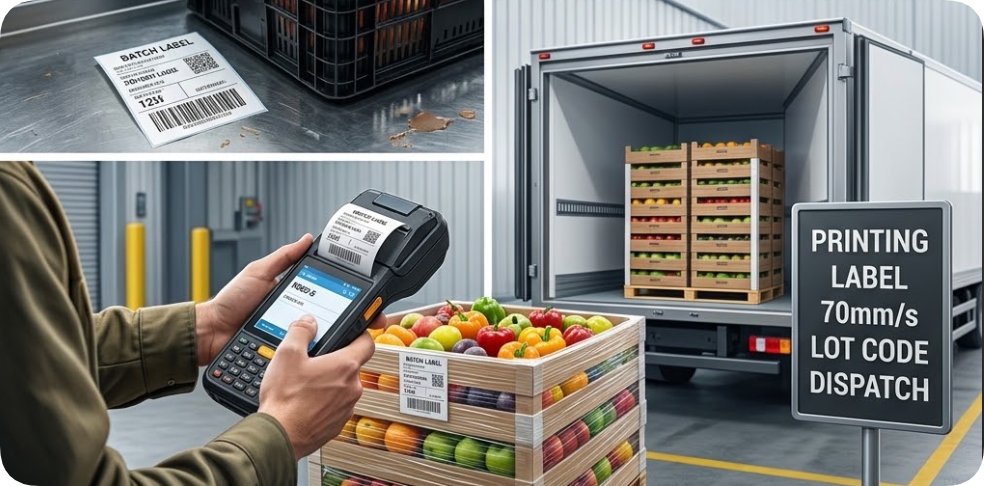
Three units sit on that chain. The U9000 Handheld PDA opens the lot at the receiving door and keeps working twelve hours on a removable cell. The Handheld PDA F505 is the all-day unit that stays on the sort line. The R860-S PDA closes the loop by printing the pallet label at the dispatch end, so the last signature is on paper before the truck moves.
Every other document in a produce chain outlives the shift. The pallet tag survives to the store. The invoice survives to the audit. The scale ticket lives for the length of one dock conversation: gross weight, tare, net weight, grade, and a lot number that may be corrected twice before the pallet is wrapped.
That makes it the weakest link in a traceability chain, and the reason it is the first thing a dock manager should stop treating as a printout. A ticket written on a thermal printer and handed to a driver is a number in a truck cab. The same ticket scanned at the door and stored against the lot is a number that can be queried a year later when a customer asks which shipment contained the affected pallet.
The U9000 takes the first signature because the receiving door is where the lot number is still attached to the grower and the field. It runs a Cortex-A53 quad-core processor at 2.0 gigahertz on Android 9.0, with 2 gigabytes of RAM and 16 gigabytes of storage that can be specified up to 3 and 32. The body measures 178 by 78 by 24 millimetres, which matters at a door where the unit lives in a coat pocket between truck arrivals.
The screen is a 5.0-inch IPS panel at 720 by 1280 under Corning Gorilla glass, and the panel supports multi-touch plus operation with gloves or wet hands. That last line is the operational one on a produce dock: the same hands that handle crates handle gloves, and a screen that drops out under moisture turns a signature into a retry.
Connectivity is listed as dual-band 2.4 and 5 gigahertz wifi on 802.11 a/b/g/n/ac, with 2G, 3G, 4G and 5G cellular support, and multi-constellation positioning across GPS, Galileo, Glonass and Beidou. Positioning is not decorative on a dock with several staging bays: it separates two pallets of the same lot number standing thirty metres apart.
Power comes from a 4800 milliamp-hour removable battery offering more than twelve hours of working time and over 350 hours of standby, with charging under four hours on a standard adapter and cable. A removable cell is the reason this unit suits the door position, because it goes to a charging cabinet between trucks instead of to a wall socket.
The sort line is the position where record-keeping quietly degrades. The lot number was correct at the door, but it has to survive two hours of crate-level handling, and a device that throttles or reboots at hour three creates a gap exactly where the sorting decisions were made.
The F505 is specified for that line. Its product page describes a sealed industrial housing rated against solid particulates, liquid submersion and multi-directional shock, a high-contrast capacitive multi-touch panel behind impact-resistant glass that stays operable under heavy gloves and moisture, and a high-capacity rechargeable lithium polymer cell engineered for uninterrupted twelve-hour field shifts.
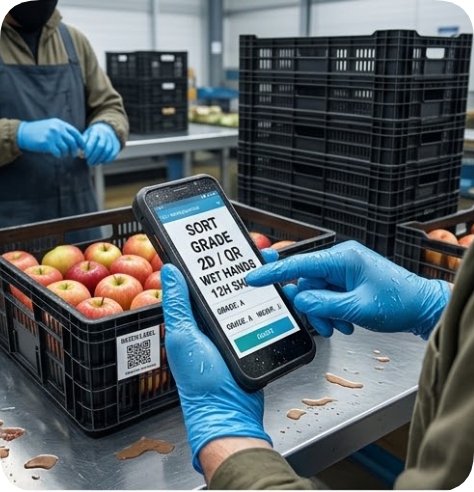
Its scan engine is where a produce line earns its keep. The page lists hardware-level 1D linear and 2D omnidirectional QR and DataMatrix imaging together with a high-sensitivity radio frequency module supporting multi-tag batch detection. A crate tag that has been reprinted or re-wrapped is often no longer a clean code, and an omnidirectional imager reads it without the operator finding the right angle first.
Connectivity is listed as dual-band wifi on 2.4 and 5 gigahertz, global 4G LTE cellular data, and Bluetooth. The platform is an enterprise-hardened Android build with native SDK access, which matters when a dock operator needs to add a field to the lot record without waiting for a vendor release.
Dispatch is the step where most traceability chains go quiet. The record exists on three screens, and then the truck leaves. The R860-S closes it by printing.
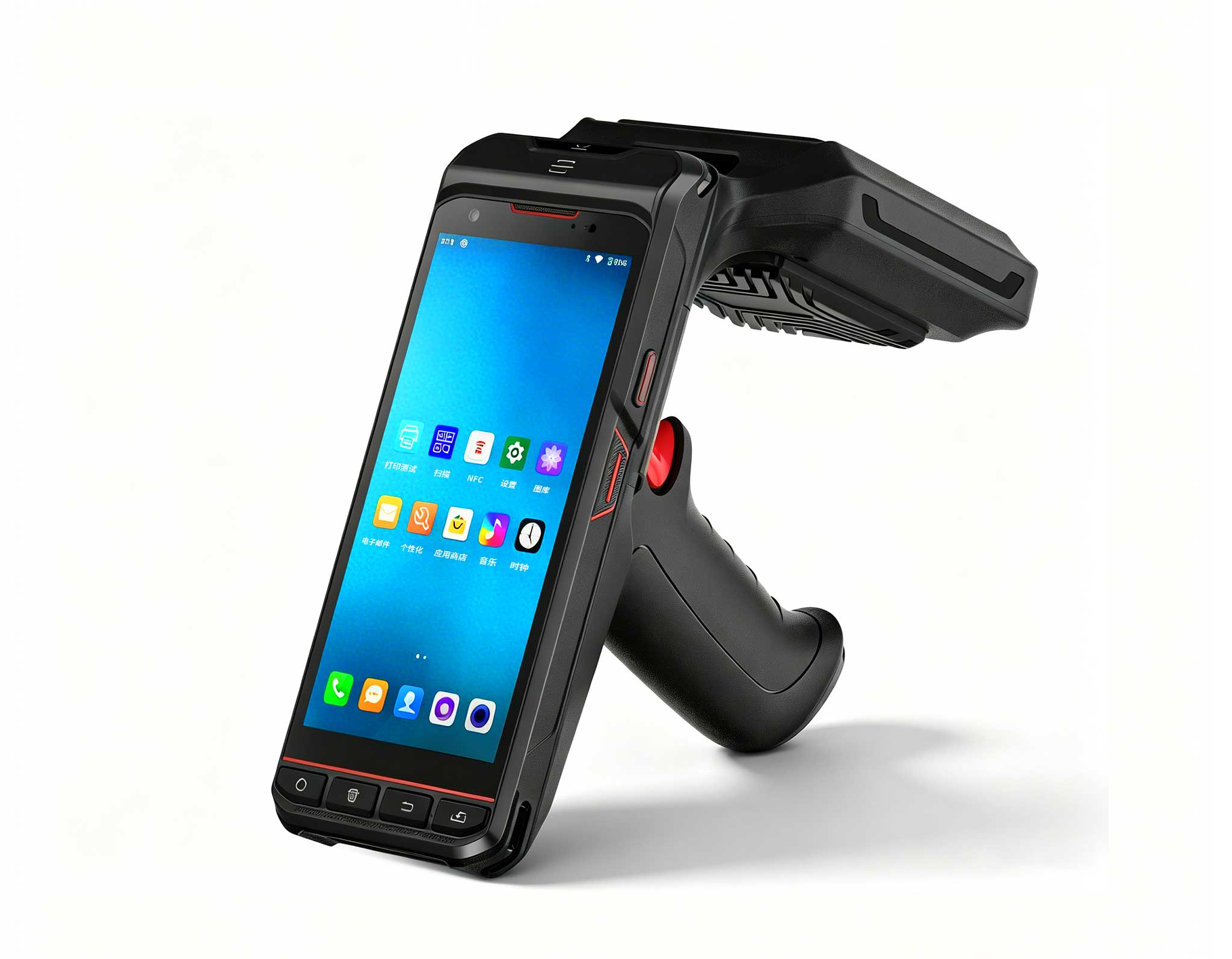
Its specification block is the most concrete of the three. A Qualcomm SM6115 octa-core processor at 2.0 gigahertz, Android 16, 4 gigabytes of RAM and 64 gigabytes of storage expandable through a TF card up to 256 gigabytes. The display is a 5.5-inch IPS HD+ panel at 720 by 1440 with multi-touch. The battery is a 5600 milliamp-hour detachable cell with standby over 350 hours and a three-to-four-hour charge. Dimensions are 177 by 80, with 73 millimetres at the grip and 45, or 23.8 millimetres at the printer end, under 500 grams.
The thermal printer is the point of the unit. It runs at 70 millimetres per second, accepts label and receipt paper, and carries black label, no-paper and overheat protection. That protection detail matters on a dock that runs long shifts: a printer that jams at the loading bay forces the pallet back into a queue that is already late.
Optional modules extend the same body. Near-field communication is listed at 13.56 megahertz across ISO14443A/B and ISO15693, reading tags at two to three centimetres, and an optional UHF radio frequency module uses a 40 by 40 millimetre ceramic block. The keypad carries power and dual scan keys, and the camera configuration lists an optional 8 megapixel front and a 20 megapixel autofocus rear with flash.
The table sets the three units against the position each one holds on the lot sheet. Where a figure is not published, the cell says so rather than guessing, because a receiving manager needs to know which numbers came from the vendor and which ones they still have to ask for.
| Position on the lot sheet | U9000 (door) | F505 (sort line) | R860-S (dispatch) |
|---|---|---|---|
| Processor | Cortex-A53 quad-core 2.0GHz | Multi-core industrial SoC, not itemised | Qualcomm SM6115 octa-core 2.0GHz |
| Operating system | Android 9.0 | Enterprise-hardened Android, version not itemised | Android 16 |
| Memory and storage | 2GB+16GB, up to 3GB+32GB | Not itemised | 4GB+64GB, TF to 256GB |
| Display | 5.0 inch IPS, 720x1280, Gorilla glass | High-contrast capacitive, size not itemised | 5.5 inch IPS HD+, 720x1440 |
| Battery | 4800mAh removable, over 12 hours | Li-polymer, engineered for 12-hour shifts | 5600mAh detachable, standby over 350h |
| Charging time | Under 4 hours | Not itemised | 3-4 hours |
| Dimensions and weight | 178 x 78 x 24mm | Not itemised | 177 x 80(73) x 45(23.8)mm, under 500g |
| Barcode imaging | 1.5m read distance, EPCglobal UHF Class1 Gen2 reader | 1D linear plus 2D omnidirectional QR/DataMatrix | Decoded accuracy 3mil or better |
| Printing | Not listed | Not listed | Thermal, 70mm/s, label and receipt paper |
| Cellular | 2G/3G/4G/5G | Global 4G LTE | 4G LTE, regional band sets listed |
| WLAN and pairing | Dual-band 2.4/5GHz, 802.11 a/b/g/n/ac | Dual-band wifi plus Bluetooth | Dual-band wifi 802.11 a/b/g/n/ac/ax ready, Bluetooth 5.0 |
| Positioning | GPS, Galileo, Glonass, Beidou | Not itemised | Not itemised |
Read the empty cells before the filled ones. The F505 page describes the enclosure, the panel and the battery in qualitative terms while publishing no screen size, no RAM figure and no ingress number, so a dock that needs those on the purchase record has to request them in writing. That request is part of acceptance, not paperwork to skip.
Three failures recur on produce docks. The first is the pallet that changes lot number after grading, leaving two records for one shipment. The second is the printer that stops at the loading bay, so the final label gets written by hand and the lot code never reaches the pallet. The third is the long sort shift, where a unit that cannot hold a charge past hour six quietly resets mid-count and the operator retypes the lot number from memory.
Each has a cheap remedy that costs nothing in hardware. The lot number belongs on the pallet label rather than in a clipboard, so it changes with the pallet and not with the paperwork. The printer is on the dispatch manifest as a consumable item, not as an accessory somebody remembers. And the shift length is written into the shift roster, so a twelve-hour battery claim is checked against the roster rather than against a product page.
Four checks decide whether this three-unit arrangement works on a given dock. Confirm that the receiving position has a charging cabinet, because a removable cell without a cabinet is a battery that sits at the wall all shift. Confirm that the sort line operates in gloves and moisture, and test it wet rather than reading the claim. Confirm that the label stock matches the printer paper path, and print one label before the first truck arrives. Confirm that the lot field can be edited after a grade change without breaking the record.
If the dock runs two shifts with one unit per position, this arrangement holds. If it runs a single long shift with one device covering all three jobs, the arithmetic changes: the printer unit has to survive the whole rotation, and the scale ticket still deserves its own record.
For the wider handheld range, browse our barcode and RFID industrial PDA line, step through our full product range when a dock needs a tablet alongside the handhelds, and compare architectures side by side in the product comparison guide before the order is cut.