A livestock farm does not get to choose when its herd file has to be correct. The breeding calendar fixes the date: artificial insemination bookings, veterinarian visits, and quarantine separations all start from an animal list, and every one of those appointments is made per head, not per barn. When the list in the office says one thing and the tags on the animals say another, the cost is not an abstract data-quality problem. It is a missed heat, a double-dosed vaccine, or a pedigree entry that attaches to the wrong dam, and none of those can be patched after the season has started. That is why serious farms run an ear-tag census in the weeks before breeding season: a full pass over the herd in which every tag is read, checked against the herd file, and either confirmed or corrected on the spot. This article looks at that census week through three Hotus terminals that map onto its three reading jobs: a pocket keypad unit for pen-side corrections, a close-range UHF reader for individual tag checks, and a long-range sweep reader for alley-wide head counts.
What the Season Deadline Does to a Herd File
A herd file fails quietly, and it fails in four distinct ways that a census has to treat differently. The lost tag is the obvious one: fencing, feeders and conventional separators pull buttons off every month, and the replacement that goes back in is often a spare from a different batch with no link to the animal's history. The duplicate is subtler: two animals carrying the same number — one from a transcription slip, one from a reused batch — can pass daily observation for years because they never stand next to each other. The unreadable tag still hangs on the ear but no longer answers a reader, whether the chip died, the antenna loop fractured, or the button was crushed in a chute. And the unregistered animal — the heifer that was tagged in the field during a busy calving week and never keyed into the herd file at all — is invisible to every report until breeding season demands its identity. A census week is the only routine that catches all four classes in one sweep, and each class gets its own fix: re-tag and link the history, retire one number, replace the button and re-verify, or register from the animal upward.
The census also has a hard property that ordinary daily scanning does not: it must be exhaustive. A spot check that samples one pen in five can live with a 95% read rate. A pre-season census cannot, because the 5% it misses is precisely the population that will produce a surprise in week three — the duplicate tag, the retired number still marked active, the young stock that never got registered at all. Exhaustiveness is what decides the equipment: the tools must cover close work at the shoulder of an animal, medium-range checks inside a pen, and long-range sweeps down an alley, and they must all write back to the same file before the team leaves the barn. The industrial handheld PDA line covers all three postures without forcing a single device to compromise on every one of them.
Three Reading Jobs, Three Terminals
Broken down by where a person has to stand, the census splits into three jobs. The first is correction work at close quarters: an animal is restrained, a tag is damaged or unreadable, and somebody has to re-key the identity, append a note, and move on in under a minute. The second is the individual tag check: standing at the fence or inside the pen, confirm that the number the reader sees is the number the file expects. The third is the sweep: walking or driving an alley while the reader harvests every tag in range at once and reconciles the harvest against the herd list afterwards. One device could technically do all three, but the way these three Hotus units divide the work is cheaper than forcing a single tool to compromise on all of it.
The barn also dictates the radio conditions in ways an office never does. Steel fencing and gate frames detune antennas at exactly the distances where a close-range check happens, animals in motion change the tag's orientation mid-read, and a wet hide after rain behaves differently from a dry one — which is why the census values having three distinct radio profiles instead of one. The long-range sweep works because it sees many attempts per second as animals shift position; the close-range check works because its operator can wait for the right geometry at 2 meters; and the keypad correction works precisely because it does not depend on radio at all. Matching the tool to the posture is not a luxury purchase here — it is what keeps the exception list from growing during the pass that is supposed to shrink it.
R350C: The Keypad Unit That Fixes What the Sweep Finds
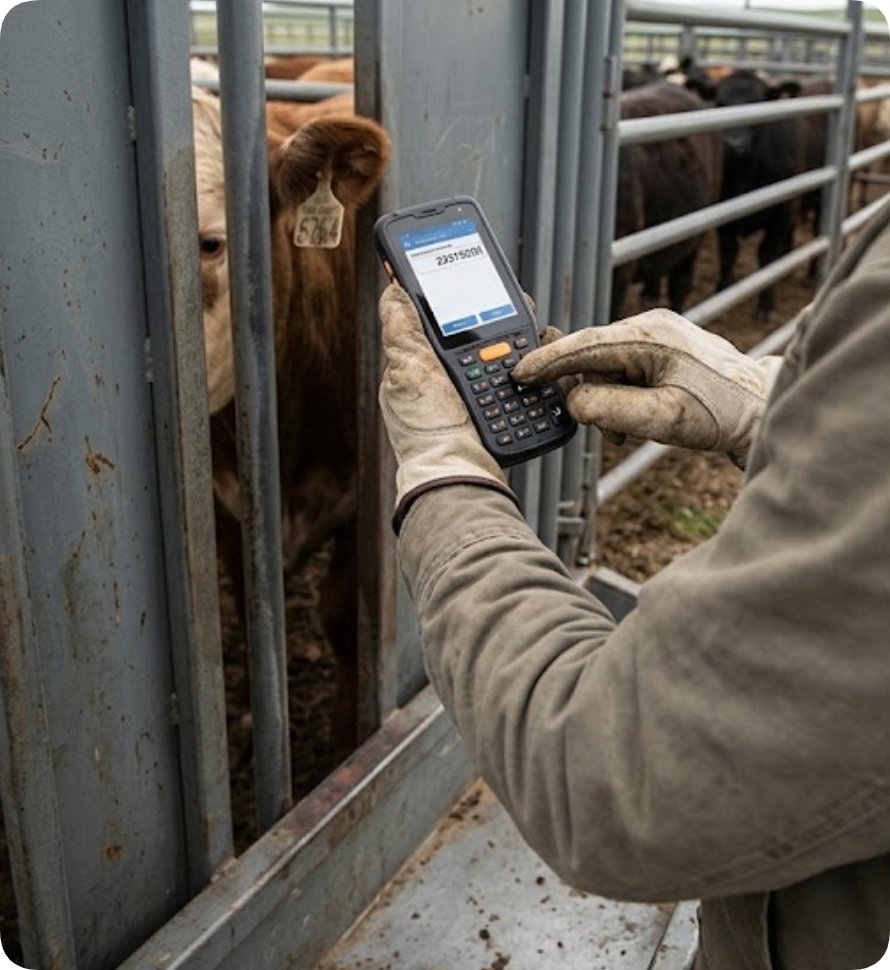
The R350C PDA is the correction station of the census, and its defining feature is the one modern handhelds usually delete: a physical numeric keypad under a 4.0-inch IPS touchscreen (480 x 800). Re-keying a tag number with real buttons — 0-9 plus delete, back, enter and scan keys — is faster and far less error-prone than tapping a glass keyboard while wearing work gloves, which is exactly the posture a head-catch or a squeeze chute puts you in. The body runs Qualcomm's QCM2290 quad-core at 2.0GHz with 4GB of RAM and 64GB of storage, expandable by microSD to 256GB, on Android 13. The removable 3.8V 4000mAh battery swaps in seconds when a correction queue runs long, dual side scan keys let the thumb fire the scanner from either grip, and the whole unit is 155 x 70 x 20.5mm at under 300g — light enough that the person doing corrections all morning is not fighting wrist fatigue by noon. Its certification line carries an IP67 industrial protection rating, which matters when the census week includes wash-down days.
R530C: The Close-Range Check That Confirms Tag by Tag
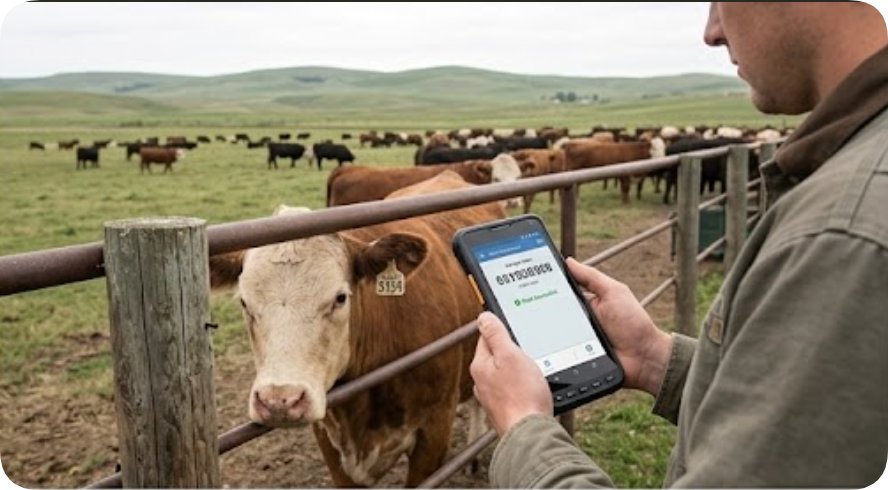
The R530C PDA owns the middle job. Its embedded UHF module uses a 40 x 40mm ceramic antenna on the EPC Class1 Gen2 (ISO 18000-6C) protocol, with a published read distance of up to 2 meters — a range deliberately suited to confirming one animal's tag without harvesting the whole pen behind it. Around that engine sits a 6.0-inch IPS FHD+ touchscreen at 1080 x 2160, the largest display of the three, which is what you want when the job is comparing a readout against a list and seeing at a glance which entry is suspect. The Qualcomm SDM450 octa-core at 1.8GHz with 2GB RAM and 16GB storage (microSD to 128GB) runs Android 16, and the 3.8V 6000mAh built-in battery is sized for a full field day. A PSAM encryption slot, dual nano-SIM, Bluetooth 4.2 and GNSS positioning round out a unit that weighs under 500g at 188 x 83 x 22mm. The published specification lists no IP rating, so wash-down suitability for this unit is a question for the quotation, not an assumption.
R366C-S: Reading the Whole Alley in One Pass
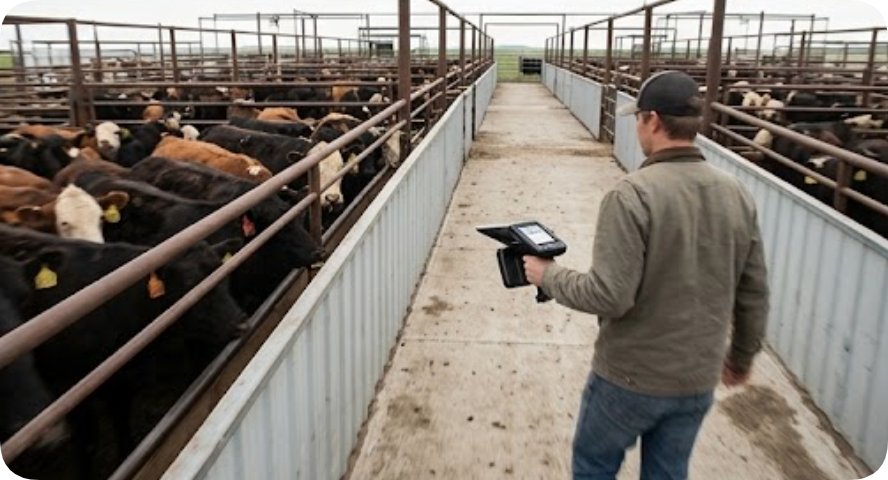
The R366C-S UHF Reader is the census engine. Its Impinj E710 module with a 4dBi antenna reads at 10 to 20 meters and clears more than 900 tags per second, which turns the alley sweep from a tag-by-tag march into a walk: a single pass down the lane collects every tag in range, and the reconciliation against the herd file happens afterwards, on the screen, not in the mud. The Qualcomm SM6225 octa-core at 2.4GHz with 4GB RAM and 64GB storage on Android 13 exists precisely to absorb that harvest — mass tag inventories are a data-volume problem as much as a radio problem. The 3.8V 10000mAh removable battery with Power Delivery fast charging is the largest of the three and is sized for consecutive high-intensity sweep days; two PSAM slots, Bluetooth 5.1 and a pistol-grip body at 170 x 79 x 22.6mm under 700g complete the unit. Like the R530C, its published specification lists no IP rating — the radio numbers are the headline, and environmental sealing should be confirmed with the factory before a wash-down-heavy operation commits.
The Census Table: One Row Per Job
| Item | R350C | R530C | R366C-S |
|---|---|---|---|
| Census job | Pen-side correction and re-keying | Individual tag confirmation | Alley-wide mass sweep |
| Display | 4.0-inch IPS, 480 x 800 + numeric keypad | 6.0-inch IPS FHD+, 1080 x 2160 | 5.5-inch IPS HD+, 720 x 1440 |
| Processor | QCM2290 quad-core 2.0GHz | SDM450 octa-core 1.8GHz | SM6225 octa-core 2.4GHz |
| RAM + ROM | 4GB + 64GB, microSD to 256GB | 2GB + 16GB, microSD to 128GB | 4GB + 64GB, microSD to 256GB |
| UHF capability | Optional module | Embedded ceramic antenna, up to 2m | Impinj E710, 4dBi, 10-20m, ≥900 tags/s |
| Battery | 4000mAh removable | 6000mAh built-in | 10000mAh removable, PD fast charge |
| Size and weight | 155 x 70 x 20.5mm,<300g | 188 x 83 x 22mm,<500g | 170 x 79 x 22.6mm,<700g |
| OS | Android 13 | Android 16 | Android 13 |
Two specification notes belong next to this table rather than inside it. First, the product page for the R350C states its rear camera two different ways in two places, so the camera row has been left out of the comparison entirely rather than guessed at; if camera evidence for the census matters, settle the exact configuration with the factory at quotation time. Second, only the R350C publishes an IP67 rating in its certification line; the R530C and R366C-S pages list CE, FCC and RoHS but no ingress rating, and this article does not infer one. The divisions that the table does settle cleanly are the ones that matter for the census: read range, tag throughput, battery size and weight separate the three jobs without overlap.
Fleet sizing follows the passes, not the head count. The sweep reader is the scarcest tool because only one operator can sweep an alley at a time — most operations run one R366C-S per barn complex and schedule the alleys so it never sits idle. The confirmation check scales with the number of pens that can be verified in parallel on the third pass, which usually means a small pool of R530C units rather than one. The correction terminal belongs to whoever holds the records, so one R350C per correction crew is the norm, and because it is the lightest unit at under 300 grams it doubles as the daily scanner between seasons instead of sitting in a drawer. Sizing this way also keeps the spare-battery math honest: the sweep consumes charge fastest, the 10000mAh pack covers it, and the correction unit's swappable 4000mAh battery means a charging cradle matters more than a bigger cell.
Scheduling the Census Week Before the Season Locks
A census that starts the week before the first insemination booking is already late, because the corrections it uncovers need their own time to propagate: a re-keyed identity has to be verified against purchase or birth records, a duplicate tag has to be physically replaced, and a replacement tag has to be re-read to confirm the fix. The workable pattern is three passes. The first pass, two to three weeks out, is the R366C-S sweep — it establishes the true tag population per pen and exposes the gap between what the barn holds and what the file claims. The second pass is the correction wave, driven by the R350C: every mismatch from the sweep becomes a work order, resolved at the animal, with the keypad doing the re-keying. The third pass, a few days before the season starts, is the R530C confirmation — tag by tag on the animals whose records were touched, so that the file entering breeding season has no unverified entries. Farms that stack all three passes into one weekend discover why the season punishes it: the corrections are the long pole, not the scanning.
Staffing the passes matters as much as timing them. The sweep wants one person who knows the pens well enough to notice when a count looks wrong for the group, walking at a pace the reader — not the animals — sets. The correction wave wants whoever holds the office records, because most fixes end at a desk comparing a birth entry or an invoice against what the barn reported; sending a scanner-only operator to do it produces corrections nobody can verify. The confirmation pass can go to any trained hand, because by then the list is short and every entry has a paper trail. One rule holds across all three: the day's harvest gets reconciled against the herd file the same evening, while the memory of which pen produced which read is still fresh, and the following morning starts from a clean exception list instead of yesterday's uncertainty.
What a Correct Herd File Buys in Week Three
The return on the census shows up after the season starts, and it is measurable in ordinary units. Insemination bookings attach to the right animal on the first attempt, so no straw and no slot is spent on an identity that turns out to belong to a different dam. Vaccine and treatment records follow the tag instead of the pen, which is what makes a withdrawal period defensible at audit. The veterinarian works from a list that matches the barn, so no appointment slot is spent resolving identities in the chute — on a four-hour visit that is easily half an hour recovered per round. And when a buyer or an auditor asks for the movement history of a specific animal, the answer is a lookup measured in seconds instead of an investigation measured in days. Set against one census week of labor and three terminals that the farm keeps using for daily inventory the rest of the year, the arithmetic rarely stays close for long. For operations weighing the hardware against that arithmetic, the full range of terminals is on the Hotus products catalog, and the cross-brand comparisons collected under Hotus news put these three units next to competing field hardware.