Fruit blocks used to be scouted the way they were planted: on foot, from memory, with a notebook that lived in the truck. A walker covered a row, saw something wrong on a leaf, wrote down a row number that depended on which end of the block they started from, and hoped the note still made sense two days later when the spray decision was made. That workflow is disappearing, and not because tablets became fashionable in agriculture. It is disappearing because the three things a block record actually needs — a precise location, a usable photo, and a screen that survives the sun — have all crossed the threshold where a phone in a plastic bag is no longer the cheapest acceptable tool. This article follows that shift through three Hotus rugged tablets that map onto the three roles in a digital scouting day: the RT81 Rugged Tablet in the row, the HTNJ10B at the packhouse, and the ST13-U in the office.
What a Block Record Has to Survive
A block record fails in three distinct ways, and each failure has a hardware answer. The first failure is spatial: "third row from the north fence, past the big tree" is not a location anyone can audit, revisit, or aggregate. Without coordinates, three seasons of observations never become a map, and without a map, a spreading problem stays invisible until it is expensive. The second failure is visual: a written note that says "spreading brown spots, lower leaves" cannot distinguish between three diseases that demand different sprays, and a photo taken on a consumer phone that then dies in July's heat is not evidence either. The third failure is environmental: a screen that cannot be read at noon, in dust, with damp hands, simply does not get used, and an unused record is worse than a paper one because it pretends to exist. Any tablet that wants to replace the notebook has to answer all three at once, which is why the three machines in this article divide the work instead of duplicating it.
RT81 in the Row: Coordinates and Evidence Photos
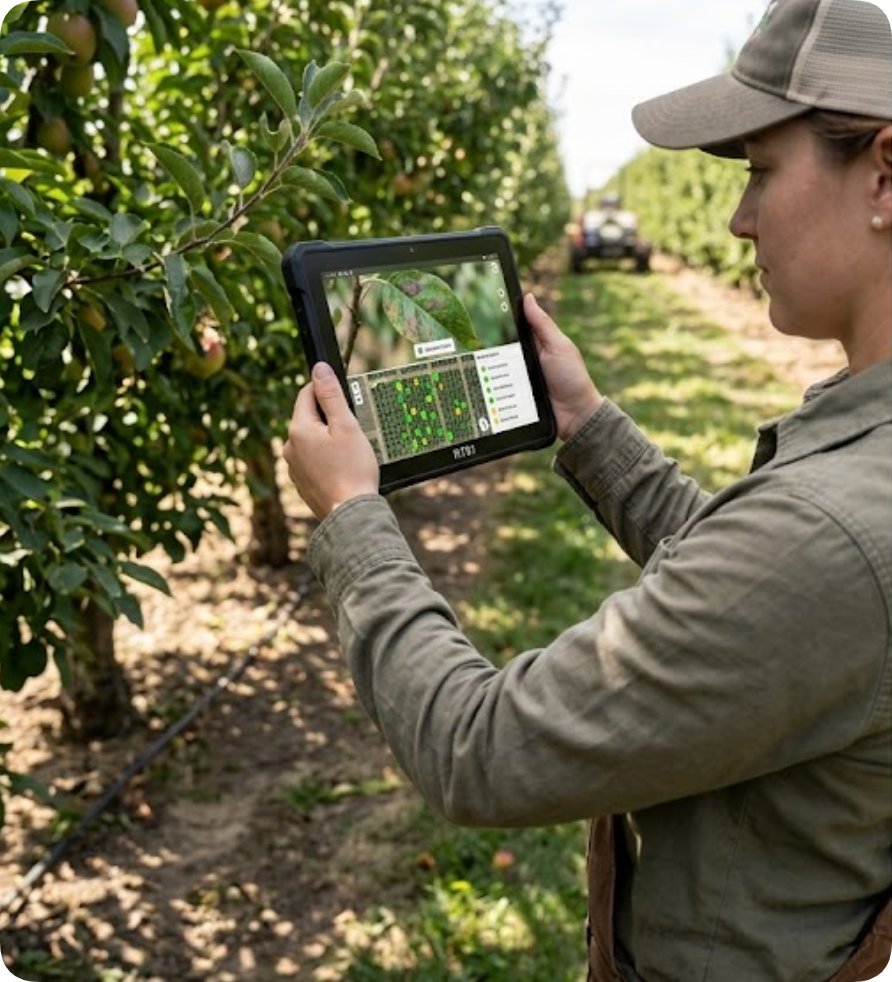
The RT81 is the tablet that walks the rows. Its positioning suite is the headline: GNSS across GPS, GLONASS and Galileo, plus an independent Beidou receiver with RTK correction, which the product page describes as centimeter-level mapping. For a scout, that changes what an observation is worth. Tapping a diseased tree pins the finding to a spot that can be revisited by a different person next week, aggregated block by block across the season, and overlaid on the spray plan. Its 20-megapixel rear autofocus camera with LED flashlight carries the second half of the record: a close-up that resolves the lesion pattern, taken in shade or in overcast morning light, attached to the pin. The 10.1-inch FHD screen at 400 nits with G+G 10-point touch reads well in the morning rounds, and the whole package is rated IP67 with 1.2-meter drop resistance against a working range of -10°C to 50°C. The 3.8V 10000mAh removable battery with Power Delivery fast charging covers a full walking day with a charged spare, and 4G LTE on dual nano-SIMs means each observation reaches the office before the scout reaches the next row.
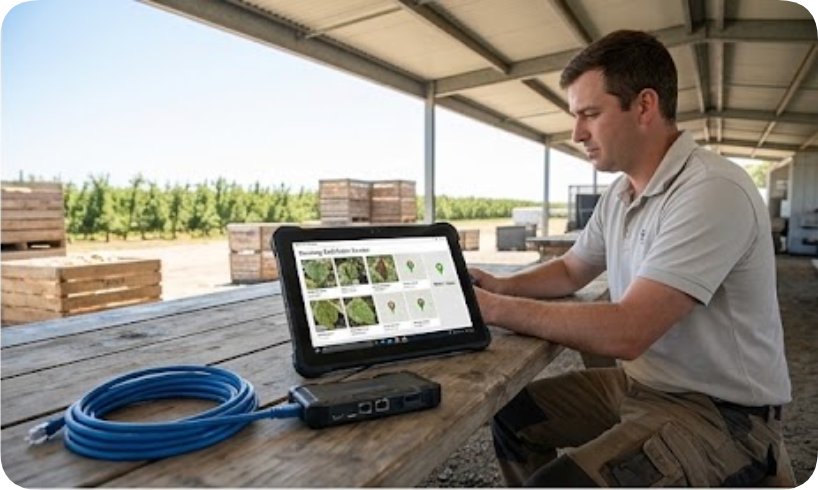
🖥️ HTNJ10B at the Packhouse: The Brightest Screen and a Wired Port
The HTNJ10B Rugged Tablet earns its place at the shed, not in the row. Its 10.1-inch screen is the brightest of the three at 560 nits with 7H hardness scratch resistance, which matters at the packhouse yard where scouting teams gather under open sky to review the morning's pins before anything is filed. It is also the most physically conservative machine of the trio: IP67 plus MIL-STD-810G certification, a 1.22-meter drop rating, and a double-layer solid body rated from -20°C to 55°C — a chassis built to be handed across the tailgate of a ute with gloves on. The port selection is where it quietly wins its role: RJ45 Ethernet alongside USB Type-A, USB Type-C, Mini HDMI and a 12-pin Pogo connector, so a sync station in the office can run over cable when the yard's wireless is congested at pickup time. Its Intel Pentium N6000 quad-core processor running Windows 10 or 11 Pro handles the aggregation forms, and the 7.6V 3500mAh removable battery suits a shed device that spends most of its day within reach of the DC 19V adapter. One honesty note for buyers: the product page lists RAM and storage only as high-speed memory with M.2 SSD expansion support and does not publish specific capacities, so those figures should be confirmed with the factory at quotation time rather than assumed.
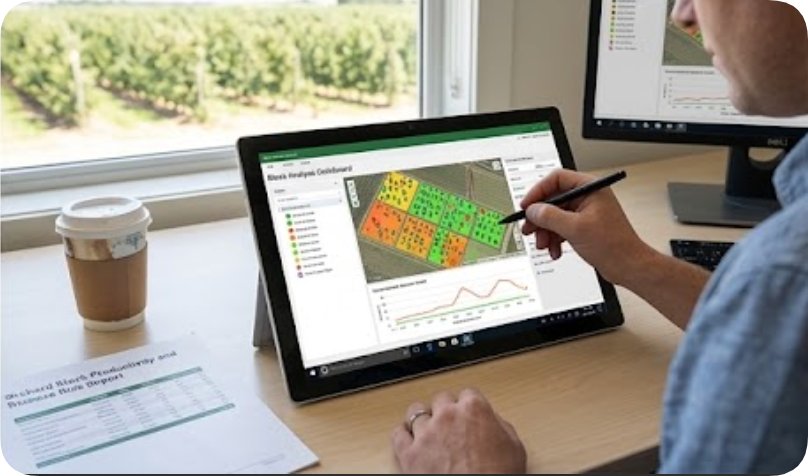
ST13-U in the Office: Where Pins Become a Season Map
The ST13-U Rugged Industrial Tablet is where the record gets read. A 13.3-inch IPS touchscreen at 1920 x 1080 with brightness up to 450 nits gives the agronomist room to put a season's worth of observation pins beside a spray schedule without squinting, and the screen accepts both an active stylus and wet-hand touch for annotating a canopy photo during a rain delay. Under Windows 11 Pro, the Intel Core i5-1235U — ten cores, twelve threads, turbo to 4.4GHz, with an i7-1255U optional — runs the full desktop stack: the GIS layer that turns RTK pins into a block map, the spreadsheet the consultant actually wants, and the video call where the spray decision gets defended. Connectivity is office-grade for a field machine: WiFi 6 on the Intel AX201, Bluetooth 5.2, global 4G LTE, and BDS/GPS/GLONASS positioning. The 8000mAh removable battery (60.80Wh, with a 6000mAh option) is honest about the role — this machine works mostly on the desk with the charger at hand. Its IP65 enclosure and 1.2-meter drop rating cover the walk from truck to office, not a life in the row, and at roughly 1450 grams nobody would pretend otherwise.
🎯 The Three Brightness Figures Decide Who Works Where
Laid side by side, the three screens tell you the intended division of labor more plainly than any marketing line. The RT81's 400 nits is honest morning-row hardware: readable early and late, dependent on shade at noon, compensated by the speed at which a pin-and-photo takes ten seconds. The ST13-U's 400 to 450 nits assumes the office, where the window blinds compete rather than the sun. The HTNJ10B's 560 nits is the brightest panel of the three and the reason it owns the yard bench — a screen that stays readable at midday under an open sky is the one that gets used for end-of-round reviews. A fleet that buys all three of one model discovers this the hard way; a fleet that buys one of each inherits a division of labor that the brightness figures were already describing.
What the Table Settles and What It Cannot
| Item | RT81 Rugged Tablet | ST13-U Rugged Industrial Tablet | HTNJ10B Rugged Tablet |
|---|---|---|---|
| OS | Android 16 | Windows 10 Pro / 11 Pro | Windows 10 Pro / 11 Pro |
| CPU | Qualcomm SM6115 Octa-Core 2.0GHz | Intel Core i5-1235U (i7-1255U optional) | Intel Pentium N6000 Quad-Core up to 3.3GHz |
| Display | 10.1" IPS 1200x1920, 400 nits, G+G | 13.3" IPS 1920x1080, 400-450 nits, stylus + wet hand | 10.1" IPS 1200x1920, 560 nits, 7H, stylus + wet hand |
| Camera | 20MP rear AF + flash, 8MP front | 8MP rear AF + flash, 5MP front | 8MP rear AF + flash, 5MP front |
| Positioning | GNSS + independent Beidou + RTK (centimeter-level) | BDS/GPS/GLONASS | BDS/GPS/GLONASS |
| Protection | IP67, 1.2m drop, -10°C to 50°C | IP65, 1.2m drop, -20°C to 55°C | IP67 + MIL-STD-810G, 1.22m drop, -20°C to 55°C |
| Battery | 3.8V 10000mAh removable, PD fast charge | 7.6V 8000mAh (60.80Wh) removable, 6000mAh optional | 7.6V 3500mAh removable, DC 19V adapter |
| Standout ports | Type-C OTG/PD, 12-pin Pogo, dual SIM, dual 2W speakers | WiFi 6 (AX201), BT 5.2, global 4G LTE, TPM2.0 optional | RJ45 Ethernet, Mini HDMI, USB-A/C, 12-pin Pogo |
| Weight | < 650g (252 x 170 x 14.6mm) | 1450g | approx. 2.1KG gross (28.4 x 19 x 2.5cm) |
Two specification notes belong next to this table rather than inside it. First, the HTNJ10B's page does not publish RAM and storage capacities — the row that would normally carry them has been left out rather than guessed, and the figure should be confirmed at quotation time. Second, the three machines carry three different protection philosophies: the RT81 and HTNJ10B are sealed to IP67 while the ST13-U settles at IP65, which reads less impressive on a datasheet but matches a machine designed to live on a desk and commute in a truck rather than live in a row. Weight follows the same logic: the 650-gram RT81 is the one that gets carried for six hours, and the 2.1-kilogram HTNJ10B is the one that does not move much.
Building the Fleet Without Overbuying It
The trend this article describes does not require a tablet per worker. A practical starting fleet for a mid-size operation is one RT81 per scouting team, because the row is where records are born and the RTK receiver is the component that cannot be improvised; one HTNJ10B per packhouse or shed, where its brightness and wired port make the end-of-round review routine; and one ST13-U per agronomist or office, where the 13.3-inch screen and desktop Windows do the aggregation that justifies the whole exercise. Every role above draws from the Hotus rugged tablet line, so spares and chargers stay within one ecosystem. Operations that already run consumer tablets usually discover the failure mode before the season ends — a dead unit in week three of a heat wave, or a photo that cannot be tied to a location — and replace the fleet mid-season at a worse price than a planned order would have commanded. Operations starting fresh can begin with a single RT81 and a used office PC, then add the yard and office units when the record becomes valuable enough to protect, which is exactly the order in which the failures arrive.
The digital block record also changes the scouting calendar more than it changes the walk. Paper-era scouting happened when someone had time, which usually meant after the problem was visible from the row end. With pins and photos accumulating daily, the calendar shifts to cadence: a full-block walk every seven to ten days in the pressure window, spot revisits triggered by the map rather than by memory, and a mid-season review at the packhouse screen where block-by-block trends decide whether the next walk is routine or targeted. The record also changes who can scout — a relief worker with the RT81 produces pins in the same format as the regular scout, because the format lives in the workflow rather than in the person. That substitution is the quiet argument for the whole investment: knowledge that used to retire with the foreman now retires into the file.
The Return: One Season of Comparable Blocks
After a season, the payoff takes a form a spreadsheet can hold. Blocks are comparable, because every observation carries coordinates and a timestamp instead of a row number and a guess. Spray decisions carry their evidence, because the photo that justified each call is attached to the record that authorized it. Recurring hot spots surface on the map by the second season, which is when drainage, canopy density and variety choice start explaining what blame used to explain. And the audit conversation — with a certifier, a buyer, or an insurer — becomes a filter instead of a search. For operations weighing the hardware against that arithmetic, the full range of terminals and tablets is on the Hotus products catalog, and the cross-brand comparisons collected under Hotus news put these three units next to competing field hardware.