A rugged tablet earns its place on a jobsite twice: once in the procurement file, where the protection ratings live, and once in person, when somebody on site decides whether the device in your hand is actually allowed to proceed. The second test is the one manufacturers never write a datasheet for. Crews discover it on the morning they arrive, when the person holding the clipboard wants to see something specific before the work starts, and again at noon, and once more before anyone goes home.
This article follows one operating day at a concrete-and-steel expansion site outside Foshan, where three Hotus Windows tablets — an HTNJ08B, an HTNJ08C and an HTYJ08A — were matched to three different demands for evidence. The site had already standardised on industrial three-proof tablets across its crews; what this day shows is how the same protection ratings answer three very different audiences: a foreman running the toolbox talk, a client representative hunting for shortcuts, and a records office that wants the whole day reconstructed before the next one begins.
✅ Three Compliance Moments in One Jobsite Day
The day opens with the toolbox talk, the fifteen minutes before first task where the foreman restates what the site accepts as evidence. On this site the list is short and physical: a device body that carries IP67 dust and water sealing, a drop rating on file at MIL-STD-810G, and hardware that still works with gloves, rain and a screen covered in concrete dust. The foreman does not read datasheets aloud. He holds up the unit each crew will carry, turns it over so the double-layer chassis is visible, and says the name of the rating once. From that moment the tablet is not just a computer; it is a document the whole crew has seen.
Three demands follow across the day. At the perimeter turnstile, identity has to match the person before the gate opens. On the scaffold after mid-morning, a client representative walks the boards and asks two random crews to show what their devices have recorded. And at the close of day, after a near miss stops work for an hour, the question shifts from what the device is to what the device saw. Each moment lands on a different unit in this fleet, which is why the site stopped treating its tablets as interchangeable.
HTNJ08B at the Turnstile: The Identity Clause
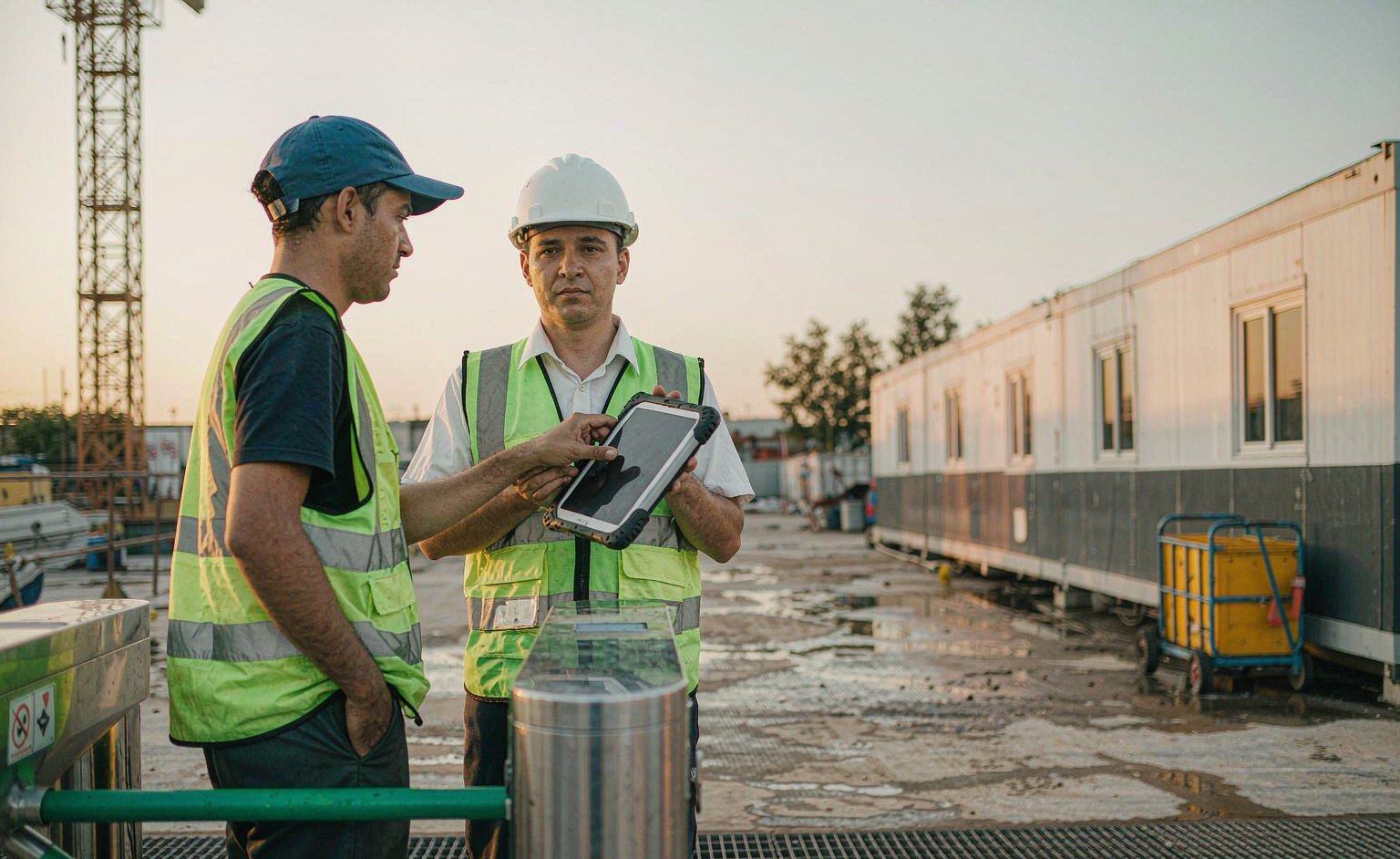
The perimeter demand landed on the HTNJ08B, and the deciding feature is optional on the spec sheet but mandatory here: the fingerprint verification module. Site access on this project is tied to the person, not the badge, because badges get lent and fingerprints do not. At the turnstile cabin the operator presses a finger to the reader, the unit confirms the match against the induction list, and the crossing logs itself with a timestamp the office can audit later. The Pentium N6000 under the shell, four cores bursting to 3.3 GHz, handles the match and the access client together without the operator waiting.
The radio choice surprised the integrator at first. This unit runs Wi-Fi 5 with Bluetooth 4.2 plus a global 4G LTE fallback — one tier behind the others in the fleet — and it is deliberately enough. The turnstile cabin sits beside the site canteen, forty metres from the nearest access point, and the older radio negotiates a stable session through two prefab walls without complaint. A full-size RJ45 port in the cabin covers the worst days, the 8-inch 560-nit panel with 7H glass reads in direct morning sun, and the 7.6V 3500mAh removable battery swaps in seconds when the night-shift operator takes over the same cabin.
🏆 The Client's Spot-Check on the Scaffold
Mid-morning, the client's HSE representative climbs the scaffold with no appointment and picks the third crew she reaches. This is the spot-check, and its rhythm never changes: she asks to hold the device, weighs it in her hand, scrolls the day's inspection form, and then looks for the two things shortcuts always betray. First, whether the photos on the form were taken where the form claims — the rear 8-megapixel autofocus camera with LED flashlight answers that, because re-shooting yesterday's form in a car park shows in the shadows. Second, whether the screen was actually used at height in the rain, which the wet-hand and stylus operation on the 10-point capacitive panel quietly confirms.
She also presses on the ratings, because that is what her own report will cite. The crew's HTNJ08C answers: IP67 sealing against scaffold dust and driving rain, MIL-STD-810G certification on file at the site office, and a drop tolerance listed at 122 centimetres — the height of a scaffold board lift, as she writes in the margin. The Intel N100 inside, four cores reaching 3.4 GHz, keeps the inspection form responsive while the camera app stays warm in the background, and the double-layer body on this unit already carries a dent from a December beam strike that the board below never felt.

HTNJ08C Sends the Shift Upstairs on Wi-Fi 6
Collecting evidence on the scaffold is half the job; delivering it before the crew descends is the other half, and this is where the HTNJ08C earns its slot in the fleet. The moment the form closes, the unit pushes the photos and the signed checklist up to the site server over Wi-Fi 6, which holds a steady connection through the scaffold's steel mesh where the older pool devices used to stall at a quarter of the form. The N100's four cores compress the photo set in the background while the engineer starts the next form, so the upload finishes before the next question is asked.
The scaffolding crew's variant of this unit carries the optional barcode module, which scans the steel tag on each standard the crew inspects and drops the component number straight into the form. That one change removed the transcription step where last year's paper process lost most of its errors. An RJ45 port on the ground-floor cabin takes over when the crew works inside the core shafts, the TF card slot holds a week of offline captures as backup, and the same 3500mAh removable battery means the charge state at noon depends on the swap ritual, not on luck.
A Muster-Point Question After the Near Miss
At half past two a coupling strap fails two levels up and a shackle lands inside the exclusion zone — nobody hurt, work stopped, and the site manager calls a muster. What follows is the third demand, and it is the one crews fear most: the question of who was where, in what order, with what recorded. The crews that carried tablets answer it by handing the devices over. The form history, the timestamps on every scan and photo, and the camera roll reconstruct the hour before the incident without anyone guessing from memory, and the site's report cites the device record rather than recollection.
This is also where the small features stop being small. The 5-megapixel front camera on the same unit confirms who was holding it when the form was signed. The LED flashlight around the rear camera lights the failed coupling for a close-up that later settles what the strap's condition actually was. And because the record never left the device unlogged, the sequence of entries carries its own chain of custody — the detail the client's representative underlines twice in the margin of her notebook.
HTYJ08A Rebuilds the Day for the Records Office
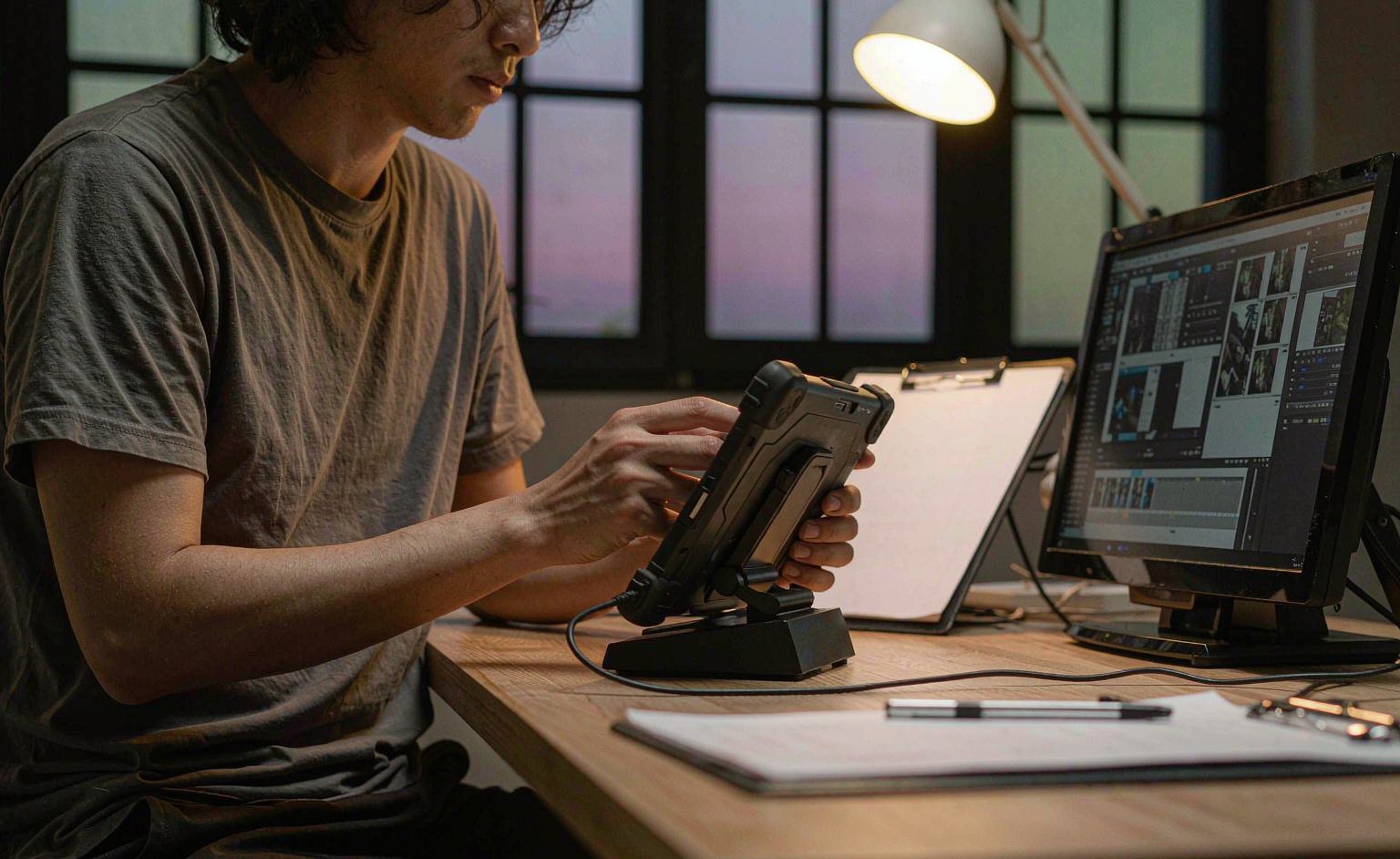
The third demand lands after hours, in the site office where the project coordinator rebuilds the day for the file, and the unit for that job is the HTYJ08A. Under its shell sits the fleet's largest engine: an Intel Core i5-10210Y, upgradeable at order time to the i7-10510Y, all four cores running Windows Pro. When the records office asks for the day assembled — access logs, spot-check forms, scaffold photos, the incident sequence — the coordinator opens all of it at once, and the 8-inch 1200×1920 panel with 560 nits of brightness still separates a shadowed photo from a stamped signature.
The build for this role leans on the ports. Mini HDMI drives the office monitor for the review session, the 12Pin Pogo-pin connector docks the unit to the desk stand where it charges and syncs overnight, and Windows Pro joins the site domain so the archive carries proper user attribution instead of a shared login. Wi-Fi 6 with Bluetooth 5.0 and global 4G LTE mirrors the scaffold unit's radio, the RJ45 port holds the office's wired link, and the same IP67 body means the device that spent the day on the scaffold sits on the office desk without a wipe-down ceremony.
What the Three Answers Share
By the time the site file closes for the day, the pattern is explicit: one protection story, three audiences, three units geared to each. The site did not buy three different classes of device — it bought one protection class and aimed the differences where the demands actually land. The grid the coordinator keeps on the office wall reduces the choice to the rows below.
| Dimension | HTNJ08B (turnstile) | HTNJ08C (scaffold) | HTYJ08A (records office) |
|---|---|---|---|
| Processor | Intel Pentium N6000, 4 cores, burst 3.3 GHz | Intel N100, 4 cores, burst 3.4 GHz | Intel Core i5-10210Y / i7-10510Y, quad-core |
| Wireless | Wi-Fi 5 + Bluetooth 4.2 + global 4G LTE | Wi-Fi 6 + Bluetooth 5.0 + global 4G LTE | Wi-Fi 6 + Bluetooth 5.0 + global 4G LTE |
| Verification and capture | Fingerprint, barcode, UHF RFID modules (optional) | Barcode, RFID modules (optional) | Windows Pro domain join, Pogo-pin dock |
| Shared protection | IP67, MIL-STD-810G, 122 cm drop, -20°C to 55°C | IP67, MIL-STD-810G, 122 cm drop, -20°C to 55°C | IP67, MIL-STD-810G, 122 cm drop, -20°C to 55°C |
| Display and battery | 8-inch 560 nits, 7H; 3500mAh removable | 8-inch 560 nits, 7H; 3500mAh removable | 8-inch 560 nits, 7H; 3500mAh removable |
Two closing notes complete the grid. Every unit in the fleet shares the same removable battery and the same 19V charging brick, so the site's contingency plan is one drawer, not one per model. And because the protection ratings are identical across all three, a crew can lend a device across roles on a short-staffed day without stepping outside the site's compliance story — the flexibility that made the fleet cheaper to run than its paper on any single day. Readers weighing the same decision against a different mix of roles will find the full Hotus product range grouped by protection class and screen size, and the running rugged tablet comparisons on this site pair these units against the alternatives site by site.