Oil and gas field stations run on repetitive line walks: someone follows the corridor, stops at markers and valves, records what the eye cannot see, and hands the day's evidence to the control desk. The hardware questions get most of the attention, but the expensive mistake is usually a staffing one — too many scanners on short routes, too few on long ones, and crews wasting battery hours waiting for a charge. This guide sets the crew structure first and then fits three devices into it: the R530C PDA for the UHF lead role, the X501 for the compact second scanner, and the Smart PDA N40 at the meter-station desk. The numbers below come straight from the product pages of each unit, and the quota rules are written so a dispatcher can apply them without a pilot program. Crews that adopt the pairing structure tend to finish the same route with fewer scanner hand-offs and a cleaner record at the end of the day, which is exactly what an audit asks for. For stations building a program from zero, the industrial PDA line page lists the full fleet alongside these three.
💡 Why Crew Size Follows the Route, Not the Org Chart
A patrol route has three measurable properties: length, reading density, and risk class. A 12-kilometer corridor with markers every 200 meters produces roughly 60 forced stops; a meter-station loop of 800 meters may hold just six. Once those two numbers are on paper, the crew size stops being a management opinion. One scanner per 25 to 30 reading points keeps a morning walk inside a battery cycle; beyond that, add a second pair instead of asking one device to stretch. Reading density also decides the split between UHF and 2D work — dense tag clusters reward the longer read range of UHF, while sparse valve tags are fine with a close-range 2D engine. Risk class adds the last rule: crossings and pigging-related stations get a dedicated scanner so a fault never takes the whole route offline. Route pairing works because each property maps to a role, not to a headcount someone guesses in a scheduling meeting.

The Lead Scanner Owns the Buried-Marker Tags
The R530C carries the pair's heavy read work. Its built-in 40x40mm ceramic UHF antenna reads EPC Class1 Gen2 tags (ISO 18000-6C) at up to 2 meters, so the lead operator sweeps marker posts from a standing position instead of crouching at each one — on a 60-stop route that difference alone returns close to an hour. The read band covers FCC, ETSI and SRRC-MII frequencies, which matters for stations that move the same tag stock across regional depots. The 6.0-inch FHD+ screen (1080 x 2160) shows the tag population clearly in daylight, and the 6000mAh battery is sized for the full walk: a lead route with 60 UHF reads and continuous LTE telemetry stays inside one charge, but the battery is built-in, so the quota rule is simple — this unit goes out at 100% or it does not go out. The Qualcomm octa-core platform runs Android 11 and is upgradable to Android 13, and the PSAM slot (ISO/IEC 7816) keeps encrypted operator credentials on the device. At 188 x 83 x 22mm and under 500 grams, the weight budget still allows a shoulder kit with a spare stylus and cleaning cloths.
Device quota for the lead role: one R530C per crew pair, enrolled to a single route card. When two pairs share one corridor from opposite ends, each keeps its own unit — shared scanners break the audit trail at exactly the point auditors sample first. The tri-color breathing LED gives dispatch a glance-level status check at the gate, and the two side scan keys let the operator trigger reads with either thumb when the other hand holds a valve chart.
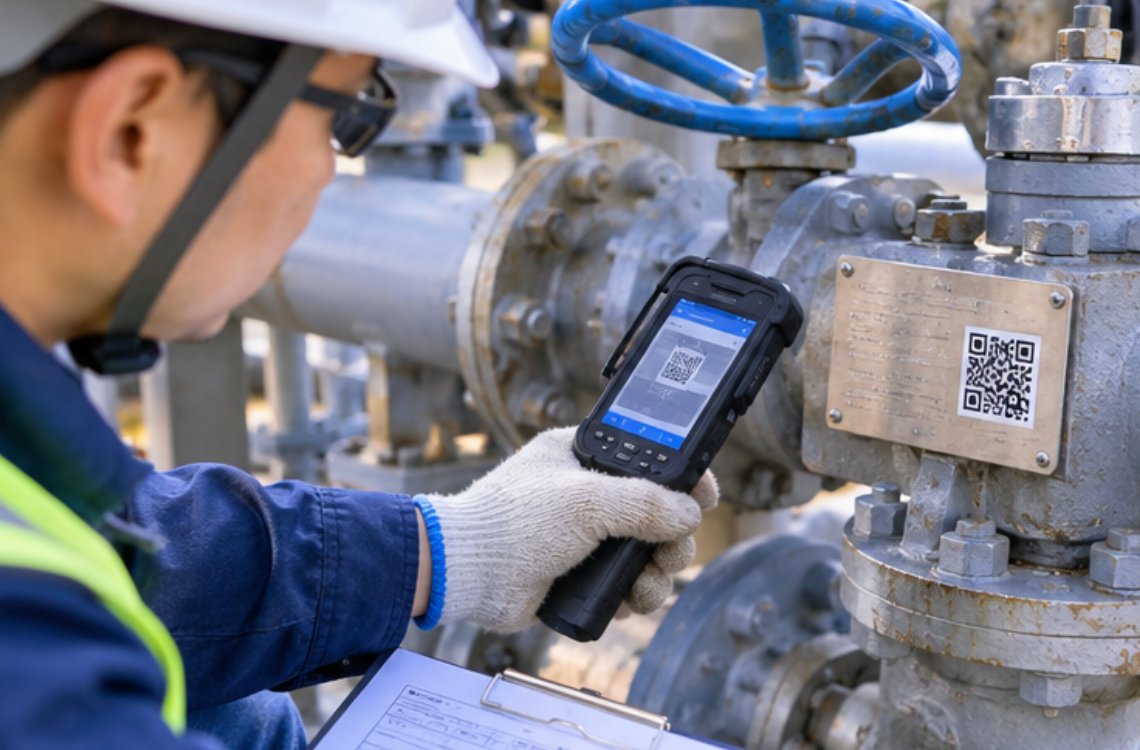
📱 The Compact Second Scanner Covers Valves and Screens
The X501 fills the second role: close-range 2D work at valves, gauges and nameplates. Its hardware scan engine — available with Honeywell or Zebra modules — decodes 1D and 2D codes on paper and on screens, which matters more than it sounds: gauge data at a meter run is often displayed on an LCD, and reading the screen barcode with a phone camera fails in direct sun. The unit weighs about 270 grams in a 158 x 75 x 16mm body, carries an IP67 rating with 1.5-meter drop resistance, and its 5.0- or 5.5-inch Gorilla Glass panel supports glove and wet-hand operation — the two conditions that actually describe a valve-check morning. The 4500mAh or 5000mAh battery is removable with quick-swap support, so the coverage ratio math changes: a pair that splits a 12-kilometer route in half can finish both halves on one battery each, and a mid-route swap takes seconds without powering down. The octa-core 64-bit platform at 2.0GHz runs Android 14 (or Android 12 for fleets standardized earlier), with 4GB RAM and 64GB storage expandable to 256GB. The pogo-pin docking interface earns its place in the quota plan: a charged spare battery in the truck plus a dock at the gatehouse covers a double shift without cable juggling.
🪧 The Desk Terminal Anchors the Meter Station
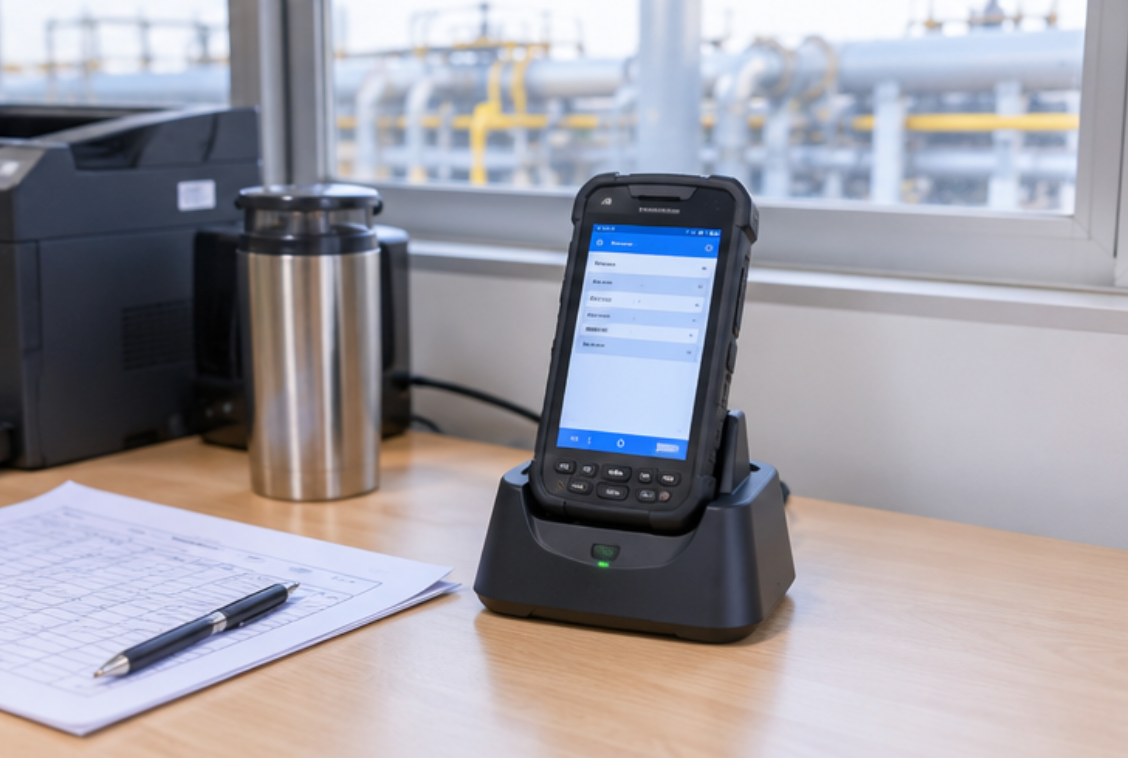
Not every scan happens on the line. Meter stations need a device that lives at the desk, logs handovers, and reads the barcode sheets that crews drop off. The Smart PDA N40 is built for that sitting role. Its 4.0-inch TN screen at 480 x 800 is small on paper but honest at a desk, and the Cortex-A53 quad-core 2.0GHz platform running Android 10 handles the log-sheet application without touching the route fleet's airspace. The 4500mAh removable polymer battery delivers more than 12 hours of working time and over 350 hours of standby, so one unit covers the longest station shift and still survives a forgotten-charger morning. Storage is 2GB plus 16GB with TF expansion to 128GB, and the Type-C USB port with OTG plus a POGO interface connects it to the station's printer and charging cradle. Optional data-capture modules — 1D/2D scanning, NFC, RFID, fingerprint — let a station tailor the unit without buying a second fleet. Scan quota at the desk is deliberately low: ten to twenty sheets per shift, which is why the device quota assigns one Smart PDA N40 per station rather than one per operator.
The Device Quota Table at a Glance
The table compresses the three roles into the columns a dispatcher actually compares when planning a shift. Weight and ingress ratings are deliberately left out of the table because the three pages publish them on different terms — the lead unit lists dimensions with a sub-500-gram figure, the second scanner states about 270 grams with IP67, and the desk terminal's page does not publish a weight — so those details live in the role paragraphs above and should be read there rather than compared as if they were measured the same way.
| Item | Lead scanner | Second scanner | Desk terminal |
|---|---|---|---|
| Operating system | Android 11, upgradable to Android 13 | Android 14 (Android 12 variant) | Android 10.0 |
| Processor | Qualcomm SDM450 octa-core 1.8GHz | Octa-core 64-bit 2.0GHz | Cortex-A53 quad-core 2.0GHz |
| Memory and storage | 2GB+16GB, TF to 128GB | 4GB+64GB, TF to 256GB | 2GB+16GB, TF to 128GB |
| Display | 6.0" IPS FHD+ 1080 x 2160, multi-touch | 5.0"/5.5" IPS HD, Gorilla Glass, glove and wet-hand | 4.0" TN 480 x 800, multi-touch |
| Battery | 3.8V 6000mAh, built-in | 3.8V 4500mAh/5000mAh, removable, quick swap | 4500mAh removable polymer, 12h work / 350h standby |
| Data capture | UHF RFID to 2m (EPC Class1 Gen2, ISO 18000-6C); optional 2D engine at 3mil; optional NFC | Hardware 2D engine (Honeywell/Zebra), 1D/2D on paper and screens; optional UHF module and NFC | Optional 1D/2D, NFC, RFID, fingerprint modules |
| Security and ports | PSAM slot (ISO/IEC 7816), Nano-SIM x2, Type-C OTG | Pogo-pin dock, Nano-SIM x2, Type-C OTG | Type-C OTG, POGO interface |
Staffing Math for a 12-Kilometer Line
Here is the quota arithmetic applied to a real shape: one 12-kilometer corridor, 60 markers, 14 valve stations, one meter building. Split the route at the midpoint and assign two crew pairs — each walks 6 kilometers and about 37 reading points, inside the one-battery envelope for both the lead and the second scanner. Device quota: two R530C units, two X501 units, one N40 at the meter station, plus one spare X501 battery per truck. If the station adds a second corridor next quarter, the structure scales by pairs, not by ad-hoc purchases: each new corridor takes one more pair, one more lead unit, one more second scanner, and the same desk terminal keeps logging for both routes. Coverage ratio discipline lives in the charge plan — built-in-battery units go on Type-C overnight at the gatehouse, removable-battery units rotate through the dock, and no unit starts a shift below 90%. Fleet cost tracking gets easier for the same reason: with roles fixed, a damaged unit is replaced in its role, not argued about. The X501 Handheld PDA anchors the second-scanner slot in that replacement plan.
Training the Pairs in One Morning
The pairing structure trains quickly because each role has exactly one skill to drill. Lead operators spend 40 minutes on UHF practice: tag placement geometry, the 2-meter read envelope, and what a failed tag looks like on the FHD+ screen. Second scanners need 30 minutes on 2D technique — reading gauge screens at an angle, wet-hand operation, and the swap ritual for the removable battery. Desk operators learn the N40 in 15 minutes: log-sheet intake, the POGO cradle, and the end-of-shift export. Cross-training is discouraged on purpose; a pair that swaps devices mid-route produces two half-audits instead of one clean one. The only shared drill is the failed-scan protocol — when a tag does not read, the lead marks the point on the route card and the desk terminal reconciles it the same afternoon, which keeps the corridor's record continuous even when hardware misbehaves. Crews running mixed fleets from other suppliers should keep that protocol device-neutral so the record never depends on which scanner walked the line. Broader application notes for utility inspection hardware are collected on the brand product hub.
Frequently Asked Questions
1. How many devices does one patrol pair actually need?
Two: one lead unit for UHF marker work and one second scanner for 2D valve and gauge work. A third device per pair looks like redundancy but mostly ends up uncharged, because the quota plan already assigns the desk terminal to the meter station rather than the crew.2. Can a single device handle both UHF and 2D duties?
Partly. The lead unit accepts an optional 2D engine with 3mil precision, and the second scanner accepts an optional UHF module. But the lead unit's strength is the 2-meter read envelope from a standing position, and a combined unit forces one operator to switch mental modes every stop. Pairs split the roles because the split keeps each scan quota clean.3. What happens when a battery dies mid-route?
For removable-battery units, the pair swaps in seconds and the route continues — that is why the quota plan puts a charged spare in each truck. For the built-in 6000mAh lead unit, the plan is preventive: it departs at 100% or not at all, and a 60-stop UHF route finishes inside one charge with telemetry running.4. Does the desk terminal need network access at the meter station?
The N40 logs locally and syncs when the station's connection returns; its Type-C OTG and POGO interfaces cover the printer and cradle without extra adapters. Stations that need cellular sync can add the optional wireless module when ordering.More deployment guides across warehouse, logistics and inspection scenarios are catalogued in the news and comparisons library, where each walkthrough follows the same quota-first structure used here.