Most defect-photo problems blamed on hardware are actually specification problems that a forty-minute bench session would have caught before the purchase order went out. The carton gets opened, the battery clicks in, someone photographs a scratch under the bench lamp, walks twenty meters toward the paint line to check the Wi-Fi bars, and hands the unit back with a verdict. Every step of that session maps to one line on the buying sheet: battery format, camera pairing, radio band, screen brightness, weight on the lanyard.
This guide runs that session against three HOTUS rugged tablets that sit at three different price and size points, and turns each step into a checklist line with a number attached. The ST9-J is the eight-inch Windows unit, the RT81 is the ten-inch Android unit, and the ST13-U is the thirteen-inch flagship. By minute forty, the sheet is either signed or annotated with the exact spec that failed.
The First Ten Minutes: What the Carton Owes the Line
The first item is battery format, because it decides how a shift starts. The ST9-J ships a 7.7V 5000mAh removable pack that charges in about three hours and runs roughly seven; a bench clerk can pull it, seat a spare, and never see a boot screen mid-shift. The ST13-U carries the same removable logic at a higher figure: an 8000mAh 7.6V pack rated at 60.80Wh, with a 6000mAh option listed. The RT81 goes the other way — a 10000mAh 3.8V sealed cell — so the carton check asks a different question: whether 12 to 14 hours of rated endurance covers the longest shift without a swap. Plants that already run battery cages with barcode-labeled spares will grade the two removable designs higher; single-shift sites can accept the sealed cell and spend the difference elsewhere.
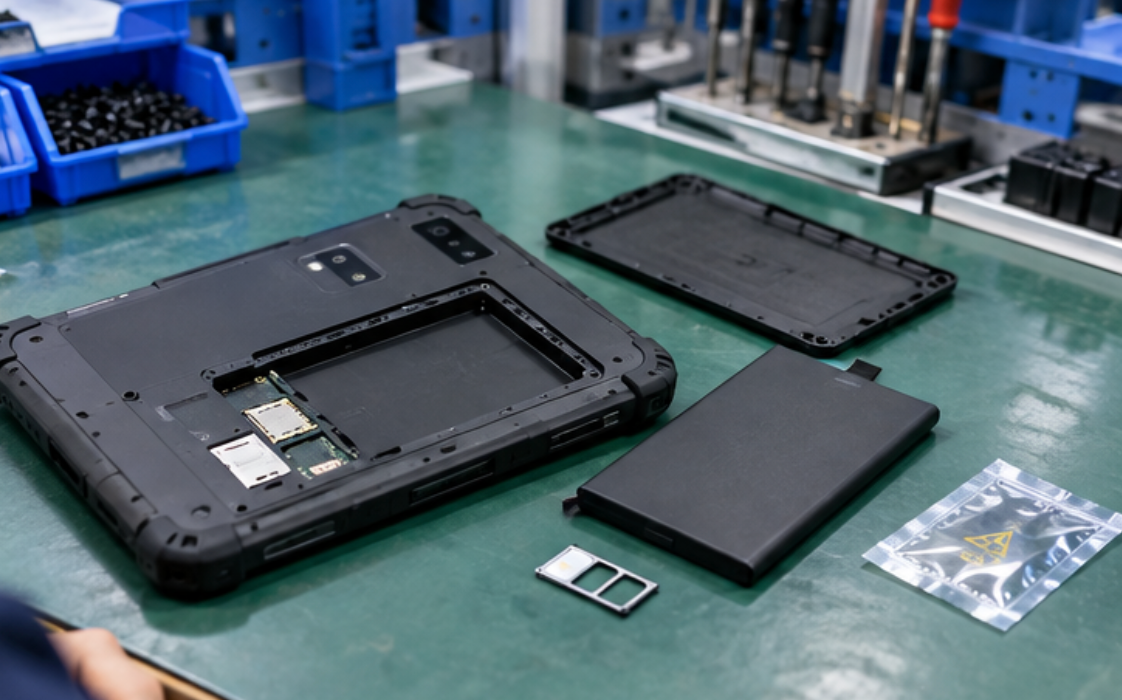
Second item in the same ten minutes: connectivity slots. The RT81 exposes two nano-SIM trays, one TF slot, a Type-C port with OTG and PD, and a 12-pin Pogo pad on the dock face. The ST9-J and ST13-U list 4G LTE through the SLM770A module and optional docking accessories instead. Count the SIM trays against the carrier plan on file, not against a competitor's datasheet — a dual-SIM plant that splits consumer and enterprise data plans cannot downgrade that line later.
🏭 Calibrating the Photo Path Before Production Does
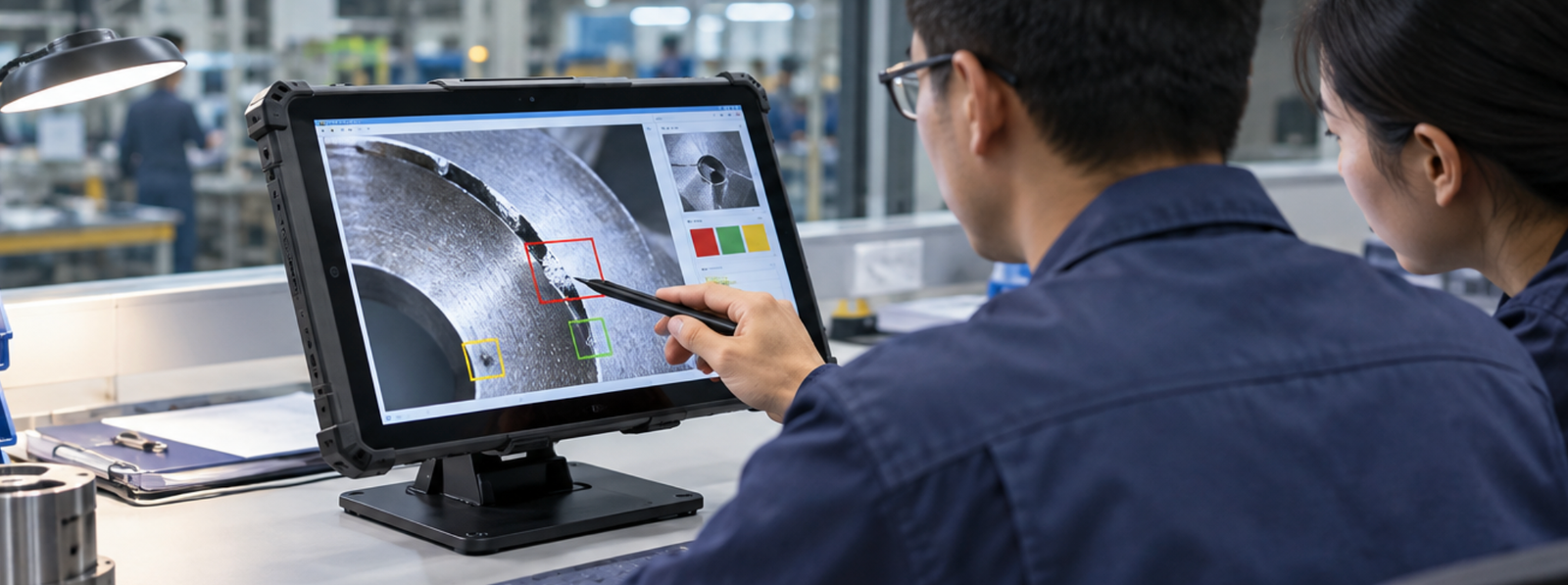
Minute ten to twenty belongs to the camera, and the three units split cleanly. The ST9-J pairs a 5MP front camera with a 13MP rear autofocus module that has its own flashlight. The RT81 steps up to an 8MP front and a 20MP rear autofocus with flash, plus an optional 2D scanner rated at 3mil accuracy for barcodes on travel documents and component labels. The ST13-U tops the front camera at 5MP but keeps the rear at 8MP autofocus with light. The bench routine is the same for all three: photograph a machined edge under the lamp, zoom until the pixel grid shows, and confirm the flaw edge stays crisp — then repeat with the flash forced on, because paint-line corners are darker than the aisle suggests.

Screen verification sits inside the same window. The ST9-J offers an 8-inch IPS panel at 1200×1920 with 400 nits and an optional 1000-nit sunlight-readable variant. The RT81 gives a 10.1-inch FHD panel at the same 400 nits with 10-point G+G capacitive touch. The ST13-U runs a 13.3-inch IPS screen at 1920×1080 with 400 to 450 nits. All three support stylus and wet-hand operation on their 10-point touch layers, so the checklist line reads: pick brightness by the brightest corner of the plant, and pick screen size by how much annotation the QC team writes on the photo itself.
The Wi-Fi Walk That Predicts Plant Coverage
Minutes twenty to thirty happen away from the bench. The RT81 lists dual-band Wi-Fi on 802.11 a/b/g/n/ac with ax-ready hardware and Bluetooth 5.0; the ST9-J holds WiFi 5 on 802.11ac with Bluetooth 4.2; the ST13-U moves to WiFi 6 on the Intel AX201 chipset with Bluetooth 5.2. All three keep global 4G LTE as the fallback path, so the walk tests one thing: where the plant's access points hand off and where the tablet silently drops to cellular. Facilities that mapped dead zones for other devices should repeat the walk with the unit that will actually carry the camera, because antenna placement differs by chassis size.
Positioning earns its own line for plants that tag assets outdoors. The RT81 supports GPS, GLONASS, and Galileo with an optional independent BeiDou module that pushes accuracy to centimeter level for RTK workflows. The ST9-J and ST13-U cover BDS, GPS, and GLONASS, with a high-precision UM960 GPS option listed for the eight-inch unit. Yard operations photographing defects on trailers or column bases should grade this line harder than indoor-only plants, which can score it as a bonus.
Three Devices, One Comparison Table
The table condenses the bench results into the lines a purchasing team actually signs. Every value below comes from the product pages, and the versions are the ones currently published — the RT81 page now lists one processor and one battery figure consistently, which was not true of every historical print.
| Checklist Line | ST9-J | RT81 | ST13-U |
|---|---|---|---|
| Operating system | Windows 10 Pro (Win 11 Pro optional) | Android 16 | Windows 11 Pro |
| Processor | Intel Celeron N5100 quad-core, burst 2.80GHz | Qualcomm SM6115 octa-core 2.0GHz, 11 nm | Intel Core i5-1235U, turbo 4.4GHz (i7-1255U optional) |
| Memory and storage | 8GB+256GB; 4GB/128GB/512GB optional | 4GB+64GB or 8GB+128GB; TF to 256GB | 8GB/16GB (to 64GB) with M.2 SSD 128GB–512GB |
| Display | 8in IPS 1200×1920, 400 nits (1000-nit option) | 10.1in FHD 1200×1920, 400 nits, G+G touch | 13.3in IPS 1920×1080, 400–450 nits |
| Camera | 5MP front + 13MP rear AF, flash | 8MP front + 20MP rear AF, flash | 5MP front + 8MP rear AF, flash |
| Battery | 5000mAh 7.7V removable, about 7 h | 10000mAh 3.8V sealed, 12–14 h | 8000mAh 7.6V removable (60.80Wh) |
| Protection | IP65, MIL-STD-810G, 1.2m drop, −20°C to 55°C | IP67, 1.2m drop, −10°C to 50°C | IP65, 1.2m drop, −20°C to 55°C |
| Weight | 700±50g | under 650g | 1450±50g |
One calibration note belongs next to the weight line: the RT81 figure is published as an upper bound ("under 650g") while the two Windows units carry nominal tolerances, so treat the RT81 row as a ceiling rather than a midpoint when comparing against supplier quotes. For teams that want the same table logic applied across whole product families, the site keeps a section of device comparisons that walks older models through the same treatment.
What the Table Cannot Settle
Four lines stay off the table because they are options, not defaults. Barcode capture: the RT81 offers a 2D scanner with 3mil accuracy, the ST9-J lists an optional 1D/2D module, and the ST13-U lists the Honeywell N4680. RFID: UHF appears on the ST9-J option list only. Security: TPM2.0 is an option on both Windows units and absent from the RT81 sheet, which matters to plants under export-control or ITAR-adjacent audit rules. NFC: all three list 13.56MHz modules in the ISO14443 family, with the RT81 adding ISO15693 and M1 card support and the two Windows units quoting a 1 to 3cm read distance. Write each option into the RFQ explicitly; a unit configured without the module will still pass the bench test and fail the process audit six weeks later.
Handing Out the Units After the Pass
The last ten minutes assign hardware to people, and the chassis sizes make the decision nearly automatic. The ST9-J at 700 grams and 236×144×17.4mm is the one-hand unit for inspectors who climb, crouch, and photograph with the same hand that holds the rail. The RT81 at under 650 grams and 252×170×14.6mm balances a larger screen with Android's MDM ecosystem — the page names SOTI and VMware Workspace ONE as deployable without modification, which shortens the IT line item. The ST13-U at 1450 grams and 331.7×203.2×19.5mm is the desk-adjacent unit for stations that review photos on-screen rather than take them: incoming QC desks, supervisor stations, and the repair-approval counter.
Operating temperature splits the same way. The two Windows units are rated from −20°C to 55°C, which covers cold-chain docks and outdoor yards; the RT81 starts at −10°C, so freezer-adjacent audits should either route that unit to warmer zones or accept the ST9-J as the cold-corner device. Protection follows the same split — the RT81's IP67 seal buys submersion margin, while the IP65 rating on the Windows pair covers dust and jets, which is what washdown corners actually produce.
🏭 The First Production Week Settles the Reorder
A bench pass predicts the first shift; the first week predicts the reorder. Three measurements are worth writing down from day one. Shots per charge: count photos against the rated endurance — about seven hours on the ST9-J pack, 12 to 14 on the RT81, and the 8000mAh pack's day-rate on the ST13-U — because flash use taxes the real figure. Sync latency: timestamp a photo, timestamp its arrival in the MES, and record the gap per unit; the two Windows units move files through the plant's existing domain tools, while the RT81 leans on its 4G and Wi-Fi path. Failure log: one line per incident, with the exact corner of the plant where it happened. If the log stays clean for five production days, the buying sheet signs itself; if it fills, the annotations name the exact spec line to renegotiate.
For buyers still weighing form factors against other deployments, the manufacturer's product catalog lays out the full rugged line alongside the accessories that ship with each unit, and the comparison section extends the same bench-test logic to projector and PDA lines where the failure modes differ.