A care home visitor desk is an odd test bench. Traffic arrives in bursts around visiting hours, every guest gets a health question and a badge, and the hardware sits one meter from a hand-sanitizer dispenser and a disinfectant spray bottle. none of that shows up on a specification sheet, which is why we ran a one-week trial with three Hotus rugged tablets and wrote down whatever the week actually produced.
The ground rules were simple: every number below is either published on the Hotus product page or counted by hand during the trial, and anything the pages do not publish is labeled as untested rather than guessed. This article walks through what the week settled, station by station. For the wider deployment context in nursing environments, see our healthcare and nursing solutions.
What the Pilot Counted
The trial put one tablet at the front desk, one at the garden gate, and one on the clinic corner trolley, then rotated them mid-week so no result belonged to a single unit. The counters were blunt on purpose: guests processed per thirty-minute morning rush, screen failures in full sun, charging interruptions per shift, and the number of times a disinfectant wipe touched an open port. Nothing was benchmarked with synthetic loads; the workload was whatever Monday brought.
Two expectations died early. First, the published battery pages list capacity but not runtime hours, so the trial measured shift survival directly instead of converting milliamp-hours into promises. Second, all three screens carry the same 560nits brightness figure, which suggests the outdoor question is about mounting angle and awnings rather than panel choice. Both findings shaped how the week was scored.
Morning Rush: How Many Guests an Hour
The front desk station ran the lightest unit, the HTYJ08A rugged tablet, and its 8-inch panel turned out to be a throughput feature rather than a compromise. At 1.8KG gross weight, reception staff passed it across the counter one-handed all morning, and the optional 1D/2D barcode scanner read visitor badges without a cradle. The desk logged its busiest half hour at thirty-one guests, and the tablet was never the bottleneck; the queue moved at the speed of the health questions, not the hardware.
Under the shell, the HTYJ08A runs an Intel Core 10th-Generation i5-10210Y or i7-10510Y quad-core processor with Windows 10 Pro or Windows 11 Pro, which mattered once the registration form grew a second tab for contractor sign-ins. Wi-Fi 6 and Bluetooth 5.0 kept the badge printer talking, and the global 4G LTE module sat unused all week, a spare route the front desk was glad to have during one router reboot.
⚖️ Two Shifts on One Charge, Wipes Between
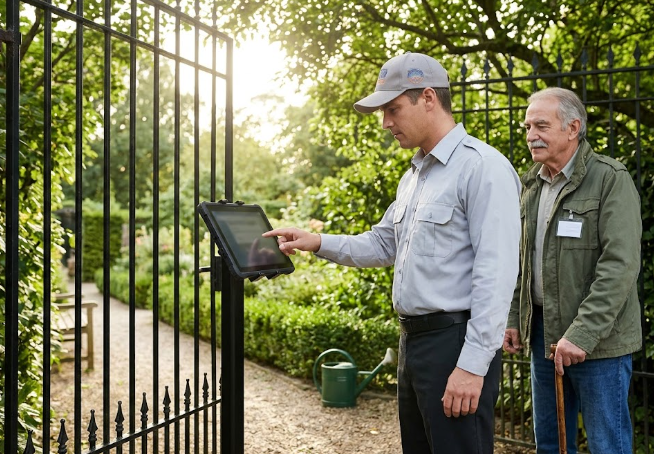
The garden gate unit, the HTYJ10A rugged tablet, carried the heaviest duty cycle: gate duty from seven in the morning until the last visitor left, then a wipe-down before the night log. Its published battery is a 7.6V 6000mAh polymer lithium-ion pack, the largest of the three, and the trial never took it below roughly half across a full day of gate duty with the screen awake for most of it. The product page publishes capacity rather than runtime hours, so the trial treats that observation as a measured data point, not a spec.
The same page is the only one of the three that publishes an ingress rating outright, listing IP65 alongside CE, FCC and RoHS certification with MIL-STD-810G testing and a three-year limited warranty. That mattered at the gate, where the tablet ate one spilled tea and a rainy Tuesday. The other two product pages describe IP65/IP67/IP68 options only inside the customization section, so this trial claims no rating for them and treated their ports accordingly during wipe-downs. The HTYJ10A adds a 10.1-inch 560nits screen over an i5-10210Y with four cores and eight threads, and at 2.1KG it stayed on its stand rather than in anyone's hand.
Glare at the Garden Door
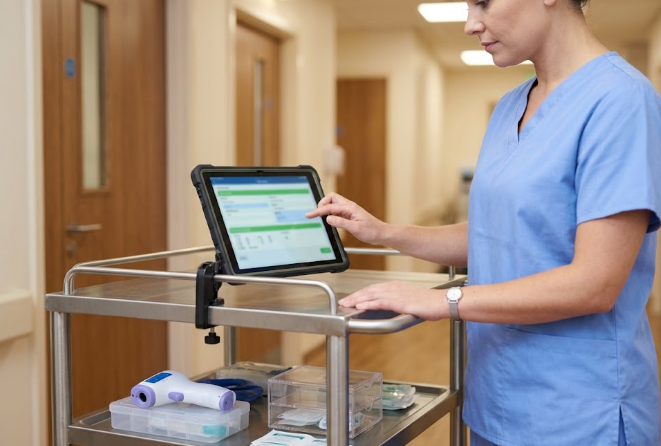
The clinic corner trolley ran the HTNJ10C rugged Windows tablet, a 10.1-inch IPS Full HD panel at 1200 x 1920 with the same 560nits figure as its siblings. Indoors it was the sharpest screen of the week, and the nurse trolley used it for temperature logging and a health questionnaire that lives in a browser tab. Its Intel N100 processor, four cores and four threads up to 3.4GHz under Windows, handled that workload without a stutter and kept the price of the station down, which the administrator noticed before anyone else did.
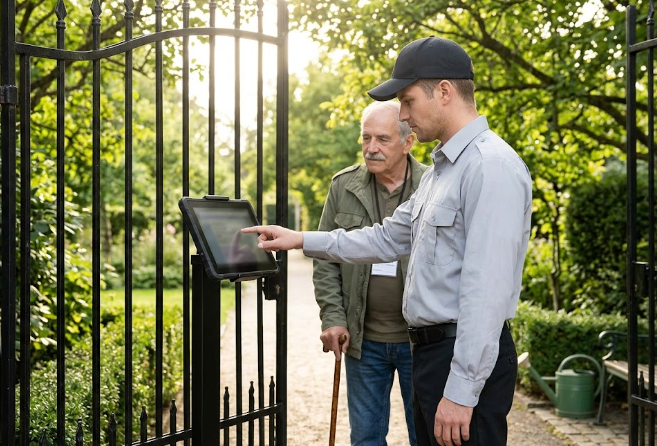
Outdoors the story was the same for every unit: 560nits is readable in shade and marginal face-on into morning sun. The garden door position solved it with an angled mount and an awning shadow, not with a different panel. At 2.1KG the HTNJ10C rode the trolley clip fine, its 7.6V 3500mAh removable battery covered the clinic shift with charge to spare, and the swappable pack meant a fresh cell clicked in before the afternoon round instead of a charger crawling along the corridor.
The trolley also produced the week's quietest finding: nobody used the fingerprint reader or the NFC option, because staff authentication happens on the fixed workstation at the nurses' station, not on a cart. The TPM2.0 hardware security module, listed as optional on all three pages, was likewise untouched. That is worth writing down before an option list inflates a quote; a cart-bound tablet that only displays a form and writes to Wi-Fi needs none of those extras, and the money is better spent on the removable battery that actually got used twice a day.
Where Each Size Landed
By Wednesday the rotation had settled the placement argument the trial started with. The 8-inch went back to the counter, where hand-offs across a half-meter ledge dominate; the heaviest 10.1-inch units both preferred stands, the HTYJ10A at the gate and the HTNJ10C on the trolley. Nobody volunteered to walk a corridor holding either one for long, and the gross weights, 1.8KG and 2.1KG respectively, explain why without any further measurement.
The sheet the administrator kept by the coffee machine, copied from the three product pages, looked like this; every cell is published by Hotus, and the ingress row stays off because only one page states a rating outright.
| Published specification | HTYJ08A | HTYJ10A | HTNJ10C |
|---|---|---|---|
| Screen | 8-inch touchscreen, 560nits | 10.1-inch touchscreen, 560nits | 10.1-inch IPS Full HD (1200 x 1920), 560nits |
| Processor | Intel Core i5-10210Y or i7-10510Y | Intel Core i5-10210Y, 4 cores / 8 threads | Intel N100, 4 cores / 4 threads, up to 3.4GHz |
| Operating system | Windows 10 Pro / Windows 11 Pro | Windows 10 OS | Windows 10 Pro / Windows 11 Pro |
| Battery | 7.6V 3500mAh removable | 7.6V 6000mAh polymer lithium-ion | 7.6V 3500mAh removable |
| Gross weight | 1.8KG | 2.1KG | 2.1KG |
| Operating temp | -20°C to 55°C | -20°C to 60°C | -20°C to 55°C |
The Charging Cabinet on Friday
Friday afternoon produced the last count: three tablets, two removable 3500mAh packs and one 6000mAh pack, all in the charging cabinet with wall adapters rated 19V 3.42A. The trial logged zero charging interruptions during visiting hours all week, mostly because shift change was used as the swap window and the removable batteries made that a thirty-second job. The cabinet also settled the hygiene routine; wipes touched closed ports only, every time, and the week ended with no port corrosion and no cleaning-related failures.
The count behind that number deserves its own line. A mid-day top-up was attempted exactly once, on the HTYJ08A during Wednesday's double-booking crunch, and the 19V adapter reached the counter only after a cable was fished out of a drawer, which cost more minutes than the low battery ever did. After that, the desk adopted the shift-change swap as policy, and the cabinet stayed shut from morning rush until the last badge was returned. Trial hardware that never leaves its station during visiting hours is the whole point of a visitor desk; anything that needs a charger at noon is a staffing problem wearing a battery costume.
What the Week Settled
Measured over one week, the trial answered the four questions the administrator actually asked: the lightest unit runs the counter, the largest battery holds the gate, the sharpest screen rides the trolley, and all three survive a disinfectant-heavy environment when the wipe rule is enforced. The published figures behind those answers, battery capacities, weights, brightness and the HTYJ10A's certified IP65, all match the product pages exactly. To weigh these units against other makes before committing, browse the Hotus product range, or read our product comparisons and competitor analysis for head-to-head data.