Every outdoor operation has a stretch of months when the field stops forgiving. Surveys stack up, inspection rounds double, and crews that carried a tablet two hours a day in April are holding it for ten in July. The hardware decisions that felt optional in spring become the constraint on the whole schedule once that stretch starts.
The three tablets compared here share one rugged platform: the HTYJ08A and the HTNJ08C in 8-inch bodies and the HTYJ10A in a 10.1-inch one, all rated IP67 with MIL-STD-810G certification and the same removable 3500mAh battery. What separates them is processing headroom, screen size and carried weight, and those three differences map cleanly onto the three limits an outdoor season pushes hardest. This article plans a fleet around them.
What the Busy Season Does to Field Hardware
A peak calendar attacks a tablet on three fronts at once. First, ambient temperature: a device left on a vehicle dash or carried across open ground works far outside the office range, and a season of thermal stress exposes any weakness in the design. Second, daylight: screens that read fine indoors become guesswork under a midday sky, and every extra minute spent shading a display with a forearm is a minute the survey route does not have. Third, duty cycle: field teams that ran one shift now run two, and a sealed unit that cannot open for a battery change had better have been chosen with that in mind.
Because the three models here share the same protection class, the same battery and the same port row, the fleet decision comes down to matching each configuration to the front that hits it hardest. The sections below take the three limits in turn and assign each one the model whose specifications answer it most directly.
The Temperature Window on the Spec Sheet
All three pages quote an operating range of −20°C to 55°C, sealed under IP67 with MIL-STD-810G drop certification at 1.22 meters. That window is identical across the family, which makes the processor choice the real thermal variable: chips that do the same work with less power leave more margin between the case temperature and the environment around it.
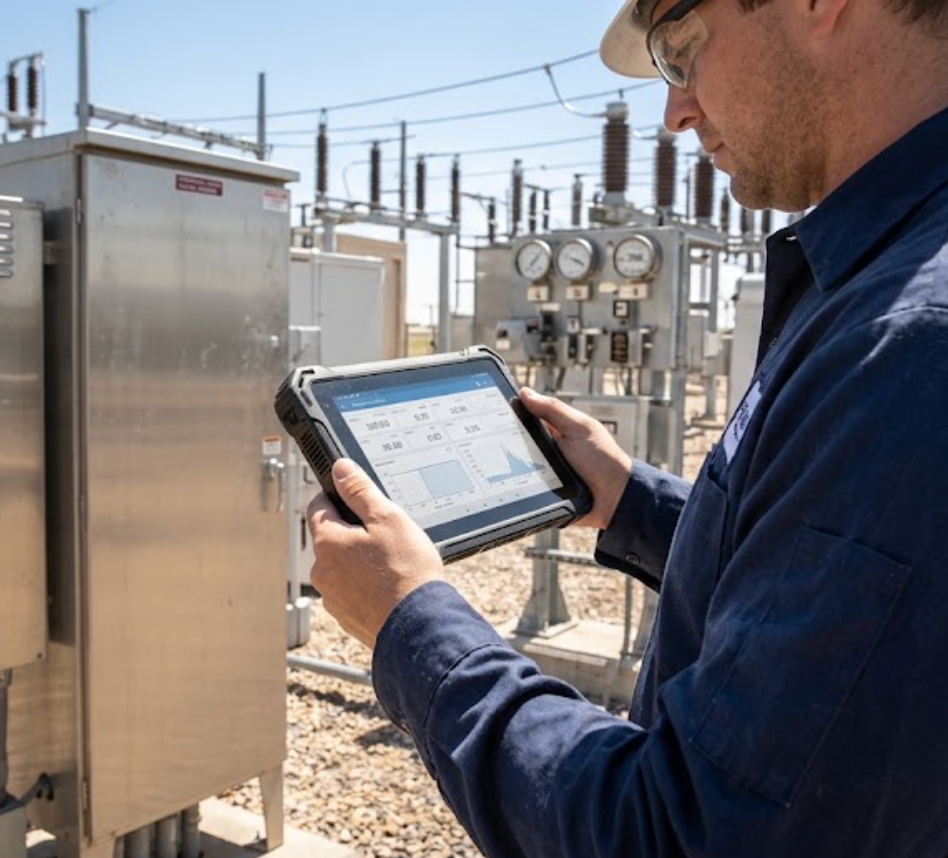
The HTNJ08C Rugged Tablet takes that role. Its Intel N100 quad-core processor bursts to 3.4GHz on four efficient cores, and the page positions the chip explicitly as the efficiency option of the line. For a peak-season crew running survey apps, meter readers and camera work all day, that profile suits long continuous sessions in warm weather better than a higher-ceiling chip idling at the same load. It keeps the same 8-inch 1200×1920 panel at 560 nits as the rest of the family, and the same double-layer solid body, so choosing it costs nothing in sealing or readability.
🖥️ The Screen in Full Sun
The second limit is visual. Field records, CAD overlays and inspection checklists are read standing up, in whatever light the day provides, and a 560-nit panel is the family's answer to that. The remaining variable is size: two of the three models carry the same resolution on an 8-inch glass, while one spreads it across ten point one inches, which changes how much of a drawing or form is legible without zooming.
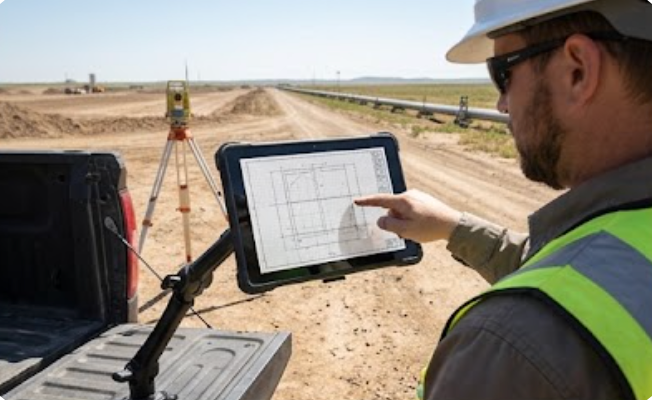
The HTYJ10A Rugged Tablet is the large-format pick. Its 10.1-inch IPS panel keeps the same 1200×1920 resolution and 560-nit brightness with 7H hardened, stylus-friendly, wet-hand-capable touch, but at the larger diagonal the text in a drawing set or a long checklist simply renders bigger. Under it sits the strongest processor option of the trio, a tenth-generation Intel Core i5-10210Y or i7-10510Y quad-core, with 8GB of RAM and 256GB of storage expandable over M.2. The trade is carried size: 28.4 by 19 centimeters and a gross weight around 2.1 kilograms with the carton. It is the unit for a truck mount, a survey desk or a supervisor who reads drawings all afternoon rather than one who walks all morning.
🔋 The Battery Math of a Double Shift
The third limit is the charging schedule. All three models run the same 7.6V 3500mAh removable pack, and because it comes out of the body, a peak-season rota is planned in spare batteries rather than outlet time: one pack in the device, one on the charger, and the swap happens at the handover between shifts instead of interrupting either one.
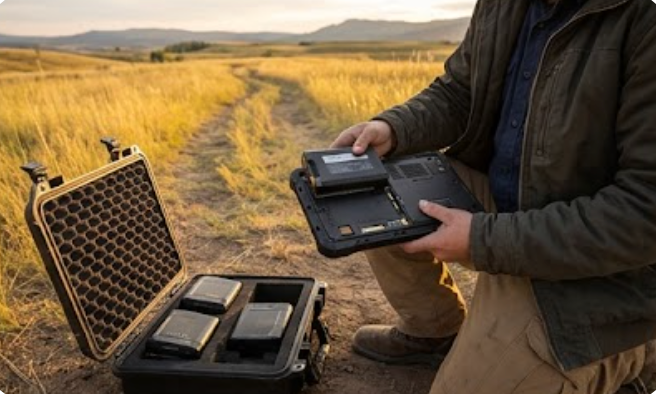
The HTYJ08A Rugged Tablet is the walking crew's version of that plan. It pairs the same Core i5/i7 processor class as the HTYJ10A with the compact 8-inch body, 23.8 by 16 centimeters and a gross weight around 1.8 kilograms with packaging, which is the lighter burden over a ten-hour walking route. Its battery philosophy is identical to its siblings, so a fleet that mixes models still stocks exactly one spare-battery type. For crews whose busiest season is also their most mobile one, this is the configuration that disappears into a vest pocket between readings.
One Spec Sheet, Three Configurations
The table lines up the published figures on the basis each page quotes them.
| Column | HTNJ08C | HTYJ08A | HTYJ10A |
|---|---|---|---|
| Processor | Intel N100 quad-core, burst 3.4GHz | Intel Core i5-10210Y / i7-10510Y | Intel Core i5-10210Y / i7-10510Y |
| Display | 8in, 1200×1920, 560 nits, 7H | 8in, 1200×1920, 560 nits, 7H | 10.1in, 1200×1920, 560 nits, 7H |
| Battery | 7.6V 3500mAh, removable | 7.6V 3500mAh, removable | 7.6V 3500mAh, removable |
| Protection | IP67, MIL-STD-810G, 1.22m | IP67, MIL-STD-810G, 1.22m | IP67, MIL-STD-810G, 1.22m |
| Size and gross weight | 23.8×16×2.5cm, approx. 1.8KG | 23.8×16×2.5cm, approx. 1.8KG | 28.4×19×2.5cm, approx. 2.1KG |
What the Sheet Does Not Settle
Memory is the row to watch. Only the HTYJ10A page publishes figures, quoting 8GB of RAM with 256GB of storage and M.2 expansion; the HTYJ08A and the HTNJ08C pages both describe memory as high-speed RAM with SSD storage and an M.2 extension, without capacities. If the season's software stack has a memory floor, that row needs a written configuration sheet from the supplier before the order, because the two smaller units cannot be compared on it from the public pages alone.
Everything else around the platform is shared, and worth confirming once rather than three times. All three quote the same camera pair (5MP front, 8MP rear autofocus with LED), the same interface row (RJ45 Ethernet, Mini HDMI, USB Type-A and Type-C, DC input, TF and SIM slots, a 12-pin Pogo connector), the same wireless set of Wi-Fi 6, Bluetooth 5.0 and global 4G LTE, and the same Windows 10 Pro or 11 Pro system choice. A mixed fleet therefore trains once, stocks one spare-battery type and one charger, and swaps accessories across models without adaptation.
Before the Season Opens
The fleet plan that falls out of the sheet is short. Put the HTNJ08C where the work is long, warm and continuous, and let its efficient N100 platform hold the thermal margin. Put the HTYJ10A where drawings and checklists are read for hours, and accept its extra 300 grams of gross weight as the price of the larger page. Put the HTYJ08A on the crews that walk, and let the shared 3500mAh removable pack turn shift changes into battery swaps. Teams that want to see how these units behave alongside the wider sealed-device line can compare them within the industrial three-proof application before committing a budget.
The buying sequence is equally short: confirm the memory configuration in writing, size the spare-battery pool to the number of walking crews rather than the number of tablets, and book the units before the calendar fills. The full rugged tablet range carries the three models covered here, and the product comparisons and competitor analysis section keeps notes on how the family stands against rival sealed tablets for teams still shortlisting.