A material trace check breaks in two different places. The first break is the fault itself: a scan that will not land, a battery that dies before the last pallet, a label the reader refuses to decode. The second break is quieter and costs more rework: nobody can say whether the repair actually held. A technician swaps a cable, clears an error, signs the work order, and the line runs until the same symptom returns on the night shift. What was missing was never the fix. It was the verification step that follows the fix, and the three handhelds on our receiving dock this quarter, the F502, the R366-S and the X501, each ended up shaping that step in a different way. This walkthrough stays inside one recurring job, checking inbound material against its traceability record at the dock, and treats every repair as unfinished until the evidence exists.
One Morning at the Receiving Dock, Three Unproven Repairs
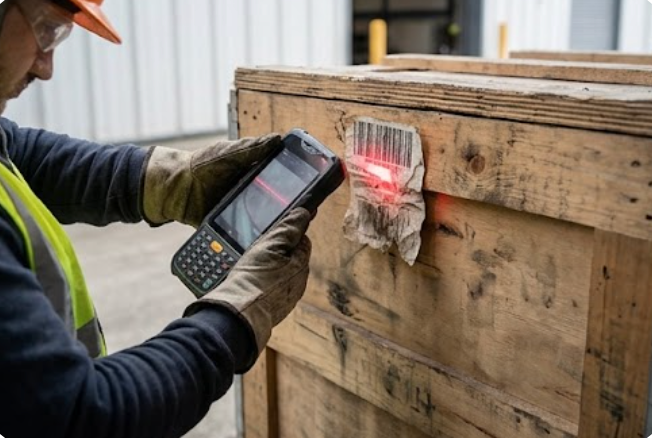
The setup is ordinary. Three roll cages arrive with mixed lots; each cage carries barcode labels that link back to supplier batch records, and the dock operator confirms every cage by scanning a sample of labels before signing the goods-in note. The count for the quarter was not dramatic: eleven call-outs across the three units, of which nine were resolved in under twenty minutes. The recurring embarrassment was the other two, faults that had been "fixed" twice each before someone admitted nobody had written down what a successful repair should look like. That admission set the rule this article follows: name the test before the repair, run the test after it, and keep the numbers where the next shift can find them.
F502: Ten Scans per Pallet, Three Times Each
The F502 had developed an intermittent miss: roughly one label in twenty would not decode on the first pass, always on the same supplier's glossy stock. Cleaning the scan window changed nothing, so the working theory became label finish rather than hardware. The repair was a switch to a matte label stock from the same supplier, arranged through purchasing. The verification step had been agreed in advance, which is what made it useful: scan ten labels on each of three pallets, three rounds in a row, and record the decode count. Round one returned thirty of thirty, round two thirty of thirty, round three twenty-nine of thirty with the miss on a creased label that was replaced on the spot. Those three numbers, written on the cage card, ended the argument about whether the glossy stock was "probably fine".
Two hardware facts made this test cheap to run. The unit reads 1D and 2D symbologies natively, so the mixed-label pallets needed no reconfiguration, and at under 300g it can be held in one hand for a full round without fatigue. Its 5.5-inch IPS display at 720x1440 shows the decode log clearly enough that the operator counted results straight off the screen instead of copying them to paper first. Storage was never a constraint either; the micro SD slot accepts cards up to 256GB, far beyond what scan logs require. One honest gap belongs in this record: the product page lists a high-capacity battery system with Type-C and OTG support but does not publish a milliamp-hour figure, so the dock team logs charge behavior by observation rather than by specification on this RFID scanner PDA from the barcode and RFID family, and the log says the unit has not yet failed to cover a full receiving shift.

🔋 R366-S: A Battery Swap Counts Only When This Shift Completes
The R366-S call-out looked like a charging fault and turned out to be a battery-age fault. The unit carries a 3.8V 4600mAh removable lithium pack with Power Delivery fast charging, and it is slim at 17.6mm and under 300g, which makes it the dock's preferred unit for long walks along the storage lanes. When evening shifts started ending with low-battery warnings, the first response was a new charging cable; the symptom survived the cable, and only then did anyone suggest the pack itself had aged past useful capacity. The swap takes seconds because the pack is removable, and the dock keeps charged spares precisely for this slim industrial PDA.
The verification step, again defined before the swap, was deliberately boring: run one complete shift on the new pack with the old charging cable and record any interruption. The shift completed with zero charging interruptions and roughly forty percent indicated at handover, which is the number that proved the fix. A follow-up check was added after a week: the depleted pack went onto the dual-slot charger the unit supports, took a full charge, and went back into the spares pool with a dated tag. That closes the loop properly, because a swapped battery that never gets revalidated just moves the same fault to whichever unit picks it up next. The Qualcomm SM6115 processor and Android 16 on this unit matter here for a small reason: the battery log lives in a simple app that syncs over the dock's Wi-Fi 6 network, so the evidence accumulated without anyone maintaining a spreadsheet.

X501: Re-reading Damaged Labels and Keeping the Samples
The X501 fault was the classic dock condition: labels abraded by cage-on-cage contact until the 2D pattern would not close. This unit is built for exactly that corner of the job, with a Corning Gorilla Glass screen that tolerates glove and wet-hand touch, dual-side scan keys so the operator can trigger a read from either grip, and a published IP67 rating with 1.5m drop resistance that explains why it is the unit assigned to the outdoor side of the dock on this handheld terminal. Its scan engine is explicitly tuned for damaged barcodes, which turned the repair conversation around: the hardware was never the fault, the verification step was.
The agreed test borrowed from the F502 playbook but added a custody rule. The operator scans the damaged label ten times; if eight or more reads land, the label goes back into service with a note, and if fewer, the label is reprinted and the original is photographed and filed against the batch record. Over two weeks this produced a small archive of genuinely damaged labels, which purchasing then used as evidence in a packaging discussion with the supplier. Under the shell the unit runs a 64-bit octa-core 2.0GHz processor on Android 14 with 4GB RAM and 64GB storage, expandable by micro SD, and it weighs approximately 270g in a 158x75x16mm body. The published operating range of -20°C to 55°C covers the unheated end of the dock in winter, which is more than can be said for the clipboard it replaced.
| Attribute | F502 | R366-S | X501 |
|---|---|---|---|
| Display | 5.5" IPS 720x1440 | 5.5" IPS 720x1440 | 5.5" Gorilla Glass, glove & wet-hand touch |
| Processor / OS | MT6762 octa-core 2.0GHz / Android (version not published) | Qualcomm SM6115 octa-core / Android 16 | Octa-core 2.0GHz, 64-bit / Android 14 |
| Memory / Storage | 2GB+16GB or 4GB+64GB, micro SD to 256GB | 4GB+64GB, micro SD to 256GB | 4GB+64GB, micro SD expansion |
| Battery | High-capacity (mAh not published), Type-C with OTG | 3.8V 4600mAh removable, PD fast charge, dual-slot charging | 3.8V 4500mAh / 5000mAh removable, quick-swap, Type-C fast charge |
| Weight / Size | Under 300g | Under 300g, 170x79x17.6mm | Approx. 270g, 158x75x16mm |
| Ruggedness (as published) | Rugged compact body (IP rating not published for this model) | Compact rugged enclosure, -10°C to 50°C, 5%-95% RH non-condensing | IP67 dustproof & waterproof, 1.5m drop, -20°C to 55°C |
| Scan & data capture | 1D/2D scanner, NFC, RFID modules | Optional 2D engine (accuracy ≥3mil), optional NFC ISO14443A/B & ISO15693 | Damaged-barcode reading, dual-side scan keys, optional NFC/UHF RFID/PSAM |
| Verification role at the dock | Count-based scan tests | Full-shift battery evidence | Damaged-label archive with custody rules |
What Each Handheld Publishes for the Verification Step
The table earns its place by showing one asymmetry honestly. Only the X501 publishes an ingress protection rating and a drop height for this model; the F502 and R366-S pages describe rugged construction but attach IP65/IP67/IP68 figures inside the OEM customization boilerplate, which we do not treat as a per-model specification. Where a number is not published, the dock log substitutes an observation, and the verification step is designed so that observation is enough. That is the deeper point of this whole exercise: verification data has to come from the device you actually trust, and trust is earned either by a published figure or by a recorded week of behavior, never by assumption. Our comparison notes track where each published figure comes from.
When the Re-scan Still Fails: Escalate With Evidence
Not every verification passes, and the dock rule for a failed verification is the same as the rule for the original fault: attach the numbers. A failed three-round scan test on the F502 goes to IT with the decode counts per round, not with the sentence "it still does not work". A battery swap on the R366-S that does not survive a full shift escalates to a pack-batch review, because two packs failing the same test points at a batch rather than an age problem. A damaged-label archive on the X501 that grows faster than the reprint budget escalates to purchasing with photographs rather than complaints. Each escalation carries its own evidence because each handheld produces it naturally: counts, shift logs, and photographs. Nobody on the dock has to write a diagnostic report from memory, which is precisely how the previous repairs kept unraveling.
Writing the Verification Step Into the Shift Brief
The last change cost nothing and outlasted all the hardware. The dock's shift brief now carries one line per open repair: what was changed, what test proves it, and where the numbers go. New operators inherit verification steps instead of folklore, and the eleven call-outs of this quarter produced a page that reads less like a repair history and more like a set of standing tests. The handhelds made the tests cheap, but the rule made them stick: a material trace check is only as strong as the evidence behind its last repair, and evidence has to be produced on purpose, by a device that was chosen for the job. For a closer look at the product family these three units belong to, the manufacturer's handheld range page lists the current configurations, and our comparison notes cover how each model positions itself against alternatives.
Teams planning a similar routine can start smaller than we did: one unit, one recurring fault, one named test. The R366-S anchors battery-sensitive rounds, the X501 suits label-abuse corners of a site, and the F502 handles mixed-symbology counting work, all within one accessory and charging convention. For procurement background beyond handhelds, the full product catalog covers the wider line, and a dock that adopts the verification habit early rarely needs to buy its way out of a traceability dispute later.