A depot used to find short-dated stock once a month, when a crew walked every aisle with a clipboard and came back with a page of circled codes. The page was already old by the time it reached the office. What has changed is not the printed date on the case, which has always been there, but the habit around it: many operations now open the day with a pull list that was recalculated overnight, and they expect that list to name the shelf, the unit and the person who will release it. A Logistics & Warehouse Industrial Hardware Solutions Supplier is often asked about scanners in this conversation, yet the harder question is which lines on that list a handheld can actually fill in and which ones still need a human hand at the end of the aisle.
The distinction matters because a pull list is not a photograph of the shelf. It is a set of small claims: that this case carries this code, that the code was read at this position, that the printed date means a certain number of days, and that someone has decided what happens next. Some of those claims arrive from a scan. Others arrive from a rule book, a roster, or a judgement call made while a glove is still on. This article follows a single short-dated case through receiving, the aisle and the hold cage, then sorts the six lines of its record by origin. Three of them can be auto-filled. Three cannot, and no amount of screen brightness or radio speed will change that.
D802 at the Receiving Pallet: Reads Before the Label Is Peeled
Receiving is where the date first becomes usable. A pallet arrives wrapped, with the outer cartons showing a printed date on the side panel and an inner code that may belong to a completely different production run. The D802 Rugged RFID Industrial PDA Wholesale page describes an eight-inch FHD IPS panel at 1920x1200, which is the sort of surface on which a checker can see a whole pallet face at once: four columns of cartons, three date groups, and the one odd carton that was loaded from a different batch. Rather than reading a single case and guessing about the rest, the operator can mark the odd one while the wrap is still intact and before anybody starts cutting into the stack.
The same page gives Android 13.0, 4GB RAM with 64GB ROM and an optional 6GB plus 128GB configuration, a 3.8V 9000mAh removable polymer battery, Type-C, Wi-Fi alongside 5G, 4G, 3G and GSM, an SDK for custom software, a three-year limited warranty, and CE, FCC and RoHS listing. It also describes the 1D/2D scanning engine and data capture module as optional. That last word is worth putting into a purchase order: a receiving desk that expects to read both an outer barcode and an inner tag needs the module specified, not assumed. A depot we would describe here works with twenty-four cartons to a pallet and four printed dates across the face, so the value of the larger panel is that the exception is visible while there is still time to send the pallet back.
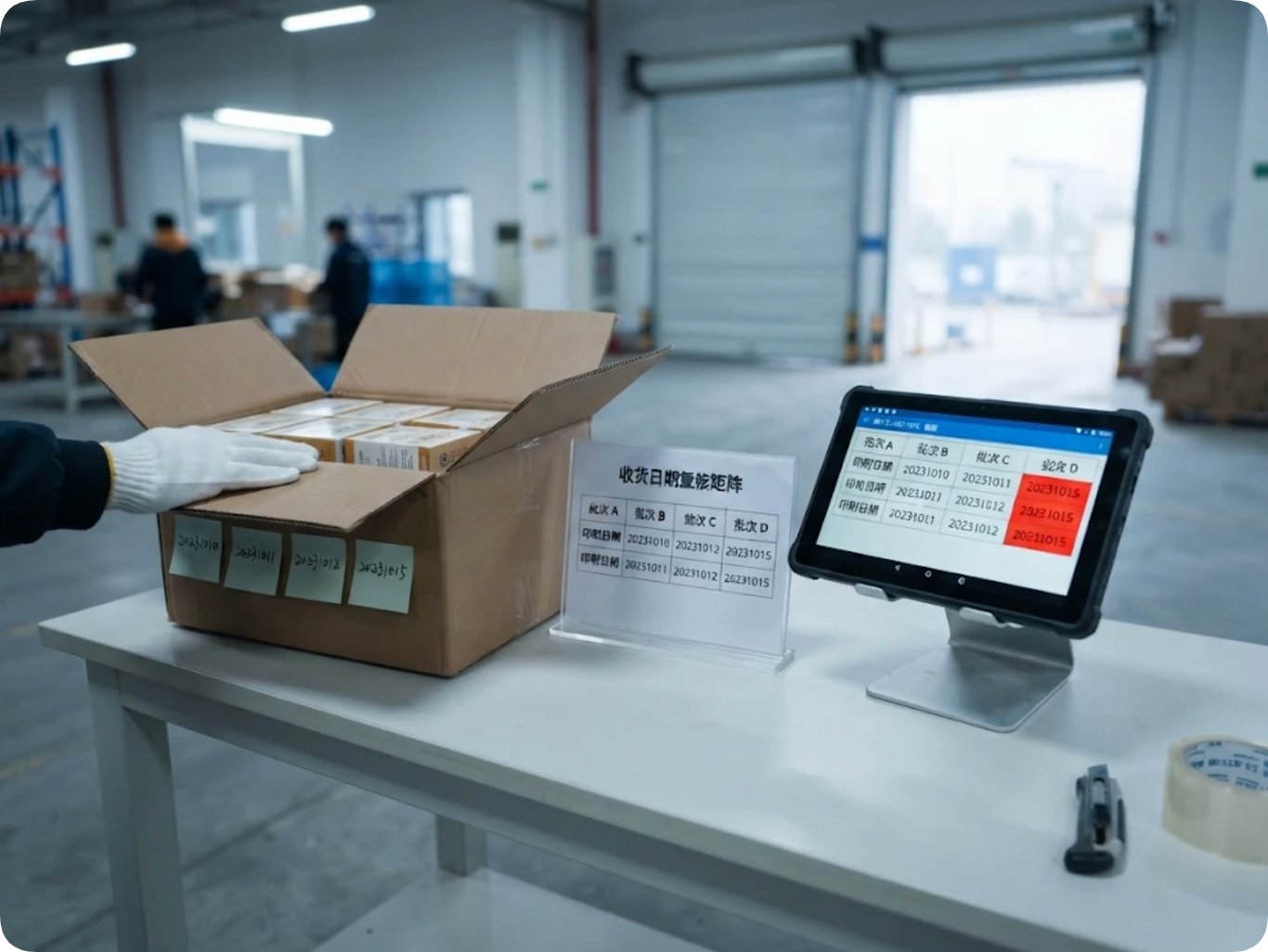
Nothing on the device decides what the printed date means. It can carry the read, the timestamp and the operator login to the system; the rule that turns a date into a remaining-days figure sits somewhere else. Keeping those two things separate is what stops a receiving clerk from quietly rewriting a date because the ink was smudged.
K401 Along the Aisle: One Hand on the Date-Coded Case
Out on the floor the job changes shape. A checker moves along a shelf with one hand steadying the case and the other holding the terminal, often with a glove on, and the date-coded side of the carton is not always facing outward. The K401 Industrial Handheld PDA Terminal page lists a 4.2in IPS display at 720x1280, a body under 300g, an IP67 rating, a 5200mAh removable Li-ion battery, USB Type-C 2.0 with OTG, Android 13 on an MT6769 octa-core 2.0GHz platform, and 6GB RAM with 64GB ROM. Its professional barcode scanner, RFID and NFC support, plus a 20MP rear camera, mean the same pass can capture the code, the date and a photograph of a damaged label without swapping tools.
Consider a shelf with nineteen facings on the fourth level, where two cartons have been turned so the printed date faces the back. A single-hand terminal lets the checker turn the case, read it, and keep the other hand on the shelf edge. The photograph matters more than it sounds: when the ink is rubbed off, the image is the evidence that a person looked, and the 20MP rear camera is listed on the page rather than inferred. Battery form is the other quiet advantage here. A removable 5200mAh pack can be exchanged between shifts at the depot counter, so the terminal does not have to sit on a charger during the handover when the morning pull list is being closed out.
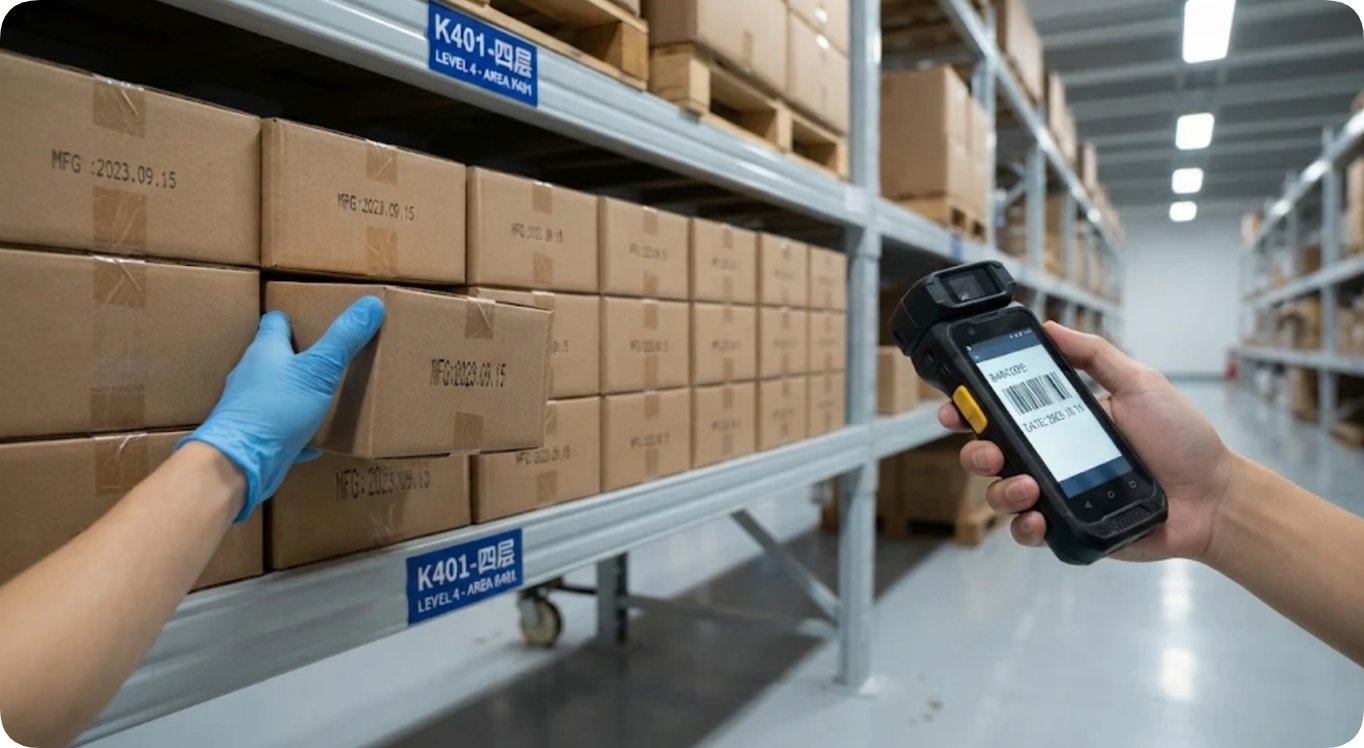
What the aisle pass cannot supply is the disposition. The device can say that case A-17 was read at 06:40 in aisle four; it cannot decide whether that case is discounted, held or released. That line on the pull list belongs to the depot rule book and to whoever signs it.
RS51 at the Hold Cage: What the Page Does Not Settle
The hold cage is where exceptions accumulate, and it is where a larger screen earns its place. The RS51 4G Rugged Handheld Barcode Terminal Technical Specifications table lists a 6.3in IPS FHD+ panel at 1080x2340, Android 13, a Qualcomm SM6225 octa-core 2.4GHz platform, 4GB RAM with 64GB ROM expandable by TF up to 256GB, and a 3.8V 5000mAh detachable battery. The same table gives 4G LTE, dual-band Wi-Fi, Bluetooth 5.1, GNSS, an optional 2D scanner rated at 3mil or better, optional 13.56MHz NFC, Type-C with OTG and PD, a two-pin Pogo Pin, an 8MP front and 16MP rear camera, IP67, a 1.2m drop rating, and an operating range of -10C to 50C. On a screen of that width an operator can see the whole exception list instead of paging through it one line at a time, which is what a cage with thirty-odd held units tends to demand.
There is a trap on this particular product page. A separate parameter block higher up lists a 5.5in HD panel, Android 11.0 or 12.0, a 4500mAh battery, a 1.5m concrete drop figure and a 13MP camera. Those are not the values used here. This article follows the Technical Specifications table throughout, and it does so for a practical reason: a buyer who quotes the display size or the operating system from the wrong block will order a device image and a case that do not match the unit that arrives. Before a purchase order is signed, the safest check is still the nameplate on a physical sample, because a page carrying two sets of numbers cannot settle which one the warehouse will receive.
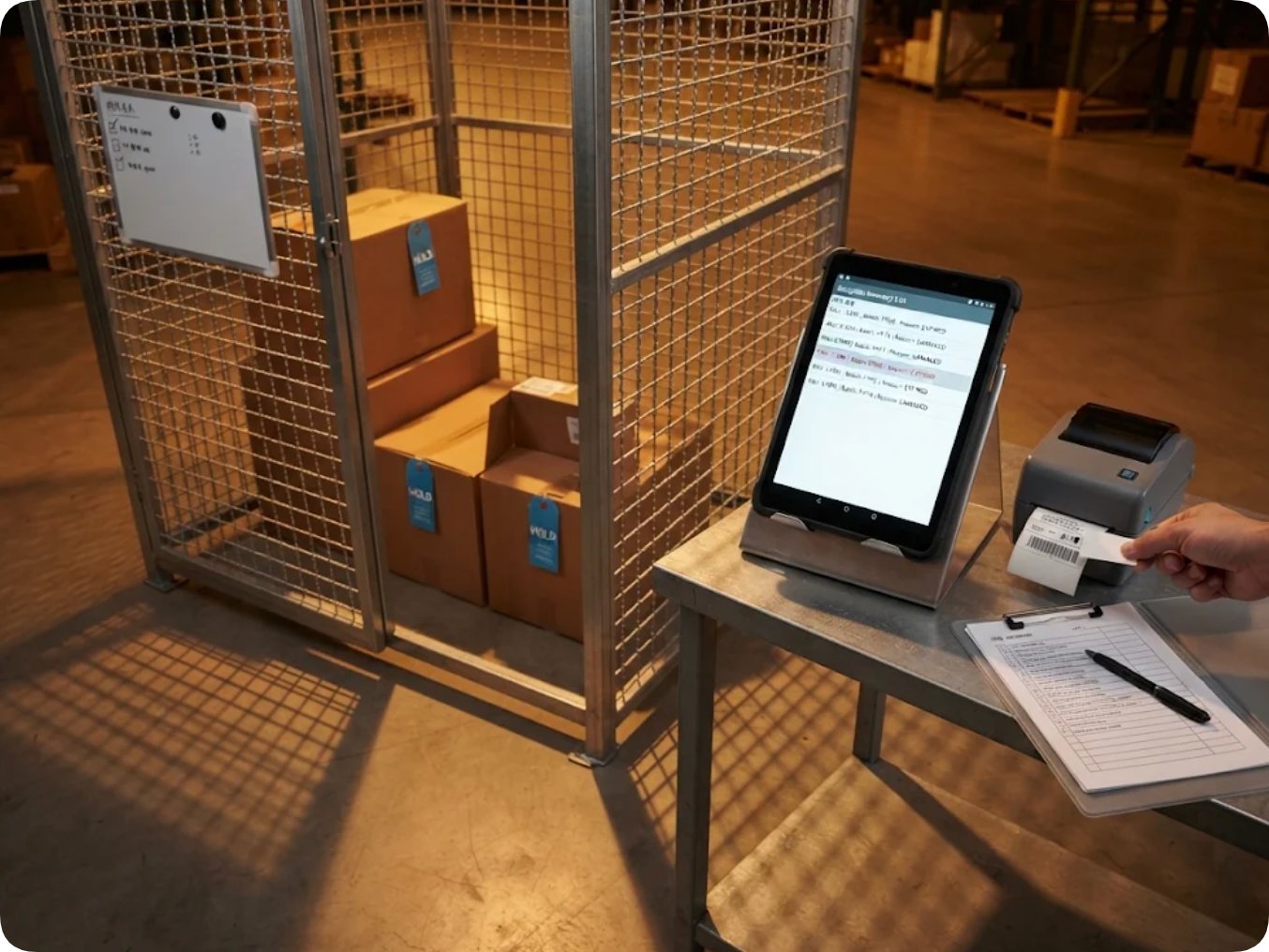
Connectivity is the other reason this unit ends up at the cage rather than at receiving. Held stock has to be reported before the morning wave picks, so 4G LTE and Bluetooth 5.1 to a nearby label printer turn a handwritten hold tag into a record that exists in the system before anyone walks away. The device supplies the transport; the release name still comes from a person.
Auto-Filled Lines and the Ones a Person Still Closes
The useful way to read an industry trend is to ask what it moved and what it left alone. Daily pull lists moved the calculation: remaining days are now recalculated instead of being copied from last week's sheet. They did not move the judgement. A Hotus Smart Hardware Products Manufacturer Catalog gives the hardware choices, but the six lines below still split three and three, and the split is the same whether the terminal has a four-inch panel or a six-inch one.
| Line on the pull list | Where it comes from | What the device contributes | What a person must still add |
|---|---|---|---|
| Unit identity | Outer barcode or inner RFID tag | One scan produces one code | Which of two codes belongs on this shelf |
| Printed date | Ink on the carton | A read or a photograph with a timestamp | A ruling when the ink is no longer legible |
| Remaining days | System calculation | The scan time and the unit code | The category rule for what counts as short-dated |
| Shelf position | Aisle and level label | The location code from the last read | Whether the case was moved after that read |
| Disposition | Depot rule book | Nothing; this is not a scanned value | Markdown, hold or release |
| Signatory | Shift roster | The device login | The second signature above the local value limit |
Three of those lines are auto-filled and three are closed by a person. That is not a failure of the hardware; it is the shape of the job. What has improved is that the three human lines are now visible as blank fields rather than being buried in a handwritten note, so a supervisor can see who filled them and when. The question that matters at the end of a shift is not only what the record says but who supplied each part of it, because a missing disposition is a cheap problem at 16:00 and an expensive one after the truck has left.
Where the Spec Sheets Line Up
Once the RS51 values are taken from the Technical Specifications table, five columns become genuinely comparable across the three product pages. Readers who want a wider hardware view can also check the Hotus Product Comparisons & Technical Insights section, but the table below stays with what the three pages actually publish for these units.
| Unit | Operating system listed | Display listed | Memory listed | Battery listed | Data capture listed |
|---|---|---|---|---|---|
| D802 | Android 13.0 | 8in FHD IPS 1920x1200 | 4GB RAM + 64GB ROM; 6GB + 128GB optional | 3.8V 9000mAh removable | Optional 1D/2D engine; data capture module |
| K401 | Android 13 | 4.2in IPS 720x1280 | 6GB RAM + 64GB ROM | 5200mAh removable | Professional barcode scanner; RFID; NFC |
| RS51 | Android 13 | 6.3in IPS FHD+ 1080x2340 | 4GB RAM + 64GB ROM; TF up to 256GB | 3.8V 5000mAh detachable | 2D scanner optional; 3mil or better |
Four fields are deliberately absent. Body dimensions and weight are not comparable: the RS51 table gives 172mm by 76.6mm by 16.5mm and under 500g, the K401 page gives under 300g with no dimensions, and the D802 page publishes neither figure. Processor names are not comparable either, since the D802 page says only that a high-performance processor is fitted. Protection and operating temperature are left out for the same reason: IP67 appears on the K401 and RS51 pages, while the D802 page describes a waterproof and shockproof build without a rating. None of these gaps is filled in here, and no value is inferred from a neighbouring model.
What the five surviving columns do show is a fairly narrow family. All three run an Android 13 generation system, all three use a removable or detachable battery, and all three can read a barcode. The differences that affect a date check are the panel size, the memory configuration and whether scanning is standard or an option. Choosing between them is therefore a question of where the work happens: a whole pallet face at receiving, a single case on the fourth shelf level, or a long exception list at the cage. It is not a question of which device is newer.
Where the Work Still Lands After the Scan
Ambient grocery storage. A depot working to a twenty-one-day mark for ambient goods will find that the pull list grows quietly for a fortnight and then jumps when a whole promotion delivery lands at once. The scanned lines stay reliable; the pressure falls on the category rule and on the person who decides whether a pallet with three different printed dates is treated as one lot. Writing the mark on the list line, rather than in a separate procedure document, is what keeps that decision visible.
Chilled and fresh receiving. A seven-day mark for chilled stock and a two-day mark for fresh stock cannot share a single rule, yet a single fourteen-day threshold is exactly the shortcut that buries fresh cases behind a neat report. The device reads the date correctly and the system subtracts correctly; the failure is in the rule a person supplied at setup. Depots that split the mark by category also need the receiving photograph, because a chilled case that has been repacked often carries a label whose date does not match the outer carton.
Store back rooms. A shop with a small back room may hold fewer than forty units, which makes a full shelf scan feel unnecessary. That is where the record breaks: the case is moved from a back-room shelf to a display facing, and the location code on the pull list still points to the shelf it left. A short confirmation read at the facing takes seconds and is the only way to keep the shelf-position line honest. Readers comparing an older note about packaging layers may also find what carries the code once the packaging layer changes a useful companion to this point.
Returns at a distribution centre. Returned cases arrive with a date but no reliable history, so the printed date is the only scanned fact and the disposition is entirely human. A hold list that shows who released a returned unit and at what time is more useful than one that only shows the code. This is also where a larger panel helps: a returns cage often holds a dozen categories side by side, and paging through them on a narrow screen is how lines get skipped.
Across all four settings the pattern is the same. The hardware has become good at reading, time-stamping and carrying a code; the industry has become better at recalculating a list overnight. What has not been automated is the small set of decisions that turn a date into an action. A well-kept pull list makes those decisions legible, names the person behind each one, and leaves the printed date untouched.
Frequently Asked Questions
1. How many days before the printed date should a unit go on the pull list?
Set the mark per category and write it on the list line: twenty-one days for ambient grocery stock, seven for chilled, two for fresh. A single fourteen-day threshold looks tidy in a report but hides fresh cases behind a slow-moving ambient queue. The number is a rule a person supplies at setup, not something a scanner can work out from the printed date alone.
2. What should happen when the printed date is rubbed off?
Do not let the operator type a substitute date into the same field. Capture a photograph of the carton, mark the line as unreadable, and route the case to the hold cage for a ruling against the delivery note. Two records are then honest: the image shows that somebody looked, and the blank field shows that nobody guessed. Filling the gap with a plausible date is the failure that a later audit cannot reconstruct.
3. Which figures should a buyer quote from the RS51 page?
Quote the Technical Specifications table: 6.3in FHD+ at 1080x2340, Android 13, a 5000mAh detachable battery, and the SM6225 platform. A separate parameter block on the same page lists a 5.5in panel, Android 11.0 or 12.0 and a 4500mAh battery. Mixing the two blocks in one purchase order is how a device image, a case and a spare-parts order end up describing three different units; confirm against a physical nameplate before signing.
4. Does a removable battery matter for a date-check fleet?
It matters at the handover, which is when the morning pull list is closed. A 9000mAh pack in the receiving unit, a 5200mAh pack on the aisle unit and a 5000mAh pack at the hold cage all support the same practical habit: a spare can be swapped at the depot counter without the terminal sitting on a charger while the next shift waits. The gain is not extra runtime on paper; it is that the record stays with the device through a shift change instead of pausing at a wall socket.