A supermarket does not change its prices all at once. On one Wednesday the price file arrived at 06:10, again at 11:40 and once more at 17:20, each run carrying a different subset of the 214 lines on that week's promotional list. Between the first and the second delivery, every shelf-edge label printed before breakfast had already become wrong. The staffing question that follows is therefore not how many people are needed to cover 38 labels per aisle. It is who is allowed to declare that a mismatch has been dealt with. Stores that schedule a shelf audit as though it were a stock count finish the morning with a tidy scan log and a price at the till that still disagrees with the sign above the product. The equipment matters here, but the rota is written around retail store POS applications and the moment a batch lands, not around the floor plan.
Three handhelds end up in the same aisle on such a morning, yet they are not three people doing the same walk. One unit reads the barcode on the label, a second one photographs what the shelf actually says, and a third holds the current batch list in a read-only view so that nobody has to walk back to the pricing desk to check a figure. That separation is the whole point of this guide.
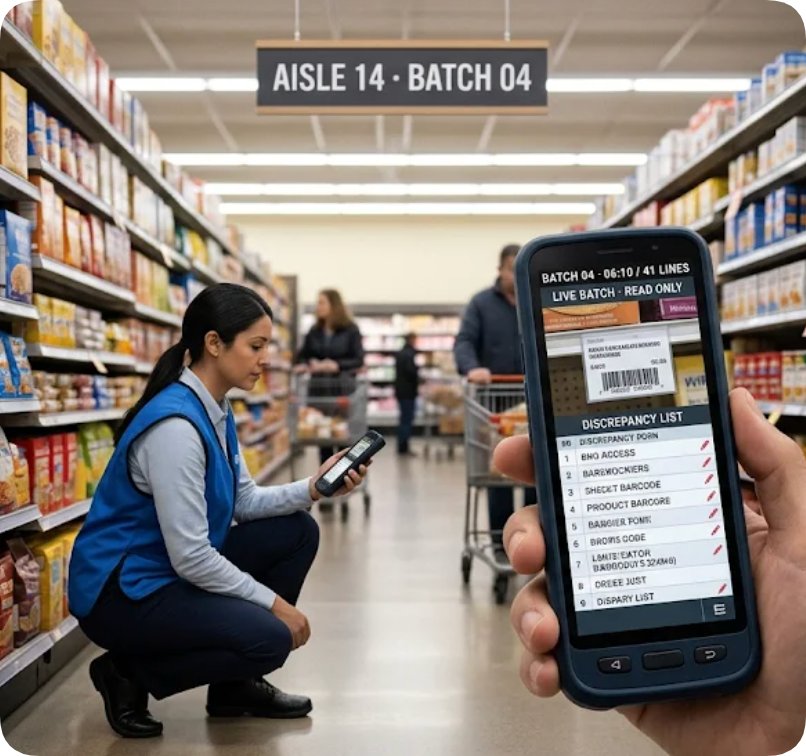
When the Price File Lands, the Shelf Is Already Wrong
A batch is a list of lines, not a list of aisles. The 06:10 run on the Wednesday in question touched 41 stock lines across nine aisles; the 11:40 run touched 63 lines, mostly chilled and fresh; the 17:20 run carried the remaining 110 lines, almost all of them in the dry grocery end of the store. A supervisor who assigns one operator per zone will have nine people walking at six in the morning for work that only exists in four of those zones. A supervisor who assigns people to the batch will have two people working hard for ninety minutes and nobody walking the other seven aisles. It is the difference between 41 labels changed before the doors open and 41 labels changed after the first customer has already photographed one.
Walking time sets the ceiling on what that ninety-minute window can hold. From the pricing desk to the furthest grocery aisle is a 3.2-minute walk with a loaded trolley, and swapping a single shelf-edge ticket takes about 40 seconds once the operator is standing in front of it. A two-person crew can therefore clear a 41-line batch with a margin for photographs; a two-person crew handed 110 lines at 17:20 cannot, and pretending otherwise is how a store ends up with a partially updated promotion. The X501 Handheld PDA is the unit we hand to the person holding the batch list, because a 270 g device with a hardware 2D engine survives being carried one-handed while the other hand pulls tickets out of a sleeve.
The batch list itself should expire. An operator who can still see yesterday's 06:10 file at 15:00 will eventually scan a label against the wrong number and log a mismatch that does not exist. Our practice is to push the current batch to the handheld at the start of the window and clear it when the window closes, so the device shows nothing but the lines that are live right now.
A Scan Produces a Mismatch, Not a Repair
The most common mistake on a shelf audit is to treat the scan as the fix. A barcode read tells you that the code on the label and the price in the file belong to the same stock line; it does not tell you that the number printed on the ticket is the number in the file. That last comparison still needs a human looking at two things at once, and it produces one of three outcomes. The first is an old label, which the batch should have replaced. The second is a wrong entry in the price file, which the store cannot repair on the floor. The third is a product sitting in the wrong facing, which is a planogram problem rather than a pricing problem at all.
Those three outcomes go to three different people, and this is where a rota built around headcount quietly fails. If the operator who scanned the label is also the person who decides which of the three it is, the log will say "corrected" for all of them, because that is the fastest way to empty a queue. We now require the operator to record the mismatch and stop. The ticket stays on the shelf until somebody else has looked at it. Units such as the Handheld PDA F505 are well suited to the recording step: the 5.5-inch HD panel is readable under the glare of a freezer aisle, and glove and wet-hand operation matters more in chilled sections than raw processor speed does.
Keep the old ticket. It is tempting to pull a stale label the moment it is spotted, particularly when a customer is standing two metres away with a phone. The problem is the gap between what it says and what the file says, and that gap has to be captured before it is closed.
Read-Only in the Aisle, Edit Rights at the Pricing Desk
Permission boundaries are staffing decisions in disguise. Give an aisle operator the ability to edit the price file and you have, in effect, given a rotating group of temporary staff the authority to change what every till in the building charges. Nothing about that arrangement is unsafe because of the device; it is unsafe because the same person can create a discrepancy, classify it and then erase it. We separated the two rights: handhelds in the aisle can read the current batch, attach a scan and upload a photograph, while the price file accepts changes only from the pricing desk, and only against an approved batch reference.
The split also makes the rota easier to defend to a store manager. A weekend promoter can be trained to scan and photograph in under twenty minutes, because their account has two buttons and no edit field. The person at the pricing desk needs to understand the promotional calendar and the approval chain, and there is only ever one of them on a shift. A straightforward way to check what the full product range can and cannot be configured to do is to write those two permission sets down before any hardware is ordered, then confirm each one against the device management tools rather than assuming the application will enforce it.
There is a second, quieter benefit. Read-only accounts generate a shorter audit trail, and a shorter trail is easier to read at 18:00 when seven lines are still open. When those two records sit in separate systems, the manager closing the shift can see at a glance which lines are waiting on the desk and which are waiting on a second pair of eyes in the aisle. Collapsing them into one login makes both lists look complete while neither is.
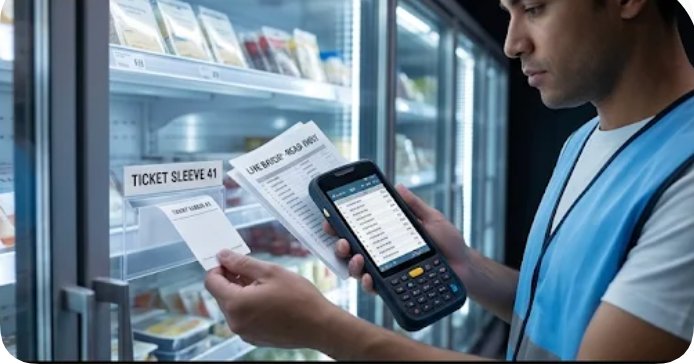
Four Eyes Before Any Line Can Be Closed
"Four eyes" here means two different operator IDs on one line, with the second person physically returning to the shelf. It does not mean a supervisor ticking a box at the desk. Of the seven mismatches logged on that Wednesday, two were sent back by the reviewer because the photograph showed the ticket but not the aisle number, and one more came back because the image had been taken after the label had already been replaced. Three of seven lines would have been closed on incomplete evidence under a single-operator rule.
The reviewer needs a camera more than a scanner. The RS50 Handheld Terminal publishes a 48 MP autofocus rear camera with an LED flash, which is enough to capture a shelf-edge ticket, the product barcode and the aisle marker in one frame without crouching into the fixture. Under the low shelves of the chilled aisle the flash is the difference between a legible price and a grey blur. The same unit also lists a 6.3-inch FHD+ panel, so the reviewer can zoom the image before leaving the aisle instead of discovering back at the desk that the last digit is unreadable.
Naming the reviewer on the rota has a knock-on effect on the batch window. If two people are needed for every mismatch, and a 110-line batch historically throws six or seven of them, then the 17:20 run cannot be staffed by two people who are also expected to finish the ticket swaps. We now add a third person for the last ninety minutes whose only job is the second look. That person is not a spare pair of hands for the ticket sleeve; pulling them into the swap work is exactly how the review stops happening.
A Photo, a Timestamp and a Barcode for Every Closure
A closure is a record, not a feeling that the aisle looks right now. Three pieces have to be attached to the line before it can be marked done: an image showing the ticket and the product together, a timestamp inside the batch window, and the barcode that ties both to a stock line. Missing any one of them turns a later dispute into an argument about what somebody remembers seeing. With all three, the service desk can answer a price challenge in about a minute by pulling up the line, without sending anyone to walk the aisle again. Teams comparing approaches often start from product comparisons and competitor analysis, but the useful comparison here is between evidence sets, not between devices.
| Action on a mismatched line | Who performs it | Record attached | Device in hand |
|---|---|---|---|
| Read the shelf-edge barcode | Aisle operator on the batch crew | Aisle number, scan time, batch ID | Compact 2D handheld |
| Photograph ticket and product together | A different operator on the review line | Timestamped image, flash exposure note | High-resolution camera unit |
| Amend the price file | Pricing desk only | Approved batch reference, desk login | No handheld involved |
| Mark the line closed | Duty manager after both records exist | Both operator IDs on one line | Desk terminal |
| Retain the replaced ticket | Whoever removes it | Envelope tagged with the batch number | None |
The table is deliberately short on numbers because the point is the separation of actions, not the specifications of the boxes. Notice that the person who amends the file never holds a handheld, and the person who takes the photograph never amends anything. The retained paper ticket in the last row sounds almost comically low-tech, and it has settled more disputes than any of the electronics in the preceding four rows.
Ninety Minutes of Extra Hands, Not an Extra Shift
The staffing consequence of a batch-driven audit is that the extra people are needed in short, predictable bursts. On our Wednesday the rota reads two operators from 06:00 to 07:30, three from 11:30 to 13:00, and three again from 17:10 to 18:40, with the third person on each of the later windows assigned to review rather than to ticket swaps. Between those windows the same crew returns to normal shelf work. Hiring an extra full shift to cover a promotion would add roughly five hours of unneeded labour per day; adding ninety minutes around each file delivery covers the work that actually exists.
This is also where a store with electronic shelf labels should not copy a paper-label rota wholesale. A useful account of the three desks involved in an electronic shelf label console rollout describes a back desk running the price engine, an aisle desk carrying the configuration toolkit and a shelf desk verifying what the tags claim. Our paper process has no configuration toolkit, so the middle desk disappears, but the verification role becomes more important rather than less, because a printed ticket can be wrong in ways a pushed tag cannot. The rota changes shape while the underlying principle stays put: verification belongs to somebody who did not produce the thing being verified.
One practical warning about the burst model. A ninety-minute window has no slack for a device that will not boot, and a review line with one handheld has no fallback if that unit is flat at 17:15. We keep one charged spare per window and check it at the start of the previous window rather than at the start of its own. The rest of the shift can absorb almost any delay; the batch window cannot.
🔮 Where the Handhelds Sit Until the Next Price Run
Between batches the three units do not stay with three named people. They sit on a charging shelf at the pricing desk with the expired batch cleared, and they are signed out against the next window rather than against a job title. This matters for a simple reason: the person holding the 06:10 list is often not on the floor at 17:20. The sign-out sheet carries the window, the operator ID and the permission set, which is enough to reconstruct any line in the log later without asking anyone to remember who was on duty.
The published figures below are the ones all three product pages state in a single, comparable form. They are useful for deciding which unit goes to the review line and which stays on the batch crew, and not much else.
| Published field | RS50 Handheld Terminal | X501 Handheld PDA | Handheld PDA F505 |
|---|---|---|---|
| Rear camera | 48 MP autofocus with LED flash | 13 MP autofocus with LED flash | 13 MP autofocus with LED flash |
| Memory and storage | 8 GB RAM with 128 GB ROM | 4 GB RAM with 64 GB ROM | 4 GB RAM with 64 GB ROM |
| Ingress and drop rating | IP67, 1.2 m drop | IP67, 1.5 m drop | IP67, 1.5 m drop |
| Approximate mass | Under 500 g | About 270 g | About 285 g |
| Cellular generation | 5G SA and NSA plus 4G LTE | 4G LTE full netcom | 4G LTE full netcom |
| Main unit warranty | 3 years limited | 3 years limited | 3 years limited |
Three columns that a buyer would normally expect are absent, and the omissions are deliberate. The X501 page lists its display as both 5.0-inch and 5.5-inch in the same specification row, so no single panel size is published there. The same page gives the removable battery as either 4500 mAh or 5000 mAh, again within one row. For the F505, the page title describes an Android 13 terminal while its own specification table lists Android 14 or Android 12. Where a source publishes two values for one field, we leave the whole field out of the comparison rather than choosing the more convenient figure; the operating system build, screen size and battery capacity are not stated here and are not inferred.
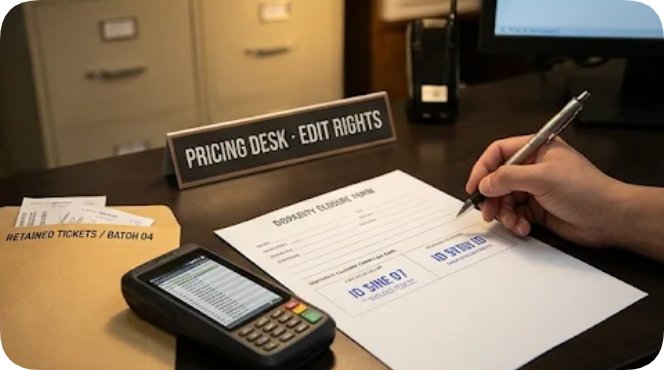
What remains after the last window is a short list of open lines, a pack of retained tickets and a set of devices ready for the next file. That is a much smaller operational footprint than a full aisle-by-aisle audit, and it is also a more honest one: it records what was actually checked, by whom, and against which batch. The next time a promotional file arrives at 06:10, the question for the supervisor is not whether there are enough people to walk the floor. It is whether the roster has a name in the review column before the first ticket is pulled.