At a dam monitoring station, the figure that reaches the daily report is rarely the only figure written that day. A round at 06:40 puts one value on the board; rain before 09:15 puts a second beside it; a supervisor's check at 13:50 adds a third. All three are honest, and all three were written by somebody standing at the same point with the same gauge in front of them. Only one of them is carried into the report, and the reason has nothing to do with how fast any device happened to wake up or save a file.
That gap is where field measurement becomes awkward for a buyer. A page describing a rugged tablet will tell you what the housing is built to withstand, how bright the screen is, and which radio bands it supports. It will not tell you which of three readings the office will keep, or whether the other two remain visible a week later. The useful question is about the record itself: which line was accepted, why the rest stayed on the page, and who is allowed to add to them without touching what was already signed.
Before the Rain Reaches Point 07
Point 07 sits on the upstream face, a short walk from the crest where the instrument cabinet is bolted to a concrete plinth. The morning round reaches it at 06:40, while the light is still flat and the board is dry enough to take a pencil. The observer reads the staff gauge, writes 142.36 on the sheet, and adds cm in the narrow column beside it. Nothing is uploaded at that moment. The sheet is a paper sheet inside a metal folder, and the folder goes back into the cabinet before the next point is visited.
The sheet has three printed columns: POINT, READING, and UNIT. There is no column for a reason, no column for a later mark, and no space reserved for a second visit. That is not an oversight so much as an assumption. It assumes one reading per point per round, within a sampling window that opens at 06:00 and closes at 08:00. Everything written inside that window is a morning reading; anything written after it needs a different explanation, even if the number itself is perfectly good.
A Second Reading on the Same Board
Rain starts at 08:50 and stops before nine. By 09:15 the observer is back at Point 07, holding an RT82 rather than the folder, because the cabinet is wet and the sheet stays dry inside it. The gauge has moved, but only a little. The second value is entered as 1.4236 m on the device and copied onto the sheet as a new row once the folder is open again. Note what changed: the same physical water level is now expressed in metres with four decimal places, while the morning line still says centimetres with two. Both are correct; neither can be compared to the other by eye.

The second row is not a correction. Nobody thinks the first observer misread the gauge. It is a repeat reading, taken because the weather changed and somebody wanted to know whether the change reached this point. The trouble starts later, when the report is assembled and one line has to be chosen. If the choice is made by picking the newest value, the report quietly abandons its own sampling window. If it is made by picking the first value, the rain reading disappears from view. Neither outcome is a hardware problem, and no amount of processing speed resolves it.
Which Row the Daily Report Takes
The rule at this station is unglamorous: the daily report takes the row written inside the 06:00 to 08:00 window, and the mark that says so is added by the duty officer on an SH6 held at the gate house, not by the observer at the gauge. The officer writes ACCEPTED 06:40 in a fourth column that was drawn in by hand. The mark names the row and the time together, which matters more than it sounds. A bare ACCEPTED with no time attached tells you nothing about which of three rows it refers to once the sheet has been photocopied twice.

This is the part that a specification comparison cannot settle. Whether the mark is typed, tapped, or pencilled has no bearing on the fact that a human being decided which row carries the day. What matters is that the decision lands on the same sheet as the rows it judges, and that it names the row rather than replacing it. A mark stored only in a separate system leaves the paper sheet looking as though three equally valid readings are still waiting for a decision.
Where the Discarded Lines Stay
Here is the sheet as it looks at 17:00, with the three rows and the mark that closed the question. The last column is the one that was added by hand.
| Row | Time written | As written | Marked | Why it is on the sheet |
|---|---|---|---|---|
| 1 | 06:40 | 142.36 cm | ACCEPTED 06:40 | Inside the sampling window; carried into the daily report |
| 2 | 09:15 | 1.4236 m | CHECK AFTER RAIN | Repeat reading; kept visible; outside the window |
| 3 | 13:50 | 142.4 cm | SUPERVISOR CHECK | Rounded value from a later visit; not a replacement |
Nothing was erased. Row 2 keeps its own place on the page, with a reason written beside it instead of a deletion. Row 3 is deliberately less precise than Row 1, and it is labelled as a check rather than quietly averaged with the others. The value of this arrangement shows up a fortnight later, when somebody asks why the reservoir figures for that week look slightly odd. The rain is still visible on the sheet. Had the second reading been typed over the first, the only evidence of the weather would be a number that no longer matched the report.
There is a practical reason to be stubborn about this. A line that has been overwritten cannot be reconstructed from the sheet, and the person who overwrote it may have been following an entirely sensible instruction. The instruction is the thing worth changing: add a row, state the reason, name the row that was accepted. That is a change to a form, not to a device.
Units Written Differently in the Same Column
The two readings at Point 07 are the same water level. One is 142.36 cm; the other is 1.4236 m. Put them side by side in the READING column and a reader who skims the sheet sees 142.36 and 1.4236, two numbers that look unrelated. The unit column is doing all the work, and it was never designed to. At the gate house the duty officer opens the HTYJ10A to normalise the figures for the report, and the first thing to decide is not arithmetic but where the unit belongs: in the same cell as the number, or in a column of its own.
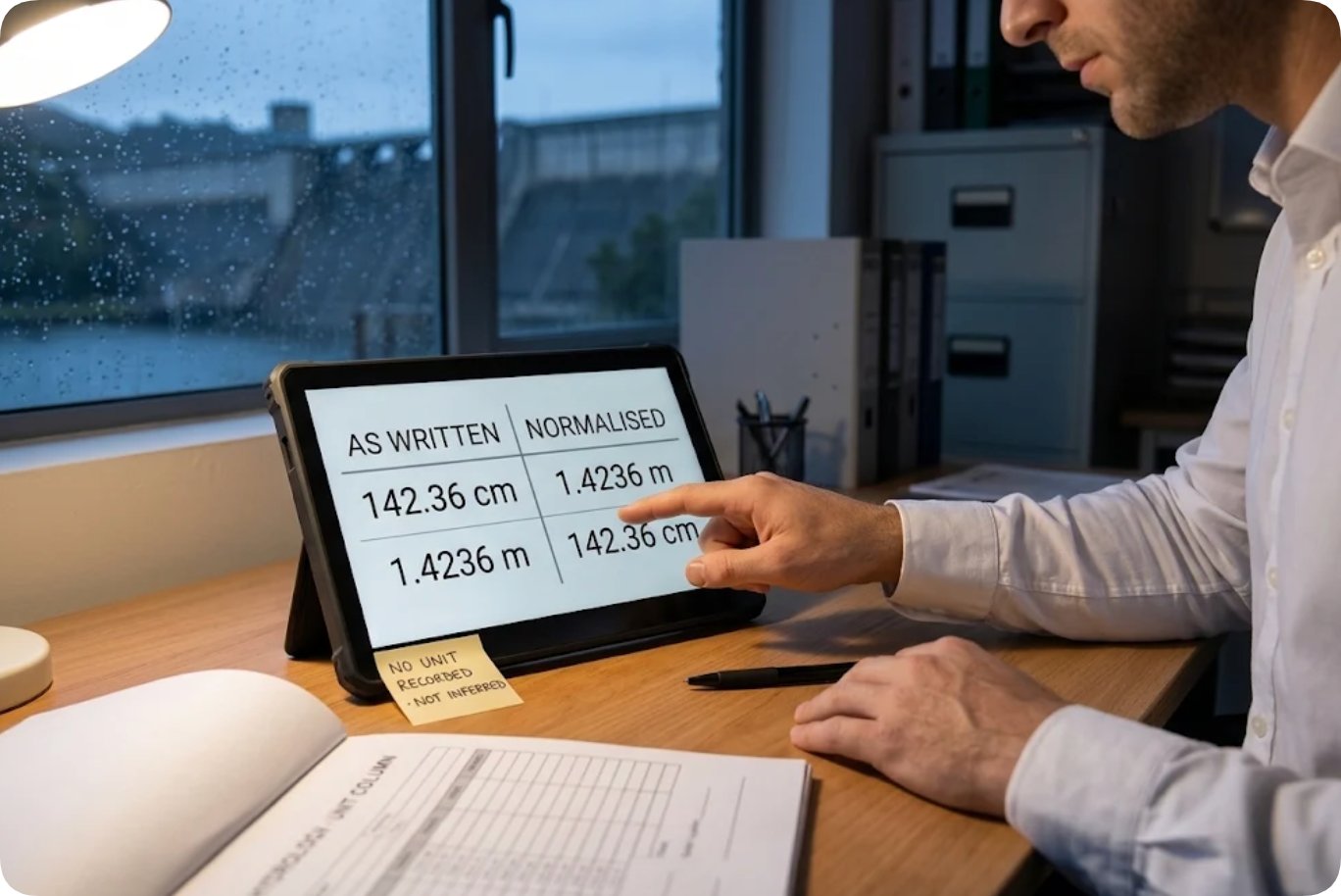
Normalising is safe only when the original writing is preserved. The sheet gains two extra columns, AS WRITTEN and NORMALISED, and the report is built from the second while the first remains untouched. A row with no unit written at all is left alone rather than guessed; the page says it was not recorded, and no inference is made about what the observer meant. That single decision prevents more arguments than any conversion table. Decimal places belong in the same conversation: 142.4 cm in Row 3 is a rounded check, not a measurement of the same precision as Row 1, and the sheet should say so rather than pretending all three rows are interchangeable.
None of this requires a faster processor. It requires the form to admit that a number has a unit, a moment, a writer, and a reason, and that those four things travel together. Once they are separated, even a perfectly accurate reading can end up attached to the wrong day.
Where the Product Pages Stop Answering
It is worth being plain about what the published pages do and do not give you. The table below is deliberately qualitative. It records where each unit sits in the round and what the sheet asks of it, rather than placing three sets of figures side by side.
| Model | Where it sits in the round | What the sheet asks of it | What the published page cannot answer |
|---|---|---|---|
| RT82 | Carried to Point 07 for the repeat visit in the rain | Hold a second row without touching the first; keep the unit visible | Which row the daily report will accept, and who is allowed to mark it |
| SH6 | Held at the gate house when the duty officer closes the sheet | Show the accepted row and its time together, on the same record | How long a rejected row must stay visible after the report is filed |
| HTYJ10A | Used at the desk where the figures are normalised for the report | Keep the original wording beside the converted value | What to do with a row whose unit was never written down |
The pages themselves are clear about some things. The RT82 page states a 10.1-inch IPS FHD panel at 400 nits, a 10000mAh battery, an IP67 rating and Android 16; the HTYJ10A page states a 10.1-inch IPS panel at 560 nits, IP67 with MIL-STD-810G, and a set of physical ports that includes RJ45, Mini HDMI and Type-C. Those are useful facts about the hardware. For the SH6, the same page carries two quite different configuration blocks for one model name, with different operating systems, screen sizes and protection ratings. We quote neither block here, and we do not infer which one a particular unit would have shipped with. Where a page also gives two different battery figures or two operating-temperature ranges for one model, those fields are left out of the comparison entirely.
This is not a criticism of the hardware. It is a boundary. Screen brightness tells you whether the observer can read the sheet in flat morning light; it says nothing about the sampling window. A protection rating tells you the cabinet can be opened in the rain; it says nothing about whether the rain reading belongs in the report. Buyers who want a measured answer to the second kind of question will not find it on a product listing, and pretending otherwise is how a test plan ends up measuring the wrong thing.
What the Next Sheet Should Carry
Three additions would have saved most of the confusion at Point 07, and none of them involves new hardware. A WINDOW column records whether the row was written inside the reporting interval. A MARKED BY column records who closed the question and at what time. An AS WRITTEN UNIT column keeps the observer's own unit next to the number, so that a later conversion never has to be reverse-engineered. A fourth, optional column can carry the reason a repeat visit happened, which is where CHECK AFTER RAIN belongs.
The next round should repeat the same three things rather than collect more numbers: the same point identifier, the same unit column, and the same place on the sheet for the acceptance mark. That is what makes two rounds comparable. Readers who want a wider view of how the site's devices are grouped by task can look at the product comparisons, but the comparison that matters here is between two rows of one sheet, not between two chassis.
Frequently Asked Questions
1. Can a repeat reading replace the first row on the same sheet?
Not at this station. A repeat reading is added as a new row with its own time and reason. At Point 07 the 09:15 row stayed on the sheet even though only the 06:40 row reached the report, because the rain was the reason the gauge was visited twice.2. Which of the three rows goes into the daily report?
The row written inside the 06:00 to 08:00 sampling window, marked ACCEPTED 06:40. The 13:50 supervisor check was deliberately rounded to 142.4 cm, so it is labelled as a check rather than used as a replacement.3. What should happen when two rows use different units?
Keep both as written, add a normalised column for the report, and leave any row without a unit untouched. At Point 07, 142.36 cm and 1.4236 m describe the same water level; converting one in place would have removed the evidence that the second visit used a different form.4. Do the published device figures settle which row is correct?
No. The pages describe the hardware, not the sampling window or the acceptance mark. One of the three pages also lists two different configuration blocks under one model name, so no figure from that page is treated as a field reading here. Where a field is published in two ways, it is left out rather than guessed.The daily report will always show a single number for Point 07. Whether that number can be defended a fortnight later depends on the sheet behind it: the two rows that were not chosen, the units they were written in, and the hand that marked which one counted. A note on how a week of site records is assembled elsewhere is kept in our warehouse operations trend review; the dam sheet needs the same discipline applied to a smaller set of rows.