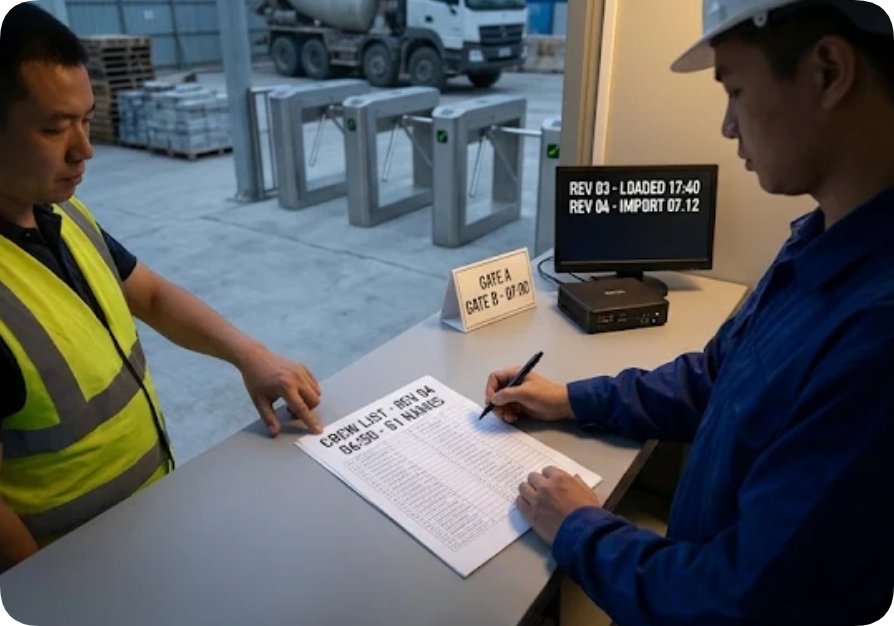
At six fifty on a Tuesday morning a subcontractor foreman hands a printed sheet to the gate house of a concrete frame site. The sheet is revision four of his crew list, fifty-one rows, signed in blue ink. The machine in the rear office is still running revision three, loaded at seventeen forty the previous evening. At seven the first ready-mix truck arrives and turnstiles A and B open. Twelve minutes later revision four is imported. When the site compliance officer arrives on Thursday, she does not ask whether the list was complete. She asks which revision was in force for the nine people who walked through between seven and seven twelve.
That question is harder than a hardware specification because it has a time attached to it. A name list becomes valid at one moment, a passage line is stamped at another, and a badge stops being valid at a third. This article follows those three moments across the small cluster of machines that a real-name access system usually leaves behind the barrier: a host holding list history, a compact node beside the turnstile, and a desk terminal where a subcontractor registers his own people. The published figures below explain what each box can hold or recover; they do not rank the boxes by generation. For a wider view of how these systems are put to work, see our access control and ticketing systems page.
Six Fifty on a Concrete Apron
The concrete apron outside the gate house holds three turnstiles, a portable cabin and a stack of pallets that nobody has moved since Friday. Revision four arrives as a single A4 sheet with fifty-one names, four of them new since Monday. The foreman signs the bottom; the gate clerk signs beside him and writes the time in the corner. Neither signature says anything about the database. At seven o'clock the first truck is waved through and nine workers follow it on foot, two of them on the new rows. The clerk lets them pass because the paper in his hand is the newest thing in the building. The machine behind him will not agree for another twelve minutes.
The WTR PRO AMD is the box that ends up carrying that disagreement. Its published page lists four 3.5-inch SATA drive bays and two M.2 2280 NVMe slots alongside dual 2.5GbE LAN ports, which is why integrators tend to leave list history and passage archives on a machine of this shape rather than on the small unit at the barrier. Keeping revision three after revision four is imported is not a storage problem. It is a decision about whether the earlier revision stays readable, with its own import minute attached, once somebody asks about a twelve-minute gap.
Two Effective Moments, One Signed Sheet
A paper sheet carries one effective moment: the instant it is signed. A database carries another: the instant an import finishes. A turnstile carries a third, its own local clock, which may be a minute or two away from both. Compliance work on a building site lives in the difference between these three. Ask an inspector what she wants and she rarely asks for a longer list of names. She asks for the revision number, the import time, and the clock source behind every passage line that falls between them.
Each of the four questions below is about a moment rather than a device. None can be answered by pointing at a processor or a port count, and that is why a purchase file listing only hardware tends to arrive at an audit with four blank columns.
| What the inspector asks | Which record answers | Where it is written | What breaks the answer |
|---|---|---|---|
| Which list was in force at opening | Revision number plus import time | Host import log | Overwriting revision three on import |
| Who entered during the offline window | Buffered passage lines | Barrier node cache | Uploading without a backfill marker |
| Who approved a changed row | Amendment line with a name | Signed sheet and register | Editing the row in place |
| When a leaver stopped being valid | Badge deactivation time | Credential table | Deleting the name but keeping the badge |
Where Backfilled Minutes Get Marked
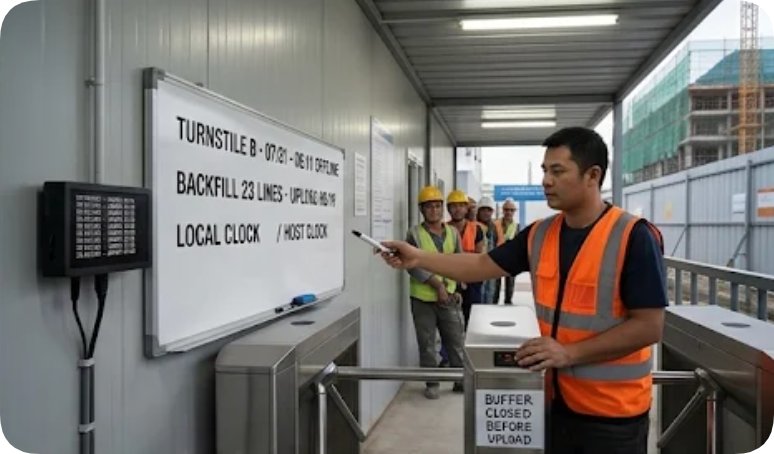
Turnstile B drops off the site network at seven thirty-one and comes back at eight eleven. During those forty minutes it holds twenty-three passage lines locally. They reach the host at eight nineteen, eight minutes after the link is restored, because the upload queue waits for the morning batch to finish. If the host writes all twenty-three lines with an eight-nineteen timestamp, the record says twenty-three people entered the site together, which is false and easy to disprove with the concrete delivery log. The fix is a marker: every line keeps its local clock time and carries a separate field saying when it was uploaded and why.
The Palm-sized miniPC is the unit usually placed on that barrier side, and its published page is unusually specific about recovery behaviour: CPU-integrated TPM 2.0 hardware security, auto power-on after AC recovery, RTC timed power-up, UEFI diskless boot support and an LED status indicator. Those lines matter here for a narrow reason. A node that restarts itself after a power cut and can be brought up on a schedule determines when the local buffer closes and when a catch-up upload can begin. The page does not say those features encrypt or certify the passage lines, and this article does not claim that they do.
Who May Amend a Lodged Register
Revision four has a problem on row thirty-one. A surname appears twice, once with a bracketed numeral after it, because two men from different subcontractors share it and the clerk wanted to keep them apart on the sheet. The foreman asks for the bracket to be removed. The gate clerk has no authority to change a signed sheet; the principal contractor's safety officer does, but only by adding a line, not by editing one. That distinction is the whole of a defensible register: the original row stays readable, and the amendment is a new row with a name and a minute beside it.
The HCAR5000 MI often sits at the desk where a subcontractor registers his own crew before they reach the barrier. Its published page lists an M.2 2280 SSD together with a 2.5-inch HDD option, Windows 10, Windows 11 or Linux soft route support, and a 202 by 212 by 65 millimetre chassis. That combination is a convenient place to keep a local copy of the sheet a foreman brought in, separate from the host copy nobody is allowed to alter. It does not make the terminal the record. It makes it the place where an amendment is first written down.

Badges Returned After a Worker Leaves
Three laminated badges are still in a drawer on Monday morning. Their holders finished on Friday, and revision six of the crew list has forty-five rows against revision five's forty-eight. Deleting three names from a list and stopping three badges from opening a turnstile are separate actions with separate timestamps, and on a busy site they are done by different people. The names usually go first, because the list is what the safety officer sees. The badges go later, when somebody has time to walk to the gate house. For the hours in between, the credential table says a person is still valid even though the paper says he is not.
Nothing in this gap requires a faster processor. It requires an owner for the second timestamp and a rule about which table an inspector reads when the two disagree. Sites that write the rule down tend to put it beside the rugged mobile computing solutions inventory rather than in the access control manual, because that is where the person who deactivates a badge actually looks first.
What the Published Pages Actually Cover
The three product pages publish different kinds of detail, so the table below keeps to fields that appear on all three and quotes only what each page states. It is a reading aid for the record questions above, not a speed comparison between generations.
| Model | Processor | Memory | Storage | Network and recovery |
|---|---|---|---|---|
| WTR PRO AMD | AMD R3 5450U with Radeon Graphics | Single DDR4-3200 SODIMM slot, up to 32GB | Dual M.2 2280 NVMe plus four 3.5-inch SATA bays | Dual 2.5GbE LAN, Wi-Fi 6, Bluetooth 5.2 |
| Palm-sized miniPC | Intel 12th Gen Alder Lake, i3 to i9 options | Dual SO-DIMM DDR4 up to 64GB, or onboard LPDDR5 | M.2 2280 plus M.2 2242, up to 4TB | 2.5G RJ45, TPM 2.0, auto power-on, RTC timed power-up |
| HCAR5000 MI | AMD Ryzen 5000H, 5900HX / 5800H / 5600H | DDR4 3200MHz, up to 64GB | M.2 2280 SSD plus 2.5-inch HDD options | RJ45 LAN, Windows 10/11 or Linux soft route OS |
Two columns are deliberately absent. Only the HCAR5000 MI page publishes a net weight, 2455g; the other two pages do not, so weight is not compared here. Dimensions are equally uneven: two pages give three measurements while the Palm-sized page gives a 113mm footprint, and a single edge is not the same field as a chassis size. Neither gap is filled by inference. Buyers who want to compare more models on paper can start with product comparisons and competitor analysis, but the questions above are settled by timestamps rather than by a faster box.
Before an Inspector Signs the Folder
A workable handover folder is short. It names the revision that was live at opening time, the minute the next revision was imported, the buffered window and its upload time, the amendment lines added since the sheet was signed, and the moment each departed worker's badge stopped being valid. One earlier article kept a similar split between two records in a very different setting: HTYJ08A, HTNJ10B and RT80 describes a bonded warehouse fleet where a single window separated what was declared from what actually moved. The objects differ; the shape of the question does not.
The original sheet from six fifty is still in the gate house, signed in blue ink. It remains accurate for what it records, which is a foreman handing over a list. What the building needed was a second line beside that signature: the minute that list became live in the machine. A site that writes both lines can answer an inspector without rebuilding a morning from memory. One that writes only the first will keep buying a faster host and keep losing the same twelve minutes.