A maintenance contractor outside Lyon runs the service side of twelve public charging depots, 118 posts in total, under a contract that pays by uptime rather than by visit. Every morning the dispatcher opens one board and sorts the overnight tickets into three fault classes before anyone touches a van: display and screen complaints, communication and billing drift, and everything that is really an asset-record problem wearing a hardware costume. The sorting rule is what makes the fleet small. Instead of stocking a device for every technician's taste, the company assigns one device family per fault class, and the three units that actually live in the van are an 8-inch Windows tablet, a 10.1-inch Windows tablet and a UHF RFID handheld reader. This case study walks through one full week of dispatch, because the depot's own service log shows more honestly than any brochure why the split works, where it creaks, and what changed when frost arrived in the second week.

What the Depot Sheet Sorts First
| Fault class | Unit assigned | Carried specification | Kerb outcome |
|---|---|---|---|
| Class S: screens, holsters, connector LEDs | ST9-J 8-inch tablet | 700 g, IP65, 5000 mAh at about 7 hours | Photograph and swap at the first stop |
| Class C: session dropouts, billing drift | ST11-U 10.1-inch tablet | Core i5-1235U, 450-nit panel, 65 W charging | Bench trace of 20 to 40 minutes per post |
| Class A: asset tags, painted-over labels | R366C-S handheld reader | Impinj E710, 900 tags per second, 10 to 20 metres | Bulk read before the van leaves the row |
The contractor's board inherits every overnight report from the charge-point operator's app, and most of what arrives is not electrical engineering. A driver taps a dead screen, a fleet card reads but the session never starts, an RFID badge is flagged as unknown even though the post recognises it every other day. The dispatcher's first move is therefore not diagnosis but classification, and the depot sheet has settled on three classes after a winter of trial and error. Class S covers anything the driver touches: scratched or unresponsive screens, jammed holsters, gun-connector LED faults. Class C covers the posts that answer slowly or bill strangely: session dropouts, meter-value drift, badge authorisation timeouts. Class A covers the paperwork layer: posts whose asset tags read back wrong, or whose label has been painted over by road works. The classes map one-to-one onto the three devices in the van, and the mapping is published on the PDA product family page that the dispatcher keeps open next to the board. What the classes buy is speed at the kerb: a technician who arrives knowing the class also knows which unit to pull from the charging case first, and the van averages 11.4 posts per shift in the period the log covers.
🖥️ Screen Complaints Leave With the 8-Inch Unit
Class S tickets are physical, close-range and frequent, which is exactly the profile of the HOTUS ST9-J 8-inch rugged industrial tablet. The unit weighs 700 grams on the page and 740 grams on the depot's own kitchen scale with the film still on, so one-handed kerb work is realistic even with the tethered stylus looped to the wrist. The screen is an 8-inch IPS panel at 1200 by 1920, and the depot's technicians run it at maximum brightness because most Class S checks happen with the sun behind the post. Inside there is an Intel Celeron N5100 quad-core at 1.10 GHz that bursts to 2.80 GHz, 8 GB of RAM and 256 GB of storage, running Windows 10 Pro, which matters because the operator's legacy screen-test utility is a 32-bit tool that refuses to install on anything else the van owns. The camera argument is quieter but decisive: the rear 13-megapixel autofocus camera with its flashlight photographs connector damage and graffiti tags well enough that the insurer accepts the evidence without a site visit. The battery is a 7.7V 5000 mAh removable pack rated for about seven hours, and the log shows the Class S technician swapping it once, at the 14:40 coffee stop, rather than tethering to the van's inverter. Sealing is IP65 with MIL-STD-810G certification and a 1.2 metre drop rating, and the operating window of -20 to 55 degrees Celsius covers the depot's entire contract territory; at 236 by 144 by 17.4 millimetres the unit slides into the door pocket, which is where it actually rides between stops.
🖥️ Billing Drift and Comms Drops Belong to the Bigger Screen
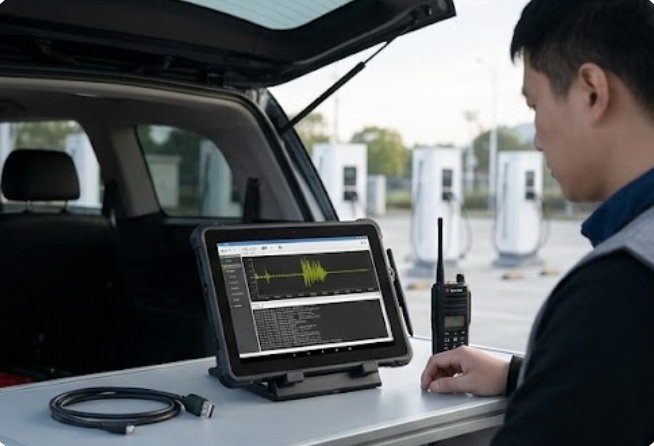
Class C tickets are the ones that turn into contract penalties, because a post that answers slowly or bills wrongly is a post the operator's help desk hears about twice. The diagnostics bench in the van is therefore the heaviest unit on board: the HOTUS ST11-U 10.1-inch rugged industrial tablet, built around an Intel Core i5-1235U (with an i7-1255U option the contractor did not take), 16 GB of RAM and a 512 GB M.2 SATA SSD, running Windows 11 Pro. The screen is a 10.1-inch IPS panel at 1200 by 1920 and 450 nits, with ten-point touch that the page says supports both stylus and wet hands; the depot's contribution to that specification is a technician who logs session traces with gloves off in February and on again thirty seconds later. The battery is a 7.6V 6000 mAh removable pack at 45.6 Wh with 65 W Type-C fast charging, and the log's pattern is consistent: the ST11-U leaves the case only for Class C work, runs the operator's diagnostic suite plus a protocol sniffer for twenty to forty minutes per post, and goes back on the 65 W charger while the van drives. Connectivity is the quiet reason this unit exists: 4G LTE alongside dual-band Wi-Fi and Bluetooth 5.2, so the diagnostic suite can watch a post misbehave on the operator's own backhaul while the van sits in the depot's dead zone. Sealing is IP54 rather than IP65, with the same MIL-STD-810G certification and 1.2 metre drop rating, and the operating window matches its smaller sibling at -20 to 55 degrees Celsius; at 1190 grams and 268.9 by 176.8 by 18 millimetres it is a bench instrument that occasionally walks to a post, and the depot treats it exactly that way.
Misread Labels End With a Ten-Metre Read Rate
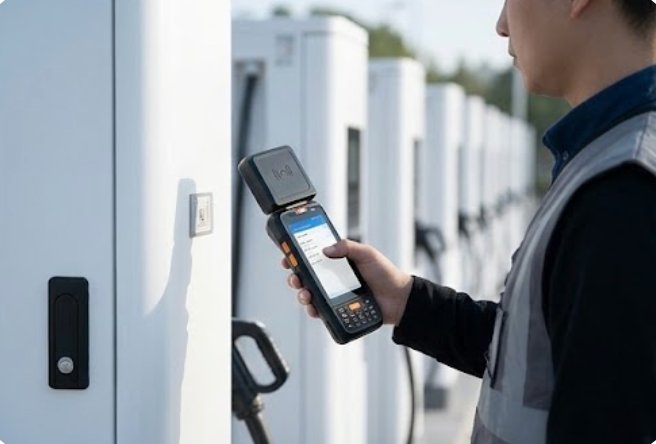
Class A tickets look cosmetic and are not. When a post's asset tag reads back wrong, the operator's asset database starts charging maintenance hours to the wrong serial number, and the contractor eats the hours. The third device in the van is therefore not another tablet but the HOTUS R366C-S UHF RFID handheld reader, an Android 13 unit built on a Qualcomm SM6225 octa-core at 2.4 GHz with 4 GB of RAM and 64 GB of storage. The RFID engine is an Impinj E710 with a stated read rate of 900 or more tags per second and a read distance of 10 to 20 metres on the 4 dBi antenna, across FCC 902 to 928 MHz and ETSI 865 to 868 MHz bands (with SRRC-MII bands listed for the domestic market), speaking EPC Class 1 Gen 2. In the depot's practice the technician walks the row at a kerb's distance and bulk-reads every post's windshield tag in one pass, and the reconciliation against the asset database happens before the van leaves the row. The page's headline battery is a 3.8V 10000 mAh removable pack with PD fast charging over Type-C, which is why the unit doubles as the shift's incidental phone; at 170 by 79 by 22.6 millimetres and under 700 grams it is the one device every technician carries even when the ticket is Class S or C. Two honest limits go into the depot's training sheet: the published operating window is -10 to 50 degrees Celsius, narrower than the Windows tablets, and the specification sheet lists no IP rating at all, so the unit rides the van's dry case rather than the kerb tray in anything heavier than drizzle.
Batteries Across Two Curfews
The van leaves at 06:40 and the dispatcher closes the board at 21:00, and the three devices handle that span with three different battery philosophies. The ST9-J's 5000 mAh pack is the smallest and gets swapped once a shift, deliberately at the coffee stop rather than at a kerb, because the swap takes forty seconds and the spare lives in a labelled pouch. The ST11-U's 6000 mAh pack at 45.6 Wh has never needed a mid-shift swap in the log's six weeks; 65 W charging on the drive between depots restores more than the diagnostic bench spends. The R366C-S's 10000 mAh pack is the strategic reserve of the whole van, since the reader doubles as the crew's dispatch phone and still ends the shift above forty percent. All three packs are removable, and the depot buys them by the pair from the manufacturer's product catalogue rather than gambling on third-party cells, because a swollen pack discovered at 07:10 costs a whole Class A round.
Frost Mornings and the Temperature Split
The second week of the log brought the season's first frost, and the temperature split between the three specifications stopped being trivia. Both Windows tablets publish an operating window of -20 to 55 degrees Celsius, so a 06:40 start at -6 posed them no formal problem; the ST11-U's wet-hand-and-stylus touch held up with nitrile gloves at the two-gram pressure the technicians already use. The R366C-S's window of -10 to 50 meant the reader started the shift inside the van's heater footprint for the first twenty minutes, which the crew absorbed by reordering the round: Class A bulk reads moved from first stop to second, after the van's cabin had done its work. The depot's winter protocol now fits on an index card: screens and diagnostics outside from the first stop, bulk tag reads after the cabin warm-up, and no reader left on the kerb tray while the technician inspects a connector two bays down. Nothing in the log suggests the split will change again before spring; the devices returned 41 of 41 frost-week tickets closed without a revisit.
What Expands When the Second Depot Opens
The contractor bids on a second territory in the next quarter, fourteen more depots across the border, and the fault-class system scales in an direction the board did not expect: the new territory's posts carry a different regional RFID band profile, which the R366C-S's page answers directly, since the reader lists ETSI 865 to 868 MHz and FCC 902 to 928 MHz as shipped band options and the crew simply confirms the variant before the vans load. What does not scale by itself is the bench: one ST11-U per van was enough when the second technician could borrow the first van's on shared rounds, and the bid prices a second diagnostics unit per van rather than a second tablet of each size. The dispatcher's summary of the experiment, which the depot attached to the bid and which the operator's procurement team read twice, is one sentence long: classify the ticket, and the hardware question answers itself. Readers who want to compare this setup against alternative fleet configurations can start from the operator-side analysis in the comparisons library, where the same three roles appear in cross-brand line-ups.