Harbour Crane Devices: Vibration, Salt and a 24-Volt Supply
What a Gantry Does to Electronic Equipment That Nothing on a Datasheet Mentions
A container crane works in a way that destroys electronics quietly. The trolley accelerates with a loaded box on the spreader, the spreader lands and the shock travels up the leg, the boom slews and the structure rings, and the whole machine does this several hundred times a shift. Add salt spray from the water side and an operator looking out through a cab window at a low sun coming off the sea, and the three constraints that decide a device purchase on a harbour are vibration, corrosion and screen readability. None of them is CPU performance, which is what most comparison articles lead with.
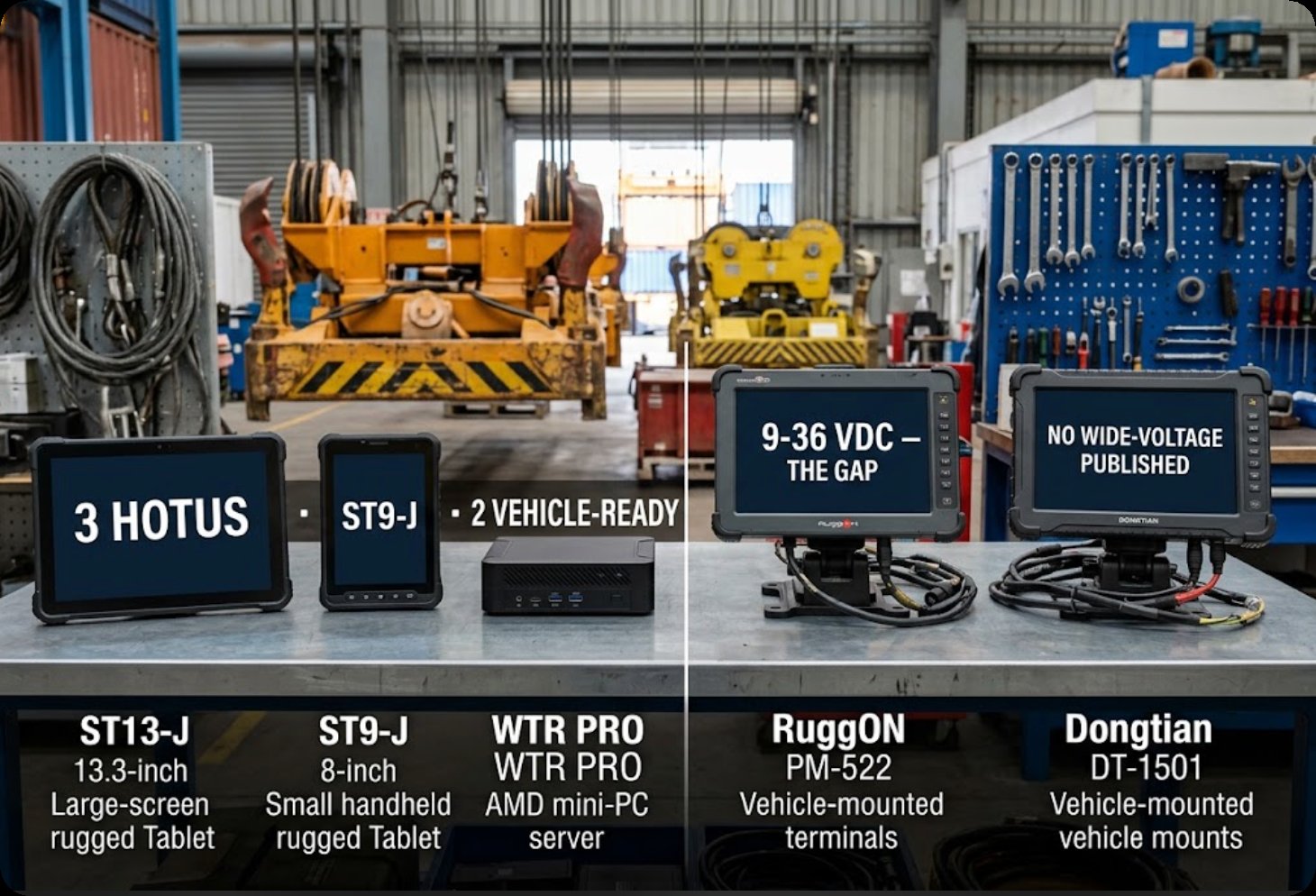
This comparison sets three Hotus units against two competitors built specifically for the same problem, and the honest finding has to be stated up front: none of the three Hotus devices publishes a wide-voltage input range or a dedicated anti-vibration design. Both competitors list 9 to 36 volt DC input and a purpose-built vibration-resistant construction as headline features, aimed directly at forklifts, port machinery and agricultural equipment. That matters because a terminal permanently installed on a crane runs on the vehicle's 24-volt system, and a device designed for 19-volt mains needs a converter, a fuse and a place to mount both.
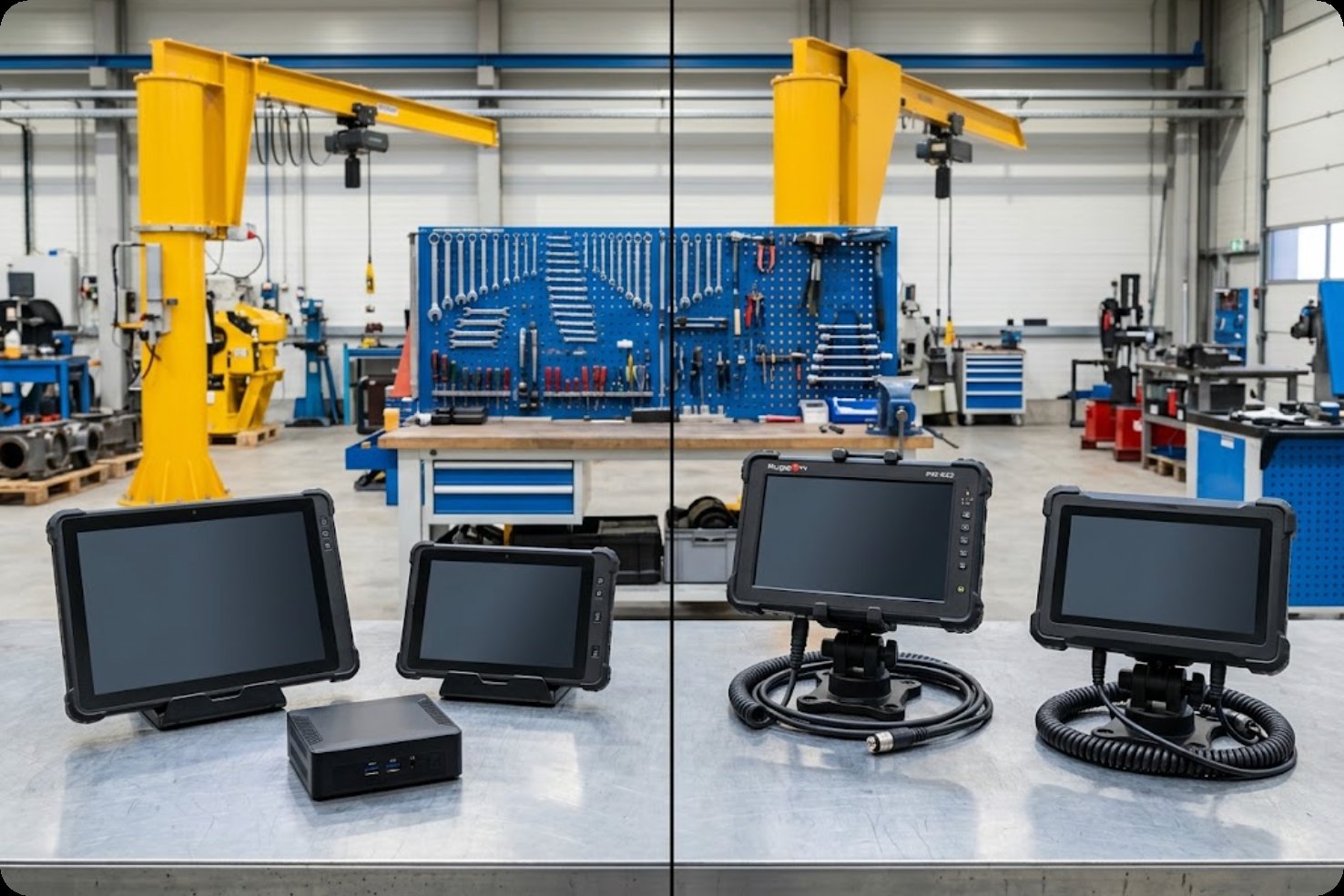
What the Hotus range does offer is equally practical. A 13.3-inch Windows panel belongs in the cab; a 700-gram 8-inch unit is the one an inspector can carry down a stack row; and a storage-heavy mini PC makes sense only back on shore.
🪧 RuggON PM-522: The Reference Vehicle Terminal
The RuggON PM-522 sits at the top of the vehicle-terminal group here, published at $2,200 to $3,000 for forklift, logistics vehicle, port, mining and agricultural machinery duty. Its parameters are built around that role: a 10.4-inch XGA panel at 1024 by 768 and 1000 nits for sunlight readability with glove and stylus touch, an Intel Atom x6425E quad core at 3.0GHz, 8GB of RAM with a 128GB SSD, Windows 10 IoT, IP66, MIL-STD-810H, a purpose-built vibration-resistant design, and a 9 to 36 volt DC input range. Positioning covers GPS, GLONASS and BeiDou, with optional 1D/2D scanning and a vehicle mounting dock.
Two figures do the work. The 1000-nit panel is the sunlight-readable answer on a working crane, and the 9-to-36-volt input is what lets the unit sit permanently on a 24-volt vehicle supply. IP66 is also one step above the IP65 that dominates the Hotus range.
🖥️ Dongtian DT-1501: The Wide-Screen Variant of the Same Idea
The Dongtian DT-1501 is published at $1,500 to $2,200 for the same forklift, logistics, port and machinery duty, and shares the same core idea: vibration-resistant construction, wide-voltage input and a vehicle dock. Its differences are all about the screen and the temperature range.
The panel is 15 inches at 1024 by 768 and 500 nits — much larger than either competitor above it, and larger than either Hotus tablet in this comparison, at the cost of half the brightness. The processor is an Intel Celeron N5100 at 2.8GHz with 8GB of RAM and a 256GB SSD on Windows 10 IoT, protection is IP65, and the operating range is quoted at -10 to 50 degrees, narrower at the cold end than most of the Hotus units. Options cover 1D/2D scanning, a vehicle mounting dock, and GPS/GLONASS/BeiDou.
The trade is legible: for an operator who needs to see a container number and a crane status page at once, 15 inches is worth more than 1000 nits. For anyone working in direct sun with no cab glass, it is not.
🔋 Hotus ST13-J: The Cab Panel on a Lower-Power Platform
The Hotus ST13-J is the largest tablet in this comparison and the one intended for the cab. Its 13.3-inch IPS panel at 1920 by 1080 is quoted at 260 to 400 nits, with ten-point touch supporting stylus and wet-hand operation — the highest resolution of any tablet here, which is what matters when an operator is reading a terminal-management screen rather than a barcode.
The processor is an Intel Celeron N5100 at 1.10GHz bursting to 2.80GHz with UHD Graphics 24 EUs, on Windows 10 Pro with Windows 11 Pro optional, running 8GB of RAM and 256GB of storage standard and expandable to 512GB or down to 4GB/128GB. The battery is a removable 7.6V 8000mAh pack at 60.8Wh, with a 6000mAh option.
The body measures 331.7 by 203.2 by 19.5mm and weighs 1450 grams. Sealing is IP65 alongside MIL-STD-810G, with 1.2-metre drop resistance and a -20 to 55 degree operating range that stores from -40 to 60. Radio is Wi-Fi 5, Bluetooth 4.2 and global 4G LTE, with position fixes from BeiDou, GPS and GLONASS. Add-on modules cover 1D/2D scanning, 13.56MHz NFC and TPM 2.0, and both a vehicle mount and a docking station are listed.
Two honest limits. At 260 to 400 nits it is the dimmest cab panel in this comparison, half the RuggON figure, which on a sun-facing crane window is a real difference rather than a spec-sheet one. And while a vehicle mount is listed, no wide-voltage input range and no vibration rating are published — permanent installation on a 24-volt crane circuit therefore needs a converter, and a vibration test that has not been documented.
🖥️ Hotus ST9-J: The Walkaround Unit With a Brighter Screen Option
The HOTUS ST9-J answers the quayside problem, where a terminal has to be carried rather than mounted, and it does so with a lighter body than the 13.3-inch unit in the cab. It runs an Intel Celeron N5100 quad core at 1.10GHz bursting to 2.80GHz with UHD Graphics 24 EUs, on Windows 10 Pro with Home and Windows 11 Pro options, carrying 8GB of RAM and 256GB of storage with 4GB/128GB and 512GB options.
Sealing is IP65 with MIL-STD-810G, drop resistance is 1.2 metres, and the unit works from -20 to 55 degrees, storing from -40 to 60. In the hand it is 236 by 144 by 17.4mm and 700 plus or minus 50 grams; a removable 7.7V 5000mAh battery charges in around three hours and is quoted at roughly seven hours of use.
Wireless is Wi-Fi 5, Bluetooth 4.2 and global 4G LTE, with BeiDou, GPS and GLONASS plus an optional UM960 module. Storage of 8GB and 256GB runs alongside 13.56MHz NFC, and 1D/2D scanning, UHF RFID, fingerprint and TPM 2.0 are all optional.
Two details matter more than the rest on a harbour quay. The 8-inch IPS panel at 1200 by 1920 is quoted at 400 nits, and an optional 1000-nit sunlight-readable version is offered — the same figure the top-ranked competitor carries as standard, which means the brightness gap on this unit is a configuration choice rather than a fixed limitation. And at 700 grams with a seven-hour figure, it is the most portable device here that still carries Windows and a full IP65 certification.
💾 Hotus WTR PRO AMD: The Terminal-Side Storage Machine
The WTR PRO AMD Mini PC belongs on the landside, not on the machine. It runs an AMD Ryzen R3 5450U with Radeon graphics, a single DDR4-3200 SODIMM slot up to 32GB, and storage built for volume: dual M.2 2280 NVMe SSD slots alongside four 3.5-inch SATA bays.
Networking is dual 2.5G LAN with Wi-Fi 6 and Bluetooth 5.2, and display output runs triple 4K through HDMI, DisplayPort and a full-function Type-C. The chassis is aluminium at 228 by 150 by 185mm and 5 kilograms on a 19V 6.32A 120W adapter, running Windows 11 or Linux. Certification is CE, FCC and RoHS.
For a terminal operator moving twenty years of container images and gate transaction logs, four SATA bays plus dual NVMe and dual 2.5G LAN is the decisive part of the specification. The honest limit is that it is a 5-kilogram desktop box: it belongs in an equipment room or a shore-side cabin, not on a quay edge, and it carries compliance certification rather than any ingress or vibration rating.
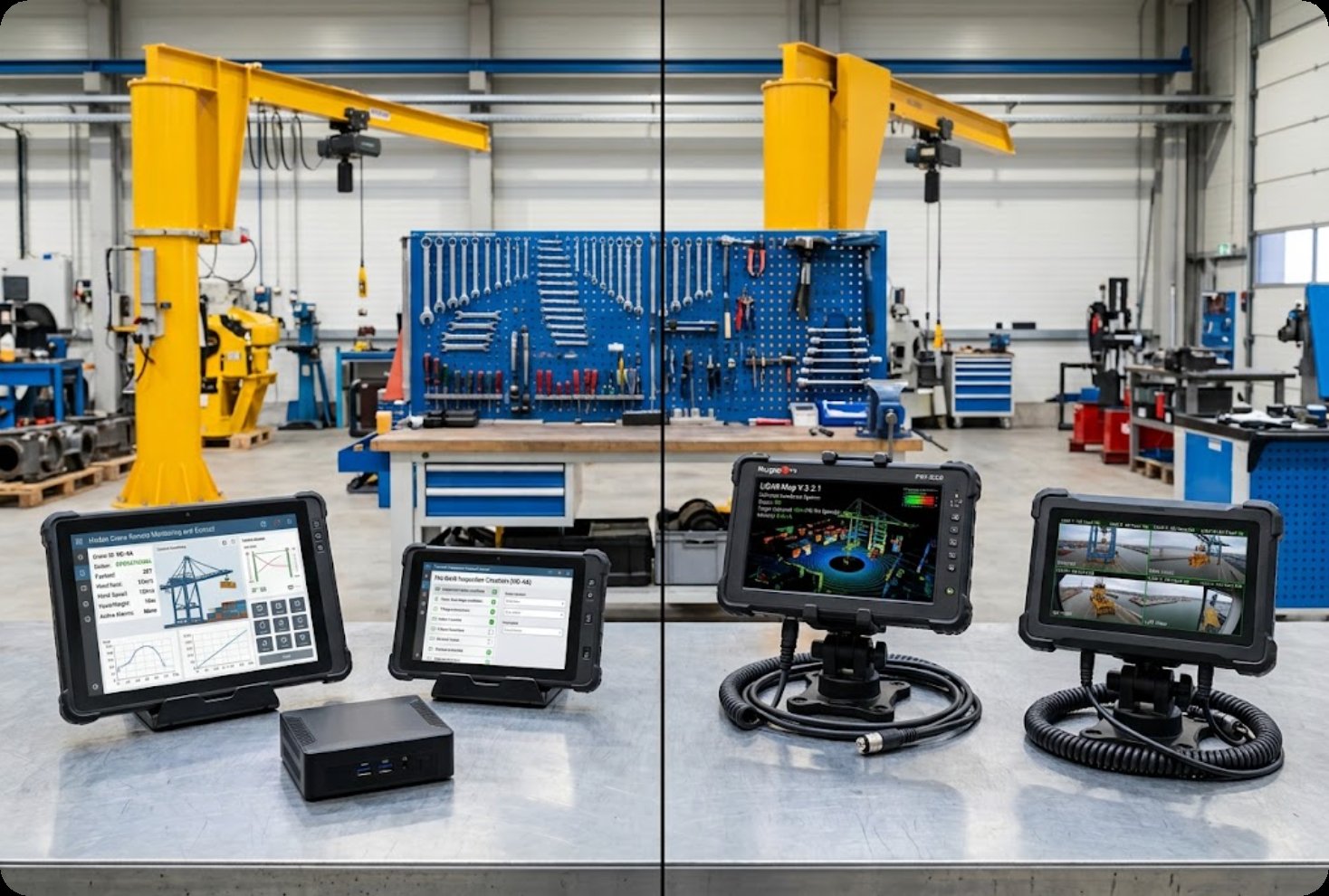
Specification Comparison: Three Hotus Units Against Two Vehicle-Mounted Rivals
| Hotus ST13-J | No vibration rating or wide-voltage input published. Vehicle mount and dock listed | IP65, MIL-STD-810G, 1.2m drop, -20 to 55 degrees | 13.3-inch IPS, 1920x1080, 260-400 nits | Intel Celeron N5100 to 2.80GHz burst; 8GB + 256GB | 331.7 x 203.2 x 19.5mm, 1450g | Not published on the product page |
| Hotus ST9-J | No vibration rating or wide-voltage input published. Vehicle mount and dock listed | IP65, MIL-STD-810G, 1.2m drop, -20 to 55 degrees | 8-inch IPS, 1200x1920, 400 nits, optional 1000-nit panel | Intel Celeron N5100 at 2.80GHz burst; 8GB + 256GB | 236 x 144 x 17.4mm, 700g | Not published on the product page |
| Hotus WTR PRO AMD | No vibration rating; mains 19V / 120W adapter | No ingress rating published; no temperature range published | Triple 4K output via HDMI, DP and Type-C | AMD Ryzen R3 5450U; DDR4 up to 32GB, 4x SATA plus dual NVMe | 228 x 150 x 185mm, 5000g; desktop chassis | Not published on the product page |
| RuggON PM-522 | Vibration-resistant design, 9-36VDC input, vehicle dock | IP66, MIL-STD-810H | 10.4-inch XGA, 1024x768, 1000 nits | Intel Atom x6425E at 3.0GHz; 8GB + 128GB SSD | Not published in the source database | $2,200-3,000 (about CNY 15,800-21,600) |
| Dongtian DT-1501 | Vibration-resistant design, 9-36VDC input, vehicle dock | IP65, -10 to 50 degrees | 15-inch XGA, 1024x768, 500 nits | Intel Celeron N5100 at 2.8GHz; 8GB + 256GB SSD | Not published in the source database | $1,500-2,200 (about CNY 10,800-15,800) |
Choosing by Where the Device Sits on the Machine
| Permanently installed in the cab on a 24V crane supply, worked in direct sun | RuggON PM-522 | 9-36VDC input takes the vehicle supply directly, vibration-resistant construction, and 1000 nits is the only sunlight-readable panel in this comparison |
| Cab operator who needs one large screen rather than a bright one | Dongtian DT-1501 | 15 inches at 500 nits with the same wide-voltage input and dock, at a lower price band than the RuggON |
| Cab terminal where resolution and Windows application support matter most | ST13-J | 1920 by 1080 on 13.3 inches with a removable 8000mAh pack; accept 260-400 nits and confirm the power and vibration story before permanent install |
| Quayside walkaround where screen readability matters as much as weight | ST9-J | 700 grams with an optional 1000-nit panel, IP65 plus MIL-STD-810G, and a seven-hour figure on a removable battery |
| Shore-side equipment room holding gate and image archives | WTR PRO AMD | Four SATA bays plus dual NVMe and dual 2.5G LAN for storage and network segregation; needs a dry, protected room |
What a Harbour Specification Does Not Settle
Two questions decide a harbour device purchase that no datasheet answers. The first is vibration testing, and it should be asked in a specific form: not "is it rugged" but "what standard was it tested to, for how long, on which axis". A device carrying an MIL-STD-810H certification has been tested; a device described as having an anti-vibration design has been engineered, which is a weaker statement. Neither of the three Hotus units in this comparison publishes a vibration figure, so that question goes to the supplier before it goes on a boom.
The second is the electrical installation itself. A crane that has been running for fifteen years rarely has clean 24-volt power, and terminals that survive a static specification can still fail on a bus with ignition transients. The two competitors both publish a wide input range, which is not the same as transient protection but is at least a published number a terminal electrician can work with. Establishing whether a Hotus unit accepts the supply on a specific crane class is a conversation worth having before the hardware is ordered.
Sites pairing harbour deployment with other outdoor vehicle work can review the full rugged tablet lineup for other chassis sizes, while the mini PC range covers the shore-side and equipment-room positions. Further device comparisons sit in the device comparison archive.