Pipeline Inspection Tablets: Centimetre Accuracy Is the Whole Job
🔍 Why a Pipeline Patrol Is a Positioning Problem First
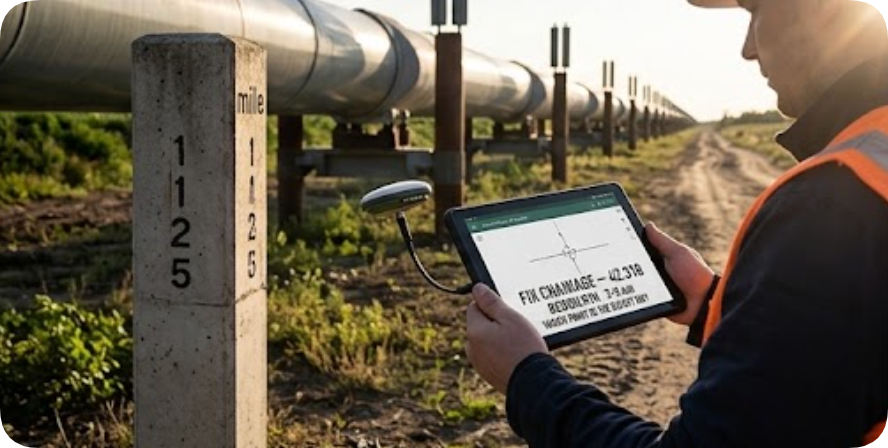
A pipeline patrol is the rare field job where the photograph is not the deliverable. An inspector walking a right-of-way records a condition report, but the report is worthless if nobody can say later which kilometre of pipe it refers to — because a corrosion finding logged to the nearest gate becomes a search operation rather than a repair. That single fact reorders the whole buying decision. Screen size, processor and memory all matter, but they matter second, and the first question a pipeline operator asks a supplier is what the device does about positioning when the corridor is cut through terrain with no cellular coverage and no base station in sight.
This comparison sets three Hotus units against two tablets sold into exactly that kind of work, and the honest finding is that all three put centimetre positioning ahead of everything else, while competing hard on how that positioning is delivered. The RT81 and RT80 both carry an optional independent BeiDou module with RTK, which the published figures put at horizontal accuracy of 2 to 5 centimetres without requiring an external base station in many regions. The RT82 takes a different route to the same accuracy, adding GPS L1+L5 dual-frequency reception that corrects for ionospheric error and multipath reflections — 0.5 to 1 metre on its own, without RTK, before the optional BeiDou module is added.
What none of the five units publishes is the one figure a pipeline specification always asks for: a stated ingress rating valid for the burial condition. IP65 and IP67 both appear in this comparison, and neither is a statement about immersion depth in the soil a pipeline is laid in.
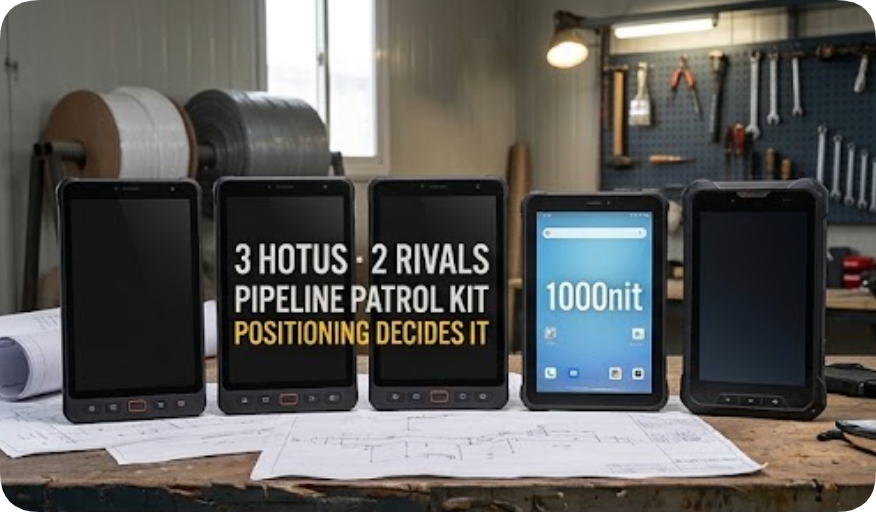
Hotus RT81: The Centimetre-Answering Patrol Unit
The RT81 4G Rugged Tablet is the unit a right-of-way crew is being described when a supplier says centimetre accuracy. Underneath the positioning story is a Qualcomm SM6115 chipset running eight cores at 2.0GHz, on Android 16, paired with 4GB of RAM and 64GB of storage that a microSD card can extend to 256GB. Positioning is the headline: GPS, GLONASS and Galileo as standard at a stated 2 to 3 metres, plus an optional independent BeiDou module with RTK giving 2 to 5 centimetre horizontal accuracy, receiving correction data over 4G from network RTK services.
For a patrol that has to mark a defect at an exact chainage, that is the feature that justifies the purchase. A 10.1-inch 1200 by 1920 IPS panel at 400 nits with G+G ten-point capacitive touch handles the readout, and a 20-megapixel autofocus rear camera with flash plus an 8-megapixel front camera covers the photographic record. Connectivity is 4G LTE with CN and EAU regional variants, dual Nano-SIM slots, a TF slot and a 12-pin pogo dock. Sealing is IP67, drop resistance is 1.2 metres, and the chassis measures 252 by 170 by 14.6mm at under 650 grams.
Two limitations should be stated plainly. The screen is quoted at 400 nits, which is readable in daylight but is the joint-lowest figure in this comparison. The operating range is -10 to 50 degrees, narrower at the cold end than the ST11-M. The battery is listed as a 3.8V 10000mAh high-capacity pack in the product summary and as removable in that same summary, while the consolidated specification table describes it as non-removable; whichever it is in a given production run, a 10000mAh pack is what a full walking shift needs, and that much is not in dispute.
Optional modules cover the rest of the patrol: a 2D barcode engine at 3 mil accuracy or better, 13.56MHz NFC, and a capacitive FAP20 fingerprint sensor.
Hotus RT80: The One That Uploads a 48-Megapixel Photo Immediately
The RT80 5G Rugged Tablet takes the same chassis and changes what it optimises. The processor is a UNISOC UIS7885 octa-core at 2.7GHz with a built-in 8-teraflop NPU, memory is 8GB with 128GB of storage expandable to 512GB, and the cellular is 5G SA/NSA dual mode alongside 4G, with dual Nano-SIM slots.
The camera is the reason to specify it. A 48-megapixel autofocus rear sensor with LED flash is joined by an optional 8-megapixel macro camera — and the macro lens is the detail that matters on a pipeline, where a crack, a coating defect or a corroded flange is photographed at close range and has to stay legible when the report is read months later. Alongside it sit a 400-nit 10.1-inch 1200 by 1920 panel, IP67 sealing, and a 3.8V 10000mAh pack charged by PD over Type-C; the interface list covers a 12-pin pogo connector, dual Nano-SIM, a TF slot, dual 2-watt speakers and dual noise-cancelling microphones. The body is 251 by 170 by 14.6mm at under 650 grams, working from -10 to 50 degrees and storing from -40 to 70.
Both RT-series units carry the same independent BeiDou plus RTK positioning option, so the choice between them is not about accuracy. It is about whether the crew needs to move a 48-megapixel file over a weak link as it is taken. On a corridor with a private 5G network, the RT80 wins that argument. On a corridor with no coverage at all, neither wins it, because a terrestrial radio is still a terrestrial radio.
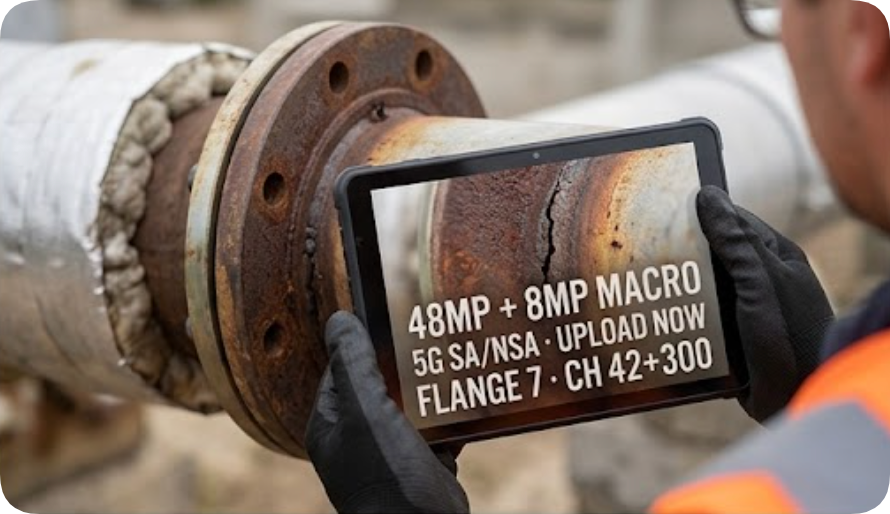
📡 Hotus RT82: Dual-Frequency GNSS That Fixes It Without a Correction Service
The RT82 5G Rugged Tablet is the third answer to the positioning problem and the cheapest of the three to get accuracy from. The chipset is a Qualcomm QCM6690 octa-core at 2.9GHz built as a 5G IoT platform, with a 6-teraflop NPU, running Android 16 on 8GB of RAM and 128GB of storage expandable to 256GB.
The positioning stack is where the engineering went. Standard reception is GPS L1 plus L5 dual-frequency, which corrects for ionospheric distortion and multipath reflections, alongside GLONASS, Galileo, NaviC, QZSS and BeiDou, on a GPS Gen9 v5.2 receiver. The published accuracy without any correction is 0.5 to 1 metre, and the optional independent BeiDou RTK module takes that to 2 to 5 centimetres. That difference matters commercially: a crew that accepts sub-metre accuracy needs no network RTK service at all, which removes both the subscription and the coverage dependency that the correction route carries.
Connectivity is the other argument. Cellular is 5G SA and NSA across N1, N3, N5, N7, N8, N20, N28 and the n38/40/41/77/78/79 bands with 4x4 MIMO downlink, plus LTE and WCDMA fallbacks. Wireless adds tri-band Wi-Fi 6E across 2.4, 5 and 6GHz — the 6GHz band is stated as free from legacy-device interference, which is the argument for a yard or depot with dozens of devices on it — and Bluetooth 5.2. RTK correction can arrive over 5G where a network service exists.
Physical figures sit alongside the RT-series: a 10.1-inch 1200 by 1920 IPS panel at 400 nits with G+G ten-point touch, IP67 sealing with MIL-STD-810G and 1.2-metre drop resistance, a 3.8V 10000mAh pack listed as non-removable, and a 252 by 170 by 14.6mm body under 650 grams. Operating range is -10 to 50 degrees, storage -40 to 70, humidity 5 to 95 percent non-condensing. Cameras are 8MP front and 20MP autofocus rear with flash. Optional modules cover a 2D barcode engine at 3 mil or better, 13.56MHz NFC, and the independent BeiDou RTK unit.
The honest limitation is the display. At 400 nits it ties the RT81 and RT80 for the lowest brightness figure among the three, and all three trail the 1000-nit options published elsewhere in this comparison. A patrol that works in open desert daylight all day needs the optional high-brightness panel, and that is a line item worth putting on the purchase order rather than discovering in the field.
💡 Yanbo RB10 Pro: The 1000-Nit, IP67, 10000mAh Alternative
The Yanbo RB10 Pro is listed at the mid tier for industrial, government, outdoor and inspection work at 3,500 to 5,000 yuan, and its published parameters are unusually targeted at exactly this trade. A 10.1-inch 1920 by 1200 panel at 1000 nits, a Rockchip RK3588 octa-core at 2.4GHz, 8GB of memory and 128GB of storage, IP67 with MIL-STD-810H, 1.2-metre drop resistance, an operating range of -20 to 60 degrees, and a 10000mAh battery. Touch supports gloves and wet hands.
On the published figures it beats both Hotus Android units where it counts outdoors. The 1000-nit panel is two and a half times brighter than the RT-series screens, and the -20 to 60 degree range is ten degrees wider at both ends than the RT81 and RT80. For a patrol that runs through a northern winter or a summer desert, those two figures are worth more than the faster processor.
What the record does not publish is the positioning story. There is no mention of an independent BeiDou module, RTK or any stated horizontal accuracy, which on a pipeline right-of-way is the gap that decides it. A bright screen and a long battery are only worth what the positioning module can do with the reading taken beside it.
SINSMART SIN-I1012E: The Wide-Temperature Open-Source Option
The SINSMART SIN-I1012E is listed at the mid tier from 600 to 1,200 dollars for industrial automation, field inspection, safety embedded applications and edge computing. Its parameters are a 10.1-inch panel, Intel Celeron N5100 or 12th-generation U-series or Rockchip RK3568 as processor options, Ubuntu 22.04 LTS and Debian 11 pre-installed, IP65 with MIL-STD-810H, 1.2-metre drop resistance, a -20 to 60 degree operating range and a four-corner reinforced design.
Two features make it relevant to a pipeline utility specifically. The -20 to 60 degree range matches the Yanbo and exceeds the Hotus RT units by ten degrees at the cold end. And the pre-installed open-source operating systems matter when the inspection application is an in-house build: a utility that maintains its own Linux software does not want a Windows licence and image-management burden on every device.
The trade is that IP65 is the lowest ingress rating of the four rugged units in this comparison, and no positioning specification is published. For a control-room-adjacent or sheltered installation that is a workable trade. For a walk-the-line patrol in open country it is not.
Specification Comparison: Three Hotus Units Against Two Pipeline Rivals
| Hotus RT81 | GPS, GLONASS, Galileo at a stated 2-3m; optional independent BeiDou with RTK at 2-5cm | 10.1-inch IPS, 1200x1920, 400 nits | 3.8V 10000mAh, pack type varies by production run | IP67, 1.2m drop, -10 to 50 degrees | Qualcomm SM6115 octa-core 2.0GHz, Android 16 | Not published on the product page |
| Hotus RT80 | Same GNSS set with optional independent BeiDou plus RTK at 2-5cm | 10.1-inch IPS, 1200x1920, 400 nits | 3.8V 10000mAh, PD fast charging, listed non-removable | IP67, -10 to 50 degrees, storage -40 to 70 | UNISOC UIS7885 octa-core 2.7GHz with 8T NPU, Android 13 or Harmony OS 6.1 | Not published on the product page |
| Hotus RT82 | GPS L1+L5 dual-frequency plus GLONASS, Galileo, NaviC, QZSS, BeiDou at 0.5-1m; optional independent BeiDou with RTK at 2-5cm | 10.1-inch IPS, 1200x1920, 400 nits | 3.8V 10000mAh, listed non-removable | IP67, MIL-STD-810G, 1.2m drop, -10 to 50 degrees | Qualcomm QCM6690 octa-core 2.9GHz with 6t NPU, Android 16 | Not published on the product page |
| Yanbo RB10 Pro | Not published in the source database | 10.1-inch, 1920x1200, 1000 nits | 10000mAh | IP67, MIL-STD-810H, 1.2m drop, -20 to 60 degrees | Rockchip RK3588 octa-core 2.4GHz | 3,500-5,000 CNY |
| SINSMART SIN-I1012E | Not published in the source database | 10.1-inch | Not published in the source database | IP65, MIL-STD-810H, 1.2m drop, -20 to 60 degrees | Intel Celeron N5100 or 12th-gen U-series or RK3568, Ubuntu 22.04 LTS or Debian 11 | $600-1,200 (about CNY 4,300-8,600) |
Choosing by What the Report Has to Prove
| A patrol report where every finding carries a kilometre mark | RT81 | Optional independent BeiDou plus RTK at 2-5cm without a base station, with a 10000mAh pack and 4G for later sync |
| Close-range photographic evidence of cracks, coatings and flange corrosion, uploaded as it is taken | RT80 | 48-megapixel autofocus plus optional 8-megapixel macro and 5G SA/NSA for immediate transfer of large files |
| Patrol on a right-of-way with no reliable network RTK service in range | RT82 | GPS L1+L5 dual-frequency reaches 0.5 to 1 metre on its own, removing both the subscription and the coverage dependency; tri-band Wi-Fi 6E for congested yards |
| Winter or desert patrol where screen brightness and cold tolerance outrank positioning | Yanbo RB10 Pro | 1000-nit panel and -20 to 60 degree range, though no positioning specification is published |
| In-house Linux inspection software on a utility budget | SINSMART SIN-I1012E | Ubuntu 22.04 LTS and Debian 11 pre-installed with a -20 to 60 degree range; the lowest ingress rating of the four rugged units |
What a Pipeline Specification Does Not Settle
Two questions decide a pipeline tablet purchase that appear nowhere on these five specification sheets. The first is the correction source for RTK. A unit that promises 2 to 5 centimetres needs somewhere to receive correction data from, and on a remote right-of-way that is either a network RTK service over 4G, which requires coverage, or a local base station, which requires a survey team. Both Hotus RT-series pages describe correction arriving over 4G from network RTK services, which means the accuracy figure and the coverage question are the same question.
The second is burial condition. IP67 on these units means dust-tight and waterproof to one metre for thirty minutes. A pipeline inspection is usually above-ground, but a valve pit, a trench or a low section is not, and no IP figure in this comparison addresses prolonged submersion. If a deployment includes pit work, that requirement needs a separate answer from the supplier rather than an inference from the ingress rating already published.
A utility running the same patrol across above-ground line walking and vehicle-mounted work should compare chassis sizes in the rugged tablet lineup, while a control room needing a fixed terminal rather than a handheld sits in the related mini PC range. Where a weighing of one unit against another is what you need, the comparison archive holds the rest of this series.