A charging post does not have a keyboard. It has a screen, a QR sticker, a contactor, a meter and a number that ties it to a billing system somewhere else, and the number is the one thing a technician has to put into the handheld terminal before any of the other work can be filed. Type it wrong and the fault report lands on a neighbouring post. Type it slowly and the technician starts skipping the post in front of them. This is the part of EV charger maintenance that never makes it into a comparison table, and it decides which three devices below are worth carrying.
The scene also has a second constraint that the datasheets handle badly: a charger post stands outdoors, in a car park, in the rain, next to a vehicle that is drawing current. A device that works in an office and a device that works on a wet concrete island between two parked cars are not the same purchase, and the difference shows up in three published numbers before it shows up anywhere else. Three Hotus devices are compared here against two handhelds built specifically for plant and depot work: the X501 handheld, the P8 8-inch tablet and the P11 10.95-inch tablet, facing the Urovo DT45 and the Chainway C66.
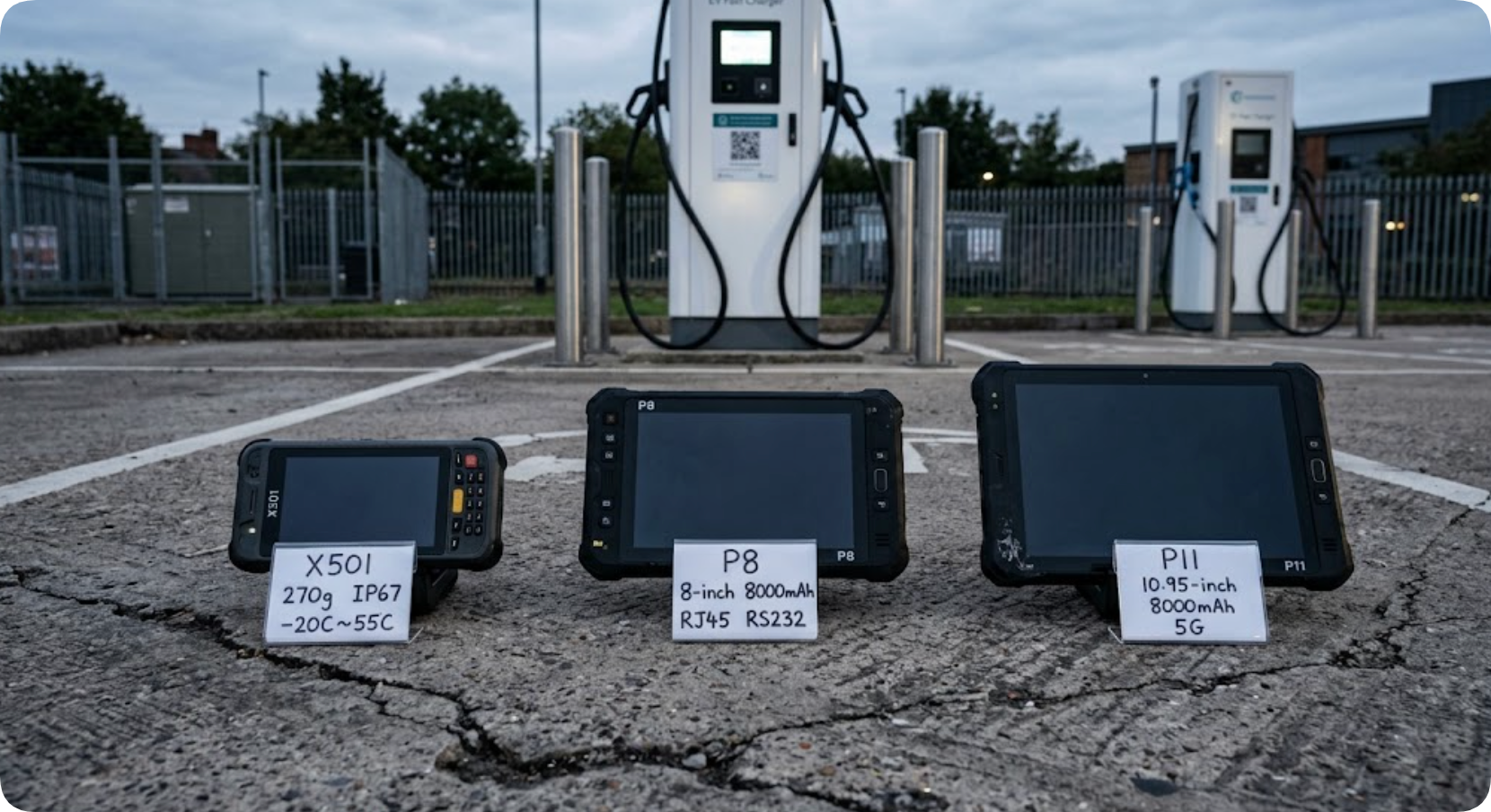
A Charging Post Has No Keyboard
Work through what a technician actually does at a post and the order of operations becomes clear. They read the post number off the label or the QR sticker, they open the management application, they confirm the post identity, and only then do they photograph the fault, check the connector and record the reading. That first step is where a device either earns its place or quietly slows the technician down three times a day, and it is the reason screen size, processor and camera specifications are the wrong things to lead with when choosing for this work.
There are two ways to get a post number into the terminal. You read it with a scan engine and the number arrives already typed, which is fast and depends on the sticker surviving. Or you type it, which is slower and depends on the screen and the keypad surviving. Neither is free. A scan engine is hardware you can drop, lose a lens to, or aim at a faded sticker; a keypad is a piece of glass you can use with gloves on, in the rain, without looking down. The three Hotus units here take the scanning route, and one of the two competitors takes the typing route with a physical keypad and a screen you can read in direct sun.
X501: 270 Grams and a Scan Engine
The X501 is the one of the three that a technician can put in a chest pocket and forget about, and it is the only one of the five devices in this comparison with a published operating temperature range and a published drop figure at the same time. The manufacturer states IP67 dustproof and waterproof sealing, 1.5m drop resistance and an operating range of -20°C to 55°C, on a body measuring 158 by 75 by 16 millimetres at approximately 270 grams with the battery fitted. That is the smallest number in this comparison, and it is the number that decides whether a device is carried or left in the van.
Capture is built in rather than bolted on. The page specifies a hardware 2D barcode scan engine with Honeywell, Zebra or professional CMOS options, and lists 13.56MHz NFC, a UHF RFID module and a PSAM security card slot as optional. The screen is a 5.5-inch IPS panel at 720 by 1440 with Corning Gorilla Glass, specified for glove and wet-hand operation. The processor is an octa-core 64-bit part running at 2.0GHz with 4GB of RAM and 64GB of storage, and the battery is a removable 4500mAh or 5000mAh pack with quick swap and Type-C fast charging, on Android 14 or Android 12.
What the page does not claim matters as much. There is no brightness figure in nits, so the screen cannot be compared against a published lumens number, and while the case carries a 13MP autofocus rear camera with LED flash, no thermal or infrared function is claimed for it. For a survey that needs a visible fault image, a 13MP camera with a flash is enough; for a survey that needs a connector temperature, this page is silent and the thermal camera remains a separate instrument.
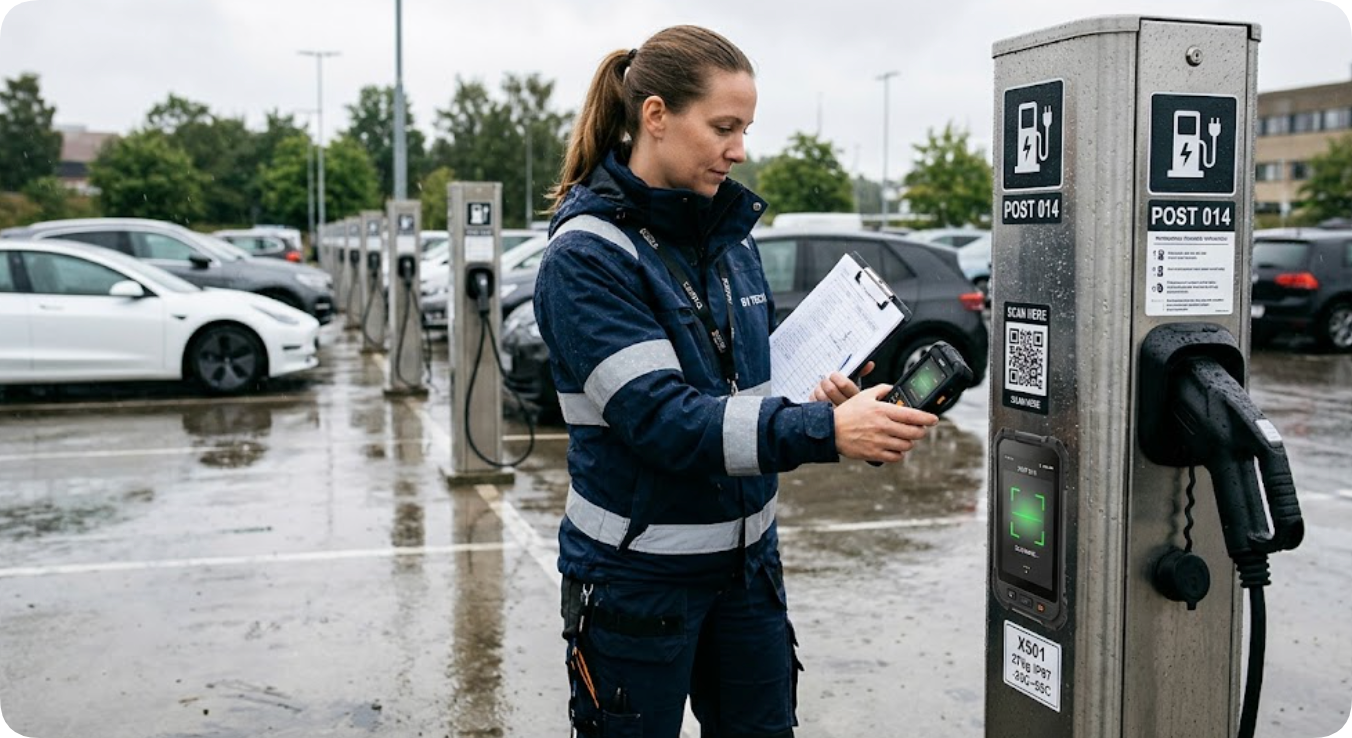
P8: Eight Inches and a Serial Port
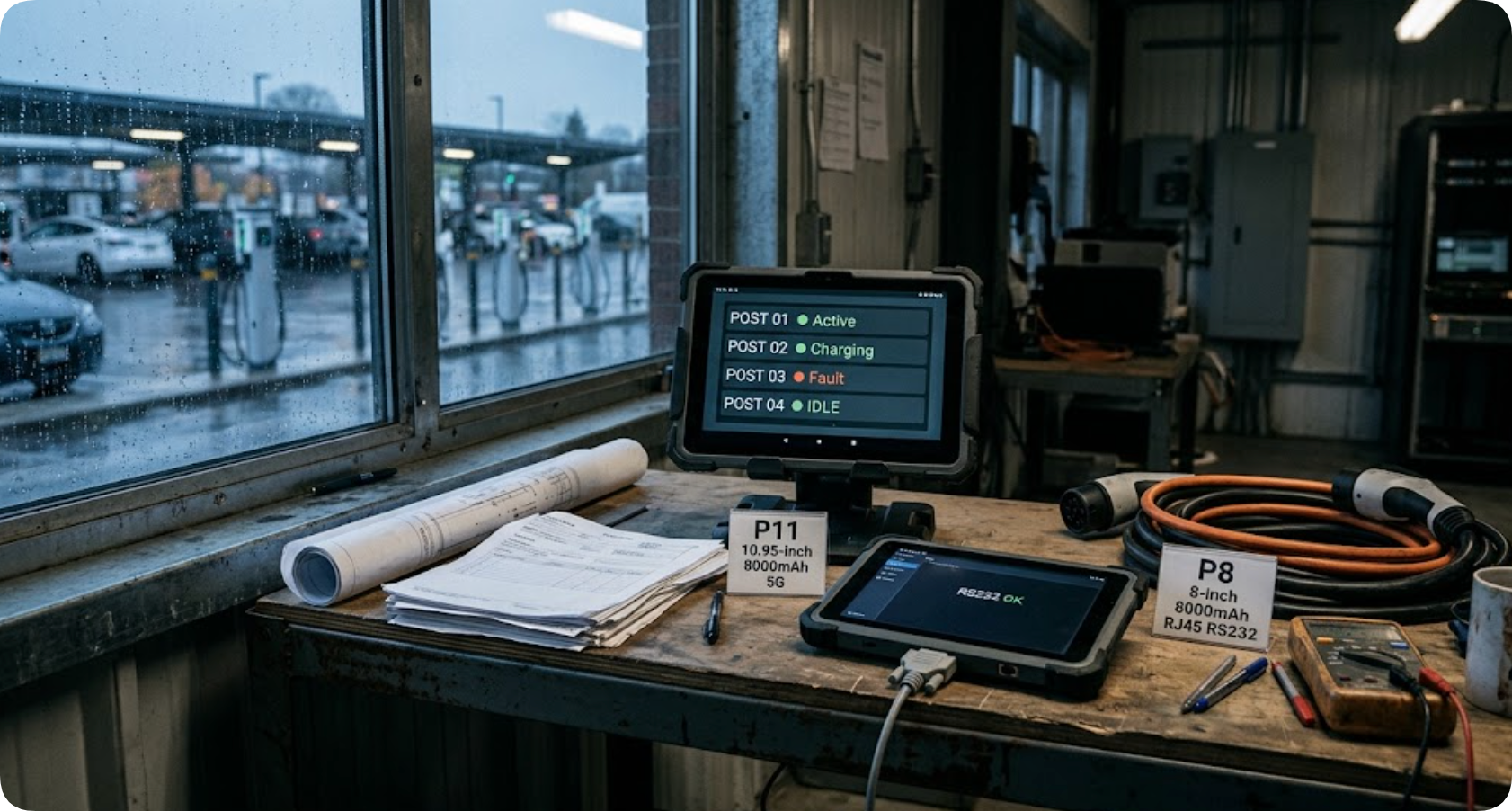
The P8 is the device that stays with the vehicle rather than the person. It is the only one of the three Hotus units with a RJ45 Ethernet port and an expansion serial port alongside Type-C USB 2.0 with OTG, and that combination is what lets it sit in the car and talk to a post or a controller over a wired link rather than over cellular data. The screen is 8-inch HD IPS at 800 by 1280 with Corning Gorilla Glass, specified as sunlight-readable and operable with wet hands or gloves, and the processor is a MediaTek MTK6769 or MTK6765 octa-core with Android 14 or Android 12.
Power and sealing are strong on paper. The battery is 8000mAh and is available as removable or built-in depending on the configuration, the rating is IP67 and IP66, and the dimensions are 245 by 148 by 18.6 millimetres at under 1000 grams. The data-capture options are the notable part for this scenario: FAP10 capacitive or FAP20 and FAP30 optical fingerprint modules, a 2D barcode scanner and NFC, which covers a site where the terminal is also used for operator login at a locked cabinet or a control enclosure. Certification is listed as CE, FCC and RoHS.
Two fields are simply absent, and both are the ones a buyer standing in a car park in December will ask for first. The P8 page publishes no operating temperature range and no drop test distance, only a drop-resistant enclosure, and it gives no brightness value in nits, describing the panel instead as high-brightness and sunlight-readable. A buyer comparing a P8 against a device with a printed temperature range is comparing a number against an adjective, and the correct response is to ask the manufacturer for the range in writing before the order rather than to assume it.
P11: Ten-Ninety-Five Inches for a Whole Row
The P11 is the largest of the three and the only one with 5G. It carries a 10.95-inch FHD IPS Incell touchscreen at 1200 by 1920 with ten-point touch, runs on a 7nm MediaTek Dimensity 700 or Dimensity 720 octa-core at up to 2.0GHz, and ships with 6GB of RAM and 128GB of storage, expandable to 8GB and 256GB with microSD up to 512GB. The 8000mAh battery is built in and takes Type-C PD fast charging, and the rating is IP67.
For a charger site this is the console unit rather than the walkaround unit. A row of posts is a list, and a list of twenty post IDs, their connector status and their last reading fits a 10.95-inch panel in a way that never fits a 5.5-inch screen, which is why the 5G and 4G LTE full netcom alongside dual-band Wi-Fi and Bluetooth 5.0 matters here in a way it does not on a device that stays in a pocket. Capture options are the modular set: an optional 2D barcode scanning module, a fingerprint reader, and RFID or NFC. The processor is Android 14, and certification is CE, FCC and RoHS.
The same two silences apply. The P11 page publishes no operating temperature range and no drop distance, and it gives neither the machine weight nor the body dimensions, which is unusual for a product of this size and means a technician cannot do the arithmetic on a wrist-strap or a sun visor from the page alone. There is also no brightness figure, despite the page describing the panel as sunlight-viewable, so the FHD resolution on paper says nothing about how the screen behaves under a canopy of direct sun on an exposed charger row.
Urovo DT45: The Case for a Physical Keypad
The Urovo DT45 is the device in this comparison that takes the typing route seriously, and on the specific question this article is about it wins. The manufacturer describes a 21-key numeric keypad on the front with two scan keys and a custom key, a 4-inch 480 by 800 colour display that supports multi-touch, glove touch, wet-hand operation and passive pen signature, and a body of 164.5 by 68.6 by 17.5 millimetres at 279 grams. A technician wearing insulated gloves at a post in winter can key a post number without removing a glove, which no pure-touch device in this comparison can offer, and the manufacturer states IP67 sealing with 1.5m drop resistance and an operating range of -20°C to 60°C, the widest in the comparison.
Its scan capability is the other half of the argument. The page lists mid-to-long-range scanning and DPM code support alongside mainstream 1D and 2D symbologies and on-screen scanning, which matters on a post whose identifier is laser-etched or dot-peen-marked rather than printed on a clean label. Internally it is a Qualcomm octa-core 1.8GHz with 3GB of RAM and 32GB of storage on Android 9.0, a removable 4500mAh battery, a 13MP rear camera with flash, and 4G full netcom with dual Nano-SIM slots, dual-band Wi-Fi and Bluetooth 4.2. It is also the only device here with a keyboard, and the only one here still shipping on Android 9.0.
That last fact cuts both ways. A long-supported platform is an operational advantage, and the DT45's 4-inch 480 by 800 panel is a genuinely small screen for reading a fault list, and the two physical scan keys plus a numeric keypad mean a technician can work a post without navigating a touch interface at all. A 3GB of RAM and 32GB of storage is modest against the P11, and the dual-band Wi-Fi is listed without the Wi-Fi 6 readiness that the Chainway claims, but for a device whose job is reading one number and pressing one button, the DT45 is a well-matched tool rather than a compromise.
🔋 Chainway C66: The Battery That Outlasts the Route
The Chainway C66 attacks the same problem from the endurance side, and it is the strongest battery specification in the comparison. The manufacturer offers a 4420mAh removable main battery, a 5200mAh version in the fingerprint or built-in UHF configurations, and an optional 5200mAh pistol battery supporting QC3.0 and RTC, with standby quoted at up to 490 hours, continuous use over 12 hours and a 2.5-hour charge. A post round across a large car park is exactly the kind of shift that punishes a 4500mAh pack, and the C66 is built for it. Sealing is IP65 per the IEC standard with 1.8-metre drops, rising to 2.4 metres with the rubber bumper fitted, and the operating range is -20°C to 50°C.
The rest of the specification is modern where the DT45 is dated. The screen is 5.5-inch IPS LTPS at 1440 by 720 with Corning Gorilla Glass, glove and wet-hand support, and the processor is a Qualcomm Snapdragon 662 octa-core at 2.0GHz running Android 11 or Android 13, with 3GB of RAM and 32GB of storage. Connectivity is the strongest here: 5G with fast roaming, Wi-Fi 6-ready dual-band and Bluetooth 5.1, with two SIM slots and a TF slot. Capture is broad, with Zebra SE4710 and SE2100 engines, Honeywell N6603, E3200 and IA166S, NFC at 13.56MHz, and optional built-in UHF and fingerprint, plus the UHF back clip and R6 UHF sled. The body is 160 by 76 by 15.5 millimetres at 287 grams with the battery, 297 with the fingerprint or UHF build.
Two points are worth stating plainly. The C66 is IP65, not IP67, and on a post that gets washed by a road-spray winter or stands in a flooded corner of the car park, that difference between water-resistant and waterproof is not a footnote. It also has no physical keypad, so on the typing question it is on the same footing as the three Hotus units, and where it beats them is the pistol battery, the fast-roaming 5G and the bumper-protected 2.4-metre drop.
The Fields That No Sheet Publishes
Three gaps are worth naming because they are gaps on the Hotus side, and a buyer who discovers them after the invoice has less leverage than one who asks before it. The P8 and P11 publish no operating temperature range, while the X501 states -20°C to 55°C, the DT45 states -20°C to 60°C and the C66 states -20°C to 50°C. Neither tablet gives a figure that can be entered into a specification comparison without a phone call, and for a site that operates through a northern winter that phone call is not optional.
The second gap is drop distance, where both tablets use the word drop-resistant without a number, against 1.5 metres for the X501 and the DT45, 1.8 and 2.4 metres for the C66. The third is that the P8 and P11 give no brightness figure in nits, describing the panels as sunlight-readable or sunlight-viewable, while no figure appears for the X501 either, and the whole Hotus range in this comparison is therefore comparable on screen size and resolution but not on luminance. The P11 also publishes neither weight nor body dimensions, so a technician who wants a sun visor or a lanyard anchor for that machine has to ask for the numbers. None of this means the devices fail; it means the published record is thinner than the competitors' on exactly the three figures that a wet outdoor site cares about.
Choosing by the Task at the Post
If the technician reads post identifiers off stickers and QR codes and works one post at a time, the X501 is the pick: 270 grams is the difference between a device that stays on the belt and one that sits in the van, the 1.5-metre drop and IP67 rating are the only Hotus numbers in this comparison that can be written into a specification without a caveat, and the removable pack swaps in seconds. If the site is a depot where the terminal stays in the vehicle and talks to posts over a cable, the P8 is the pick, because the RJ45 and expansion serial port are the reason it can. If the site is managed from a desk with a screen, the P11 is the pick, because a list of twenty posts and their readings is what a 10.95-inch panel is for and a 5-inch panel is not.
And if the technicians wear gloves and type their post numbers, the honest answer is that the DT45 is the better machine for that part of the job, and a pure-touch tablet is not going to change that. The C66 is the one to buy when the post round is long enough that a 4500mAh pack will not survive it. The comparison for anyone else in this lineup is straightforward: the Hotus three give you a 5G-connected Android platform with a wider industrial feature set, and the two competitors give you a numeric keypad, a better published environmental record and a longer battery. Both sides of that sentence are true at the same time, and a buyer who has only read one of the two datasheets is not ready to sign anything.
For the full range of handheld terminals, tablets and mini PCs that Hotus builds for industrial and field work, and for the rest of this comparison series, the handheld terminal and RFID scanner lineup and the rugged tablet range cover the alternatives, and every device-versus-device breakdown sits in the Hotus comparison guides.
🎯 Specification Summary and Selection Matrix
| Hotus X501 | 5.5in IPS, 720 x 1440, glove and wet-hand | 4500mAh / 5000mAh removable, quick swap, Type-C fast charge | IP67, 1.5m drop, -20°C to 55°C, 158 x 75 x 16mm, approx 270g | Hardware 2D engine (Honeywell / Zebra / CMOS), optional NFC, UHF RFID, PSAM slot | Octa-core 2.0GHz, 4GB + 64GB, Android 14 / 12, 4G LTE, dual-band Wi-Fi, Bluetooth 5.0, 13MP rear |
| Hotus P8 | 8in IPS, 800 x 1280, sunlight-readable, wet-hand and glove | 8000mAh, removable or built-in | IP67 / IP66, drop-resistant enclosure, no published range or drop distance, 245 x 148 x 18.6mm, under 1000g | Optional FAP10 / FAP20 / FAP30 fingerprint, 2D scanner, NFC | MediaTek MTK6769 or MTK6765 octa-core, 4GB + 64GB to 8GB + 256GB, Android 14 / 12, 4G LTE, RJ45, expansion serial port, CE FCC RoHS |
| Hotus P11 | 10.95in FHD IPS Incell, 1200 x 1920, 10-point | 8000mAh built-in, Type-C PD fast charge | IP67, drop-resistant, no published range or drop distance, weight and dimensions not published | Optional 2D scanning module, fingerprint reader, RFID / NFC | MediaTek Dimensity 700 or 720 octa-core 2.0GHz 7nm, 6GB + 128GB to 8GB + 256GB, Android 14, 5G / 4G LTE, dual-band Wi-Fi, Bluetooth 5.0, CE FCC RoHS |
| Urovo DT45 | 4in colour, 480 x 800, 21-key numeric keypad, glove and wet-hand | 4500mAh removable, spare battery supported | IP67, 1.5m drop, -20°C to 60°C, 164.5 x 68.6 x 17.5mm, 279g | Mid-to-long-range scanning, DPM code support, 1D / 2D, on-screen scan | Qualcomm octa-core 1.8GHz, 3GB + 32GB, Android 9.0, 4G full netcom, dual Nano-SIM, Bluetooth 4.2, 13MP rear |
| Chainway C66 | 5.5in IPS LTPS, 1440 x 720, glove and wet-hand | 4420mAh main, 5200mAh with fingerprint or built-in UHF, optional 5200mAh pistol battery with QC3.0, up to 490h standby, over 12h use, 2.5h charge | IP65, 1.8m drop, 2.4m with bumper, -20°C to 50°C, 160 x 76 x 15.5mm, 287g (297g with UHF or fingerprint) | Zebra SE4710 / SE2100, Honeywell N6603, E3200, IA166S, NFC, optional built-in UHF and fingerprint, UHF back clip and R6 sled | Qualcomm Snapdragon 662 octa-core 2.0GHz, 3GB + 32GB, Android 11 / 13, 5G fast roaming, Wi-Fi 6-ready, Bluetooth 5.1, 2 SIM + TF, 13MP AF |
| One post at a time, identifiers read from a sticker, and a device that is carried rather than left in the van | X501 | 270g is the lightest in the comparison, and it is the only one of the three Hotus devices with a published temperature range and a published drop distance alongside its IP67 rating |
| A terminal that stays in the vehicle and reaches the post over a cable instead of over cellular data | P8 | The RJ45 Ethernet port and the expansion serial port are the reason this configuration is possible, and 8000mAh covers a full shift in either removable or built-in form |
| A console view of a whole row of posts and their readings | P11 | A 10.95-inch 1200 x 1920 panel with 5G is what a list of twenty posts and their status actually needs, and the Dimensity 700 or 720 platform has the headroom for it |
| Technicians in insulated gloves keying post numbers rather than scanning them | Urovo DT45 | The 21-key numeric keypad, the -20°C to 60°C range and the mid-to-long-range DPM scanning capability are the strongest combination for that specific task in this comparison |
| A post round long enough to outlast a 4500mAh pack, with handsets dropped off a tailgate | Chainway C66 | The 5200mAh pistol battery, up to 490 hours of standby, Wi-Fi 6-ready 5G and 2.4-metre bumper-protected drop rating are the endurance and ruggedness answer, with IP65 to note against a winter wash-down |