- Select Language
The R501 PDA combines a powerful MT6762 Octa-Core ...
Enterprise Flagship SeriesEngineered for mission-c...
Technical SpecificationsModel: Palm-sized miniPCTy...
R366-S 5.5-inch Industrial PDA | Qualcomm Octa-cor...
The EGPU Graphics Card Expansion Dock is a high-pe...
R860-S 5.5-inch Industrial PDA with Thermal Printe...
R366-S Thin 5.5-inch Industrial PDA | Qualcomm Oct...
The X501 Handheld PDA combines advanced barcode sc...
A site can always add a person. One more inspector means another pair of gloves, another torch and another tablet on the bench, and the work divides cleanly between them. That arithmetic does not travel down the phone line. When someone raises a hand for help, the call has to be answered by a specialist in an office with a screen, a headset and a list of other sites.
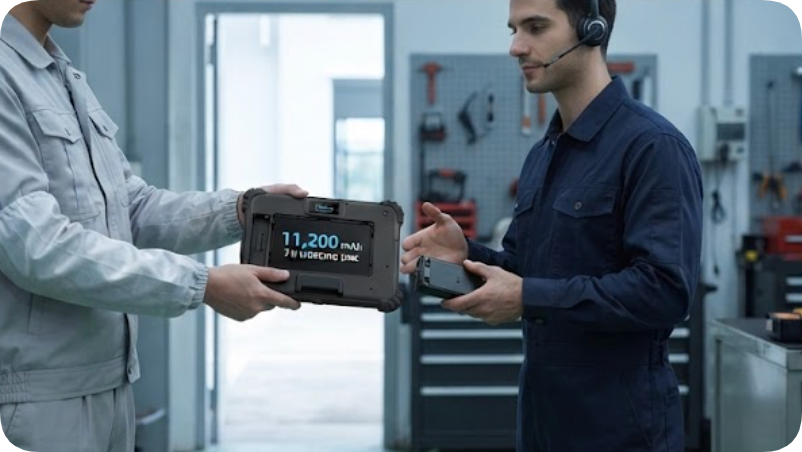
This is the part of a staffing plan that rarely gets written down. Rosters count the people standing on site, but seldom how many could be talking to the same expert at once. Three units shape that figure: the AR Smart Glasses, which put the camera where the wearer's eyes already are; the HTYJ10A Rugged Tablet, a 10-inch Windows machine rated for a 1.22 m drop; and the HTXUK10A-55 Rugged Tablet, quoted at seven hours on an 11,200 mAh pack.
Head count on site behaves like a straight line. Two technicians cover twice the area of one, and inspections per shift climb with every person added. Remote cover behaves nothing like that. It is a fixed quantity handed out in slices, and each caller takes one from someone already waiting.
The awkward consequence is that a site can become harder to support because it was staffed well. Four people served by one specialist generate more simultaneous questions than two, and the queue grows although the equipment has not changed.
A plan that only counts people on site reads half the sheet. The other half is a ceiling that sits somewhere else, and nobody on the floor can raise it by working faster.
It is tempting to treat remote support as one hour of attention per hour of clock. Anyone who has watched a support desk for a morning knows how quickly that falls apart. The hour contains answering the call, working out what the caller describes, pulling up the right drawing, and waiting while somebody walks to the machine.
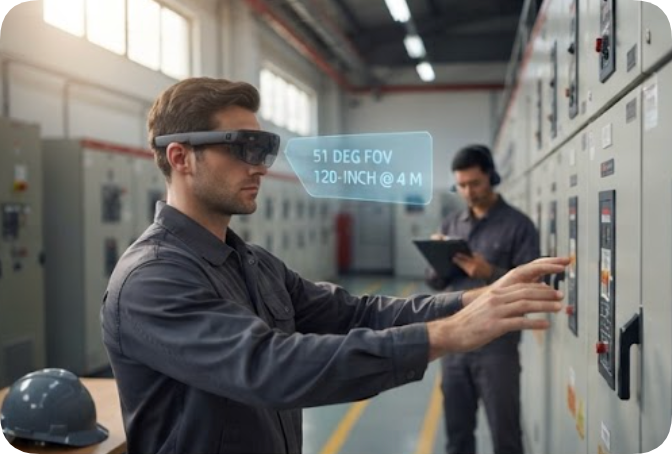
The glasses remove part of this. With a 51 degree field of view and an image quoted as a 120-inch equivalent at four metres, the specialist is not spending minutes asking which panel is meant. That time comes straight back. What does not is the switch between one caller and the next.
An honest figure for deliverable attention sits closer to forty minutes in every hour than sixty. Plans built on the larger number are quietly built on overtime.
When one specialist takes a second site live, the easy assumption is that output doubles. What happens is that each caller receives part of a person. The specialist hears the second question while still holding the first, and both descriptions blur.
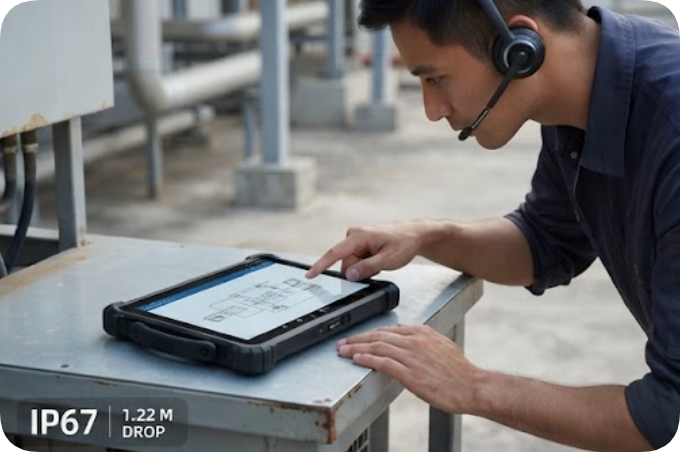
Sealing and power figures matter here for an unexpected reason. A unit rated IP67 and able to survive a 1.22 m drop can be carried to the fault and set down while the call continues. A machine with a lower sealing figure has to be held or parked first, and every one of those seconds is time the specialist spends waiting on a line that is already open.
Two live sites do not produce twice the throughput. They produce one call going well and one going slowly, and the slow one is remembered at the next review.
First come, first served is the default because it needs no thought, and it is the wrong rule for a line one person has to keep clear. A sensible queue sorts by what happens if the call waits. A machine standing still with a crew idle around it should jump ahead of a question that could be answered after lunch without harm.
The second question is whether the site can proceed unaided. If it can, the call should not be made yet. That rule protects the specialist more than any hardware upgrade, because it removes the calls that were never urgent.
A queue written on a wall, even a crude one, beats a queue that exists in nobody's head.
Every problem a site can solve locally is one the specialist never has to touch. That turns local capability into a staffing decision rather than a training footnote. Somewhere on the plan belongs a named person who can swap a battery, reseat a connector, restart an application and confirm a unit is powered.
There is a second, quieter role sites often leave unfilled. Someone has to judge whether a fault is worth a call, which is not the same skill as fixing it. Three people who can operate equipment and nobody who can classify a problem will still flood the line.
The devices set the floor for this. Battery packs that detach can be swapped by whoever is nearest, and where no published figure exists the plan should say so.
The AR Smart Glasses ask least of the hands and most of the head. The wearer keeps both arms free, adjusts for a personal prescription across a 0 to 600 degree range, and switches between a flat panel and a 3D mode with one control. The trade is that the wearer is the camera operator, so wherever the head turns, the specialist follows.
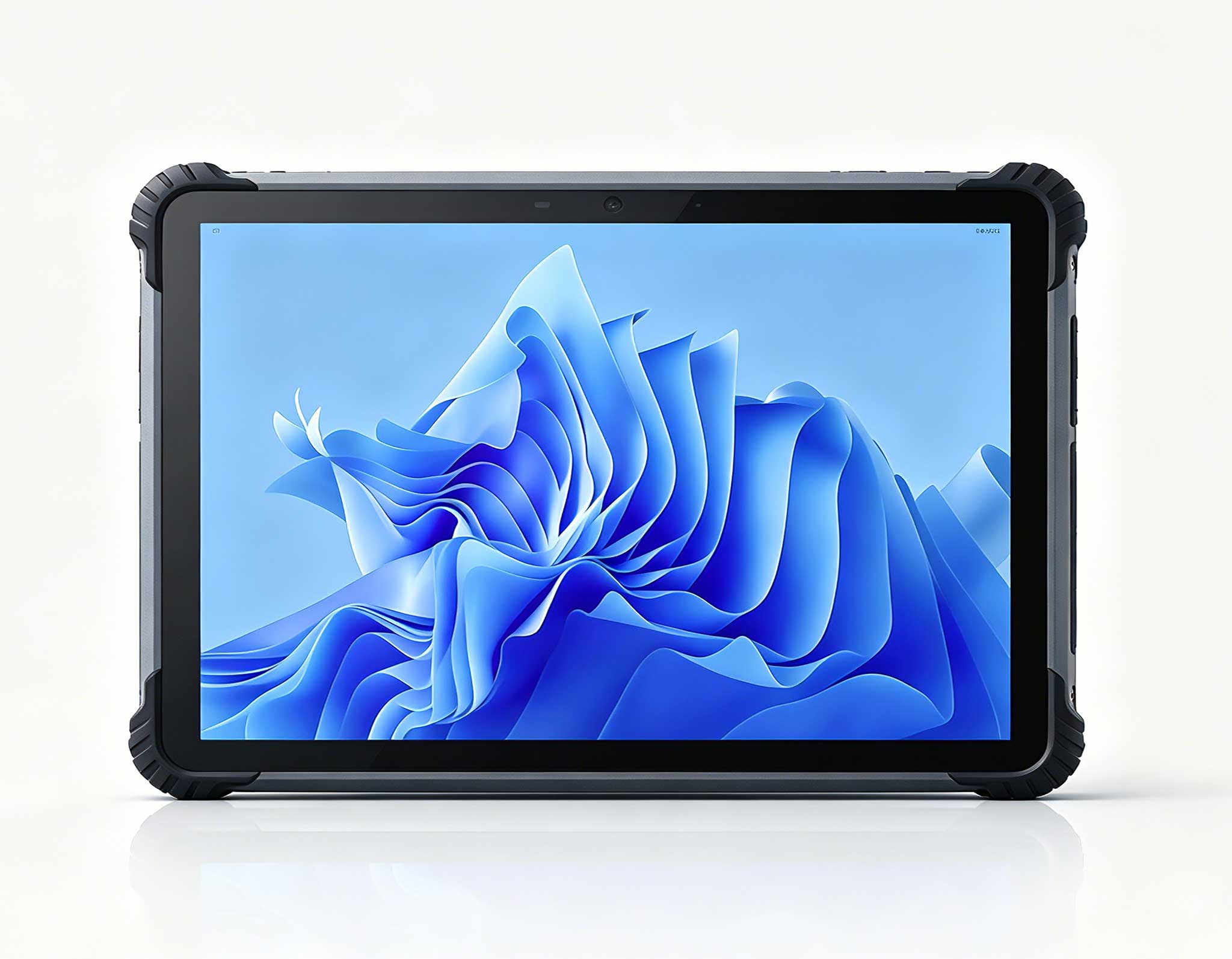
The HTYJ10A Rugged Tablet is the opposite bargain. It is built around Intel Core 10th Generation i5-10210Y or i7 10510Y silicon, a 10-inch LCD at 1200 by 1920 and 560 nit, and a chassis good for IP67 with a 1.22 m drop rating. At 2.1 kg it gets set down before a long call begins, so whoever carries it has chosen a place to work.
The HTXUK10A-55 Rugged Tablet sits between the two. Its Intel Core 12th Generation i7-1255U runs 10 cores and 12 threads, memory reaches 16 GB, and the 7.6 V 11,200 mAh pack is quoted at seven hours. At 2.0 kg and IP65, with an operating range of minus 20 to 60 C, it is carried rather than strapped. None of the three answers the staffing question alone; what they change is how long a site stays useful before someone picks up a phone.
Published specifications set the interval between calls. A unit that holds charge for a full shift, survives being set down on concrete and keeps working at the temperature of the room carries a site through the hours when nobody is free to answer.
| Figure | AR Smart Glasses | HTYJ10A Rugged Tablet | HTXUK10A-55 Rugged Tablet |
|---|---|---|---|
| Display | 51 degree field of view, 120-inch equivalent at 4 m | 10-inch LCD, 1200 x 1920, 560 nit | 10-inch LCD, 1920 x 1200, 550 nit (700 nit option) |
| Processor | Not published | Intel Core 10th Gen i5-10210Y / i7 10510Y | Intel Core 12th Gen i7-1255U, 10 cores / 12 threads |
| Memory and storage | Not published | Not published | 16 GB RAM, 128 GB ROM |
| Battery | Not published | 7.6 V / 3,500 mAh | 7.6 V / 11,200 mAh, detachable, 7 h working time |
| Protection | Not published | IP67, 1.22 m drop resistance | IP65 |
| Operating temperature | Not published | Not published | Minus 20 to 60 C |
| Interfaces | Not published | Audio, Mini HDMI, Type A, Type C, DC IN, RJ45, TF, SIM, 12-pin POGOPIN | Audio, Mini HD, USB, Type C, DC IN, RJ45, COM (VGA), TF and SIM in one, 12-pin POGOPIN |
| Weight | Not published | 2.1 kg | 2.0 kg |
Two rows are deliberately empty. The glasses are marketed on the viewing experience, and no battery, sealing or weight figure is published, so a plan needing those numbers would have to request them. Filling a gap with a plausible guess is how a cover plan acquires a failure it cannot explain later.
The battery row most often decides a shift. A detachable pack with a quoted working time can be handed on mid-shift with a fresh cell, while a smaller pack becomes a break in cover unless a charger sits nearby. Read with the weight row, it answers who carries the device: the lighter unit travels further between calls without anyone asking for relief.
Most rotas are built from three columns and a note. The columns name the people, the hours and the area; the note mentions the help desk. Nothing on the sheet says how many calls may be live at once, the figure that decides whether a shift runs or stalls.
| Roster column | What it usually holds | What it should also hold |
|---|---|---|
| People on site | Names, hours, area | Who may raise a call, and who decides it is worth raising |
| Devices | Number of units | Which unit each person is holding when a call starts |
| Remote cover | Hours the desk is open | How many sessions may be open at the same moment |
| Waiting rule | First come, first served | Sorting by consequence, and by what the site can still do alone |
Writing the missing column changes the shape of the plan rather than its size. A site that knows it may hold two lines open posts its classifier where the calls originate and keeps the crew working, instead of finding the ceiling at the worst moment.
The two halves read better side by side. The AR Smart Glasses, the HTYJ10A Rugged Tablet and the HTXUK10A-55 Rugged Tablet each change how much a site settles by itself, and the AR-assisted inspection workflows show how those units sit inside a working day. For the wider range behind them, see rugged mobile computing solutions; to check the AR smart glasses, the HTYJ10A Rugged Tablet or the HTXUK10A-55 Rugged Tablet against the alternatives, the model-by-model product comparisons and competitor analysis are the place to start.